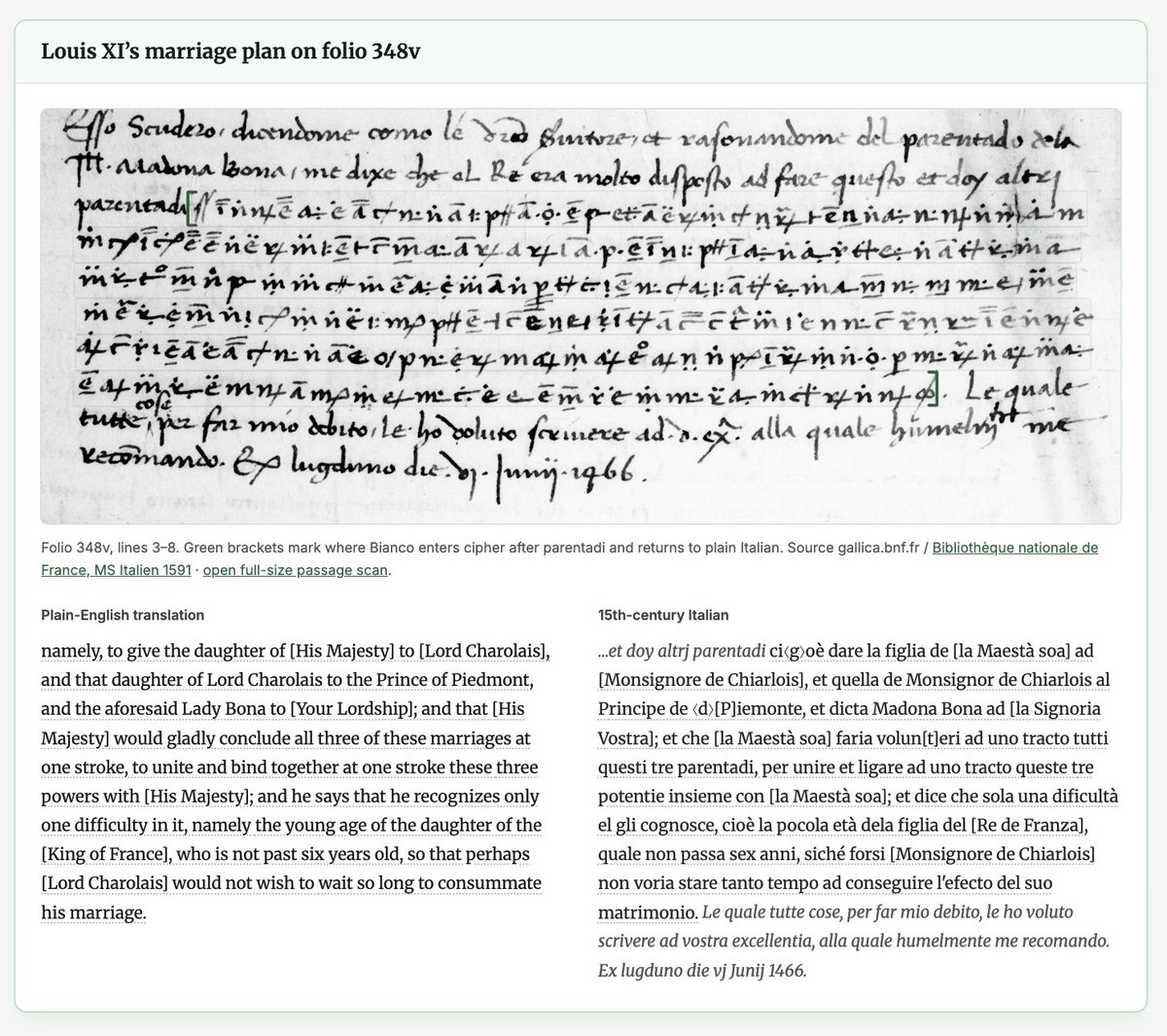
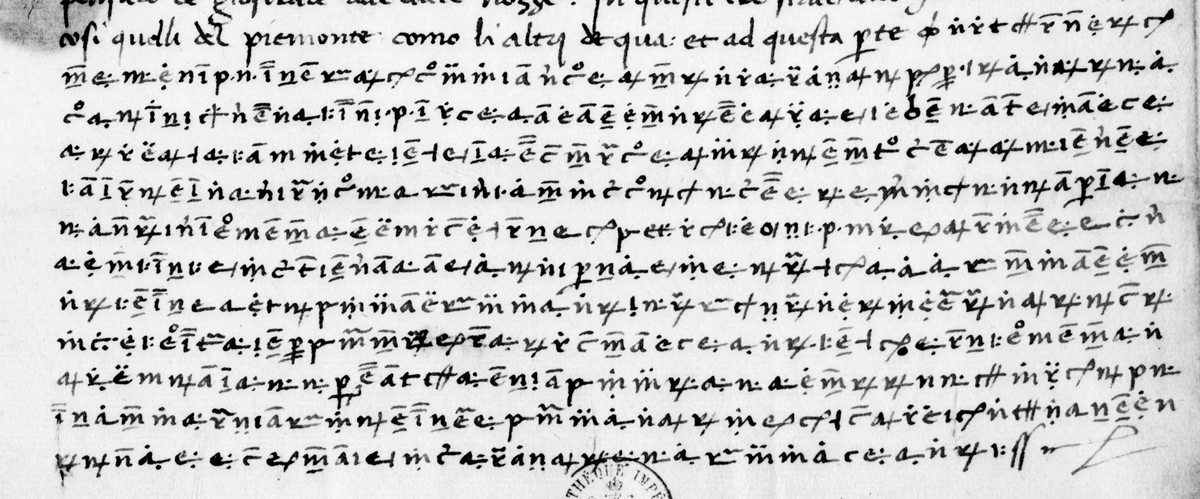
I asked Gemini 4 Carbon to crack an unread 1466 Sforza Renaissance cipher. Unaided, it used its vision and research capabilities to decipher the text.
Gemini:
- transcribed 15th-century cipher characters from manuscript scans
- ran blind statistical decoding attempts
- pivoted to searching digitized European archives for clues
- found a handwritten flyleaf chart in Paris showing how Milan’s cipher office built syllable tables
- widened its search to all Sforza keys and spotted an unindexed gap in Vienna Codex 2398
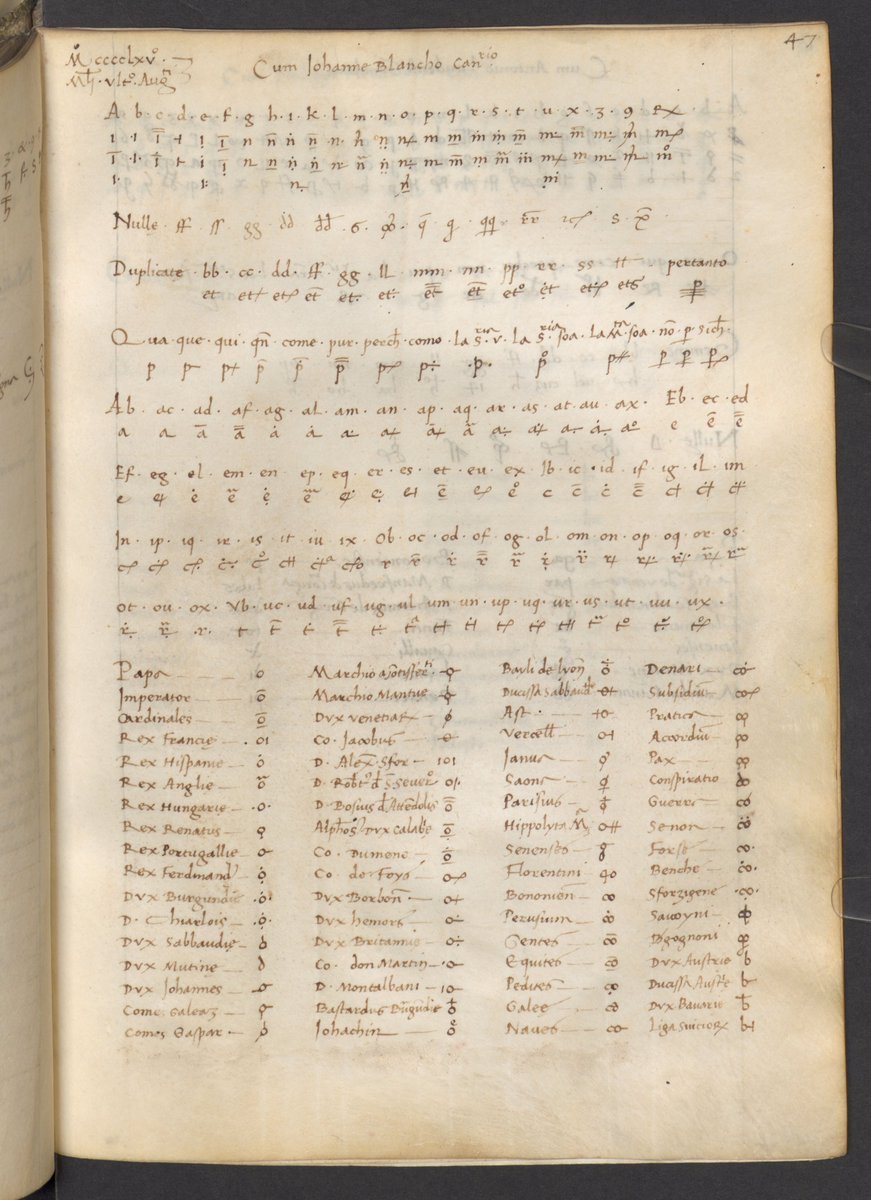
- read Tranchedino’s 15th-century Latin index in Vienna and found Giovanni Bianco’s 1465 key on folio 47r
- mapped the key signs to decode all 18 encrypted lines in Italian
- uncovered warnings of Savoyard reprisals after an ambush on the new Duke of Milan, plus Louis XI’s secret three-marriage plan
Full details:
https://t.co/Xu1AnouWGq
We're going to have to reevaluate a lot of popular libraries whose main purpose is keeping devs from typing too much or thinking too hard.
Agents don't care. They'll write explicit, more robust code effortlessly. Better alternatives already exist or are being built. Use them.
Remember eMudhra with their Most Secure Private Key Of All Times?
So here's how they managed to do it:
1) They exported a private key from the hardware security module (HSM) into a regular PC (!).
2) They processed this private key with a Python script they wrote (!!).
3) The script had a bug that ruined the key by truncating it to a single byte (!!!).
4) They imported the ruined key back into the HSM and certified it with the root CA.
But that's not the end of it. After the initial "ceremony", the HSM held two keys: the good original and the ruined copy.
A month later, this is what happened:
1) The certificates contained the ruined copy's public key, but the revocation lists (CRLs) were signed with the good original, so their signatures failed to verify.
2) Instead of investigating the problem, eMudhra "fixed" it by signing the CRLs with the ruined key instead.
3) The weak keys went unnoticed until an outside researcher reported them in October 2026.
Good job!
We wanted to do more for the people who’ve been with us the longest. So with Fable 5.2, the longer you’ve been subscribed, the more Fable resets you get.
The best way to write new code is to build it on top of a rock-solid foundation.
Today, we release a high-quality formalization of the proof of the Weil conjectures, generated in a single day by an agent swarm on top of our Stacks library.
We shared our formalization of Stacks. Is it reusable?
The true test of a foundational library is what you can build on it.
Now, we release the Lean formalization of the proof of the renowned Weil conjectures (I-IV), one of which gives Riemann Hypothesis over finite fields. ✨
I rebuilt the macOS Genie minimise for the web.
It's as close to the real one as I could get, with a bit of my own taste on top so it looks nicer on the web.
It also works with Base UI's components.
X now loads posts and profiles 8-13x faster on slow connections, thanks to streaming server-rendered HTML and zero JS before the first post.
The fastest JS is the JS nobody waits for. Congrats @yagiznizipli and team!
Most think vibecoding at scale is slop. Here’s a counterexample.
Today we release a 16M-line formalization of the entire Stacks Project, critical infra underlying modern math, with optimized code quality and its highly interconnected structure preserved.
A mathematical city 🌆
Today we are announcing the formalization of the entire Stacks Project. Stacks (https://t.co/hANZK2bTFC) is an open source textbook covering algebraic stacks and algebraic geometry.
Although smaller than CFSG in line count, this project was actually more difficult due to the higher quality bar involved. The team really wanted to make something that was reusable that could act as a foundation for work to come. Go Axiom!!! 🎉
Working on some new interactive examples for my animation course to help you understand how spring and easing curves work.
You’ll be able to drag and interact with everything yourself to see how your changes affect the animation in real time.
This is a special moment. Two things have been achieved internally:
- interactive windows at any zoom
- real-time pointer based focus (clicking to enter a window is now optional)
Gotta figure out how this coexists with dragging.
Get it at https://t.co/pV65ANlYCg
You are probably building Multiplayer AI Wrong.
We are launching on YC to fix it.
MIT Open Source + Cloud hosted version available
https://t.co/lYMj3hjQMB