Banyak juga ya yang masih susah paham bahwa anak ialah bagian dari kelompok rentan, hidup dalam supremasi orang dewasa sebagai struktur opresif, dan pengalamannya didismiss terus oleh orang sekitar.
Dengan kata lain, she’s not an icon for toying with a child’s emotion for fun.
The Love Live song of the day is 'SUNNY DAY SONG' by All Groups!!! (Originally performed by μ's!)
Making me so emotional dammit... makes me so happy to be a Love Live fan even if I wasn't there to witness the lovely performance 🥺🥺🥺🥺🥺🥺🥺🥺🥺🥺🥺🥺
mathematical ideas can be shared through wild gesticulations and doodles, but this only works if both parties *already* possess in their minds the platonic ideals of the relevant objects: these in turn can only be acquired through staring at convoluted formulas in greek notation.
I think of my goal as a mathematician as something like: to better understand the fundamental concepts “shape” and “number,” and to convey that understanding to others. I think this is a valuable goal for many reasons. The primary reason discussed on social media is the (admittedly slow, but I think very real) diffusion of mathematical ideas into technologies that better our lives. There are others, though: production of human capital (which plays some role in this diffusion), and diffusion of mathematical understanding into culture, for example. It is not obvious to me that even the bare technological need for mathematics can be filled without human experts; this seems to me to be a tricky question of institutional design.
For me the most compelling reason is simply that we feel a pressing need to understand. While deep understanding is largely limited to professional mathematicians, the existence of mathematicians and of the institutions they make up is a huge part of what makes mathematical understanding available to those who want it. I believe that the capacity to understand mathematics (and the universe as a whole) is part of a good life, and we should try to provide people with a good life.
We operationalize the goal of understanding in a number of ways, problem-solving and theorem-proving among them. My own research is oriented around certain open questions that I believe measure our lack of understanding (of numbers, shapes and so on), and I think resolving those is genuinely important. I would welcome a solution with any provenance. But I think proof is only a measure of progress—what actually matters (for technology, human capital, culture, a good life) is a bit harder to get at.
Crucially it is very hard to measure progress—plausibly theorem-proving is used in large part because it is easy to measure rather than because it is a perfect proxy for what we care about. I worry a bit that we may automate many easy-to-measure things without automating the correlates we care about for which they are proxies. This presents a clear problem for the design of institutions aimed at achieving progress.
In part because I think problem-solving is a proxy for something else, I don’t feel that my goal of understanding “shape” and “number” is particularly threatened by a machine that is good at problem solving. I expect that machine to be a substantial boon, instead. Ultimately I think we will operationalize mathematical progress in better ways. But how to do this is a difficult question and I think many on here are too quick to dismiss concerns about it.
Apart from general awkwardness, mathematicians are at a disadvantage in discourse because the general public (including much of the twitterati) has very little sense of what we do. I like the activity of solving problems/proving theorems but math research is not a problem set.
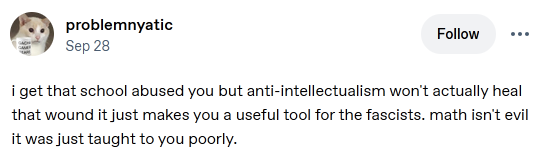
AI boosterism is just thinly veiled right wing anti-intellectualism:
- you don’t need to understand the code
- you don’t need to understand math or science just let ai do it
- you don’t need to read or write, just dictate
They want you to be uneducated cattle.