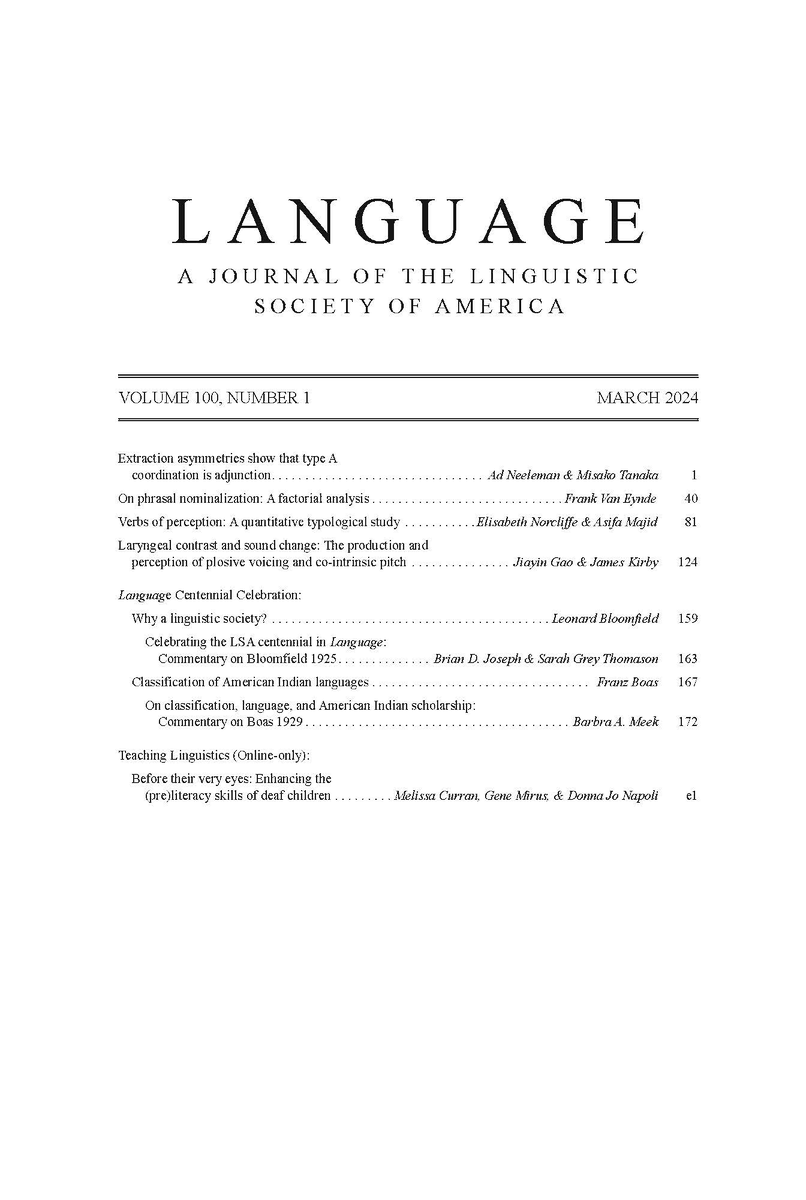
We are happy to share that a new, special issue of Language is out, the first of our 100th volume! As well as the usual slate of articles, it includes the first of an 8-part celebratation of Language's Centennial!
https://t.co/A4gqL4Hlbl
More details soon, and happy reading!
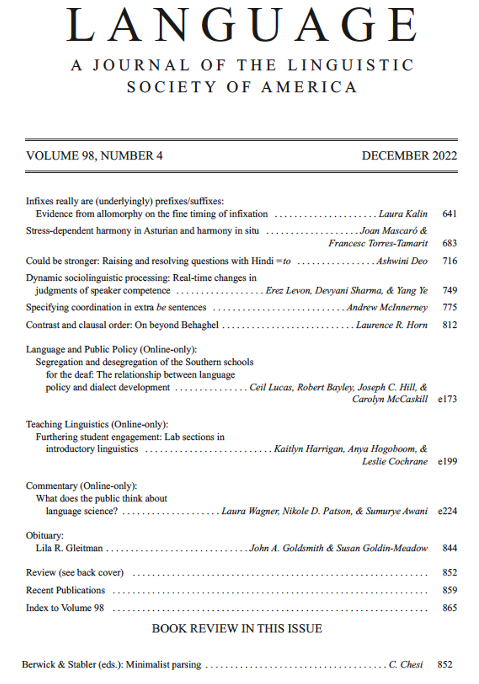
Dear readers, we are happy to share that a new issue of Language is now available!
You can find our December 2022 issue here: https://t.co/sblJTh0ahk
Happy reading!
We recommend specific strategies for assessing documentary linguistic scholarship in academic review contexts, based on a brief description of the field for the benefit of colleagues in other areas.” 2/2
Dear readers, we invite you to join us in reading our featured article of the week:
“Assessing scholarship in documentary linguistics” by Andrew Garrett & Alice C. Harris
DOI: 10.1353/lan.0.0266
Abstract in 🧵
“Documentary linguistics is new and distinctive enough that some linguists and other participants in academic reviews may be uncertain about how to assess its outputs. 1/2
Students’ responses indicate that metacognition surveys can help students and instructors gain greater awareness of learning concerns and capabilities and identify areas for intervention.” 3/3
Happy start of the week, colleagues! This Monday we invite you to read our featured article of the week:
“Infusing metacognition into advanced linguistics courses” by Rosa Vallejos-Yopán, Eva Rodríguez-González
DOI: 10.1353/lan.0.0265
Abstract in 🧵
We hypothesized that the application of metacognition surveys would enhance students’ awareness of techniques that promote critical thinking and active learning. Two surveys built in as core components in each course were deployed at different points during the semester. 2/3
“This study explores the implementation of critical thinking via metacognition in linguistics courses. It employs surveys to examine strategies used by students in two courses, Morphosyntax and Field Methods, devoted to the development of analytical skills in linguistics. 1/3
on the coordinate structure. The article discusses ways of formalizing such distributive satisfaction of constraints within four major linguistic frameworks: lexical-functional grammar, categorial grammar, head-driven phrase structure grammar, and minimalism.” 3/3
Dear readers, we invite you to read our featured article of the week which examines coordination in languages like Polish, Estonian, and others:
“Coordination of unlike grammatical cases (and unlike categories)” by Adam Przepiórkowski
DOI: 10.1353/lan.0.0272
Abstract in 🧵:
On the basis of data from Polish, Estonian, and other languages, it demonstrates that there is no universal requirement that conjuncts be alike. Any appearances of such a requirement result from the fact that each conjunct must satisfy all functional constraints 2/3
“It is often claimed that conjuncts in coordinate structures must be alike in various ways, in particular, that they should have the same syntactic category and the same grammatical case, if any. This article aims to refute such claims. 1/3
Let's start off the week on the right foot and with a #linguistics paper on hand!
Join us in reading our featured article of the week:
“Are there factive predicates? An empirical investigation” by Profs. Judith Degen & Judith Tonhauser
DOI: 10.1353/lan.0.0271
Abstract in 🧵
for the assumed categorical distinction between factive and nonfactive predicates. We discuss implications of our results for formal analyses of presuppositions, one area where factivity has played a central role. 5/6
with the goal of establishing whether these properties identify a class of factive predicates. We find that factive predicates are more heterogeneous than previously assumed and that there is little empirical support from these experiments 4/6
troublesome situation given the central role that factivity plays in linguistic theorizing. This article reports six experiments designed to investigate two critical properties of the content of the complement of clause-embedding predicates, namely projection and entailment, 3/6
as well as uncertainty about whether the content of the complement of particular predicates exhibits the properties attributed to the content of the complement of factive predicates. This has led to a lack of consensus about which predicates are factive, a 2/6
“Properties of the content of the clausal complement have long been assumed to distinguish factive predicates like know from nonfactive ones like think (Kiparsky & Kiparsky 1970, inter alia). There is, however, disagreement about which properties define factive predicates, 1/6