Dear Shola.
1/2 You say the Mombasa refinery proves your point. With respect it doesn't.
You are right that Kenya once had a refinery but you have the reason it died wrong. It was not killed by Saudi Arabia. It was killed by old age.
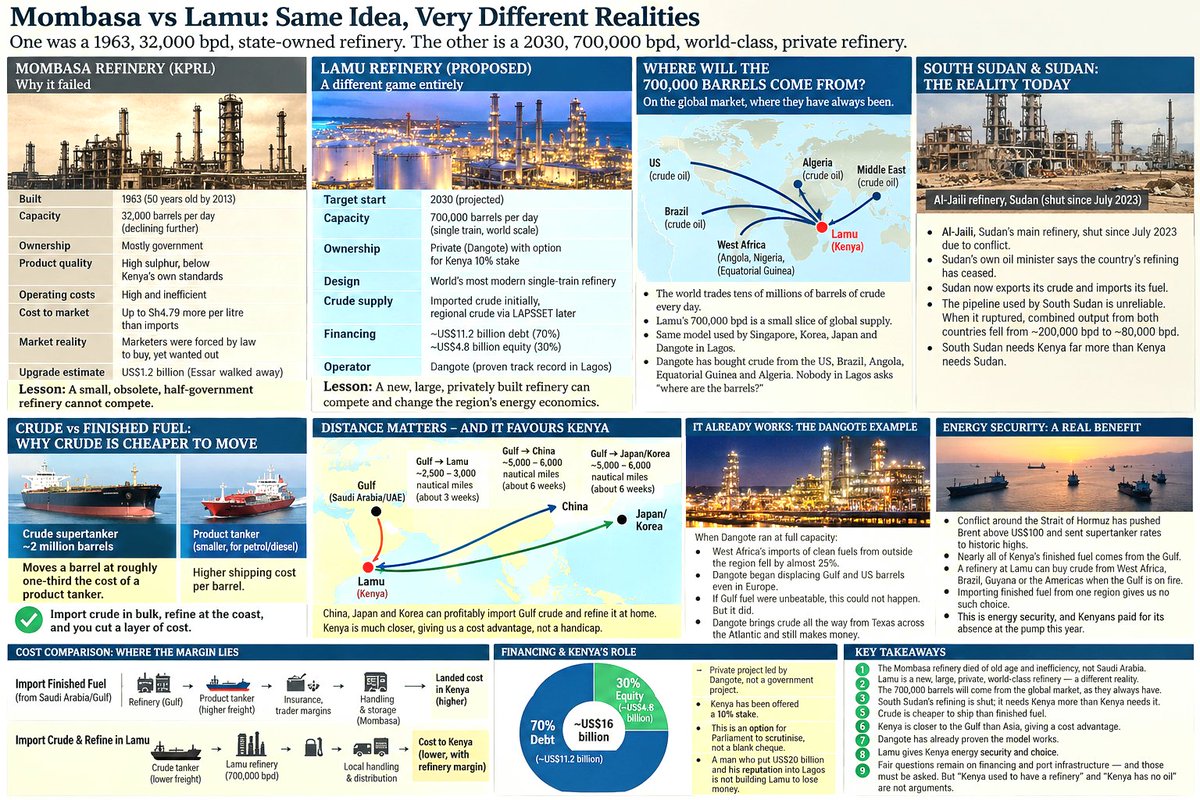
By 2013, that plant was 50 years old, built in 1963, and processing only about 32,000 barrels a day, falling further as marketers stopped buying. Its products were poor. Its diesel carried more sulphur than Kenya's own standards allowed. It suffered higher operating costs, inferior yields and chronic inefficiency, and its fuel cost up to Sh4.79 more per litre than imports.
Oil marketers were legally forced to buy from it and still wanted out. Essar looked at the $1.2 billion upgrade it needed and walked away.
So the lesson of Mombasa is not "Kenya cannot refine." It is "a tiny, obsolete, half-government refinery cannot compete." Lamu is the exact opposite: brand new, twenty times the size, privately built, and modelled on the most modern single-train refinery in the world. Judging a 2030 plant by a 1963 plant is like judging the SGR by the old metre-gauge railway.
You asked two questions and here are the two answers.
✅️1. Your first question: where are the 700,000 barrels a day?
On the sea, where they have always been. The world trades tens of millions of barrels of crude every single day. Lamu at full capacity would need a small slice of that. Singapore, Korea, Japan and Dangote in Lagos all buy this way. Dangote has bought US, Brazilian, Angolan, Equatorial Guinean and Algerian crude. Nobody in Lagos asks "where are the barrels?". You also said South Sudan already uses Sudan's refineries. That is out of date. Sudan's main refinery at Al-Jaili became a battlefield and has been shut since July 2023 please updateyourself. Sudan's own oil minister says the country's refining has ceased; it now exports all its crude and imports its fuel.
Sudan is even struggling to maintain the pipeline South Sudan depends on. When it ruptured, combined output from the two countries fell from about 200,000 barrels a day to around 80,000. Is that the reliable partner you are pointing to? South Sudan needs Kenya far more than Kenya needs Sudan.
On Turkana, your 20,000 barrels is correct. But nobody claimed Turkana would feed Lamu. Lamu starts on imported crude, exactly as Dangote does, and regional crude comes in as LAPSSET matures.
✅️2. Your second question: how can fuel from imported crude beat imported refined fuel?
This is the heart of your argument, so let me answer it with basic shipping and refining economics.
First, crude is cheaper to move than finished fuel. Crude travels in supertankers carrying about 2 million barrels. Petrol and diesel travel in much smaller product tankers. On long hauls, a supertanker moves a barrel at roughly one-third the cost of a medium product tanker. Import crude in bulk, refine it at the coast, and you have already cut a layer of cost.
Second, Lamu does not need to be cheaper than Saudi Arabia's refinery gate. It only needs to be cheaper than Saudi fuel landed in Mombasa, after product freight, insurance, trader premiums and handling. That gap is the refinery's margin. Today, that gap leaves Kenya in dollars.
Third, the proof already exists. When Dangote ran at full capacity, West Africa's imports of clean fuels from outside the region fell by almost 25%, and Dangote began displacing Gulf and US barrels even in Europe. If Gulf fuel were unbeatable, as you suggest, that could not happen. It happened.
You told us to check the distance between India or China and the Gulf. I did. It works against you.
The Gulf to China, Japan and Korea is roughly 5,000 to 6,000 nautical miles, around six weeks for a laden supertanker. The Gulf to Lamu is less than half that. If China and Korea can profitably import Gulf crude and refine it at home, Kenya, sitting far closer, has the advantage, not the handicap.
Your journey matters to us, and we want to help you avoid unnecessary trips to the airport during the current disruptions out of Jomo Kenyatta International Airport.
Before setting off, please check the latest flight updates on our website or KQ Mobile App, and ensure your contact details are up to date so we can reach you with any changes.
Click here to stay updated : https://t.co/pBDOZ9hSCi
Thank you for your patience and cooperation.
#ThePrideOfAfrica
We’re excited to announce that TAV Technologies will be attending the 37th IATA Ground Handling Conference (IGHC) in Nairobi!
Join us at Booth 14 from 13–15 May to explore our innovative solutions enhancing the future of airport ground operations.