𝐀𝐠𝐞 𝐢𝐬 𝐛𝐞𝐭𝐭𝐞𝐫 𝐮𝐧𝐝𝐞𝐫𝐬𝐭𝐨𝐨𝐝 𝐢𝐧 𝐫𝐞𝐯𝐞𝐫𝐬𝐞!
It was @nntaleb that drove home to me that aging should not be seen using the distance from birth, rather through the estimated distance from death.
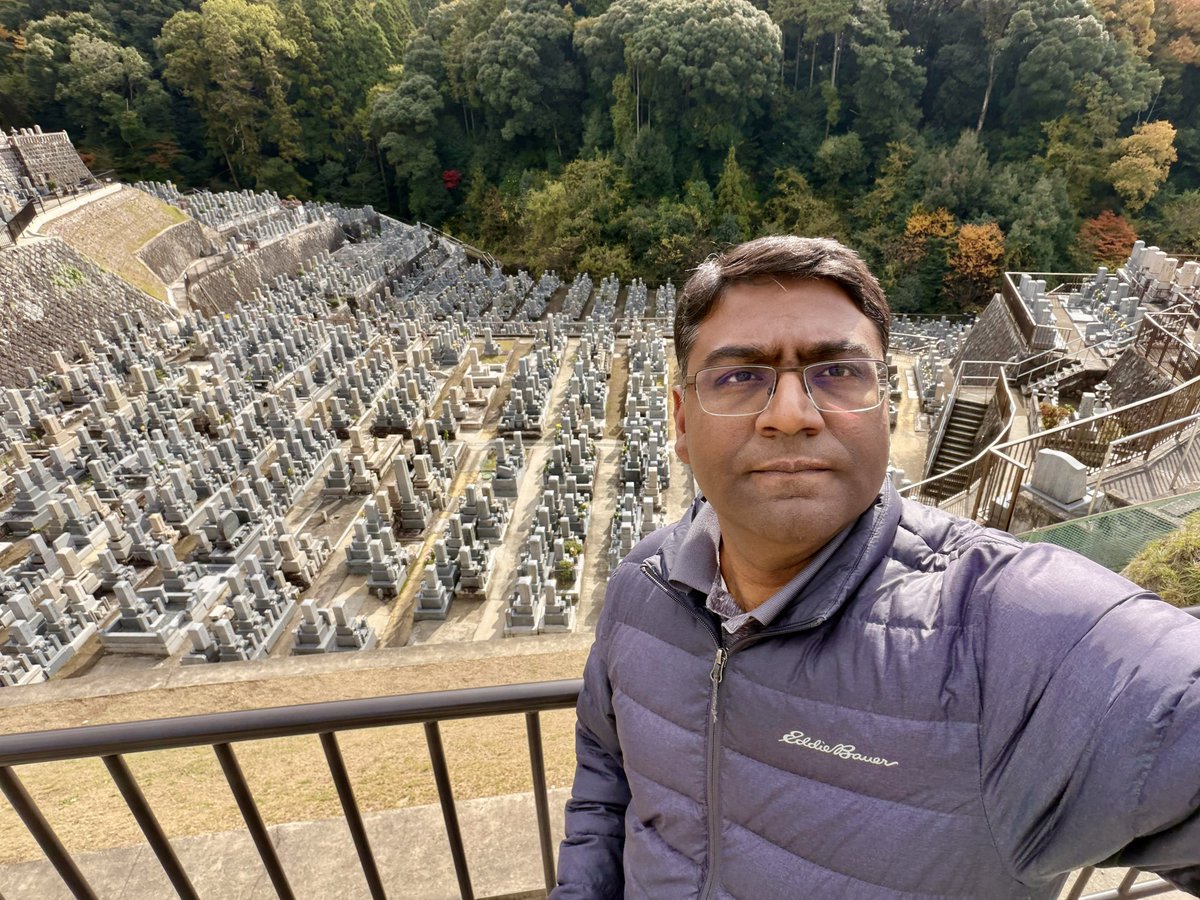
I like to visit and walk the cemeteries whenever I’m in a new city to remind myself of the eventuality and give me the courage to speak truth to power.
I recently went back to Japan after 20 years. Here is me walking the cemetery in Kyoto.
Well, why am I talking about this now?
I wrote a book! A book that I wrote knowing that I’m going to be dead one day and that I must come clean about the mistakes I made as a Tech. leader.
Failed executives don’t write books about their failures. They just go on to make millions and fail elsewhere.
They may appear to be a success if you just look at quantifiable metrics like their net worth or the share price of their company.
But they are miserable failures if you look closely at what they did to the lives of their employees - bureaucracy, burn out, forced relocations, layoffs, etc.
So I decided to write a book that catalogs and details many of my mistakes. On thinking deeper, they are not just my mistakes, but the mistakes of
mainstream management in general - I simply took them for granted without questioning their validity and effectiveness.
As much as I have become skeptical of anything prescriptive (what to do) that ignores the unique context in front of us, I think it is important to talk about what NOT to do.
So, I made sure this book is full of negative advice (what NOT to do) - traps and pitfalls you must avoid.
Why negative advice?
I go back to Nassim Taleb, who explains the why elegantly:
“I have used all my life a wonderfully simple heuristic: charlatans are recognizable in that they will give you positive advice, and only positive advice, exploiting our gullibility and sucker-proneness for recipes that hit you in a flash as just obvious, then evaporate later as you forget them.
Just look at the “how to” books with, in their title, “Ten Steps for - - ” (fill in: enrichment, weight loss, making friends, innovation, getting elected, building muscles, finding a husband, running an orphanage, etc.). Yet in practice it is the negative that’s used by the pros, those selected by evolution: chess grandmasters usually win by not losing; people become rich by not going bust (particularly when others do); religions are mostly about interdicts; the learning of life is about what to avoid.”
Grab a copy here: https://t.co/ASkWWiN0HQ
#leadership #systemsthinking #complexity #cybernetics #philosophy
@masa_kanagawa I adore your love for Indian food.
But, this is not a “thali”. This is Idli (white cakes) and Vada (fried spicy doughnut)- a popular breakfast combo.
Every culture has fermented food and idli is one of them from the south.
Also, it is Sambar and not Sambal.
@harshacoach Thank you! Another big hit was the buffalo yogurt with honey.
Sri Lanka has lot more to offer than the typical hopper, sambol and kottu that most tourists know about.
Celsius is obviously the superior system for science - but for every day UK weather, Fahrenheit makes much more sense. 0 is very very cold, 100 is very hot, normal is around 60.
Any time you find an advantage in an activity, and choose to supercharge it only along that one dimension, it is going to cause problems.
There will never be an exception to this rule.
It is a basic fact of natural systems.
When you look at any object or behavior in a natural system you are never looking at an isolated thing. You are looking at a surface-level manifestation of countless latent balances and tradeoffs.
If you max it out on that one conspicuous dimension, it is going to cost the rest of the system.
Every time.
VSM for Cybersecurity!
In episode 41 of the Cyb3rSyn Labs podcast, Glenn Wilson (@GlennDynaminet) discusses how cybersecurity programs are often fractured because teams like SOC and AppSec don’t communicate, leading to “random chaos” instead of a recursive, cohesive structure.
Using the Viable System Model (VSM), he emphasize managing risk through organizational viability and resilience rather than treating vulnerabilities as isolated problems or compliance checkboxes.
We discuss how some breaches don’t destroy companies (e.g., Marks & Spencer, Equifax) while others do, and suggest studying what enables survival, recovery, and adaptation.
We also critique reductionist “A vs B” tradeoffs like features versus security, referencing John Boyd’s decision effectiveness over speed, and propose learning from Toyota’s Andon Cord to break builds early, fix issues immediately, and prevent vulnerabilities.
A MUST WATCH for Cybersecurity executives and practitioners!
Link: https://t.co/YPdyZBXOFb
“𝙄𝙣 𝙖 𝙨𝙮𝙨𝙩𝙚𝙢, 𝙩𝙝𝙚 𝙗𝙚𝙨𝙩 𝙬𝙖𝙮 𝙩𝙤 𝙩𝙧𝙚𝙖𝙩 𝙖 𝙥𝙧𝙤𝙗𝙡𝙚𝙢 𝙞𝙨 𝙨𝙚𝙡𝙙𝙤𝙢 𝙬𝙝𝙚𝙧𝙚 𝙩𝙝𝙚 𝙥𝙧𝙤𝙗𝙡𝙚𝙢 𝙖𝙥𝙥𝙚𝙖𝙧𝙨.”
- 𝙍𝙪𝙨𝙨𝙚𝙡𝙡 𝘼𝙘𝙠𝙤𝙛𝙛
cc: @botchagalupe
#leadership #cybersecurity #systemsthinking #cybernetics
SpaceX has not committed to leasing Colossus for years, although it’s possible that may be what happens.
This is a 180 day lease with 90 day notice mutual cancellation thereafter. The short term was our request, not Anthropic’s.
We won’t leave them hanging and will provide a reasonable off-ramp, but if compute gets super tight I said we might need it back at some point.
Be the person in the room who keeps asking questions, never thinks they (or anyone else) really understand/s, and ends the session in an unsatisfied state.
It will annoy people, but it will do wonders for your true understanding.
The first longbow moment unlocked the path towards mass standardisation. The current longbow moment generates mass bespokeness.
Read the full essay: https://t.co/lEy75xyYCx