Media coverage of science can be improved by small doses of training, according to a study. A 7-minute video covering sources of funding, sample composition, statistics, causal interpretations, and graphs improved the accuracy of headlines. In PNAS Nexus: https://t.co/VBeBFaifDk
Media coverage of science can be improved by small doses of training, according to a study. A 7-minute video covering sources of funding, sample composition, statistics, causal interpretations, and graphs improved the accuracy of headlines. In PNAS Nexus: https://t.co/VBeBFaifDk
Was macht der Druck, möglichst viel Aufmerksamkeit zu erzeugen, mit Nachrichten? Was hilft gegen (den Glauben an) Fake News? Und wie lässt sich Hate Speech eindämmen? Darüber durfte mit @AndresRaphaela im @ZEW Podcast sprechen. Hier reinhören: https://t.co/nSOmNAjBkG 🎧🎙️
🎧 New #Podcast “ZEW Wirklich Wirtschaft”
Clickbait & hate speech: Why are headlines becoming more and more extreme and what does this do to users? #ZEW economist @AndresRaphaela and @lariberger discuss regulation, Germany’s Network Enforcement Act & counter-strategies ⬇️
🎙️🆕 #Podcast „ZEW Wirklich Wirtschaft“
Clickbait & Hate Speech: Warum werden Überschriften immer extremer und was macht das mit Nutzer/-innen? Im Podcast diskutieren #ZEW-Ökonomin @AndresRaphaela & @lariberger über Regulierung, NetzDG & Gegenstrategien.
➡️https://t.co/lYJPcvs16H
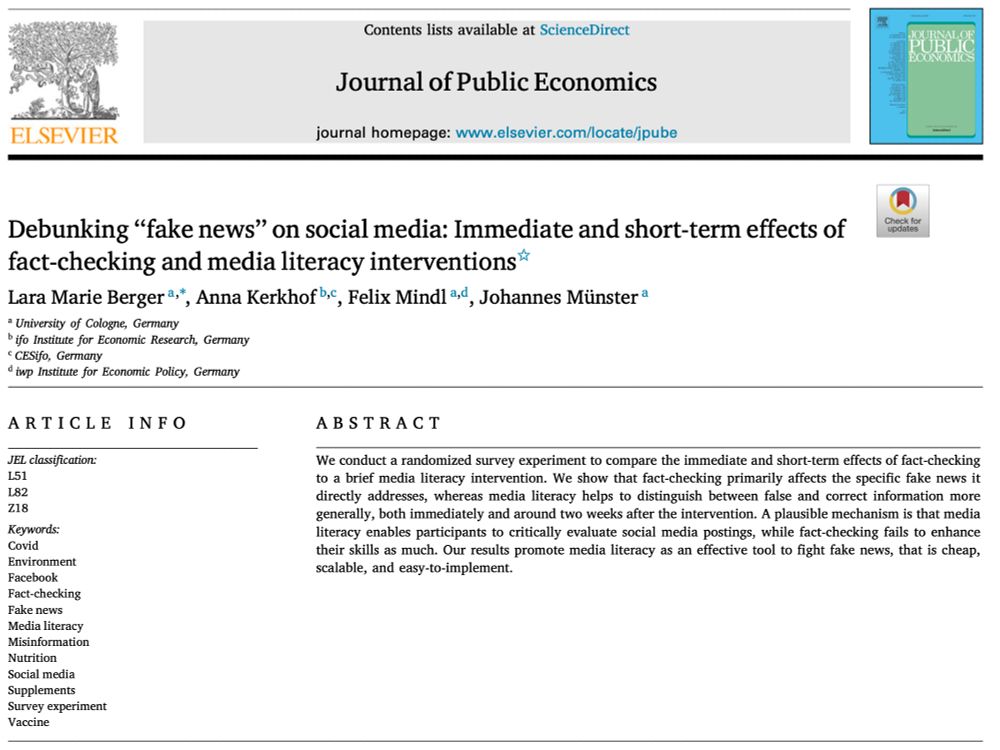
Just published in @JPubEcon:
"Debunking “fake news” on social media: Immediate and short-term effects of fact-checking and media literacy interventions"
By @lariberger, Anna Kerkhof, @FelixMindl, & Johannes Münster
#econtwitter
https://t.co/7ioesJJfOG
@FelixMindl Policy takeaway: Brief, scalable “tips to spot fake news” can often outperform reactive fact-checks. They’re easy to implement and foster critical thinking. Check out the full paper for all the details!
Excited to share our new paper: “Debunking ‘fake news’ on social media: Immediate and short-term effects of fact-checking & media literacy” (w/ Anna Kerkhof, @FelixMindl & Johannes Münster) – forthcoming in Journal of Public Economics.
https://t.co/sK0NNHDvnc
@FelixMindl Some of the positive effects persist even two weeks later. Both interventions preserve trust in accurate posts, but media literacy builds broader, longer-lasting skills to spot misinformation.
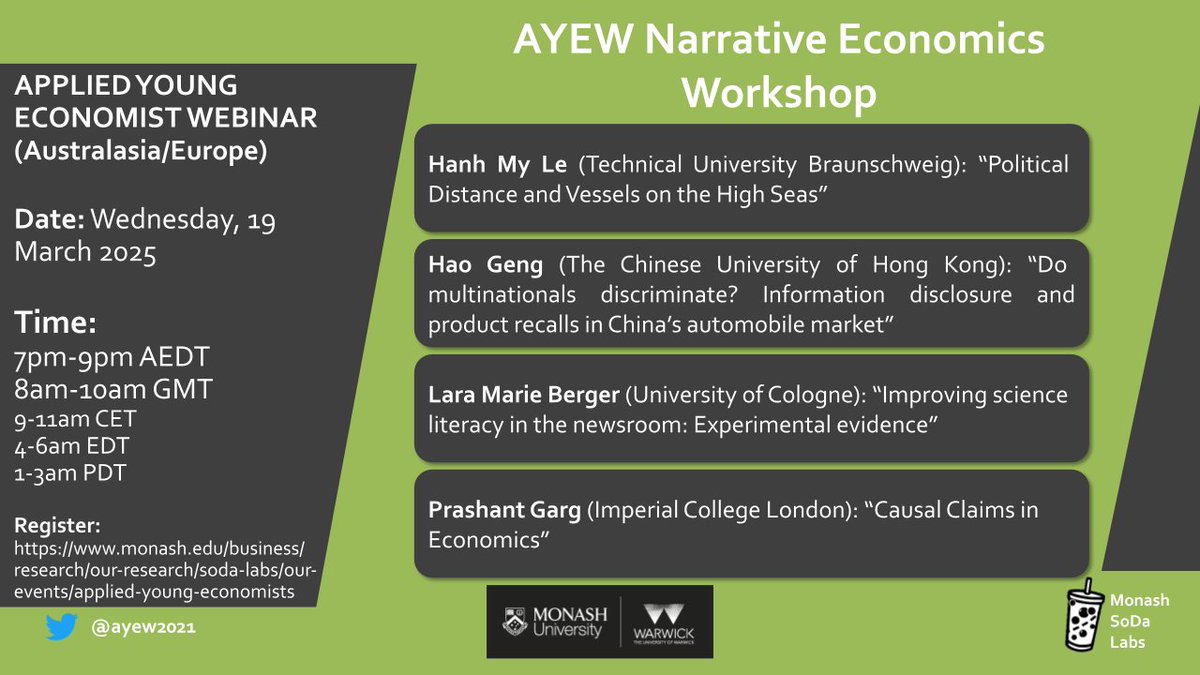
AYEW is back with Season 8!🎉
Join us TOMORROW (13 March) for the Political Economics Workshop at 11:00am GMT to listen to @Hugo_Sbtl (@IPZ_ch), @lariberger (@UniCologne) and
@AikoSchmeisser (@BSE_Berlin)
Sign up for Zoom details:
https://t.co/9uqg3n69rP
📢 Calling all Econ PhD candidates studying Digital markets! Don't miss out on the 7TH DOCTORAL WORKSHOP ON The Economics of Digitization happening in Warsaw on June 13-14. Submit your top paper before February 28, 2024! 👉 https://t.co/F49JP0US1l #EconPhD#DigitalMarkets
📢Exciting News Alert!
Calling all female researchers in Political Economics! Join our network of Women in Political Economics
🖥️ Website: https://t.co/8er3jHrEYx
1/4
Debunking “Fake News” on Social Media: Short-Term and Longer-Term Effects of Fact Checking and Media Literacy Interventions | @lariberger, Anna Kerkhof, @FelixMindl, @YohannesBecker#EconTwitter
https://t.co/Le0ajc8YSE