The real sign that blockchain has gone mainstream will not be more people talking about blockchain.
It will be people using it without noticing.
Nobody thinks about TCP/IP before sending a message. No one also checks how GPS works before opening Maps. The technology stays in the background while the product does its job.
Blockchain still asks users and developers to think too much about the plumbing. Bridges, oracles, indexers, automation bots, extra servers and custom integrations can turn one simple idea into a pile of moving parts.
And that is why the direction @RialoHQ is taking feels important.
A contract should be able to read trusted web data, react when something happens, protect private information and complete the next action without a dev stitching together five different services.
Think about flight delay insurance, the app checks the flight, confirms the delay and sends the payout automatically. Then the traveller does not need to understand wallets, data feeds or settlement systems. They only see that the product worked.
That is the level blockchain has to reach.
The biggest win will not be making everyone understand onchain infrastructure.
It will be making that infrastructure quiet, reliable and almost invisible.
@rialo_africa@0x_alextine
Anyone who has shipped something onchain knows the app itself is rarely the expensive part.
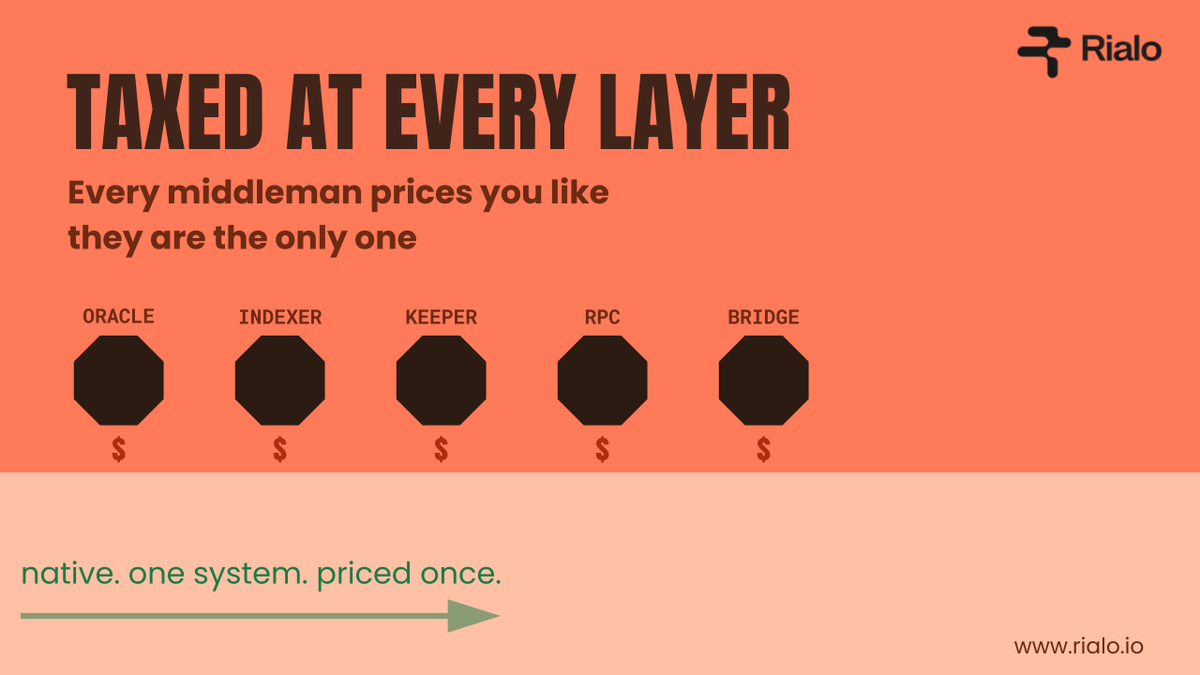
The contract goes live cheaply enough. Then the supporting cast shows up with invoices. A price feed here, an indexer to search your data there, a keeper to trigger actions, an RPC plan to stay connected, a bridge skimming a fee each time value crosses over. Every one of them sets its price as if it were the only thing you pay, and none of them talk.
Pile them up and the tolls end up eating most of what your app brings in. That is the real reason so many sensible, low margin products die in a doc somewhere. The margins only exist for high leverage, high risk plays.
@RialoHQ approaches it differently by folding those functions into the protocol itself, so live data, automation, external calls, indexing and cross chain movement arrive as native features instead of five separate rent collectors lining up at the door.
The shift worth noticing is not raw speed. It is turning a stack of independent toll booths into one system that prices the whole journey a single time.
@rialo_africa@0x_alextine
One quietly silly thing about crypto is how often you have to spend a transaction just to look at something.
Think about checking your bank balance and the app treating that glance as if you had moved the money. Nobody would tolerate it. Yet a lot of onchain apps do precisely that, dressing up a simple read in all the heavy gear built for actually changing state. That is why so many dashboards feel slow and grudging when all you did was open them.
Reading and writing were never the same action. One asks the chain a question and leaves it be. The other rewrites what the chain holds in memory. Forcing both down a single costly road is a habit, not a rule.
@RialoHQ separates them properly with a dedicated read path, letting apps pull current on chain state the instant you ask, without a transaction and without poking the network at all.
The payoff is not an abstract metric. It is an app that answers immediately, balances that show up the moment a screen loads, and an experience that finally matches what people already expect from everything else on their phone.
APIs promise uptime and almost nobody enforces it.
Covenant is a settlement layer that does this by consensus. @GenLayer validators measure the live service, judge each checkpoint, and the contract moves payment + bond automatically based on what was actually delivered.
And when validators split on a verdict, the minority reasoning is written onchain, rather than discarded. The majority moves the money while the dissent stays on the record.
https://t.co/1oey1KAQpU
Yesterday I gave an AI agent a $ and sent it out to the @RialoHQ AGP race.
Every question it asked cost real money. The guesses also cost more. I finished 25th on about 12 cents, and the placement is not what stayed with me. What stayed with me is that none of it depends on my honesty.
The run wrote itself to chain as it went. Questions, spend, verdicts, timestamps. Anyone can pull the record and see exactly how I did, whether I like the number or not.
Software does not usually work this way. A server does the job, hands you a result, and you accept it because you have no other option. The work stays invisible and the receipt is just somebody's word in a nicer font.
@RialoHQ puts the evidence inside the execution. The computation produces its own proof, so the result can be verified independently instead of taken on faith.
That stops being abstract the moment agents are approving requests and moving funds at machine speed, which is already happening.
Verification beats reputation once nobody is fast enough to supervise the machines.
We basically solved the "make AI smart" problem.
The one nobody's solved yet is "make AI accountable," and after actually building on Latch this past week, I'm convinced that's the whole game now.
Here's the thing a wallet address can't tell you: who or what is behind a transaction, and whether it's allowed to be doing what it's doing. A key proves ownership. It says nothing about authority.
I wired agents through Latch and watched this get fixed live, every request the agent made carried a machine-native identity, got checked against a policy before it ran, and landed in a log with the exact reason it was allowed or blocked.
One agent tried to delete something and got stopped cold with the rule that caught it named right there.
The question stopped being "do I trust this agent" and became "what did I actually permit," which is a question you can answer, log, and revoke.
When millions of agents are moving money and calling APIs every day, the ability to see who's acting, under what policy, with what authority, is the real foundation of the agent economy. Not just smarter agents but ones you can hold responsible. @RialoHQ@rialo_africa@0x_alextine
For weeks now the @RialoHQ community has been circling the same three questions about Latch, what it actually is, how it works under the hood, & why Rialo decided to build it in the first place, & today we finally get the answers straight from the source.
Ade Adepoju, the Co-Founder & CEO, is going live on the Discord stage to walk through the whole thing himself. And it's not a summary or a recap from someone who sat in, but the person who actually shaped the product breaking down the vision, real-world use cases, & where it fits in the bigger picture of where Rialo is heading.
The part I am genuinely looking forward to is the live Q&A, because it is rare to get a founder on a stage taking unscripted questions about a product on the day it gets introduced, & that openness has quietly been one of the best things about this community the whole way through.
If you have been even mildly curious about AI agents, secure automation, or what comes after the API-key era, this is the session to actually show up for. Bring your questions to the stage & ask them live.
See you there.
@rialo_africa@0x_alextine
A couple of days ago @GenLayer crossed 1,000,000 onchain decisions, & it's heading into Testnet Clarke, the last stop before mainnet. Good moment to actually understand staking.
One of the most interesting thing about @RialoHQ is not its consensus, it is the question almost nobody in crypto wants to answer out loud, which is who eats the loss when an external fact turns out to be wrong.
The whole industry has built a strange economy around admitting it needs the normal internet, oracle feeds, keepers, indexers, webhook relays, bridge-adjacent glue, & some of that genuinely buys you guarantees while plenty of it is just a surcharge for wrapping an ordinary dependency in crypto-shaped infrastructure with a token & a dashboard attached.
Native api calls do not make web2 data magically true, what they do is make the dependency visible inside the app instead of laundering it through another network pretending to be decentralized.
That matters because every api response a contract treats as binding is a liability event waiting to happen, a bad price, a bad credit score, a wrong shipment status, & the moment that value triggers settlement, somebody owns the damage.
The real edge is helping apps decide which outside facts can bind state, under what quorum, fallback, and with what recourse. If that works, pipes that only move data get cheaper & accountable correctness becomes the thing worth paying for.
@rialo_africa@0x_alextine
Been reading the @RialoHQ thesis on double marginalization in crypto & it reframed the whole scaling debate for me, because the industry has spent years insisting the core problem is gas fees or throughput when the actual cost usually lives in the infrastructure wrapped around the transaction rather than the transaction itself.
Double marginalization is a real concept from industrial economics, the idea that when a product passes through a chain of separate businesses each adding its own markup, the final price ends up higher than even a single monopolist would charge, because nobody is optimizing for the whole, everyone is optimizing for their own slice.
Crypto has a brutal version of this because a single advanced action does not pass through two middlemen, it passes through an oracle, an automation network, a bridge, a data provider, a sequencer, each one an independent business taking its cut.
The reason bringing those primitives to the protocol level matters is not just convenience, it collapses the entire markup chain into one layer where fees flow to validators instead of leaking out through five separate tolls.
Scaling was never only a throughput problem, it was an economic structure problem hiding behind one.
Almost every conversation about AI agents fixates on intelligence, how smart they get, how many tasks they automate, how well they reason, but intelligence on its own does not build an economy, & the thing the Subzero Labs stack made click for me is that an actual agent economy needs three completely separate layers that nobody talks about together.
You need governance, which defines what an agent is even allowed to do, & that is the job Latch handles with hardware-bound permissions instead of leakable api keys. Also you need execution, the ability for an agent to actually take actions, read real-world data & settle onchain, which is the @RialoHQ infrastructure itself.
And you need economic coordination, a way for agents to evaluate each other's work & pay each other for it, which is what SCALE introduces. A swarm of brilliant agents with no governance is a liability, with no execution layer is a demo, with no payment rails is just a group chat.
The hard problem was never building one smart agent, it was building the rails that let millions of them work, transact & stay accountable at once. Intelligence is the easy part now, the coordination is the real frontier.
@rialo_africa@0x_alextine
@GenLayer's Intelligent Oracle resolved 97.2% share of Polymarket's prediction marketsin its live benchmark.
On every market it called, agreement with Polymarket's own resolution hit 100%.
The bigger story is what's now sitting on top of it. OKX's Exchange OS handles 300,000 TPS of permissionless market creation. GenLayer plugs in as the permissionless resolution layer underneath, no custom adapters, plain English criteria.
Permissionless markets meet permissionless resolution. That's a much bigger idea than prediction markets alone.
Quick breakdown below 👇
Have been turning over the word supermodularity since reading it in a thread yesterday, & it captures something most people miss when they look at @RialoHQ as a checklist of features.
On their own, none of the primitives are revolutionary, web calls exist elsewhere, native scheduling exists elsewhere, account abstraction exists elsewhere, confidential compute exists elsewhere, gasless transactions exist elsewhere.
The interesting part is what becomes possible when all of them sit together in one execution environment that was designed for them to compose.
A payroll system that streams salaries directly from a company's bank api, runs the calculation under privacy so individual amounts stay confidential, schedules itself monthly without a keeper, & pays the gas out of staking yield, that is one application.
On any other chain it is six stitched together services with six failure modes. The Saving Jar demo from Shark Tank yesterday was a tiny version of this, email login plus native timer plus confidential identity mapping plus zero-gas, & it works as one clean product instead of four glued ones.
The features themselves are not the story, the way they multiply each other when they actually share the same protocol is.
The part of compliance nobody really wants to admit is that the entire kyc & aml stack is just a giant pipeline for collecting & storing sensitive personal data, your passport scan, address proof, bank statements, selfies, sitting on some compliance vendor's server waiting to be the subject of next year's breach notification.
The actual question being asked, is this person eligible to transact, gets a yes or no answer, but the way the industry currently arrives at that answer involves shipping every supporting document upstream as a permanent liability.
Zero-knowledge proofs flip that whole setup, you can mathematically prove the requirement is satisfied without ever exposing the data behind the proof, & @RialoHQ is one of the few chains structurally positioned to make this practical at protocol level rather than a bolt-on.
A user proves they are over eighteen without revealing their birthday, proves they live in an approved jurisdiction without revealing their address, proves they cleared sanctions screening without revealing the screening data itself.
Compliance ends up stronger because the verification is cryptographic instead of trust-based, & the breach risk shrinks because the data nobody collected is the data nobody can lose.
@rialo_africa@0x_alextine
The question I cannot stop turning over after reading a compliance thread here on X is the one buried right at the end of it, which is fine, @RialoHQ checks the rules before a transaction even runs instead of cleaning up problems after the fact, but the rulebook itself still gets written by somebody outside the chain, & whoever holds the pen there is quietly steering the entire system.
That tension is the real conversation we should be having about regulated onchain finance, not whether it can be done, but who gets to decide what the rules even mean in the first place.
The reason I keep landing on Rialo as the cleanest version of this argument is that the rule-checking actually lives in the protocol itself, paired with private execution that proves a transaction passes a rule without exposing the borrower's full file, so the same setup can serve very different rulebooks in different countries without breaking.
Privacy stops being about hiding things & starts being about proving only what matters. Onchain compliance was never going to be solved by adding another freeze button to a token contract, & it is refreshing to see a chain take the problem seriously where it actually lives.
The global banking infrastructure most of the world relies on today was architected in 1973, a time when computers were the size of entire rooms & the concept of instant global communication didn't exist yet, & somehow that same foundational plumbing is still what moves your money internationally in 2026.
Send money from Nigeria to the UK right now & you're looking at 3 to 5 business days, fees somewhere between $25 & $50 depending on how many correspondent banks your transfer touches along the way, & zero visibility into where your money actually sits during that journey because the system was never built to tell you that.
Blockchain & stablecoins solved the speed & cost part of that problem genuinely well, $0.01 per transaction, near instant settlement, running 24 hours a day including weekends & public holidays, which traditional banking infrastructure physically cannot do because the networks it runs on simply switch off.
But then came a problem nobody talks about loudly enough, every transaction on a public blockchain is completely readable by anyone with a browser & a few minutes, meaning a business processing payroll on chain just broadcast every salary to the world, a lending platform just exposed every borrower's position publicly & a company making supplier payments just handed its entire procurement strategy to competitors for free.
That's where the @SeismicSys design decision starts making real practical sense, because every transaction running through it is encrypted at the hardware level via Intel TDX from the moment it's submitted, meaning a fintech processing rent payments, a platform handling cross-border payroll or a credit market managing private loans all get the speed & cost benefits of blockchain settlement while keeping the financial details as private as they would be inside a traditional bank, except without the 1973 infrastructure underneath holding everything back.
Brookwell, Prism, DashX & Sedona all figured this out independently & all landed on the same infrastructure. That pattern is usually worth paying attention to.
Took an angle on @GenLayer I haven't seen broken down well anywhere: the GenVM vs the EVM, side by side.
The short version is that the EVM is a calculator built for certainty, while the GenVM is a thinking engine built for everything else.
Python at the top instead of Solidity. WebAssembly sandbox in the middle. A native LLM bridge underneath. Two execution modes running in parallel so AI can live onchain without breaking consensus.
Explainer below 👇
Spent some time mapping out where @GenLayer actually fits in the agentic stack & put it into a short explainer.
The whole agent economy is being built on payment rails right now, ACP, AP2, x402, all moving fast. But money moving between agents was never the hard part.
The hard part is what happens when two agents disagree on whether a job was done, when a plain-English contract gets challenged, when "satisfactory completion" needs a verdict.
GenLayer is the adjudication layer underneath all of it. Under a dollar per resolution, finalised in under an hour.
Video below 👇
Shipped NewsGate on @GenLayer Bradbury, it's my first end-to-end Web3 dApp.
Paste a news headline, claim, or article URL → validators independently judge → consensus locks the verdict onchain with reasoning. All in under 90s
Tbh getting here was rough doing this for the first time lol.
The local tooling kept giving issues, the wallet integration had a small detail that took hours to spot, & my first design fetched articles inside the contract which pushed verification past 3 minutes.
Then i rewrote the architecture mid-build to fetch articles in the browser instead & verification dropped to under 60s.
Test it here: https://t.co/qhdN86ZaKB
Repo: https://t.co/n2ecuXVQV1