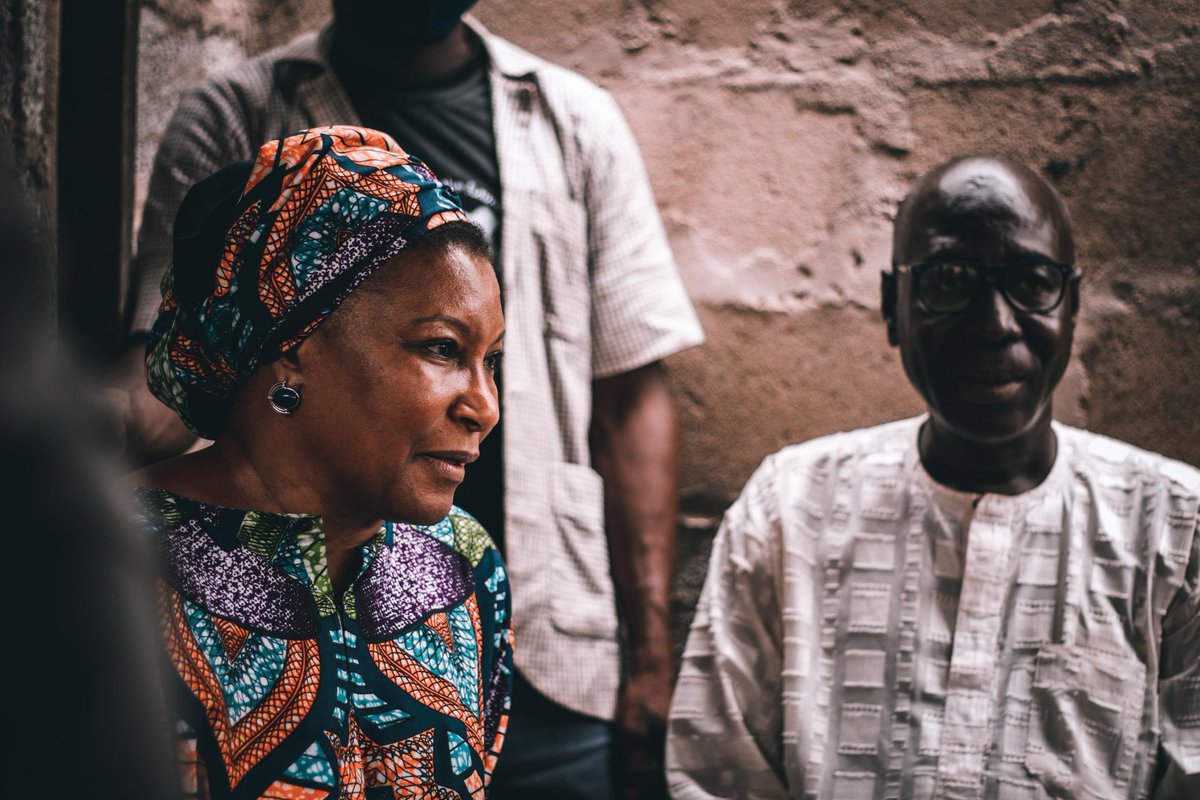
“We didn't fight for this rickety democracy... That somebody will look at your face and say, oh, you should not vote.”
Human rights lawyer Femi Falana says Nigerians deserve answers about the Lagos-Calabar Coastal Highway’s estimated ₦15 trillion cost and route changes.
A Pain One Carries Silently
This afternoon, as I travelled from Abuja to Lagos, a group of young Nigerians approached me at the airport and said: “We have not heard or read anything from you today or yesterday, despite all the heartbreaking news dominating our front pages—from the appointment of some of the least qualified individuals as ambassadors, to our institutions being ridiculed, the First Lady hosting extravagant dinners for Senators while children are being abducted, and the countless killings across the country.”
I looked at them and understood their frustration. My response came from the depth of my heart:
My dear younger brothers and sisters, there is a pain one carries silently when watching a nation you love bleed daily. There is a pain that words cannot fully describe—when you see the suffering of ordinary Nigerians and compare it to the reckless insensitivity displayed by those entrusted with leadership. It is the kind of pain that makes you remember the humiliating remark from the American president who referred to Nigeria as a “now disgraced country.”
Today, when you look around, you begin to understand why the world speaks of us that way. Yes, some of the names being paraded to represent us as ambassadors globally are shocking. But with a leadership that has allowed mediocrity, corruption, and impunity to rise to the top, who else did you expect them to choose?
When our people are being killed, our leaders are busy hosting dinners.
When children are being snatched from their schools, the political class is celebrating and dancing.
When families cannot afford their next meal, those in power are welcoming defectors and exchanging gifts as though Nigeria is not burning.
This is not governance.
This is not leadership.
And this is certainly not the Nigeria we deserve.
We cannot continue normalising this level of moral decay and national indifference. A nation rises when its leaders feel the pain of its citizens—not when they insulate themselves from it. A nation progresses when compassion, competence, and accountability guide public office, not when frivolity becomes the order of the day.
But I want you, the young people, to know this: do not lose hope. Do not become numb. Do not let this darkness demoralise your hearts. The New Nigeria we dream of—a just, secure, productive, and respected nation—is still possible. But it will not happen by accident. It will happen because people like you refuse to accept failure as our destiny.
We will continue to speak and insist that Nigeria can and must be better.
A New Nigeria is POssible. -PO
Someone tagged me to a post someone made here on X. The quote reads: "For a young Christian seeking a close relationship with God, the Catholic Church is not for you."
In the comment section, she mentioned that her reason for saying this is because in the Catholic Church, the prayers are already written, and it feels like mere recitation. She asks: “When do you actually get to communicate with God in your own words and express how you feel?”
While I commend her openness, I find the post a bit shocking because the young lady mentioned in one of the replies under the post that she is a Catholic and even confirmed. The sacrament of confirmation is the sacrament of Christian maturity. A confirmed Catholic is considered mature in the faith. But the post shows a misunderstanding of what prayer truly is in the Catholic tradition.
This response is for every other person who may feel the same way about prayers in the Catholic Church.
First, the Catholic Church does not restrict anyone to written prayers. In fact, the Church encourages spontaneous, personal, heartfelt prayer. We have countless devotions that require personal communication with God:
1. Visitation to the Blessed Sacrament/Adoration, where you sit alone with Jesus and speak to Him freely from your heart.
2. Meditation on Scripture (Lectio Divina), where you reflect and talk to God personally.
3. Private prayer at home, morning and night, where you use your own words.
4. The Rosary, which includes deep personal meditation on the mysteries of Christ’s life.
5. Silent contemplation, where no written word is needed - only your heart before God.
Written prayers are not barriers - they are guides, just as Jesus Himself taught a written prayer: “Our Father…”(Mt 6:9).
So the issue is not that the Catholic Church prevents anyone from speaking to God. It is that many have not yet discovered the depth and freedom of Catholic prayer. The Church gives you both: ancient prayers that form the soul and the freedom to speak to God in your own words.
Amazing 🤩 This boy sings the Benediction prayer in Igbo language with looking at the book🤭 “Thou has given they people bread from heaven”
#CatholicTwitter
Delighted to share that we have sealed a deal with the renowned Landmark Africa Group to revamp and reposition the iconic Nike Lake Resort. This Public-Private Partnership (PPP) marks a bold step towards achieving our vision of growing Enugu’s economy to $30 billion within the next six years.
Under this agreement, the Enugu State Government has entrusted the Nike Lake Resort as an asset, while Landmark Africa Group will invest an impressive N10 billion in the first phase to restore its past glory. This investment will bring in up to two (2) million visitors annually, create countless jobs, and significantly boost our Internally Generated Revenue (IGR).
Nike Lake Resort is a jewel of our state and a symbol of our rich history and potential. By partnering with Landmark, a leader in the hospitality industry, we are setting the stage for the Resort to become a premier global destination for tourism, business, and relaxation.
This collaboration aligns seamlessly with our broader efforts to transform Enugu into a hub of opportunities. Our administration has committed N800 billion this year alone to infrastructure development, including the ongoing dualisation of the Enugu-Opi-Nsukka Road, which will enhance connectivity to the Resort and foster even more investments along the corridor.
To our prospective investors, I extend an open invitation: Enugu is ready for business. We are creating an environment where businesses thrive, backed by improved infrastructure, enhanced security, and progressive governance.
I applaud the Founder and CEO of Landmark Africa Group, Mr. Paul Onwuanibe, for believing in our vision and for joining us in this journey to restore Nike Lake Resort’s iconic status.
Tomorrow is here!
I expect NBA’s activities to have gone beyond mere reaction. It’s 2025, we shouldn’t be going around as a body getting Lawyers and other citizens who are illegally detained out of Police custody without repercussion for every officers involved.
NBA should be influencing policies towards its aims and objectives as an organization. If your motto is “promoting rule of Law”, you are not promoting Rule of law by getting people out of police stations after their rights has been infringed. You should be promoting the Rule of Law by ensuring people’s rights are not breached to start with. What do you mean a Lawyer was detained for weeks or years and you got the lawyer out and you didn’t announce the sanctions for the officers that perpetrated the injustice? They weren’t even named.
How’s NBA ensuring that officers who erred and deny Lawyers and citizens their rights are punished? The recent Lawyer that was incarcerated illegally for years, what is NBA’s move to ensure it never happens again? The officers involved, what pressure is NBA mounting to ensure they either lose their jobs or at least, get reprimanded so they don’t do it to another person?
Promotion of Rule of Law should start from Law making, to implementation. It should be evident in the court rooms and how we approach Law enforcement agencies. You see, NBA is one of the pressure groups that everyone, including the Government should sit down and listen to when we are talking. So far, we have refused to be that NBA.
HOW IT HAPPENED IN GHANA & WHY .
Watch. Watch. Watch
Martin K. N. Kollie writes…
Twenty-one (21) African Heads of State were present but only one (1) was celebrated and cheered.
As they called them out, including the chairmen of ECOWAS and AU, at President John Dramami Mahama’s inauguration, the place was still quiet.
When they called president Capt. Ibrahim Traoré of Burkina Faso, the audience went wild with unending cheers and applause. He stole the entire show even from President John Dramami Mahama. A huge crowd even escorted Traoré outside to his car after the program.
Why did millions of Ghanaians celebrate Traoré?
1) He stays in his country working hard every day to solve structural problems for his people. He’s more focused on domestic affairs.
2) He doesn’t charter private jets traveling abroad almost every week to beg for aid and loans. He’s cutting down on public waste and prioritizing the development of the ordinary people.
3) He has built and is building factories across Burkina Faso including pharmaceutical production plant, tomato factories, cashew nuts factory, waste treatment factory, nuclear plant, etc.
4) He is building an industrial complex to produce shea butter, refined edible oil, etc. Millions of youth are getting back to work.
5) No public official is allowed to ride expensive cars, fly first class or waste money on foreign trips, etc. The President himself uses a used pick-up and diverts a huge amount of State money into improving the lives of his people.
6) He is nationalizing mineral resources to ensure Burkina Faso has its fair share. He’s investing millions in strategic sectors, including agriculture, health, education, energy, food security, tourism, security, etc. to drive job and wealth creation for his people.
7) Captain Ibrahim Traore reduced the wages of ministers, managing directors, commissioners, and other big shots by 30% and increased the wages of civil servants by 50%.
Just to name a few. Are you still wondering why Ghanaians were celebrating him yesterday in front of 20 other African presidents”?
Can I make a wish for an end to all wars and sue for peace in 2025?
The Nigeria/Biafra Civil War ended 55 years ago, on January 12, 1970. I was a child when the war began, and it resulted in millions of deaths, widespread starvation, and the destruction of property. Almost every Igbo family suffered losses, with many still missing loved ones. Unaccompanied children who left Biafra were never reunited with their families. Fortunately, I survived the bombs dropped on us and the famine that devastated the civilian population. The scars and emotional trauma I and others carry are indelible. The slogan "No victor, no vanquished" failed in its practical implementation, and to this day, the Igbo people continue to experience unprecedented marginalization and discrimination.
My current assignment with the United Nations—the Independent International Fact-finding Mission on Sudan (FFM Sudan)—brings to mind my childhood and the stories of suffering I heard. I vividly remember tales of families, women and children constantly on the move, fleeing as towns and cities fell during the civil war from 1967 to 1970. Today, Sudan, Ukraine, Gaza, and Myanmar are all suffering due to the impact of war.
The suffering of the Sudanese people seems to have been overlooked and doesn’t get much media attention, even among Africans. The conflict that began on April 23, 2023, is still ongoing and has spread across much of the country. This violence has led to thousands of deaths and injuries, as well as widespread displacement and the destruction of residential homes, hospitals, schools, and other vital infrastructure. The situation remains dire, with civilians enduring immense hardships. Over eleven million people have been displaced, and over two million have fled the country. Nearly half of the population, approximately 25.6 million, is facing hunger.
As members of the United Nations Fact-Finding Mission in Sudan, we have received countless harrowing testimonies from civilians fleeing the war in Sudan to neighbouring countries and beyond, such as Chad, the Central African Republic, Uganda, Egypt, Ethiopia, and Kenya. Independent International Fact-Finding Mission for the Sudan
Of significance is the recent USA action concerning the Sudan conflict, announced by the outgoing Secretary of State, Blinken (https://t.co/ybE8AOEjQw). Hopefully, Sudanese people and millions of civilians caught in this internal armed conflict will have respite, and the warring armed general's warlords of SAF and RSF will embrace the call for a ceasefire and political solution.
The international community, particularly the African Union, should provide humanitarian aid to help end this man-made famine in Sudan. Additionally, the international community needs to support countries that are hosting large numbers of Sudanese refugees. This support should ensure that these refugees have access to basic necessities, including nutrition, healthcare, hygiene, and education, allowing them to live in humane, dignified conditions.
I'm still dreaming of a more peaceful 2025, especially in Nigeria, where insecurities are rising and nowhere feels safe.
The latest directive of the Inspector General of Police (IGP) placing some restrictions on the distribution of palliatives to the less privileged in our midst is disturbing.
Even though the directive is a timely response to the series of tragedies recorded across the country recently, and the IG's honest reaction to the challenges of the prevailing economic hardship, it's open to abuse.
It is capable of discouraging citizens from helping the hungry and distressed among us.
While I understand the need for better organization and more attention to public safety, it is important to clarify that acts of goodwill should not be hindered by excessive bureaucracy.
Rather than requiring people to seek permission to assist those in need, we should encourage them to find better, more organized ways to offer such help. The focus should be on promoting coordination, not imposing barriers that could deter much-needed acts of kindness in a time of widespread hunger, pain, and anger.
This is not the time to stifle the spirit of compassion and generosity among our people. Instead, let us channel these efforts constructively, ensuring that help reaches the most vulnerable safely and efficiently.
The government must also do more to address the root causes of this hardship, providing lasting solutions rather than creating obstacles for those stepping in to fill the gaps created by government’s insensitive policies.
I urge the IGP to immediately review this directive and ensure that the police fosters collaboration and support, not division and discouragement, in our shared quest to alleviate the suffering of Nigerians. -PO
As the senator representing the Federal Capital Territory, my primary responsibility is to advocate for the welfare, dignity, and rights of every resident of the FCT. While urban development and ensuring compliance with planning regulations are essential for a thriving capital city, it is equally critical that such actions adhere strictly to the principles of due process and fairness.
Recent reports of demolitions in the FCT have raised significant concerns among residents and stakeholders. I must emphasize that any demolition exercise must be guided by transparency, proper notification, and lawful procedures. Residents must be given ample opportunity to address concerns regarding their properties, ensuring that no one is unjustly displaced or denied their rights.
The FCT belongs to all Nigerians, and as such, governance here should reflect the highest standards of accountability and justice. I will continue to monitor these developments closely, engage relevant authorities, and advocate for policies that strike a balance between urban development and protecting the rights of all residents. My commitment remains to stand firmly for what is right and just for the people of the FCT.
I urge all authorities involved to prioritize dialogue, follow established legal frameworks, and maintain the trust of the people by ensuring fairness and equity in all actions taken. Together, we can build a city that thrives not only in infrastructure but also in the confidence of its people.
-SenatorIretiKingibe
The recent announcement of Microsoft Nigeria to its workers about shutting down its innovation center in Lagos and cutting 200 jobs is deeply troubling. It underscores the urgent need for comprehensive economic reforms in Nigeria.