@niilista360@EdsonPecly@clarionrox Se falar: "fulano comeu manga" também é impossível saber. Vai que o fulano comeu a manga da camisa dele, nunca se sabe né...
Talvez o jogo dos EUA seja o xadrez 5D.
Porque no xadrez 4D eu ainda estou com bastante dificuldade de enxergar essa vitória americana...
Para mim parece bola fora total!
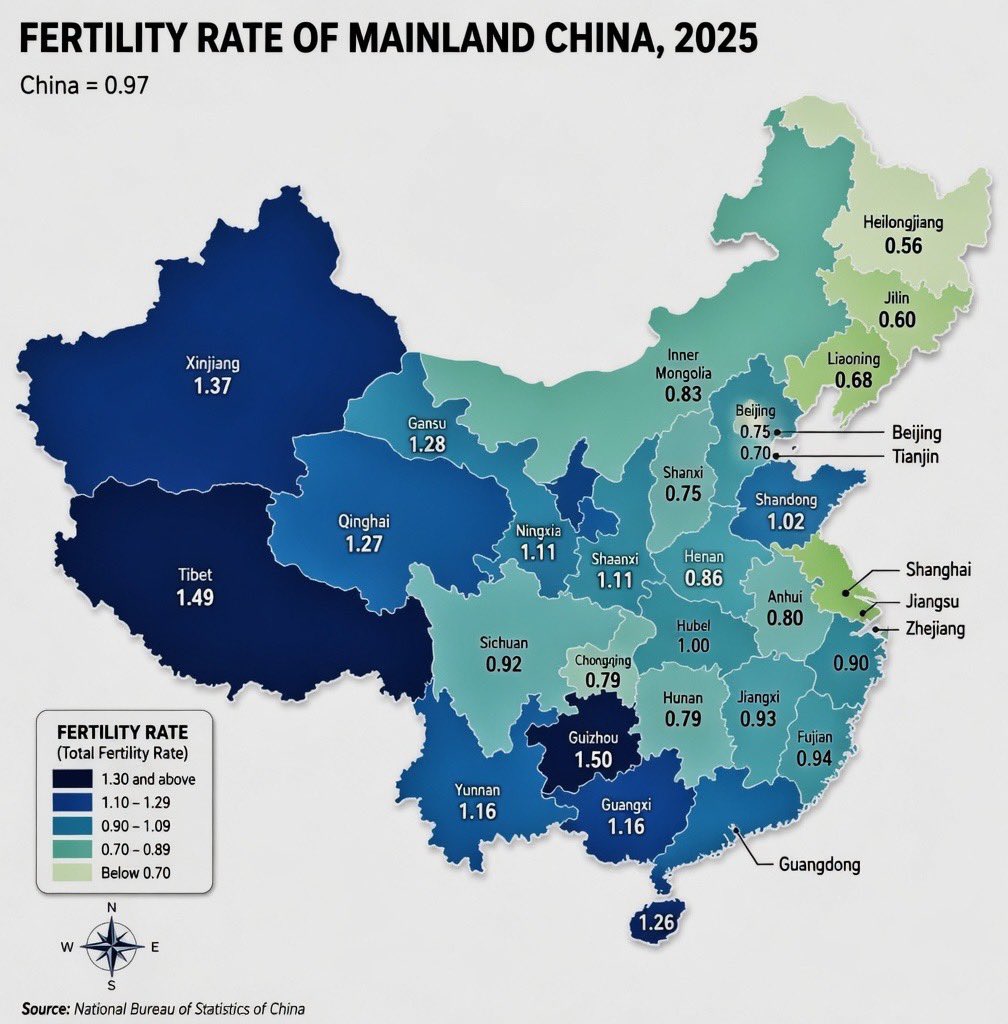
Everyone is aware of the demographic crisis in Europe, but take a look at China.
A fertility rate below one means that after just two generations, the population drops by more than 3/4. There will be massive economic and geopolitical implications going forward. Are we ready?
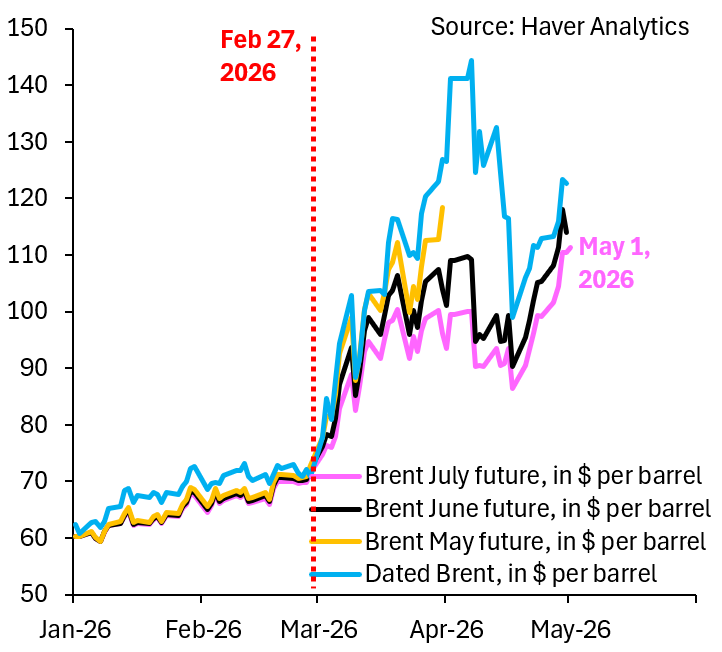
Lots of scare stories about how oil prices will rise indefinitely. None mention the fact that the front-month Brent future (pink) is up 85% so far this year. If you think prices should rise more, you first need to explain why this 85% isn't high enough...
https://t.co/Vnn2XZQmYn
Look at who is actually constrained right now.
Trump absorbs political damage at every dollar above $100 Brent. Iran bleeds reserve capacity daily. The Fed has no room to move with core PCE at 3%. China needs a semiconductor deal before the controls compound. Europe is staring at crack spreads that have doubled in Northwest Europe.
Every major actor is boxed in simultaneously. That kind of alignment doesn't produce escalation. It produces negotiation — and it produces a geography trade.
Latin America sits outside the war zone. Brazil is JPMorgan's OW #1 in EM. Annual inflow of R$62B. The Real captures petrodollars that can't move through the Gulf. The carry is expensive and it's also a geopolitical hedge. That combination doesn't exist anywhere else.
OW Real and commodities. Short Euro. Steepener 7-30s in the US curve.
Semiconductors now represent 14% of US market cap.
At the dot-com peak in 2000, the number was 7.1%. Double. Microsoft's Q3 confirmed the momentum: AI run rate of $37B, capex of $31.9B. The hyperscaler cycle is real and accelerating.
So is the concentration. SOX logged 17 consecutive sessions of gains. Capital is flowing in by structural necessity — competitive positioning in AI, not just return-seeking.
Short-term earnings are constructive. But passive exposure at this cap-weight carries dispersion risk most investors aren't pricing. SPY and QQQ are not diversified instruments right now. They are semiconductor ETFs with extra steps.
Selectivity beats direction from here.
Powell is staying on the Fed board through 2028.
The April meeting ended with 4 dissenters — a record since 1992. Core PCE is at 3%. No meaningful disinflation in two years. Warsh takes over in June and inherits a board that cannot pivot fast, a mandate that hasn't been met, and a curve that isn't buying the soft-landing narrative.
4 supply shocks in 5 years have left the institution perpetually behind the curve. The debate over whether to keep "next move is likely a cut" in the statement captures the problem exactly: the Fed is stuck managing optics instead of inflation.
Morgan Stanley's read: the market is sub-pricing cuts and under-appreciating the steepening that comes with a regime change.
The curve is the honest signal. The statement is noise.
Starting May 1, the UAE operates outside OPEC/OPEC+.
Full production capacity, uncapped. In theory, the relief valve everyone's been waiting for. In practice: it only works once Hormuz reopens. While the conflict is active, the barrels don't move.
China has 1.8 billion barrels in strategic storage. The UAE exit is coming. The Chinese buffer is already there.
Oil has a high floor and a limited ceiling. What looks like a trend is actually a constrained range. The upside from here requires a scenario that both sides are materially incentivized to avoid.
Since Greenspan, reading the Fed meant reading the chair. Markets priced a single voice.
Wednesday changed that.
4 dissents — a record since 1992. Not over the rate decision. Over the signal. Hammack, Kashkari, and Logan voted against keeping "next move is likely a cut" in the statement. Miran dissented in the opposite direction, favoring a cut. Four votes pulling in different directions.
Powell stays on the board through 2028. Breaks a 75-year precedent. Warsh takes over in June wanting "messier meetings" and "a good family fight." He'll get both.
The most underpriced risk isn't about the rate itself. It's about pricing. When markets read the Fed, they read one voice. If they now read a fractured committee, volatility around each meeting goes up. That has a cost: higher borrowing rates for households, businesses, and the Treasury itself.
The regime transition has started. And it isn't just about names.
Four dissents. An outgoing chair who isn't leaving. A new chair who wants "messier meetings."
Since Greenspan began releasing FOMC statements in '94, reading the Fed meant reading the chair
Wednesday raised the possibility that era is ending https://t.co/80GDuqZwql
The Hormuz question isn't who's winning. It's who runs out of rope first.
JPMorgan's adverse scenario puts Brent at $150 if the closure extends. That means +2pp in global inflation and -1.6pp in global GDP. Worse than 2022. Comparable to 1979 and 1990.
$150 isn't just a tail risk. It's a deadline in disguise. Trump's approval is already absorbing $114 gas prices. Iran is bleeding into obsolete storage tanks in Ahvaz and Asaluyeh.
Neither side has the room they pretend to have.
The market is pricing a war of attrition. The economics are pricing a deal.
🇧🇷 Brazil — Institutional & Politics:
The Senate’s rejection of Jorge Messias’s nomination to the Supreme Court (42 votes against, 34 in favor) marks a historic setback for the administration, being the first time a nominee has been blocked in 132 years. The move signals a clear deterioration in the Executive's support base, reflecting a structural divide between the Senate leadership and the administration.
The backdrop for this decision goes beyond the nominee himself. There is a growing perception of a drain in the administration’s political capital less than six months away from the presidential election. The opposition's recent growth in polls has emboldened the Senate, which used this vote as a display of power and a direct message of dissatisfaction to both the Executive and the Judiciary.
For local risk assets, this episode introduces a new layer of structural risk and instability. The lack of governability in the Upper House, combined with a tightening electoral calendar, drastically reduces the administration's room to maneuver regarding any economic or fiscal agenda. The landscape demands a cautious stance from investors in the face of increasingly fragile institutional dynamics.
The market thinks Hormuz is temporary.
It's not.
Trump demands up-front nuclear concessions. Iran can't give that without internal political collapse.
And oil won't explode because China has 1.8bn barrels stockpiled. UAE left OPEC.
High floor. Limited ceiling. For much longer than consensus is pricing.
Brazilian households have never been this indebted.
49.9% of income committed to debt payments. All-time record.
At the same time: JPMorgan ranked Brazil OW #1 across all emerging markets. Foreign inflows +R$62bn YTD.
How does that make sense?
It doesn't. It's carry. And carry lasts until it doesn't.