@neural_avb https://t.co/cV37IaNoQx doesnt seem to be far away maybe next month we get the new glm.
Therw will always be a new model which will eat up more and more of the harness.
Two face of the same ai coding camp.
One side sees coding agents as a real productivity unlock and is actively building workflows around them ( multi-agent pipelines, “ticket-to-PR” automation).
🧵
A useful practical signal from community experimentation: vague flattery-style prompting (“you’re the best programmer”) was repeatedly
described as worse than structured task decomposition and explicit orchestration roles.
>be me
>expert in search and retrieval problems
>read hype post
>claims memory solved
>open hood
>use basic vector search
>doesn’t understand query document encoder problem
>no reranker
>every time
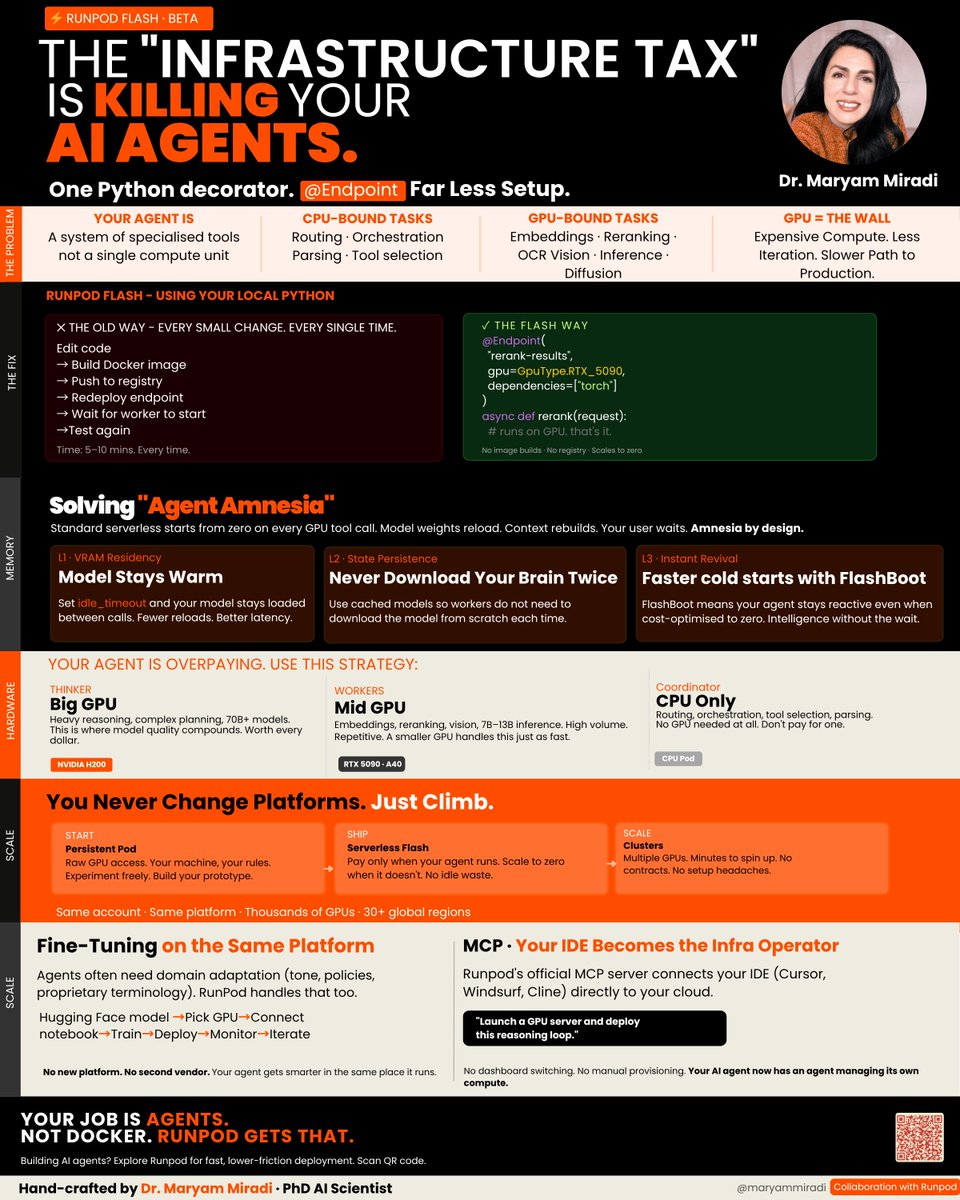
The “infrastructure tax” is killing your AI agents.
One Python decorator. Far less setup.
Your agent is not one compute unit.
It is a system of specialized tools.
Some are CPU-bound:
routing, orchestration, parsing, tool selection
Some are GPU-bound:
embeddings, reranking, OCR, vision, local inference, diffusion
And GPU-bound tasks are where many teams hit the wall:
- Expensive compute.
- Less iteration.
- Slower path to production.
That is why @runpod Flash stands out.
✦ THE NO-DOCKER MANDATE
Runpod launched Flash as a Python SDK for Serverless GPU workloads.
You write Python functions locally, decorate them, choose hardware and dependencies, and Flash handles the endpoint setup and execution.
No Docker in your workflow. Just Python.
The old way:
Edit code → Build Docker image → Push to registry → Redeploy → Wait for worker → Test again
Every small change. Every single time.
The Flash way:
- Decorate your function with Endpoint
- Choose your GPU
- Run it
Your local Python becomes a live GPU-backed endpoint.
↳ Flash GitHub: https://t.co/Ff40tgj3Oy
✦ WHY THIS MATTERS FOR AI AGENT BUILDERS
Because agent systems usually need both:
- fast user-facing tools
- longer background jobs
Flash has two endpoint types. Both matter for agents:
- Queue-based endpoints → batch, async, long-running jobs
- Load-balanced endpoints → low-latency APIs with shared workers
That is a clean fit for real agent systems.
A reranker or vision tool can serve live requests.
A heavier indexing or batch job can run in the background.
Same platform. Cleaner architecture.
✦ SOLVING AGENT AMNESIA (MEMORY TIERING)
Every GPU tool call can force your agent to start from zero.
Model weights reload. Context rebuilds. Your user waits.
Amnesia by design.
Runpod Flash fixes this at three levels:
- L1. VRAM Residency: Warm workers to reduce reloads
- L2. State Persistence: Cached models to reduce repeated downloads
- L3. Instant Revival: FlashBoot for faster cold starts
✦ THE 2026 HARDWARE STRATEGY
Most agent teams are also overpaying for hardware.
A simple strategy:
- Thinker → Big GPU
- Workers → Mid GPU
- Coordinator → CPU only
Do not pay for a GPU where you do not need one.
And you do not need to keep changing platforms.
- Start → Persistent Pod
- Ship → Serverless Flash
- Scale → Clusters
Same account. Same platform. Same agent lifecycle.
✦ FINE-TUNING MATTERS TOO
Agents often need domain adaptation:
tone, policies, proprietary language, internal workflows.
Runpod supports fine-tuning too, including Hugging Face-based workflows and Axolotl-powered training.
↳ Fine-tuning docs: https://t.co/B0IG9yQsBP
✦ MCP IS ANOTHER SMART MOVE
Runpod’s MCP server supports tools like Cursor and Claude Desktop, so your coding environment can talk directly to your cloud workflow.
Your job is agents.
Not Docker.
Huge thanks to Runpod for this collaboration.
---
P.S. Building AI agents? Explore Runpod for fast, lower-friction deployment.
⫸ꆛ https://t.co/586FLMjNor
Controlling the probabilistic reasoning loop by using harnesses, making it as deterministic as possible.
The one who can do this will build the future.
Vibe-coding is not the same as AI-Assisted engineering.
A recent Reddit post described how a FAANG team uses AI and it sparked an important conversation about semantics: "vibe coding" and professional "AI-assisted engineering". While the post was framed as an example of the former, the process it detailed - complete with technical design documents, stringent code reviews, and test-driven development - is a clear example of the latter imo.
This distinction is critical because conflating the two risks both devaluing the discipline of engineering and giving newcomers a dangerously incomplete picture of what it takes to build robust, production-ready software.
As a reminder: "vibe coding" is about fully giving in to the creative flow with an AI (high-level prompting), essentially forgetting the code exists. It involves accepting AI suggestions without deep review and focusing on rapid, iterative experimentation, making it ideal for prototypes, MVPs, learning, and what Karpathy calls "throwaway weekend projects." This approach is a powerful way for developers to build intuition and for beginners to flatten the steep learning curve of programming. It prioritizes speed and exploration over the correctness and maintainability required for professional applications.
There is a spectrum between vibe coding and doing it with a little more planning, spec-driven development, including enough context etc and what is AI-assisted engineering across the software development lifecycle.
In stark contrast to the post, the process described in the Reddit post is a methodical integration of AI into a mature software development lifecycle. This is "AI-assisted engineering," where AI acts as a powerful collaborator, not a replacement for engineering principles. In this model, developers use AI as a "force multiplier" to handle tasks like generating boilerplate code or writing initial test cases, but always within a structured framework.
Crucially, the big difference here is the human engineer remains firmly in control, responsible for the architecture, reviewing and understanding every line of AI-generated code, and ensuring the final product is secure, scalable, and maintainable. The 30% increase in development speed mentioned in the post is a result of augmenting a solid process, not abandoning it.
For engineers, labeling disciplined, AI-augmented workflows as "vibe coding" misrepresents the skill and rigor involved. For those new to the field, it creates the false and risky impression that one can simply prompt their way to a viable product without understanding the underlying code or engineering fundamentals.
If you're looking to do this right, start with a solid design, subject everything to rigorous human review, and treat AI as an incredibly powerful tool in your engineering toolkit - not as a magic wand that replaces the craft itself.