Mamá, no permitas que la manipulación dirija la atmósfera de tu hogar.
✨ Dios te llamó a criar con ternura, pero también con convicción y límites claros.
https://t.co/YgGwIJD2xE
One of the huge challenges in ministry right now, and there are many, is helping women regain agency and strength.
Now, before I say what I mean by that, some of you are already thinking, “Yeah, but what about men? Isn’t that one of men’s biggest problems too?” Of course it is. I just said there are many problems.
But another problem is that many of you can’t read what’s right in front of you without immediately thinking about the opposite. You’ve been trained to read antithetically. Instead of taking the point being made, you immediately think about how it isn’t universally true or how it applies to someone else, and you miss the point entirely.
When it comes to men and women, our culture assumes you can never talk about one without immediately talking about the other. If you praise men, you have to praise women. If you criticize women, you have to criticize men. Everything has to be perfectly balanced. It’s one of the ways our age has made honest conversations unnecessarily difficult.
Back to the point.
Modern culture has told women they can do anything a man can do, and probably do it better. It has told them they can have it all. They can be a mother, a lawyer, an astronaut, bake sourdough, keep a spotless house, and become the next Allie Beth Stuckey.
At first glance, that sounds like the culture is giving women unlimited agency. But there’s a twist. While women are supposedly capable of everything, they’re also told they’re rarely responsible for anything. If they fail, it’s because the “patriarchal system” is rigged. If they’re anxious, it’s because their husband doesn’t love them like Christ enough, not because they refuse to take their worries to God. Then there’s trauma culture, which labels nearly everything as trauma and then uses that label to excuse sinful reactions and behavior.
So women are told they’re stronger, smarter, and more capable than ever, yet they’re also taught that their failures and sins are almost always someone else’s fault. That combination produces people who are proud and fragile at the same time. They’ve been raised in a culture that constantly flatters them, so correction feels like an attack.
That’s what I mean by women losing agency.
Women need to be told they are responsible before God for the outcomes of their lives. They are responsible for their sinful attitudes and actions. Outside circumstances affect everyone, but they do not remove personal responsibility. Women must own their sin, repent of it, and accept the consequences that often come with it.
That isn’t misogyny. It’s love. It’s helping women recover adulthood from a culture that constantly encourages them to remain children.
I am very much in favor of strong women. But by strength, I mean strength of character. Nothing keeps a person weaker than refusing to take responsibility for their own sin, and nothing makes a person stronger than humility, the ability to see yourself truthfully before God.
That kind of humility produces remarkable women. Women who are gracious. Women who walk through life with poise. Women who are not easily offended because they are far more concerned with their own souls than protecting their pride.
Any pastor or ministry that undermines a woman’s agency is a people-pleasing, woman-fearing, God-dishonoring ministry. They do not have the courage to love women enough to tell them the truth. More often than not, they are married to women who think this way themselves. Instead of helping them grow in grace, they flatter them, excuse them, and surrender to their weakness and sin.
Another part of this, and this is where the men come in, is that many men are married to women who have bought into these modern lies. They are proud and very difficult to correct. The husbands have either bought into the same lies themselves or have simply surrendered to the fact that their wives won’t receive correction.
These are the “happy wife, happy life” kinds of men. More than anything, they just want to keep the peace. They want their wife to be happy regardless of her spiritual condition so they can go about their lives without conflict.
So when something in the culture or the church upsets their wife, they get upset too, not because you’re wrong, but because you’ve disturbed the little bit of peace they’ve managed to carve out in their marriage.
That’s when the names start. You’re a misogynist. You’re a woman-hater. You’re unloving. They’ll say whatever they need to say because they have to reassure their wife that they don’t agree with the man calling her to repentance. They need her to know she’s basically fine, or at least that you’re overstating the case. The goal is simple: get things back to normal.
Many of these men are pastors.
On the other side are men who have become embittered. They’ve watched this for years, they’re tired of it, and now they’re overcompensating. They speak without patience, but patience is exactly what’s needed. When an entire sex has been catechized by a lie for decades, sanctification takes time.
So you’ve got flattering, enabling husbands on one side and embittered men on the other. Neither helps.
It’s our mess. God has given it to us, and it’s our responsibility to deal with it. So we must.
Two humble men. Two remarkable legacies, thanks to His amazing grace. Robert and I spoke often of our gratitude for the deep and lasting influence of Art DeMoss and Sam Wolgemuth that now spans five generations.
https://t.co/9ANc0SJZXh
Feminism tells women that they are strong enough to run nations, lead armies, build empires, and even walk on the moon.
But at the same time will tell you that motherhood would destroy, and derail you.
Apparently, women are powerful enough to rule the world, just not powerful enough to raise a child.
"So keep building. But build at the altitude where your wings actually work. Learn that faithfulness matters more than endless expansion, and learn that some of God's best gifts are not new opportunities but boundaries."
A few years ago I looked around and realized I had caught most of what I had been chasing.
I had set goals that felt ambitious when I set them. I wanted to build the church and rise at work and write a meaninful book. One by one those things came. Opportunities opened up that a nobody from Lawrenceburg, Indiana had no business expecting. Larger platforms were circling, and people who could make things happen were asking for meetings.
You probably follow men like me because of things like that. You see the results and you want them, and I understand that because I wanted them too. But what I need you to understand is what happened after I got them.
I caught the cars, and I was not satisfied. My first instinct was to go looking for another one.
There is an old image of a dog chasing a car. He runs after it day after day and never really believes he will catch it. But suppose one day he does. He would not know what to do with it, so he would lose interest and start chasing the next one. That dog is the thing I want to warn you about, because that dog was me.
Like many men, I loved the chase more than the prize. And here is what no one tells you while you are still running. The prize does not do what you think it will do. You tell yourself a story about it. You say you will be satisfied when you make VP. You will be satisfied when the church reaches a certain size. You will be satisfied when you finish the degree or publish the book. Then you get there, and life keeps going.
Movies end at the climax, but real life does not, except for death itself. You reach the summit and take a breath, and then you discover that tomorrow is Tuesday and the alarm still goes off at the same time. The accomplishment becomes ordinary much faster than you expected. The possession loses its shine and the promotion becomes yesterday's news.
Augustine had the diagnosis right when he said our heart is restless until it rests in God. No car on the road will quiet it. You can catch every one of them and still lie awake at night, already scanning for the next.
This is the part that younger men do not believe until it is too late. You think the problem is that you have not caught enough yet, and that one more will finally do it. It will not. The chase is not broken because you are after the wrong things. The chase is broken because you have asked it to do something it was never able to do.
What saved me was not catching more. It was learning where my wings actually work.
I keep returning to the story of Icarus and his father Daedalus. I have heard it preached as a warning against ambition, but I do not think that is what it means. It is about flying at the proper height. Icarus did not die because he flew. He died because he flew too high and ignored the boundaries that were built into his own design. His father flew the middle course and reached Sicily alive. A wise man knows there are heights he can reach and heights he should not pursue.
For me those boundaries did not arrive as wisdom. They arrived as difficulty. I was a bivocational pastor with a large family, and I had to pass on much of what was opening up in front of me. Then our family entered a long season of death. Over several years we buried family members and close friends, and some of them died in tragic ways. Between the losses and the demands of ministry and the weight of work and family, I did not have the capacity to chase what was circling.
At the time it felt like loss. Looking back, I can see that it was instruction. God sent difficulty into my life to teach me something I would not have learned any other way. I have enough. To keep climbing past that point would cost me things worth far more than influence.
This is not a call to abandon ambition. God made men to build and to extend, and there is a real and honest satisfaction in doing hard things well. So keep building. But build at the altitude where your wings actually work. Learn that faithfulness matters more than endless expansion, and learn that some of God's best gifts are not new opportunities but boundaries.
At some point a man has to be able to look at his life and say that this will do.
I decided to stay at this altitude. If I climb much higher it may cost me my soul. Here, my wings will not melt.
Painting: Thomas Smythe
Your parents should live close to your children. If possible, in the same intergenerational house.
When our kids are married, if they ever wanted to live at home with us, we would welcome them and be happy. We want to do whatever we can to help them start their family and give our grandchildren a good home. I don't want them throwing away money on rent when they could be saving for a down payment.
There are young families whose parents willingly help them out financially because the cost of living is so high. Instead of investing in retirement plans, they're investing in the future of their family.
In every culture except modern Western culture, multi-generational living is the default. In Asia, Latin America, the Middle East, and Africa — families live together.
We're the weird ones. And our families are suffering because of it.
A multi-generational household means grandma watches the kids. Mom can work part-time or not at all. The family saves money. Children grow up with four loving adults instead of two overwhelmed ones.
Galatians 4:4 looks like a transition verse.
“But when the fullness of time had come, God sent forth His Son.”
If you read it fast, it sounds like a timestamp. But if read slowly, it is the most staggering sentence in the Bible.
‘Fullness of time’. Paul isn't saying God picked a convenient moment. He is saying God declared a moment complete. “The preparation is finished and everything I have been building across centuries is exactly where I need it to be”. God looked at human history and said: now.
Which forces the question. Why then? Why not a thousand years earlier, when Moses was fresh? Why not a thousand years later? What was so perfect about the first century?
I started looking into it and I have not recovered.
God needed a people with the theology. He spent 2000 years forming Israel; the covenant, the sacrificial system, the prophets, Isaiah 53 written seven centuries before Calvary, the framework of a coming Messiah who would bear the sin of the world. The Jews were shaped by wilderness, exile, and divine discipline, until the theological infrastructure for substitutionary atonement was fully in place.
But theology alone could not travel. God needed a language. Not a tribal dialect, but a universal tongue. So five hundred years before the Gospel, He let the Greek philosophers begin.
Heraclitus sat in Ephesus and concluded the universe was governed by an invisible rational principle. He called it the Logos.
The Stoics built on it. Philo of Alexandria stood at the intersection of Greek thought and Hebrew scripture and said the Logos was the mind of God in creation. For five hundred years, philosophy built a conceptual category it could not fill.
Then God sent a conqueror with no interest in theology. Alexander the Great wanted glory and empire. God let him want it. In satisfying his ego across three continents, Alexander Hellenized the ancient world and forged Koine Greek, the common tongue of the docks, markets, soldiers, and slaves. A language stripped of complexity, simple enough for anyone, universal enough for everyone.
The Hebrew scriptures were translated into it. The Septuagint was born. God used a pagan conqueror’s ambition to translate His own Word.
Then Rome came and paved the road. The Pax Romana. Piracy cleared. Stone highways stretching from Spain to Syria. A framework for movement the ancient world had never seen.
None of them knew they were collaborating.
Heraclitus thought he was doing philosophy. Alexander thought he was building a monument to himself. Rome thought it was building an empire for Rome. Not one of them understood they were stagehands. God was with Heraclitus in his pondering, with Alexander in his conquest, with Roman engineers laying stone, quietly requisitioning their work for a purpose none of them could see.
And then, when the covenant people were in place, the language primed, the roads built, and the category ready, when everything He had been quietly assembling was finally set, God stepped into the room they had unknowingly prepared.
John picked up his pen and wrote: “In the beginning was the Logos.”
Every Greek philosopher in the Mediterranean felt the ground shift. “And the Logos became flesh.” The category they spent five centuries constructing was not a principle. It was a Person.
The ‘fullness of time is not a timestamp’. It is God’s signature on a completed work. And the humbling thing is that this work was not built by saints. It was built by conquerors, philosophers, and emperors who thought they were writing their own story. God let them think that. And used every word. If this is not amazing then I don’t know what is.
Birth control fundamentally changed the relationship between men and women, and NOT for the better.
Before the pill, sex had consequences. Men had to commit before they could access a woman's body. Marriage was the price of admission.
The pill removed that. Now men get all the benefits of intimacy with none of the responsibility. Why would a man commit when he can have casual relationships indefinitely?
The result: marriage rates have plummeted. Birth rates are below replacement in EVERY Western country. Men delay commitment while women spend their most fertile years hoping casual relationships will "turn into something."
And the pharmaceutical companies profit from both sides — selling the pill to prevent babies, then selling IVF to women in their late 30s who desperately want them.
You were never liberated. You were made into a customer.
1980s: "self-esteem" movement
1990s: "self-made" movement
2000s: "self-help" movement
2010s: "believe in self" movement
2020s: "self-love" movement
It’s all "self-worship" with different labels.
However, you're created to worship Someone other than "self". His name is Jesus.
¿Cómo puede un pecador ser justo delante de un Dios santo?
Esa pregunta sigue siendo la más urgente del mundo.
Y ninguna cantidad de liturgia, tradición o continuidad histórica puede reemplazar su respuesta bíblica:
Sola gracia.
Sola fe.
Solo Cristo.
¿Cómo debería orar cuando estoy agotado, desanimado y cansado de la batalla? El pastor Colin habla sobre dos enfoques distintos: puedes orar de manera general pidiendo ayuda, o puedes orar específicamente en relación con la batalla que estás enfrentando.
https://t.co/mEDZgnrjOr
¿Cuál es la batalla que te está cansando ahora mismo? Todos tenemos batallas que enfrentar y a veces, simplemente nos agotamos. El Pastor Colin habla sobre cómo seguir adelante cuando eso sucede.
Escucha el primer episodio de la nueva serie en: https://t.co/orHJ1zGmhD
If you want to measure a man, look to the women near him.
“Woman is the glory of man” (1 Corinthians 11:7) — in friendships, marriages, families, churches, and societies — so where women are honored, cherished, and flourishing in Christ, the men are acting as God intended.
Sermon: “Honor, Guard, and Cherish: A Call to Christian Husbands.”
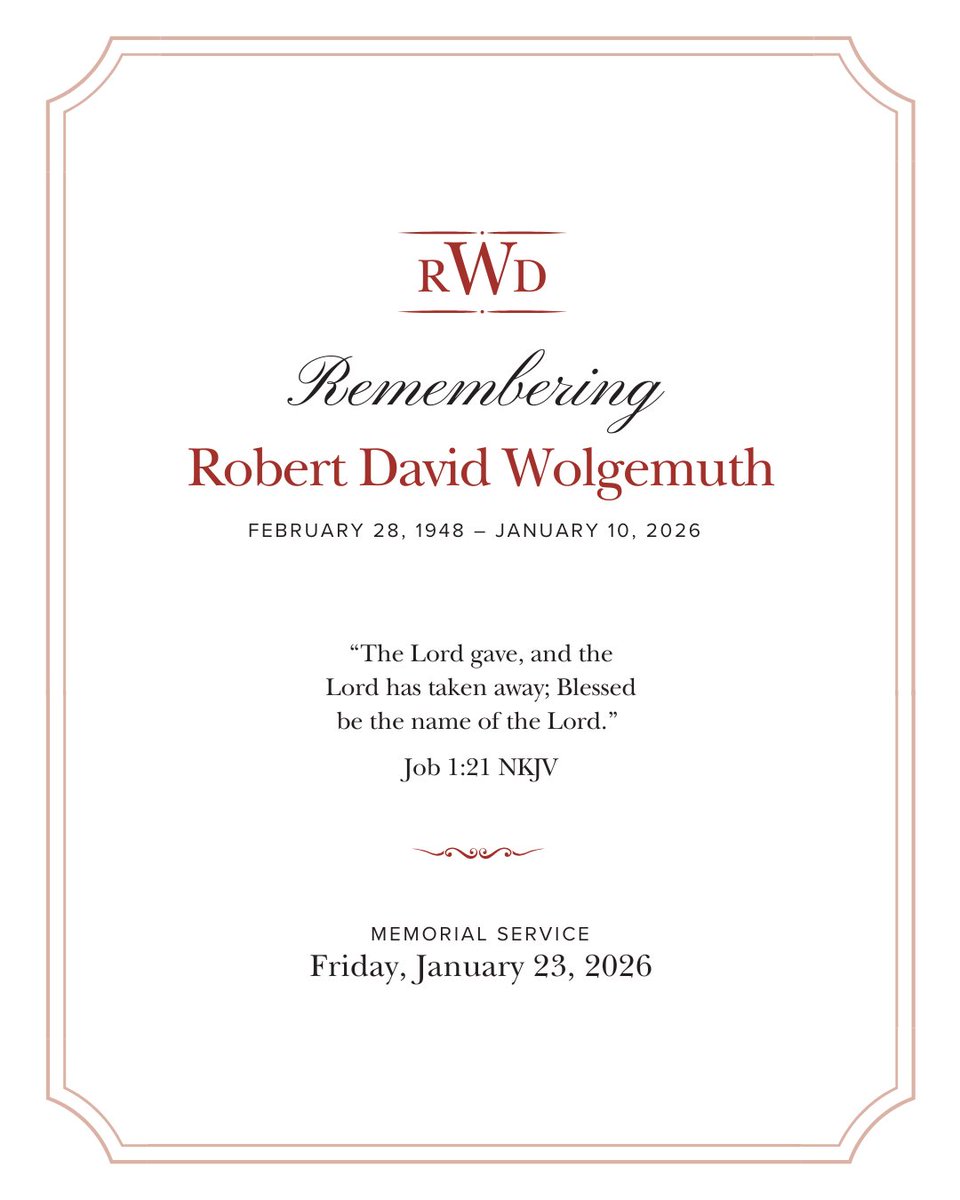
With grateful hearts we remember the life of Robert Wolgemuth—beloved husband of Nancy DeMoss Wolgemuth, devoted father and grandfather, faithful servant of Christ, encourager, mentor, and cherished member of the Revive Our Hearts family.
We invite you to join us via livestream today, January 23, as we honor Robert’s legacy of faith, love, and steadfast devotion to Christ. The memorial service will include worship, heartfelt reflection, and thanksgiving for the impact of his life—a life lived fully for Jesus.
The main service is 2–4:30 p.m. (EST). You also are invited to join us around 5:30 p.m. (EST) as we sing hymns and share memories.
Thank you for your prayers, your support, and for holding Nancy and the Wolgemuth family in your hearts during this tender time.
—The @ReviveOurHearts Team