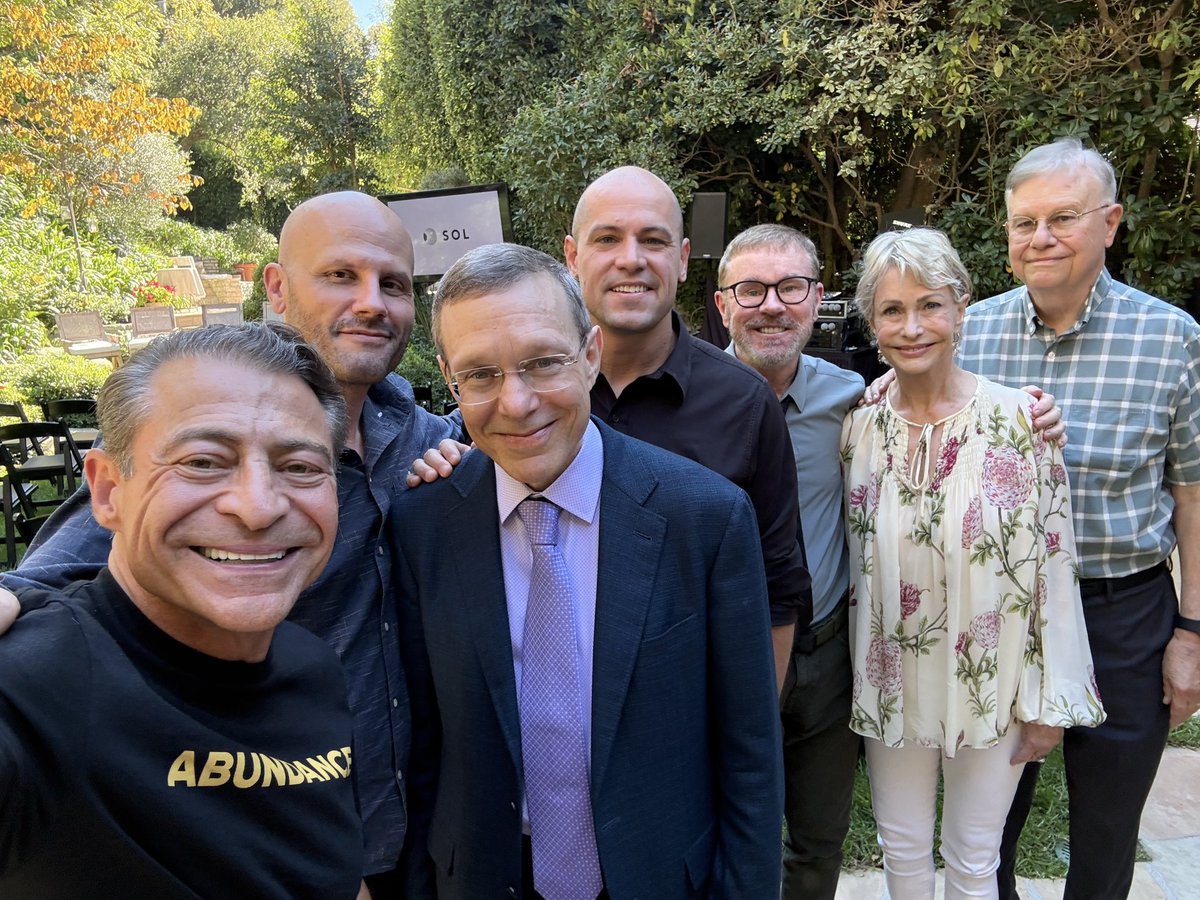
Hosting a UAP salon at my home. Here with Avi Loeb, Garry Nolan, Whitley Striber, Peter Skafish and Ryan Graves. Discussing the Science and tech and disclosure.
Thanks, Peter! This is the beginning of the end for destructive wildfires. In a country that loses ~$500B every year to wildfires, even tiny gains make for huge savings, to say nothing of the incalculable value of lives and homes.
Concern yourselves more with the needs of others, with the needs of all humanity, and you'll have peace of mind. Selfishness creates a distance between us and other people, leading to suspicion and mistrust, ultimately resulting in loneliness. Think of others' well-being and you’ll be happy.
Major life hack: Don't complain, ever. Nobody likes a complainer. They drain the energy of everyone around them. It's exhausting spending time around someone who constantly complains about things outside their control. If it's within your control, go do something about it. If it's not, you're just wasting energy thinking about it. Complaining gives too much power to the thing. Take back that power.
The World Cup games are really something else. Beyond the competition and the games themselves—which are fantastic—there’s this incredible element of how people from different countries interact with each other.
People bring their unique personalities and nationalities, and everyone just gets along with so much respect. Whether it’s the Scots bringing their spirit and bagpipes to the games, or the Japanese fans cleaning up the stadium after a match, it’s a beautiful reflection of what the United Nations—and all countries—should be.
It brings out a joy, laughter, and a warmth that gives us a real element of optimism. We should learn from this whole experience of what it's like to be together, and how we can be together.
#WorldCup #soccer #raydalio
Tonight, June 29, the Strawberry Moon rises as the lowest-hanging full moon in nearly 20 years for Northern Hemisphere viewers.
It will not be matched until 2043.
June full moons follow a low path because they sit opposite the high summer sun near the solstice. This year the effect is stronger due to the low point in the 18.6-year lunar cycle. The moon rises far southeast, traces a shallow arc low in the southern sky, and sets far southwest.
Its low position near the horizon creates the moon illusion, making it appear larger and more dramatic. It may also look orange, red, or golden because its light passes through more atmosphere, scattering blue light and leaving warmer colors. The "Strawberry" name comes from the harvest season, not the color.
The best view is around local moonrise.
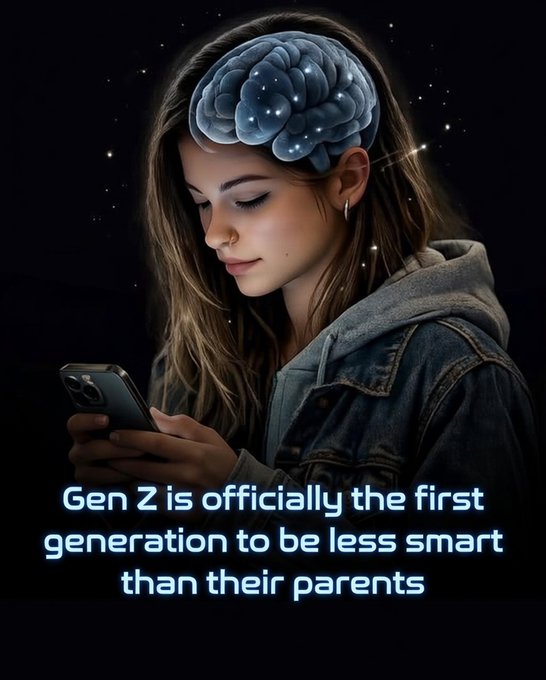
Scientists have identified a reversal of the long-standing Flynn effect—the roughly 200-year trend of rising average intelligence (measured via IQ and cognitive tests) across generations.
For the first time in modern recorded history, Generation Z (born roughly 1997–2012) shows lower performance than previous generations in key cognitive domains, including attention, memory, literacy, numeracy, executive function, problem-solving, and general IQ—despite spending more years in formal education than ever before.
Neuroscientist and educator Dr. Jared Cooney Horvath, PhD, MEd, testified before the U.S. Senate Committee on Commerce, Science, and Transportation on January 15, 2026, highlighting this shift. In his written testimony, he stated that cognitive development in children across much of the developed world has stalled or reversed over the past two decades, with declines evident in international assessments (e.g., PISA, TIMSS) and other large-scale data starting around the mid-2000s and accelerating post-2010.
Horvath attributes the primary driver not to reduced schooling, but to the widespread integration of digital screens and educational technology (EdTech) in classrooms. He argues that human brains evolved for deep, focused learning through face-to-face interaction and sustained attention, not fragmented skimming or constant task-switching encouraged by devices.
Key points from his testimony include:
- Teens now spend over half their waking hours on screens, with significant portions in school involving computers or tablets—often leading to off-task behavior and shallower processing.
- Evidence from meta-analyses and national/international studies shows a consistent pattern: higher classroom screen exposure correlates with weaker outcomes in reading, math, science, and higher-order reasoning.
- Digital tools may aid narrow, repetitive skill practice in controlled settings, but in core academic contexts, they tend to reduce depth of understanding, retention, and critical thinking.
Horvath describes this as a "structural mismatch" between human cognition and how digital platforms are designed (to capture and fragment attention), warning that unchecked EdTech adoption risks long-term harm to workforce skills, innovation, and societal reasoning.
[Horvath, J. C. (2026). Written testimony before the U.S. Senate Committee on Commerce, Science, and Transportation. U.S. Senate]
The TRUMP meme coin generated about $616 million for the Trump family, while buyers lost more than $700 million, according to Reuters' estimates.
The coin has dropped 97% from its January 2025 peak
🚨 STOP COMPLAINING — IT’S LITERALLY TRAINING YOUR BRAIN TO BE NEGATIVE
Ever notice how some people seem stressed all the time, even over small things? Science says it’s not just their personality — it’s their brain.
Research shows that repeated complaining actually rewires your brain. Every time you complain, your brain activates stress and threat-detection circuits. Do it again and again, and those circuits get stronger. This process is called neuroplasticity — your brain becomes better at whatever you practice most.
So if you constantly talk about problems, frustrations, and annoyances, your brain learns to search for negativity. What starts as a bad day slowly turns into a habit of negative thinking. Over time, the brain treats the world as a dangerous place, even when nothing is wrong.
This is why chronic complainers often feel tense, irritated, or overwhelmed by small issues. Their stress level stays high because their brain is stuck in “alert mode.” Even minor problems feel big, because the brain has been trained to react that way.
The powerful part? This can be reversed. Stanford researchers explain that once you understand how your brain works, you can retrain it. Shifting how you speak — focusing on solutions, gratitude, or learning — builds new, healthier pathways. Your brain can be trained for calm, resilience, and clarity just as easily as it was trained for stress.
What you repeat, your brain remembers.
So choose your words carefully — you’re shaping your mind every day.
The dropout who built Shopify into a $100 billion company just shared the dead-simple brain hack he used to rewire his own psychology.
"If you tell yourself, or write down 100 times something about yourself, that writes it into the frontal cortex at such a deep level that your brain will start reconciling you to that."
"I was terrified of public speaking until I just sat down for like a week and every day spent like 10 minutes just writing that I like public speaking, I love public speaking."
"A week later, it's not like a placebo, it's like you just actively change your frontal cortex and how you respond."
"When I feel like something is like, hey, there's something I figured out that I really like, I know I have to write a scheduled message for myself to remember it because I need space and repetition on the idea."
PS. We post daily content strictly for dedicated entrepreneurs, so if you’re one of them, make sure to follow us @entreprneursonx for more.
Like and repost if you found value in this post: