Today we are releasing a claude code plugin for red-teaming AI Agents!
Behold, artemis-recon
Turn your claude code harness into a scoped security researcher who recons, threat-models, and finds initial gaps inside your AI Agents
Install the plugin & run /artemis-recon:recon
Today we are launching Workstation Lens
A CLI scanner to discover and monitor security issues in your Skills, MCPs, hooks and other plugins being used across agents like like Claude code, Cowork, Codex, Cursor, Antigravity and more, in your device.
Open for early access, dm.
🛡️ Hiring Cybersecurity Interns @RepelloHQ
We're looking for hackers at heart to join our team and help us break (and secure) AI systems.
About Repello AI:Repello is building the security layer for AI - helping enterprises red-team, monitor, and secure their GenAI applications. Backed by top investors, working at the intersection of AI and cybersecurity.
Who we're looking for:
Folks with hands-on experience in :
- Offensive security / pentesting
- Bug bounty (HackerOne, Bugcrowd, Intigriti, etc.)
- CTFs (CTFtime profiles, writeups welcome)
- Red-teaming / adversarial research
- Bonus points if you've poked at LLMs or AI systems before.
Why this role:
- Work directly with top cybersecurity and AI minds from Silicon Valley
- Research + execution heavy, breaking real-world AI systems
- Very high ownership : your findings ship
- Competitive stipend
- Strong potential to convert into a full-time role
How to apply:
Drop an email to [email protected] with: → Resume → HackerOne / Bugcrowd / CTFtime / GitHub profiles → Writeups, CVEs, or proof of work (the juicier, the better)
If breaking things is your love language, we want to talk. 🔥
A mathematician who shared an office with Claude Shannon at Bell Labs gave one lecture in 1986 that explains why some people win Nobel Prizes and other equally smart people spend their whole lives doing forgettable work.
His name was Richard Hamming. He won the Turing Award. He invented error-correcting codes that made modern computing possible. And he spent 30 years at Bell Labs sitting in a cafeteria at lunch watching which scientists became legendary and which ones faded into nothing.
In March 1986, he walked into a Bellcore auditorium in front of 200 researchers and told them exactly what he had seen.
Here's the framework that has been quoted by every serious scientist for the last 40 years.
His opening line landed like a punch. He said most scientists he worked with at Bell Labs were just as smart as the Nobel Prize winners. Just as hardworking. Just as credentialed. And yet at the end of a 40-year career, one group had changed entire fields and the other group was forgotten by the time they retired.
He wanted to know what the difference actually was. And he said it wasn't luck. It wasn't IQ. It was a specific set of habits that almost nobody is willing to follow.
The first habit was the one that hurts the most to hear. He said most scientists deliberately avoid the most important problem in their field because the odds of failure are too high. They pick a safe adjacent problem, solve it cleanly, publish it, and move on. And because they never swing at the hard problem, they never hit it. He said if you do not work on an important problem, it is unlikely you will do important work. That is not a motivational line. That is a logical one.
The second habit was about doors. Literal doors. He noticed that the scientists at Bell Labs who kept their office doors closed got more done in the short term because they had no interruptions. But the scientists who kept their doors open got more done over a career. The open-door scientists were interrupted constantly. They also absorbed every new idea passing through the hallway. Ten years in, they were working on problems the closed-door scientists did not even know existed.
The third habit was inversion. When Bell Labs refused to give him the team of programmers he wanted, Hamming sat with the rejection for weeks. Then he flipped the question. Instead of asking for programmers to write the programs, he asked why machines could not write the programs themselves. That single inversion pushed him into the frontier of computer science. He said the pattern repeats everywhere. What looks like a defect, if you flip it correctly, becomes the exact thing that pushes you ahead of everyone else.
The fourth habit was the one that hit me the hardest. He said knowledge and productivity compound like interest. Someone who works 10 percent harder than you does not produce 10 percent more over a career. They produce twice as much. The gap doesn't add. It multiplies. And it compounds silently for years before anyone notices.
He finished the lecture with a line I have never been able to shake.
He said Pasteur's famous quote is right. Luck favors the prepared mind. But he meant it literally. You don't hope for luck. You engineer the conditions where luck can land on you. Open doors. Important problems. Inverted questions. Compounded hours. Those are not traits. Those are choices you make every single day.
The transcript has been sitting on the University of Virginia's computer science website for almost 30 years. The video is free on YouTube. Stripe Press reprinted the full lectures as a book in 2020 and Bret Victor wrote the foreword.
Hamming died in 1998. He gave his final lecture a few weeks before. He was 82.
The lecture that explains why some careers become legendary and others disappear is still free. Most people who could benefit from it will never open it.
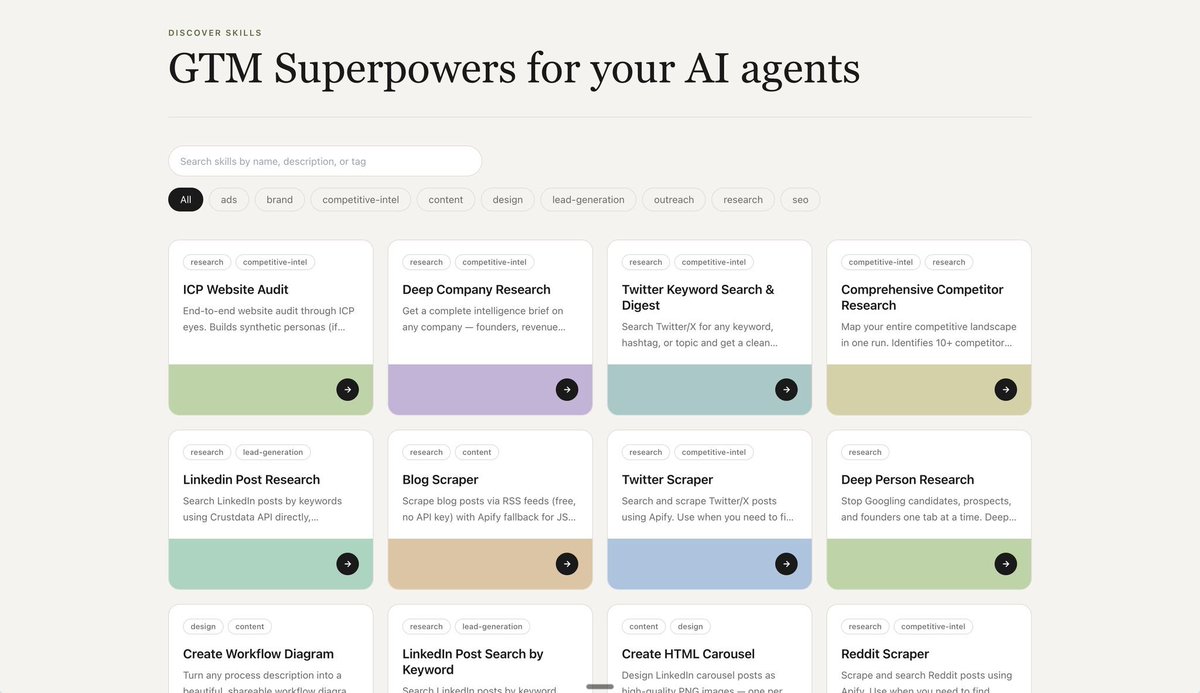
Over the last few months, we've been using Claude Code to do practically all our GTM execution work.
Not just coding. Everything.
Running outbound campaigns, finding high-intent leads and candidates, creating SEO pages, running marketing campaigns, managing my CRM, even finding apartments.
Claude can truly do anything you need. It just needs the right setup + skills.
So we created a library of skills that teach Claude how to do GTM work. Things like:
- Scraping reddit for your ICP's pain points
- Monitoring your competitors posts across all social channels
- Finding leads from comments on LinkedIn posts
- Enriching & qualifying leads
- Scraping reviews
- Creating slides & graphics
- Auditing your SEO / content strategy
It's completely free and has over 50 skills specifically designed for GTM skills.
Link + OSS below 👇
@harshilmathur@openclaw sounds like a very cool use case Harshil, but i think you should be a bit more careful with this.
i ran the skill through our skill-check tool and it flagged quite a few security issues that are oversights but can be established attack paths
https://t.co/A0SIsHns8v
As a developer - model context or agent memory is no longer the bottleneck for 100x productivity, the main bottleneck I believe is the context of your brain as a human being.
How many worktrees can you simultaneously work on in claude-code/codex, where you actually read, understand, research, plan and approve code - without letting the agents go on without supervision?
It's not a matter of attention, it's the question of how big is your brain's context window to simultaneously handle frequent switches between different code blocks belonging to different features/bugs.
These are wild times indeed.
(5) Built on XLM-RoBERTa, CREST is parameter-efficient and ready for real-time agents and on-device moderation where latency budgets are strict.
In conclusion, multilingual safety doesn't need billions of parameters; it needs smart linguistic transfer.
(4) Our analysis shows that high-resource languages (e.g., Hindi) provide much stronger safety transfer to neighbors than low-resource languages (e.g., Sindhi) do. 📊
(3) Zero-Shot Generalization: The real breakthrough? CREST’s zero-shot performance on unseen low-resource languages (like Pashto or Galician) is nearly identical to languages it was trained on. 🤯
(2) CREST supports 100 languages, runs 10× faster than existing LLM guardrails, and trains using data from only 13 languages.
Instead of fine-tuning for every language, CREST uses "cluster-guided” transfer through 8 linguistic clusters using shared language embeddings.
(1) AI Safety has a blind spot: guardrails don't generalize globally. A harmful prompt blocked in English often slips through in low-resource languages like Javanese or Pashto.🌍
Existing guardrails are built and evaluated mostly on English or a set of high-resource languages.
🚀 New Research: CREST (CRoss-lingual Efficient Safety Transfer) - a Universal AI Safety Guardrail for 100 languages.
Scaling AI Safety Efficiently with "Cluster-Guided" Cross-lingual Transfer.
📄 Paper: https://t.co/OQTV3RLt1r
🤗 Model: https://t.co/Bjk0e832Xo
See Thread 🧵
getting some great applications for fullstack FT+intern roles. thanks to everyone who shared in their network.
aggressive hiring on at Repello. shoot your shot.
note - we are also hiring for growth and marketing roles (interns + FT). dms open if you wanna help me and @aryamanTitan hype up the work we do at world's hottest ai sec startup.
Teaching a new course @Stanford this quarter on explainable AI, motivated by neuroscience. I have curated a paper list 4 pages long (link in comment). What are your favorite papers on explainable AI/mechanistic interpretability that I am missing? Please comment or DM. thanks!
Yes.
Writing is not a second thing that happens after thinking. The act of writing is an act of thinking. Writing *is* thinking.
Students, academics, and anyone else who outsources their writing to LLMs will find their screens full of words and their minds emptied of thought.