Advocating for Law/Legal Reforms & implementing change in legal & legislative system. At #LawReforms we aim on enhancing justice & delivering just society..
Marianne Bachmeier’s story forces us to confront a painful feminist question:
what happens when institutions fail women and children so profoundly that a grieving mother stops trusting the system to protect them?
Her act was not a model for justice but neither should society ignore the conditions that make vengeance feel like the only remaining language of justice.
A civilised society does not ask mothers to become warriors after their children are harmed.
It builds institutions strong enough to protect the vulnerable, hold perpetrators accountable, and make justice possible without revenge.
جن لائٹوں کے آگے ڈرائیور حضرات خود ایک منٹ نہیں کھڑے ہوسکتے، وہی لائٹیں یہ دوسروں کی آنکھوں میں مار کر اندھا کررہے ہوتے ہیں..!
سبق سکھانے کا اچھا طریقہ ہے ویسے 🔥
Case Law;
Marianne Bachmeier was the West German mother who shot and killed Klaus Grabowski in a Lübeck courtroom on March 6, 1981, during his trial for the rape and murder of her seven-year-old daughter, Anna.
The Case and Shooting
•Marianne Bachmeier: A single mother from West Germany who smuggled a .22-caliber Beretta pistol into the District Court of Lübeck on the third day of the trial.
•Klaus Grabowski: A 35-year-old butcher and repeat sex offender who confessed to abducting and strangling Anna, but falsely claimed the seven-year-old had tried to seduce and blackmail him.
•The Act: Bachmeier stepped behind Grabowski, raised the gun, and fired eight shots in quick succession, striking him seven times and killing him instantly on the courtroom floor.
Trial and Aftermath
•The Verdict: Bachmeier was put on trial for the killing and convicted of manslaughter and unlawful possession of a firearm in March 1983, receiving a six-year prison sentence.
•Release: Facing massive public sympathy and media debate over whether her act was justice or vigilantism, she served three years before being released on probation.
•Later Life: She later moved abroad to Nigeria and Sicily, worked in a hospital, and returned to Germany after being diagnosed with pancreatic cancer. She died on September 17, 1996, at age 46, and was buried next to Anna in Lübeck.
Reference(S):
Adrian Langenscheid, Benjamin Rickert & Stefanie Löschmann, True Crime Deutschland 3 Wahre Verbrechen – Echte Kriminalfälle: Ein erschütterndes Portrait menschlicher Abgründe (BoD – Books on Demand 2022), ISBN 978-3-7546-5920-5.
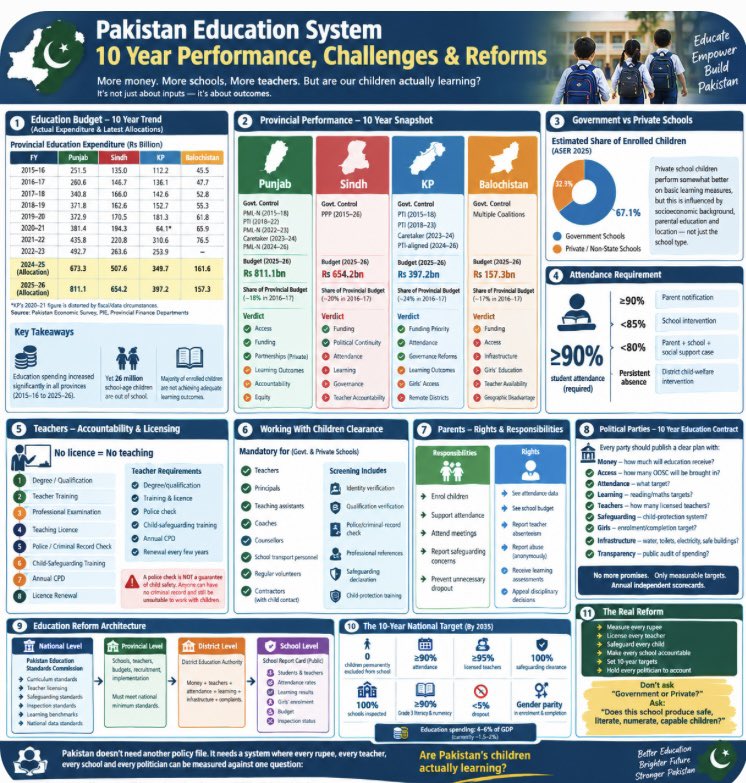
Pakistan Education Reform.
Pakistan's education crisis isn't just about money-it's about outcomes & accountability.
26m+ children remain out of school, while billions are allocated every year.
Government or private: every school must meet the same standards.
90%+ student attendance | licensed teachers | child-safety & police checks | teacher accountability | independent inspections | transparent per-child funding | parent responsibility | annual political scorecards.
Measure what every child can actually READ, WRITE & CALCULATE.
By 2035, Pakistan should aim for:
ZERO children permanently excluded from school
≥90% attendance
≥95% licensed teachers
100% safeguarding clearance
100% schools independently inspected
≥90% Grade 3 basic literacy/numeracy
<5% dropout
gender parity in enrolment and completion
education spending approaching 4-6% of GDP
Pakistan's education spending has generally remained around 1.5-2% of GDP, well below the commonly cited 4-6% international benchmark.
UNESCO UIS
But more money must be conditional on better accountability.
#Pakistan #Education #EducationReform
#Accountability #ChildProtection
A simple formula for genuine decentralization:
Power + Money + Responsibility + Accountability = Effective Decentralisation
Creating a new district, division or province alone won’t fix governance.
If budgets and decision-making remain centralized, it’s simply another layer of government.
We must also abolish dynasty politics and patronage.
Public office should be earned through merit, competence and accountability not family name or political inheritance.
Power must reach elected local councils and capable people must be empowered to use it.
#DevolutionOfPoweIsMust
New districts, divisions or provinces won’t automatically improve governance.
If power, budgets and decisions remain centralized, you’ve only added another layer of government.
End dynasty politics and patronage. Public office must be based on merit,
competence and accountability not family names or political inheritance.
Devolve power to elected local councils and empower capable people to deliver.
My article published in Dawn in 2025 emphasised that “Honour” crimes #femicide should be declared crimes against the #state. When the family does not pursue the case, the state must pursue it till justice is done. Along with #legal amendments and effective implementation of the laws, a strong police and community-level mechanism of #prevention of the crime must be developed and enforced. Institutions responsible for protecting #women and providing justice can themselves be discriminatory and have biased #gender representation.
Killing women - Newspaper - https://t.co/3nFEzxXXXx https://t.co/qTTRLNUUnU
Punjab’s atrocious Anti-Terrorism (Amendment) Bill, 2026, passed by the assembly yesterday, has effectively abolished the right to a fair trial in all cases and “class of cases” that a BS-20 officer nominated by the Govt considers “special security” cases
Yet another example of our assemblies making a complete mockery of fundamental rights in the name of “security” and “extraordinary circumstances”
Police cannot stop you from recording on your phone for your own safety.
Judge reprimands the lawyer for defending the police who tried to stop a citizen from recording.
Supreme Court should declare the Right to Record Public Officials in Public Space as a Fundamental Right.
A cashier at Dollar General with diabetes drank a $1.69 orange juice during a low blood sugar emergency, paid for it immediately after, and was later fired for violating company policy. A federal jury ruled it was disability discrimination and awarded her more than $277,000.
تاریخ ہمیشہ جسٹس قاضی فائز عیسی کا نام سنہری حروف میں لکھے گی کیونکہ پاکستان کی تاریخ میں واحد جج اور واحد چیف جسٹس قاضی فائز عیسی ہی آئے ہیں جنہوں نے سیاسی اور غیر سیاسی دبائو کو جوتے کی نوک پر رکھتے ہوئے دلیری کے ساتھ 100 فیصد آئین و قانون کے مطابق فیصلے دیئے، ایسی بزدلی بھی نہیں دکھائی کہ اہم مقدمات کو التواء میں ڈال کر فائلیں دبا دیں اور ثاقب نثار اور کھوسہ وغیرہ کی طرح بطور ٹائوٹ جج کام کرنے سے انکار کیا۔
دلیری اور آئین و قانون کی بالادستی ہی جسٹس قاضی فائز عیسی کا فخر ہے۔
Justice (Rtd) Athar Minallah’s lengthy article in Dawn asking why there is no lawyers’ movement today suffers from a glaring omission: he never explains why the 2007–09 movement received wall-to-wall live television coverage in the first place.
Movements do not magically dominate every television screen in Pakistan. Someone opens those doors, and someone decides what gets amplified and what gets ignored.
The mythology surrounding the lawyers’ movement has long outlived the facts. It is routinely presented as a spontaneous democratic uprising that shook an authoritarian regime. The reality was far less romantic. The movement gained traction because it coincided with a split within the establishment itself. As I argued years ago, powerful actors within the system had fallen out with one another, and the movement became a convenient vehicle in that larger struggle. Without that establishment divide, it is doubtful that it would ever have acquired the momentum, protection, and saturation coverage that it enjoyed.
The canonisation of Iftikhar Chaudhry is perhaps the most absurd part of this revisionist history. He was not some lifelong dissident courageously standing up to power. His meteoric rise from a provincial judge to Chief Justice of Pakistan was facilitated by the very power centres that later became his adversaries. He was widely seen as a beneficiary of the system, not its victim. To retrospectively transform him into a democratic icon requires a level of historical amnesia that borders on fiction.
Justice Minallah is also curiously silent about his own role in that period. He served as a minister under General Musharraf’s regime. Yet his article reads as though the events of that era can be discussed without acknowledging the intricate web of establishment patronage, elite rivalries, and institutional manoeuvring that shaped them.
The real question is not why there is no lawyers’ movement today. The real question is why so many continue to cling to a sanitised and self-congratulatory narrative about the last one. Genuine grassroots movements arise from sustained public mobilisation and collective conviction. They do not require establishment blessings, elite sponsorship, or round-the-clock media promotion to survive.
Pakistan’s tragedy is that too many of its political dramas are later repackaged as democratic epics. The lawyers’ movement has become one such sacred cow.
Questioning its origins is treated as heresy, even though the evidence points to a far more complicated and far less noble reality. History deserves honesty, not mythology. Until we abandon these convenient myths, we will continue to misread our past and misunderstand our present.
@dawn_com@abbasz55
https://t.co/339BNd3sF2