Hey new frens 👋 Welcome aboard!
Here I post about #crypto, #Web3, #DePIN, #space, #travel & #photography 🚀🌌📸
Your turn 👉 Drop a quick comment, tell me who you are & what you’re into.
Let’s connect! ✨
A strange phenomenon in the sky, the nature of which, of course, is well known to us.
These are so-called "cosmic jellyfish", which occur during the launch of space rockets under certain conditions. When taking off, the rocket leaves behind exhaust gases and a condensation trail. In this case, we see the launch of the Falcon 9 rocket: during its operation, mainly water vapor and carbon dioxide are emitted.
This effect is not always visible. The launch took place 52 minutes before sunrise, and the Sun was not yet illuminating the shooting location, but the trail from the rocket was high enough to be already lit by the sun, which is why it shines so brightly. Therefore, such an effect is possible either shortly before sunrise or shortly after sunset.
Interestingly, in the photo, it seems that the rocket is flying "downward". In fact, it simply follows the curvature of the Earth. Rockets take off vertically to quickly rise above the dense layers of the atmosphere, but it's not just about gaining altitude, but also about reaching orbit, which requires sufficient horizontal speed. In other words, the task is not just to "rise as high as possible", but to make the rocket fly fast enough and, when "falling", always miss the Earth - that is, to be in orbit.
Interestingly, conspiracy theorists use this maneuver of the rocket's turn as an argument in favor of the claim that rockets supposedly do not fly into space. They say: "Look, it didn't fly up, but somewhere beyond the horizon".
Photo: Michael Seeley
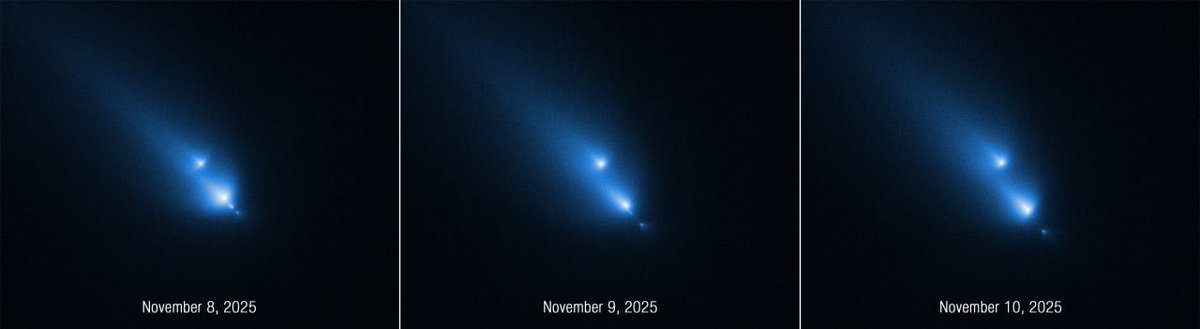
The comet broke apart!
Astronomers pointed the Hubble telescope at the comet C/2025 K1 (ATLAS) and saw that its nucleus had split into at least four parts. Comet nuclei can break down under the influence of thermal, gravitational, and dynamic loads as they approach the Sun.
Hubble observed the comet after its closest approach to the Sun, about a month later.
For the first time, Hubble captured a comet breaking apart so soon after it began to disintegrate into pieces. The noticeable split did not occur immediately during the closest flyby. It likely happened just a few days before the observations.
The Japanese cargo ship HTV-X1
In this shot, we see the Japanese ship docked to the Harmony module of the #InternationalSpaceStation. Also visible in the frame is part of the #Canadarm2 robotic arm. After the photo was taken, the arm disconnected the #HTVX1 from the Earth-facing docking port and moved it to a temporary parking position.
Then, #Japanese #missioncontrol specialists are planning to conduct demonstration tests of the sensors on the HTV-X1 while it is still being held by the Canadarm2 #manipulator. After that, the Canadarm2 will release the device into Earth's #orbit, where it will conduct scientific experiments for another three months at a safe distance from the #orbital #station.
The photo was taken with a long exposure, which is why both the city lights on #Earth and the #stars have stretched into trails. In the distance above Earth, horizontal stripes from #satellites (most likely #Starlink) are visible.
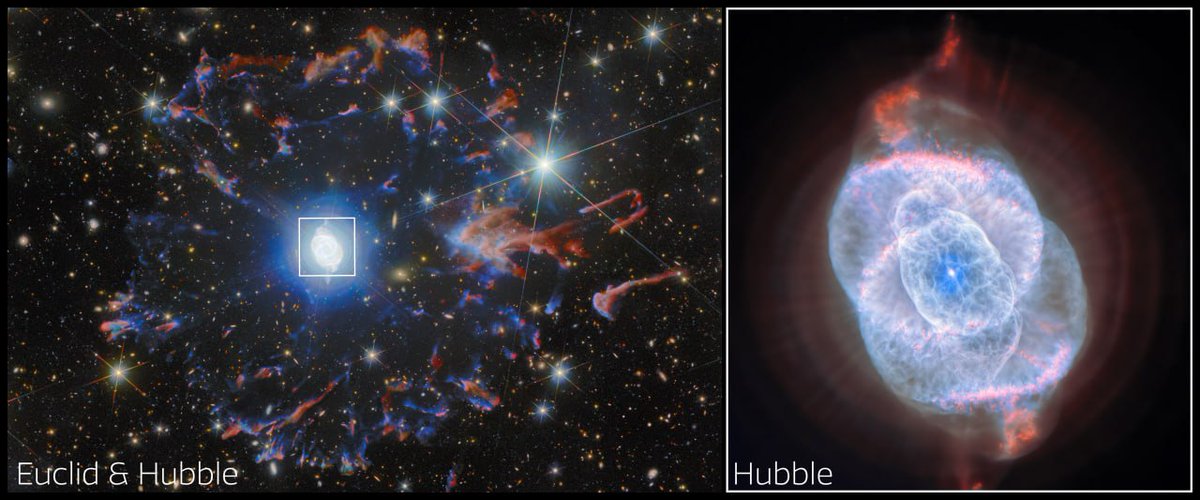
We've never seen it like this before!
A new image of the #CatsEye planetary nebula (NGC 6543). Previously, we saw it in an image obtained by the #Hubble telescope (on the right), and now the Euclid telescope has captured a photo of this nebula, but with a wider field of view. On the left, we see the combined observations of the two #telescopes.
The new data show concentric shells, #jets of high-speed gas, and denser knots formed by shock waves. It is believed that these structures record episodic mass ejections from the dying #star at the center of the #nebula, creating a kind of cosmic "fossil record" of its final stages of evolution.
Few people on #Earth saw the annular #solareclipse on February 17 in its full phase, because it was mainly visible in #Antarctica. However, the Proba-2 #satellite managed to photograph it from #space.
A galactic dwarf and distant galaxies
In this stunning image obtained by the #JamesWebbTelescope (using the NIRCam instrument), we see a part of the dwarf galaxy Leo P. These are blue stars in the lower right corner. There are a large number of young massive stars - they are blue in color, and such stars are very bright, so they are easier to see.
At the bottom of the frame, closer to the center, among the blue #stars, we can see a "bubble". This is a region of ionized hydrogen that surrounds a massive O-type #star.
Leo P #galaxy is more than 5 million light years away, and in the background we can see many more distant galaxies.
The green light in this photo of #Earth from space is from fishing boats along the western coast of #India. Green light is used to attract squid, shrimp, sardines, and mackerel. The photo was taken from the #InternationalSpaceStation. The Earth's own glow can be seen above it.
The #stars are visible here because only the night side of the planet is in the frame. Unlike the day side, it is dim enough that some stars can be seen in the same frame as the Earth.
A cosmic coincidence!
In this image, obtained by the #JamesWebb telescope, we see the #HerbigHaro object 49/50 - a structure that forms when the ejected matter of a #protostar interacts with slower matter ejected earlier.
The edge of the structure formed by the forming star coincides with a #spiralgalaxy located much further away. The Herbig–Haro object 49/50 is located within our #galaxy
The dark rings of an unusual galaxy
This is the galaxy NGC 7722. It belongs to the type of lenticular #galaxies, which are intermediate between spiral and #ellipticalgalaxies. They have a large spherical part of old #stars, like elliptical galaxies, but also a disc-like, flatter part, like #spiralgalaxies. However, they lack pronounced spiral arms.
In the disc-like part of this #galaxy, we see dark concentric rings of #dust, as well as extensive dark stripes in the outer regions. These are likely the traces of a past galaxy merger.
This new image was obtained by the #Hubble telescope.
Nebulae over the mountains!
A cool #landscape#astrophotography with several deep-sky objects in the frame. The Orion #constellation is in the frame. Below and to the right of the three stars of #OrionsBelt is the bright #OrionNebula. To the right of the nebula is the bright star #Rigel, and diagonally up and to the right of it is the grey Witch's Head Nebula. The huge arch in the left part of #Orion is the Barnard's Loop emission #nebula. The bright orange star is, of course, #Betelgeuse. And to the left and below Betelgeuse is the #RosetteNebula.
Author: Włodzimierz Bubak
Torres del Paine, Chile 📷 Those jagged granite needles are the Paine massif — the kind of skyline that makes your brain do a double-take because it looks too sharp to be real 📷📷.
Patagonia does not do “gentle”: the weather flips fast, the wind edits your plans, and the light can go from soft to dramatic in minutes 📷📷. If you want a place that feels like the edge of the map (but with trails that actually get you close), this is the one 📷📷.
📷: Photography by Daniel Dawn
We've never seen it like this before!
A new image of the Snail Nebula (NGC 7293) with incredible detail, captured by the #JamesWebb telescope. Here we see part of one of the closest planetary #nebulae to us - material ejected by a dying star, similar to our Sun.
In the image obtained by the near-infrared camera NIRCam, pillars, similar to comets with long tails, outline the border of the inner region of the expanding gas shell. Here, the heated winds of hot gas from the dying #star collide with the cooler shells of dust and gas that were ejected earlier in its life, forming the amazing structure of the nebula. This happens when lighter and faster-moving matter pushes into heavier and slower-moving matter, just like oil trying to push through water.