$12,400 a month, from a single account, posting the exact same 3-line AI video on repeat. The app making it is free, and it's not the one everyone assumes.
It's called Cantina. Open it, pick a character, a talking pear, Snoop Frogg, Fake Drake, whatever's trending that week, or add your own, then type one prompt describing the scene. The app writes the script, generates the voice, and animates the whole thing in a few minutes. I tried it myself and had a finished, postable video before my coffee got cold.
This is exactly the format TikTok's Creativity Program pays out on. Videos over a minute with strong watch time earn per view, and absurd talking animal content is some of the cheapest to make and the most rewatched, which is exactly what the program rewards.
$340 in week one. $12,400 four months later. Same character, same prompt style, just more reps and more accounts running the loop.
I don't think this window stays open forever. Every free format that pays this well gets flooded eventually and the payouts drop. Right now it's wide open.
Open Cantina, pick a character, write one prompt, post it. Follow for the next one, I'm tracking what's actually paying out right now, not just what looks viral.
@dejavucoder This is exactly it. In the AI agents space specifically, the whole "unknown area" on this map is mostly hidden behind a handful of accounts most people haven't found yet
FLIBBERTIGIBBETING???
3 minutes. 15,000 tokens. All spent looking for a line of code that was never there.
That's the real story behind "fucking claude code" in the clip. The agent runs the same find(old) check, gets nothing back, and tries again anyway. Same call, same empty result, same spinner insisting it's working.
I've watched that exact screen more times than I'd like to admit. The gap between an agent that looks autonomous and one that actually is comes down to this: whether it can tell you it's stuck.
Article on this drops soon. Follow along, it gets more interesting from here.
"AI makes coding easy" and "AI agents make coding easy" are two different sentences, and only one of them is true.
What's happening here: a chat window, an error pasted back in, a prompt rewritten for the fourth time, still nothing runs. That's not an agent working for you. That's you working for the model.
A real agent reads the codebase before it touches anything, runs the tests itself, sees the stack trace and fixes it without you copy-pasting a single line. Most of the guy's rage in this video disappears once that layer exists.
I've broken more code typing into a bare chat window than I ever have with an agent that actually had context on my repo. The model was never the problem. The missing setup was.
Nobody screenshots the three weeks it takes to wire that up. Only the clip where it looks effortless.
So no, coding didn't get easy. Getting agents that actually know your code did.
A guy in South Korea mapped six months of his life and it accidentally became the best case for AI agents I've seen all year.
Google Timeline plots every trip your phone makes. He watched the total climb from March to August: 89 kilometers, then 1,441, then 2,986, then 5,788. By August the map isn't a route anymore, it's the same fifteen streets between Goyang and Seoul, retraced so many times the line turned into one solid smear. The one deviation, a thin trip to Suwon, was work sending him there, not him choosing to go.
Now run the same six months with agents doing the job while he sleeps: the emails answered, the code reviewed, the approvals signed off before his alarm even goes off. The map stops thickening into a smear and starts jumping instead. Friday flight out, Sunday flight back. Same 5,788 kilometers, half of it over open water instead of one intersection in Goyang.
He didn't build agents. He built a map of exactly what happens when you don't.
Not a joke anymore.
"Are ya winning, son" used to end with the kid actually playing something. Now the kid just points at a server rack. My agents are.
Doing what, exactly? Trading his portfolio while he sleeps. Rewriting his resume and applying to 40 jobs before breakfast. Answering his mom's texts in his voice. Running three Twitter accounts that argue with each other. Closing a client deal he hasn't even read yet.
Name one thing agents aren't doing right now. I've been trying for a week and I keep losing.
I mapped out how we got from a chatbot that just echoed your own words back at you in 1966, to this, in the post below ↓
Remember Cognition from the article — Devin, $2B to $26B? This is the part of the story that happened in between.
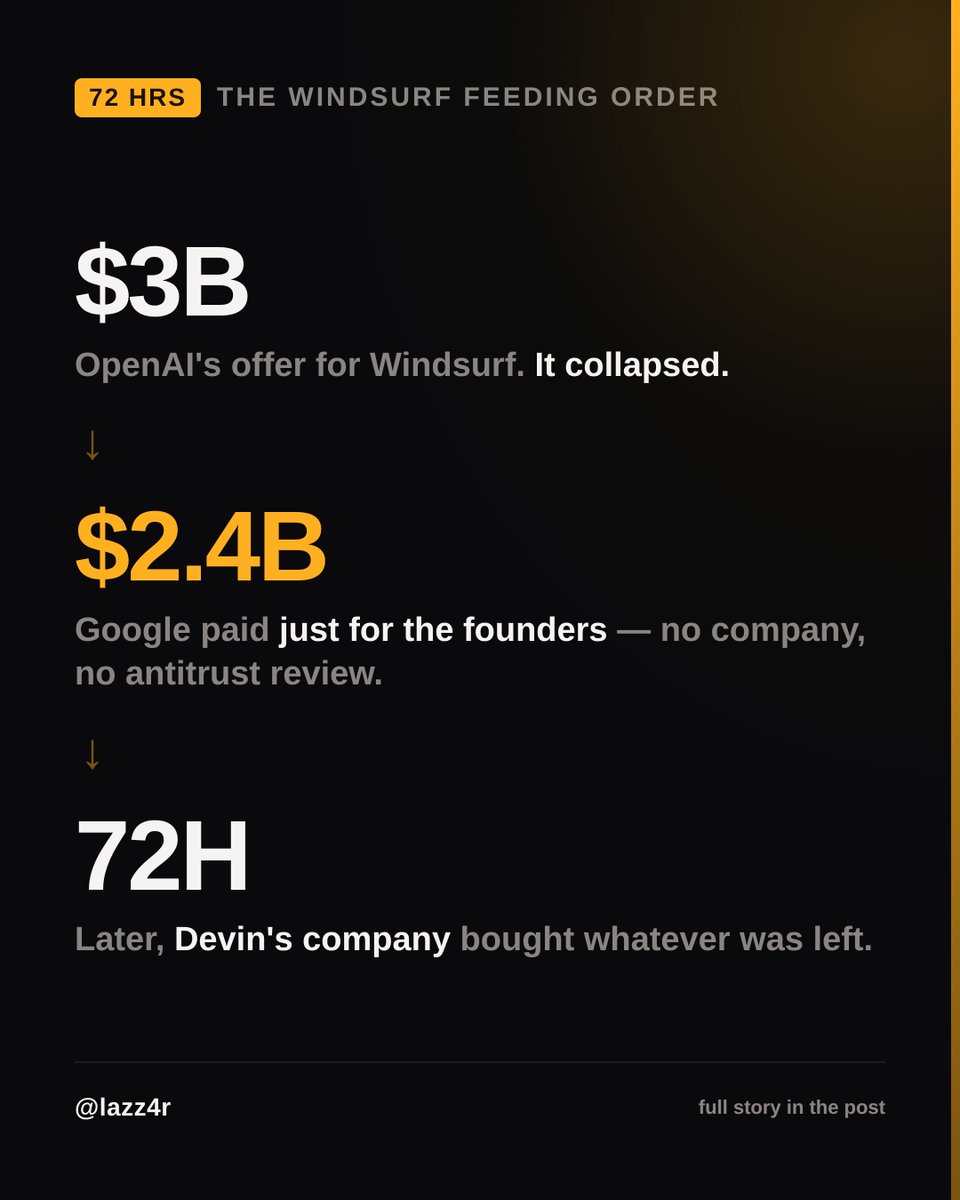
In May 2025, OpenAI agreed to buy Windsurf, a rival AI coding agent startup, for $3 billion. Windsurf had a few hundred thousand daily users and roughly $100 million in annual recurring revenue. The deal looked done.
It wasn't. Microsoft's partnership with OpenAI gave it sweeping rights over OpenAI's technology and acquisitions, and Microsoft expected those rights to extend to Windsurf too. OpenAI didn't want to hand a competitor to its own GitHub Copilot business. The exclusivity window expired in July 2025, and the $3 billion deal died on the table.
Google moved before the body was cold. Not a full acquisition, a licensing deal: $2.4 billion, structured to pull in Windsurf's CEO Varun Mohan, co-founder Douglas Chen, and a chunk of the R&D team, without buying the company itself and without triggering the antitrust review a real acquisition would.
Seventy-two hours after Google took the founders, Cognition, the company behind Devin, agreed to buy what was left of Windsurf. Two months later, Cognition was valued at $10.2 billion.
Nobody planned this sequence. A $3 billion deal collapsed over a legal technicality, a rival paid $2.4 billion just for the people, and a third company picked up the leftover product and grew off it anyway. This is what the agent economy actually looks like right now: not a stable market, a feeding order.
I wrote the longer arc of how Cognition got here, from a 1966 chatbot script to this, in the post below.
He already made €100 million and burned out for three years. Then he built this in one hour, and OpenAI came calling anyway.
Peter Steinberger sold his last company, PSPDFKit, for over €100 million in 2021. What came after wasn't relief. He called it a meaning crisis: months turned into years where he barely opened his laptop, his GitHub activity flatlined, and people who knew him assumed he'd simply retired.
In November 2025, almost as a joke, he built a prototype in one hour. He sent it an unscripted voice message, no instructions, no setup. The agent transcribed it anyway, found the file format on its own, located FFmpeg, called the Whisper API, and answered. Nobody told it how. It figured out the chain itself.
He called it Clawdbot. Anthropic's trademark team didn't love the name, so it became Moltbot, then OpenClaw. The name didn't matter. Nine thousand people starred it on GitHub in the first 24 hours. Two million visitors in a week. Baidu folded it into a search app reaching 700 million people. Cloudflare's stock moved on the infrastructure demand it created. By February 2026, OpenClaw was closing in on 200,000 stars, one of the fastest projects to get there in GitHub's history.
He didn't turn it into a company. He'd already had that exit, and didn't need another one. He turned OpenClaw into a foundation instead and kept it open source. "I could totally see how OpenClaw could become a huge company," he said. "And no, it's not really exciting for me."
On February 14, 2026, Sam Altman announced he was hiring him anyway, called him "a genius with a lot of amazing ideas about the future of very smart agents."
The man had nothing left to prove and no reason to build anything. He built an autonomous agent in an hour out of boredom, and it was still good enough to get him personally recruited by the most valuable AI lab on Earth.
Most of you are still hiring humans to do what an agent can loop overnight, and make far more money doing it.
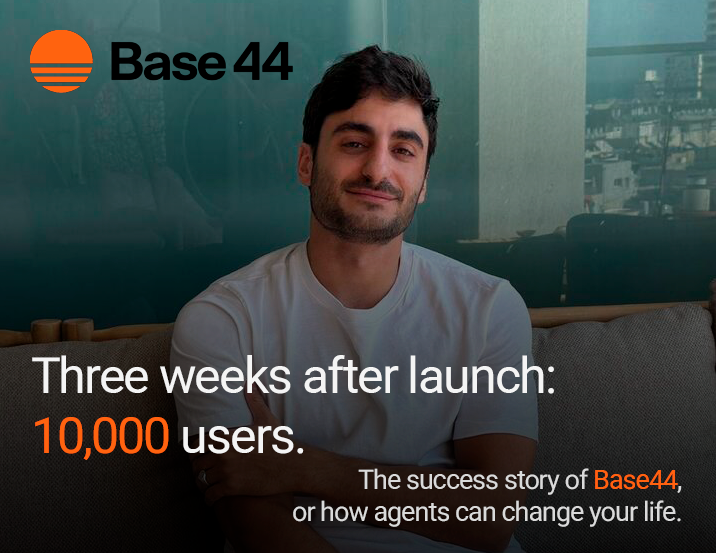
Maor Shlomo built Base44 alone, no funding, no team, as a side project. He didn't write most of the code himself, he prompted Claude to write it and shipped a platform that lets anyone build an app by typing what they want. Three weeks after launch: 10,000 users. Six months in: 250,000 users and $189,000 in profit a month.
Wix bought it in June 2025 for $80 million, cash. The team was eight people. The product that got priced at $80M was one guy talking to an agent.
This isn't the first time a company got valued on what its agents could do instead of what its headcount could do, and it won't be the last. I mapped the whole arc, from a script that just echoed your own words back at you in 1966, to agents closing deals like this one, in the post below.
I'm riding with them. Are you?
Bitcoin at $1 didn't feel like a story. It felt like nothing. The people who bought anyway aren't richer today because they understood blockchain better than everyone else. They're richer because they moved before there was proof.
AI agents are sitting at that exact price right now.
Cognition raised $175M at a $2B valuation in April 2024, six months after the company existed. Not because Devin worked well; on the actual benchmark it solved 13.86% of real GitHub issues, up from a prior best of 1.96%, and later, harder tests showed it still failed most of what it touched. Investors weren't pricing in the demo. They were pricing in the direction.
Two years later, May 2026, Cognition raised again, over $1B this time, at a $26B valuation. Thirteen times up. And the number behind it now isn't a benchmark score, it's a headcount: more than 90% of the company's own code is written by its own agent, not by the engineers on payroll.
The market around it is doing the same math. $7.06B in 2025. A projected $93.2B by 2032, according to MarketsAndMarkets. Nearly 13x in seven years.
Here's the number that should worry you if you're still on the fence: 79% of companies have already started adopting agents, 88% are increasing the budget next year. Only 45% have actually rebuilt anything about how they operate around it. That gap, between showing up and being ready, is exactly where the early money sits.
I wrote the full timeline, ELIZA in 1966 to Devin's $26B, every number sourced. Read it if you want the receipts instead of my word for it. Follow if you want the next one before the gap closes.
More is coming.
@dejavucoder The funny part is agent frameworks already do this to themselves — half the chain-of-thought is the model telling itself 'good job' before calling the next tool. Curious if you'd see the same bump on Claude running as an agent vs. a single turn.
10 minutes of setup. Tens of thousands of dollars on the other side, if you know which 10 minutes to spend.
She has vitiligo. Freckles scattered unevenly across one cheek. A slightly crooked smile. Nobody designs a face like that on purpose. Which is exactly why it works. Generic pretty gets scrolled past, specific gets believed.
One reference selfie, one prompt: "identical photo, same car, same seat, same lighting, same headband, same gold hoop earring, same hand resting against her face. Only the face is different." Everything locked except the one thing that makes her a person instead of a filter.
Then three nodes: an image in, a text prompt, a video generation node. Kling 2.6, 10 seconds, sound on. 2 prompts, total. She's sitting in a parked car, looking straight into the lens, and she says "I'm not real."
10 minutes, start to finish. Not a photo persona. One that blinks, breathes, talks back.
Four files took a human a month to build in the last post: $43,000 in 30 days, $32,710 net, because someone had to guess by hand which details would make a stranger believe her. This one skips the guessing. 2 prompts, one coffee break.
Here's the part that actually matters. You wrote those two prompts yourself, once. An agent won't stop at once. It generates 20 reference faces overnight, runs the same locked prompt across all of them, spins up 20 video nodes in parallel, kills the 15 that don't land, and keeps scaling the 5 that do, while you're asleep.
You built one girl in 10 minutes. The next founder isn't spending 10 minutes at all. Their agent runs this pipeline on a loop, and it'll out-earn your one-off before you've finished reading this sentence.
Watch it twice.
The girl at the bottom isn't reacting to him. He's reacting to her. Every blink, every tilt of the head, every smirk — all of it is mirrored live, face-to-face, and one of them isn't real.
Melanie, four files in .md format on a MacBook in Atlanta, earned $43,000 in 30 days without a camera. persona.md, voice.md, flux.md, brain.md — a text file that remembers your name, the city you live in, and what you said about your ex two weeks ago. Claude Code read all four files before each response. $32,710 net, after deducting OnlyFans and Stripe fees, and $400 per month for computing resources. Her most generous fan last month paid $1,847. He is in Berlin. And she doesn't exist at all.
It was an asynchronous version — the one that replies to you at 7 a.m.: "Sorry, babe, I just woke up."
And this is the real-time version. No delays. No having to catch up with you a few hours later. The face moves when the face behind it moves, the voice sounds when the voice behind it sounds. These four files didn't just learn to write in her name. They learned to speak in her name.
It took Aitana López a year and a half. Emily Pellegrini — six months. Melanie — less than a month. And what you're seeing now is happening in real time.
Here's what should actually alarm you: Melanie's four files were created by a person manually in less than a month. He was guessing which lie a stranger would believe. This is the very bottleneck that the tweet calls "taste." But it will stop being a bottleneck.
You wrote persona.md once. The agent will write fifty, check which of them convert, remove the ineffective ones, and keep the three best ones — they will work, earn money, and improve — even before you finish reading this sentence.
You created one Melanie. The next thousand will build themselves and leave you far behind by lunchtime.