New paper! In work led by Cristiano Longarini @lcris96 during his Stony Brook / @FlatironCCA visit, we explore a novel possible mechanism for planetary core formation: particle collapse in self-gravitating disks where the gas is stable to fragmentation.
https://t.co/tfdIRJmW7x
1/4 Fabulous week hosting the 4th phantom and MCFOST users workshop at @Monash_Science@MonashAstro in conjunction with @MonashWarwick. A great week of collaboration and science!
New paper! In work led by Cristiano Longarini @lcris96 we explore analytic aspects of gravitational instability in 2-component disks of gas and dust. Part of broader efforts to see if the Class O/I YSO environment is favorable for early planet formation.
https://t.co/JLgadAQrxX
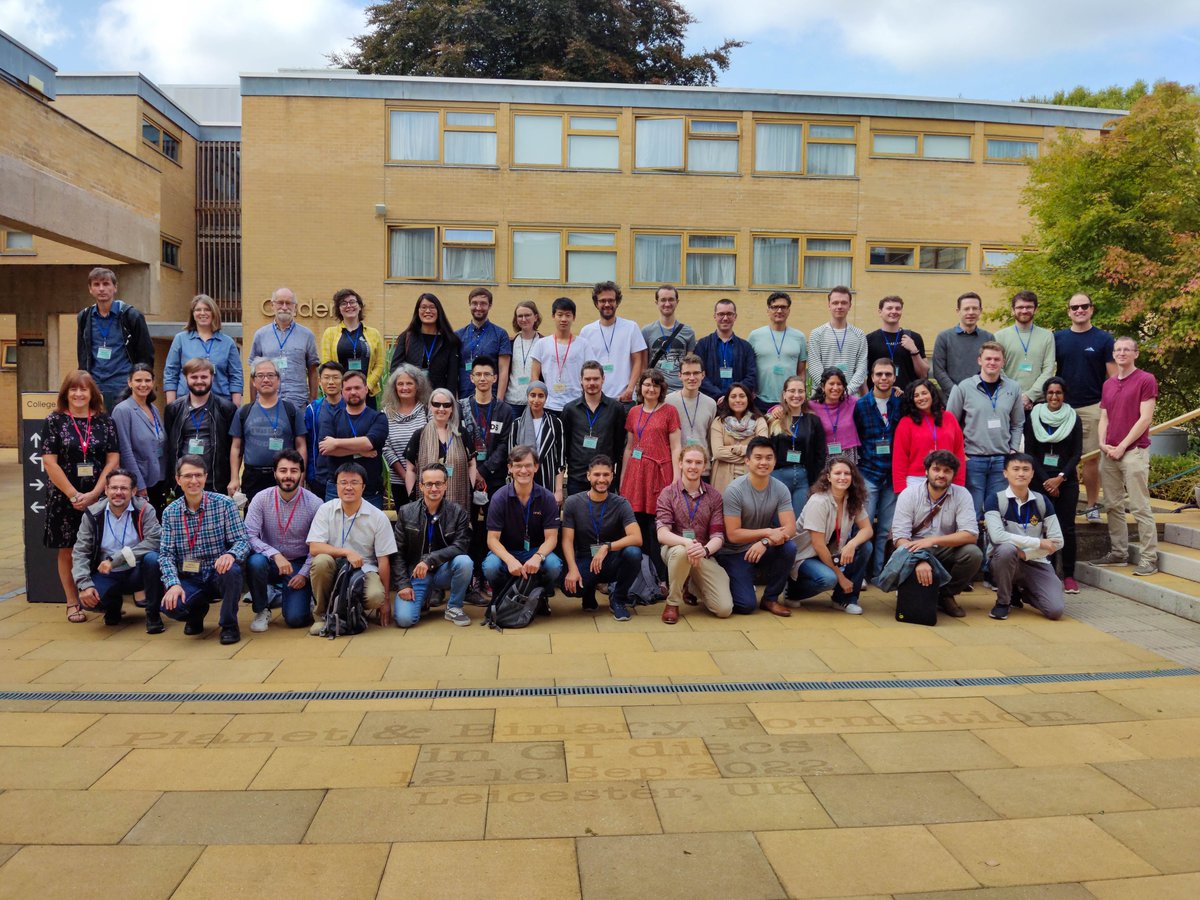
Conference photo from a fantastic meeting last week in Leicester.
A perfect size of meeting in my opinion. Lots of friends/colleagues new and old and lots of new ideas too
https://t.co/DpdMWISAaE
Other super guests in Arcetri! This week we have Leonardo Testi leading a team of PhD students (UniMi & ESO). Brainstorming on protoplanetary disks!!
Amazing paper of my amazing friend @alicesomigliana ! Are you interested in populations of protoplanetary discs? You must have a look at it! 😍 https://t.co/oClSC3zjPG
Could a giant planet be shaping the protoplanetary disc of CIDA 1? If this question sparks your interest, don’t miss @PietroCurone’s new paper: https://t.co/r4wGQmuHh2 🤩
Are you interested in triple systems? Check out the latest paper led by my colleague Simone Ceppi, @nomadastro and @DustbustersA ! Through (very cool) numerical simulations, they investigate accretion rates in triple systems! 🚀🚀 https://t.co/3npmtTSW1a
If you are interested in protoplanetary disc sizes measured with CO emissions, don't miss this new paper led by my university colleague @LaStatale and close friend, Alessia Rota, now PhD student @UniLeiden!
https://t.co/4m1W4IW4y8