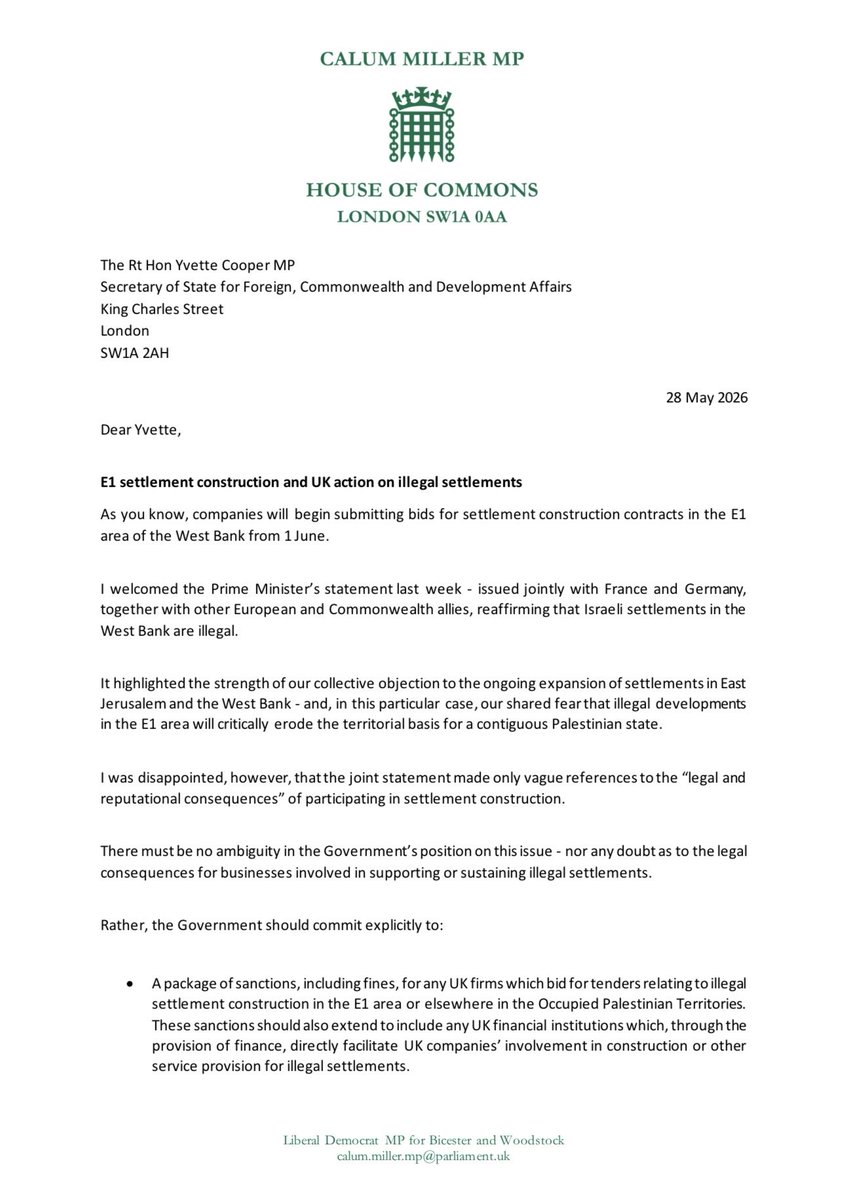
The UK was right to recognise the State of Palestine.
But recognition means little unless Ministers protect the territorial basis of that state.
With E1 tenders opening on 1 June, I’ve urged the Foreign Secretary to make clear UK firms must not aid illegal settlement expansion.
Learning from Jewish Diversity: Over the past few weeks, the fractures within Jewish, Israeli, Zionist, and pro‑Israel circles have been impossible to miss. Religious, political, ideological, organizational, and strategic divides have erupted into open accusations: some are “too extreme,” others “too soft on Israel’s critics,” “reckless,” “undiplomatic,” “not pro‑Israel enough,” “sabotaging the cause,” or even “endangering Jewish safety.” Whatever one thinks of these claims, the reality is clear: Jewish communities and Israeli society contain a wide spectrum of socio‑religious and political diversity.
Across that spectrum, there is space, sometimes narrow, sometimes wide, for people to express their unique identities, their Judaism, and their individual politics. The communal infrastructure is vast and enviable: JCCs, Federations, JCRCs, Hillel, Atid, AIPAC, Israel Policy Forum, J‑Street, JVP, the World Zionist Organization, ZOA, ICC, AJC, ADL, Birthright, and dozens more. Add to that the Reform, Conservative, and Orthodox movements, plus the full range of political organizations in both the U.S. and Israel. This is not a monolith; it is a sprawling ecosystem.
That is precisely why simplistic labels like “Zionist” obscure far more than they reveal. And it is why I often find myself wishing that Palestinian, Arab, and Muslim Americans had anything comparable. Instead, there are fewer than a handful of national organizations, political and student alike, that enforce near‑total conformity on the Israel and Palestine discourse, despite the fact that Palestinian, Arab, and Muslim Americans hold a wide range of views on Hamas, Gaza, Israel, peace, pragmatism, the U.S., and belonging.
One of my deepest frustrations with certain Jewish groups of a particular political orientation is the role they expect me to play as someone from Gaza. Consciously or not, some want me to perform the part of the Palestinian victim who reinforces their own narratives. They recoil when I speak about Palestinian failures, Hamas’s catastrophic impact on Gaza, or my efforts to build bridges with center‑right Jewish and Israeli audiences. To them, these points “distract” from the larger story of Israeli wrongdoing. And if my words are cited by conservative pro‑Israel voices, that becomes the ultimate offense: “tokenization,” even though anti‑Israel activists routinely cite these same groups when convenient.
The result has been predictable: invitations withdrawn, doors quietly closed, and participation discouraged. I failed to play the role they had scripted for me; a victim to be wielded in their internal communal battles. And for that, I was sidelined.
We need a New Path
For too long, Palestinian politics has remained trapped in managing crisis rather than building a credible national future. The Palestinian Authority was created as a transitional mechanism toward statehood, yet many Palestinians today increasingly feel that the transition itself has become permanent while the political horizon continues to disappear.
The growing discussion around succession inside the Palestinian leadership reflects a deeper structural problem: the absence of democratic legitimacy and national renewal. Palestinians do not simply need a change of names within the same closed political system. They need the restoration of public trust through elections, accountability, institutional reform, and genuine political participation.
This is not about individuals. It is not about Hussein al-Sheikh, Yasser Abbas, Majed Faraj, or others personally. The real issue is that the Palestinian national movement risks becoming disconnected from the very people it claims to represent. A national cause as important as Palestine cannot be reduced to internal arrangements decided behind closed doors while an entire generation remains excluded from political choice.
The Palestinian people deserve functioning institutions, democratic legitimacy, and leadership that derives its authority from the ballot box rather than political inheritance or managed succession. Without renewal, reform, and elections, the gap between the Palestinian public and its political system will only continue to widen.
The future of the Palestinian national project cannot be protected by preserving the status quo. It can only be rebuilt through legitimacy, participation, and the return of politics to the Palestinian people themselves.
גדי מוזס והיונים.
✨
גדי מוזס הפריח יוני שלום באירוע חג שבועות של ניר עוז. אחרי 482 ימים בשבי חמאס, ואמר לילדי ניר עוז ולחברים: "למרות הצער והכאב, אנחנו מאמינים בשלום".
✨
זה הרגיז מחפשי נקמה שתקפו אותו ברשתות. בעולם ציני שבו המילה שלום מעוררת פחד, קל לתת לכעס ולשנאה לנהל אותנו. וגדי יודע, כמו רבים אחרים, שנקמה לא תביא פתרון. היא רק תשאב אותנו לעוד מעגלי דמים. הכוח האמיתי הוא לשלוט בנקמה ולבחור בחיים, בשפיות ובסוף, גם בהסדרים ובשלום שיביאו שקט אמיתי.
✨
השבוע ראינו שר בממשלה, נקמני וכוחני, חוגג מעל פעילי משט כפותים, כשפניהם צמודות לרצפה. ואתמול ראינו את גדי מוזס מעיף יוני שלום אל השמיים, בניר עוז. חושך ואור.
✨
גדי אתה גיבור. לא רק בגלל ששרדת שבי, אלא בגלל שהלב שלך נשאר אנושי וגדול, כדי להראות לנו את הדרך הנכונה לעתיד טוב יותר. רק שתדע שאנחנו איתך.
*ניר עוז-אנחנו אתכם*
https://t.co/oshzi7rHSX
Eric Mandel @MepinOrg raises legitimate security concerns that cannot simply be dismissed. October 7 left deep trauma in Israeli society, and no serious Palestinian should underestimate the fear, anger, and distrust that followed. Hamas’s ideology, methods, and history make skepticism understandable.
But realism also requires recognizing another truth: wars rarely end because one side simply disappears. Armed movements are usually weakened and eventually transformed through a gradual political process that creates alternative institutions, incentives, legitimacy, and governance structures capable of replacing them.
My argument was never that #Hamas should be “accepted” as the future of #Gaza. Quite the opposite. The question is how Gaza eventually moves beyond Hamas rule in practice — not only in slogans. If Hamas is indeed showing willingness to relinquish governing authority to a broader Palestinian technocratic framework, even partially and imperfectly, that should be tested carefully, verified rigorously, and used to begin rebuilding an alternative center of gravity inside Gaza.
This is not naïve optimism. It is pragmatic statecraft.
No responsible person suggests blind trust, immediate Israeli withdrawal, or abandoning security oversight. Israel will continue requiring strong security guarantees and operational capabilities for the foreseeable future. But permanent war, permanent destruction, and permanent absence of political horizon will not produce moderation either. They risk producing exactly the opposite.
The real strategic battle is ultimately over who governs Palestinian society politically, institutionally, educationally, and economically in the years ahead. If credible Palestinian institutions fail to emerge, the vacuum will continue empowering extremists.
The choice is therefore not between idealism and realism. It is between managing a difficult transition intelligently — or remaining trapped indefinitely in a cycle where both Israelis and Palestinians continue paying the price.
Israel’s ambassador:
(1) Spits in the face of the many US Jews whose views align with J Street’s by calling them a “cancer”
(2) Argues that you can’t be pro-Israel and anti-Netanyahu’s gov, which is absurd on its face and strategically stupid considering how loathed he is
1/3
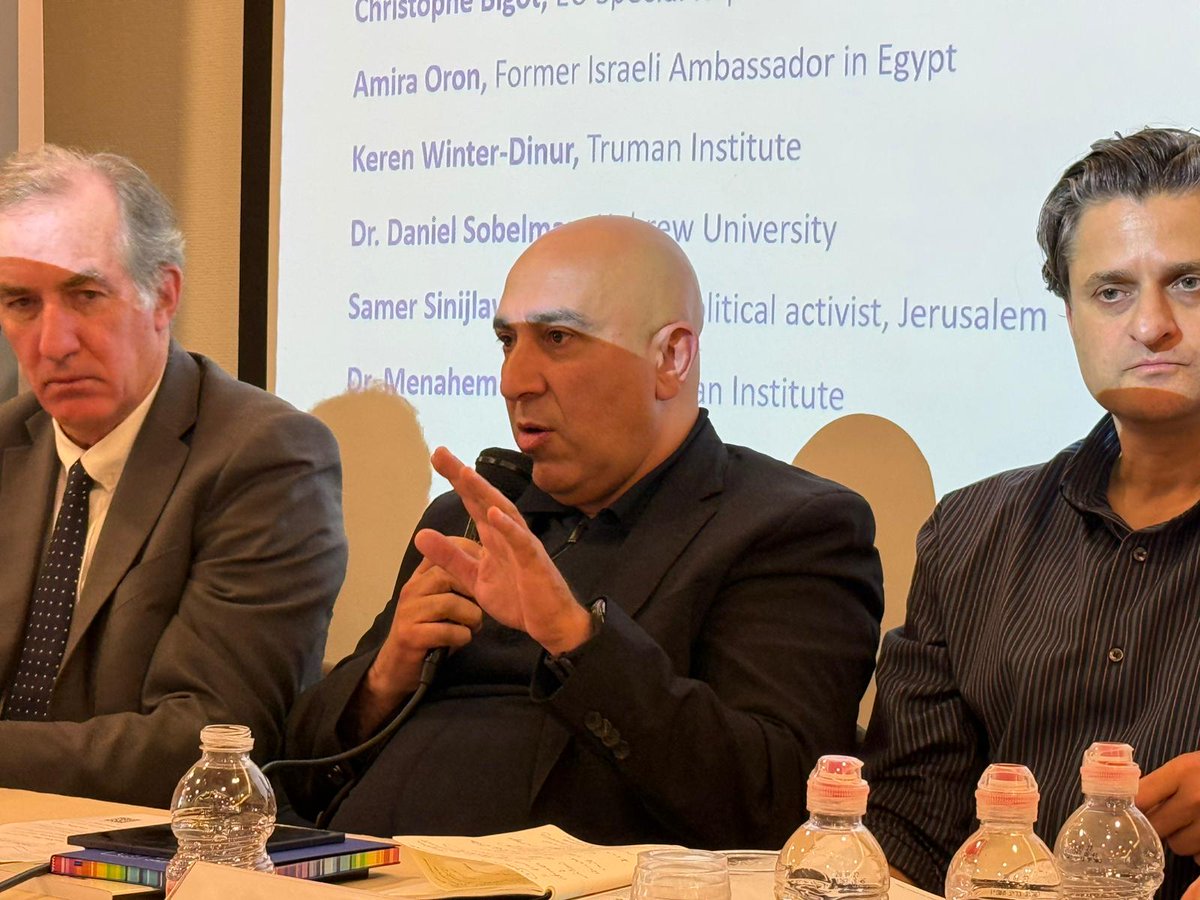
Yesterday’s seminar at the Hebrew University, organized by the Truman Institute and sponsored by the @EUinIsrael@EUpalestinians proved again that open and public Israeli-Palestinian dialogue is still possible — and deeply needed. Important discussions with EU Ambassador to Israel @MichaelMannEU and @EUSR_MEPP highlighted both Europe’s enormous potential and its deep strategic contradictions.
The EU could become the most relevant international player in the Israeli-Palestinian conflict. But today it suffers from a severe lack of leadership and political courage.
My criticism focused on two deeply destructive European policies:
1- Europe’s unconditional, public, and continuous endorsement of Mahmoud Abbas — a leader entering his third decade without democratic legitimacy while Palestinians remain denied presidential and legislative elections.
2- Europe’s strange fear of supporting open public dialogue between Israelis and Palestinians. Instead of investing in visible public engagement like yesterday’s seminar, the EU and leading member states such as Germany and Sweden continue funding closed “Chatham House” style conferences in Geneva and other European cities— conversations with no public accountability, no transparency, and no impact on public opinion.
Peace will not emerge from secret rooms filled with the same old faces. It will only emerge when Israelis and Palestinians are capable of speaking publicly, honestly, and directly to each other in front of their own societies.
Our President's latest update to the group is now on line both on our Substack feed - https://t.co/LiVjtKz4Jk
and on our website https://t.co/DOcb1Ek7fr
The continuous humiliation of Palestinians in the West Bank is destroying any remaining belief in justice, coexistence, or human dignity.
When armed settlers, under military protection, blindfold, detain, and publicly humiliate Palestinian civilians, the message sent to an entire generation is devastating: your life, freedom, and dignity do not matter.
No society can normalize this without paying a deep moral price from within. Security cannot be built on humiliation. Stability cannot grow from daily abuse.
Anyone who truly cares about the future of Israelis and Palestinians alike must have the courage to say clearly: this madness must stop.
Criticism is legitimate. Antisemitic conspiracy theories are not. Anyone with basic decency should condemn them clearly and publicly.
I met @BarakRavid some years ago at a speaking event in Baqa al-Gharbiyye, an Arab city in northern Israel. Although it was a two-hour drive to get there, I went to listen to him, I felt it was worth every minute.
At the time, he had not yet published his book or become so closely connected to the White House, but he was already a rising and respected voice in Israeli media. Joining Channel 12 was an upgrade for the channel — not for him.
Among the many Israeli reporters covering this war, very few have maintained professionalism and credibility. Barak is certainly one of them.
I proudly consider him a friend.
The real crisis today isn’t just political—it’s leadership.
Our leadership is living in a bubble, disconnected from the people it claims to represent.
Every European leader who hosts Abbas as the “legitimate” voice of Palestinians is not supporting stability—they are betraying Palestinian democracy.
You cannot preach democracy at home and deny it to us.
We Palestinians deserve real representation, real accountability, and real elections.
Enough double standards.
Tomorrow’s Palestinian local elections may be more important than they look.
90% of Palestinians have been calling for the resignation of the current leadership under Mahmoud Abbas.
85% demand immediate presidential and legislative elections.
These calls have been ignored. The last presidential election was held in 2005. But reality is shifting.
In tomorrow’s local elections (April 25), a new political current is emerging—organized, pragmatic, and forward-looking.
Across 9 cities, lists led by a younger generation—many from mainstream Fatah, alongside independents, professionals, business leaders, academics, and civil society figures—are stepping forward.
They are contesting the only elections currently available, representing over 1 million eligible voters.
Their common ground is clear:
• Change the current Palestinian reality
• Reset relations with Israel, the region, and the international community
• Advance a liberal, democratic, and moderate political vision
This is not just about municipalities.
It’s about whether a new political center can emerge from within Palestinian society itself. Watch these elections closely.
If this trend holds, it may mark the beginning of a structural shift in Palestinian politics.
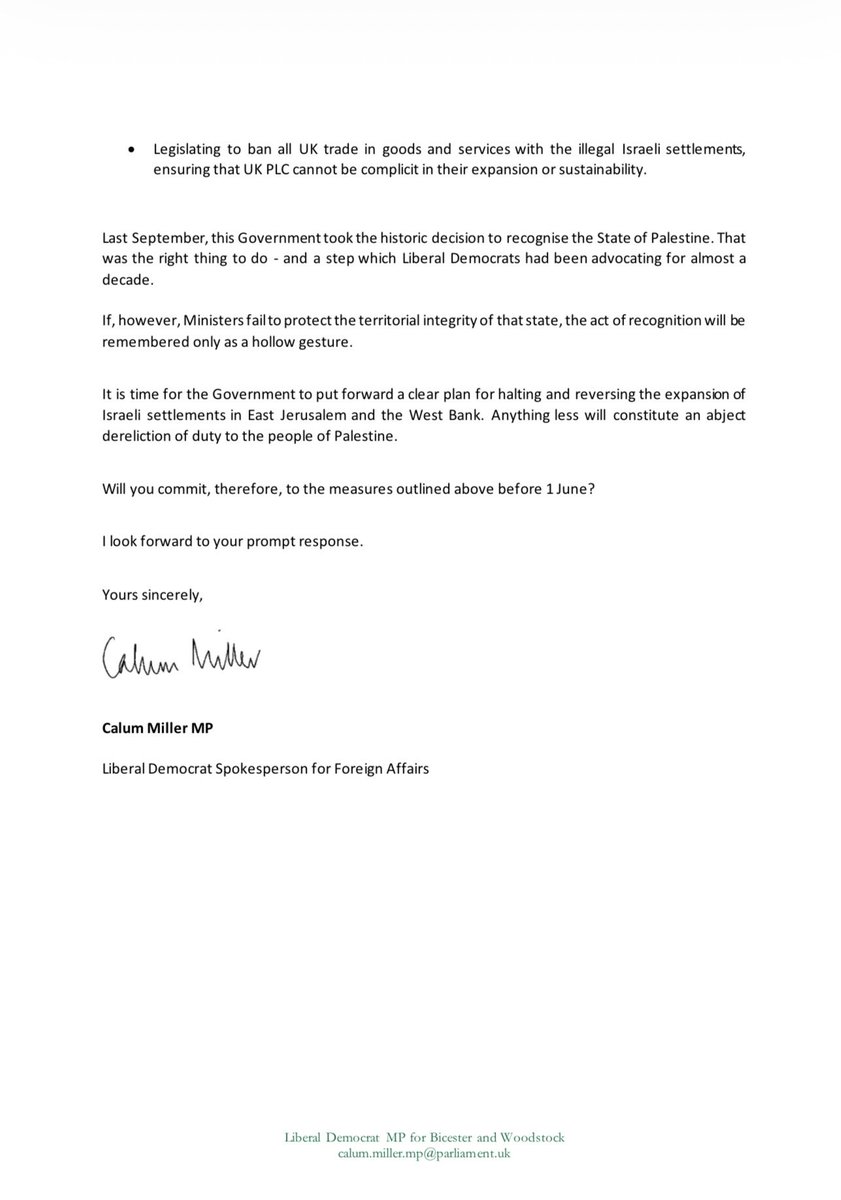
Recognising the state of Palestine was right. But it cannot be the end of the story.
Illegal settlements are destroying the prospect of a two-state solution. I pressed the Foreign Secretary to ban settlement goods and stop UK firms, banks and individuals enabling them outright.
April 12, 2026, I visited Marwan Barghouti in my capacity as his lawyer.
What I confirmed through this visit is deeply alarming. In recent weeks, Marwan Barghouti has been subjected to three violent assaults. On April 8 in Ganot Prison, he was severely beaten and left bleeding for more than two hours. He requested medical care and was denied treatment. On March 25, he was assaulted during his transfer from Megiddo to Ganot. On March 24, in Megiddo Prison, guards entered his cell with a dog, forced him to the ground, and the dog repeatedly attacked him. 
These are not isolated incidents. They form a clear pattern of escalating abuse: violence, medical neglect, and treatment that places him at immediate risk.
He had a great deal to say. Above all, he wanted to know more about his family and the Palestinian people, What is happening in Palestinian and Israeli scene I tried to tell him everything I know.
But even that conversation took place under absurd conditions: the phones did not work, so we had to shout through the glass just to hear each other.
For five hours, I sat there without food or water, trying to make sure this visit meant something.
This is what a legal visit looks like today: basic conditions denied, communication obstructed, and even the most elementary human and professional standards ignored.
And still, despite all of that, his mind was sharp, focused, and deeply engaged with everything happening outside those prison walls.
.@MichaeRoseYES Standing Together, Jewish & Palestinian Israeli citizens in solidarity @omdimbeyachad have been protesting against war& occupation, racism& human rights abuses since 2015. https://t.co/OYB328EGbw & we are UK Friends of Standing Together https://t.co/SouZnizz9u
إلى الشباب الفلسطينيين الذين ما زالوا يؤمنون بأن السلام ممكن،
يوم السبت التقيت بمجموعة مميزة من الشباب الإسرائيليين المنتمين إلى حركة اسمها "أبناء إبراهيم"، ويُعرفون أيضاً باسم "مؤمنو اليسار". هؤلاء شباب يهود متدينون، لكن إيمانهم الديني يقودهم إلى الوقوف ضد الاحتلال ومن أجل السلام والعدالة.
هم ليسوا مجرد أشخاص يتحدثون عن السلام، بل ناشطون حقيقيون على الأرض. في كل أسبوع يتواجدون في الضفة الغربية، ويقفون إلى جانب الفلسطينيين لحمايتهم من عنف المستوطنين والجيش الذي يساندهم. إنهم يضعون أجسادهم بين السكان الفلسطينيين وبين المستوطنين والجنود، إيماناً منهم بأن إنهاء الاحتلال هو الطريق إلى السلام الحقيقي.
هؤلاء الشباب يبحثون عن شركاء فلسطينيين — شباباً وشابات — يؤمنون بأن المستقبل لا يجب أن يُبنى على الخوف والكراهية، بل على الشجاعة، والعدالة، والعمل المشترك.
إذا كنت في العشرينات أو الثلاثينات من عمرك، وتعيش/ين في الضفة الغربية أو القدس الشرقية أو غزة، وتؤمن/ين بإمكانية السلام، وترغب/ين في لقاء شباب إسرائيليين يعملون بصدق من أجل إنهاء الاحتلال وبناء مستقبل أفضل لنا جميعاً، فأرجو أن تتواصل/ي معي مباشرة.
من فضلك اكتب/ي لي:
من أنت،
أين تعيش/ين،
كم عمرك،
وماذا تفعل/ين في حياتك.
معاً يمكننا أن نفتح باباً جديداً للأمل.
من فضلك أرفق أيضًا رقم الواتساب الخاص بك
غرشون باسكين
Those who've paid the highest price know what's at stake, and they refuse to stand by while Israelis and Palestinians head toward an even more dangerous future. They found another way, and they're leading.
Deeply concerning to see the closure of the Al-Aqsa mosque during Ramadan. This extraordinary joint letter shows the strength of feeling outside Jerusalem. Very worried by this precedent and for those in the city. UK should call on the Israeli authorities to review this decision.