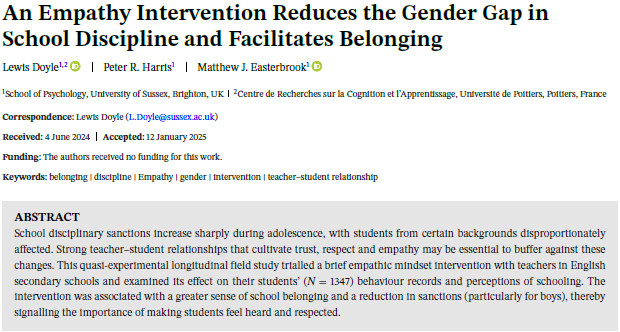
New paper in @easpinfo detailing an empathy intervention with teachers in England.
Students (notably boys) whose teacher had been encouraged to make them feel valued and heard had better end of year behavioural records.
@MattEasters@profprharris
https://t.co/LY2SfwfdlF
New #OpenAccess#EJSP paper by Lewis Doyle et al: An Empathy Intervention Reduces the Gender Gap in School Discipline and Facilitates Belonging https://t.co/zmQzRqXmQh
NEW PAPER @BPSOfficial with the incredible @MattEasters & Linda Tropp.
Trainee teachers had an aversion to working at schools in low-income communities. BUT this bias was attenuated when they had contact experiences with people in financial hardship.
👀https://t.co/IOv6X1Mq6b
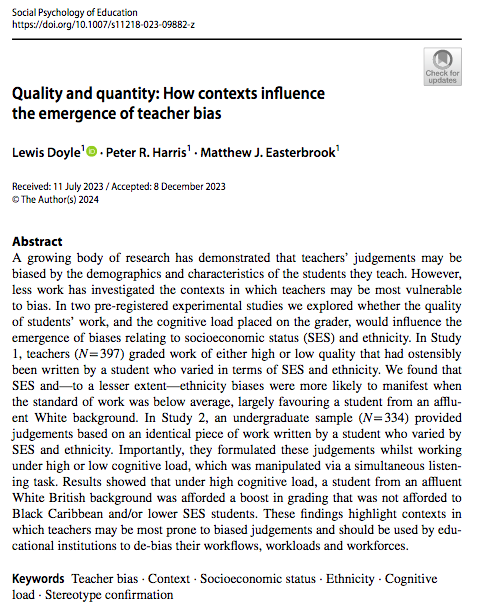
New paper.
Teachers' implicit SES and ethnicity biases were more likely to emerge when assessing low-quality work (S1) and when working under high cognitive load/overworked (S2). Clear advantages for White middle-class students.
@MattEasters@profprharris
https://t.co/XtpalPVgPf
If you want to do a PhD that uses social psychology to understand and reduce educational inequality, get in touch! We have new PhD studentships advertised at Sussex Psychology:
https://t.co/Wf781ieuhe
https://t.co/JL285MgU5N
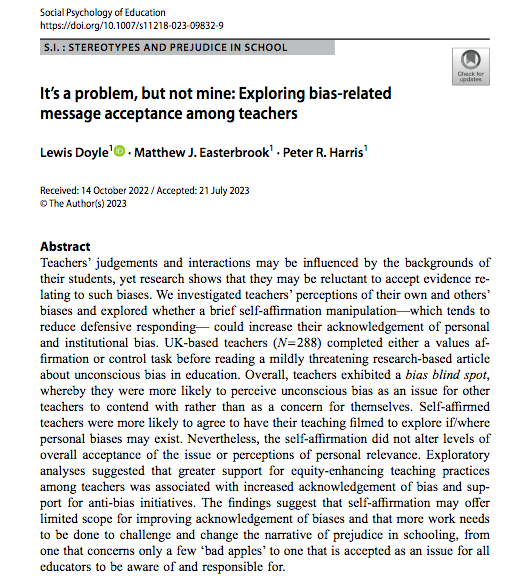
New paper!
Building on our work showing that teachers, like us all, exibit biases, we find that teachers exhibited a bias blind spot: they perceived unconscious bias as an issue for other teachers but not for themselves.
https://t.co/NeRnvvWQTi @LDoyle_
…more work needs to be done to challenge and change the narrative of prejudice in schooling, from one that concerns only a few ‘bad apples’ to one that is accepted as an issue for all educators to be aware of and responsible for.
New paper with @MattEasters & @profprharris in SPOE @SpringerNature
https://t.co/N8SsoNuinw
We found that teachers exhibited a bias blind spot, whereby they were more likely to perceive bias as an issue for other teachers to contend with rather than as a concern for themselves.🧵
…Self-affirmed teachers were more likely to agree to have their teaching filmed to see if/where personal biases may exist. However, we found that self-affirmation did not alter levels of overall acceptance of bias or perceptions of personal relevance.
Why, on average, are children from poorer backgrounds outperformed in school by their more affluent peers?
New study, led by @LewisDoyle_ , along with @MattEasters and @profprharris , explores the impact of unconscious bias on student grades, #Makeit10 👉https://t.co/X4IiOtsqZW