This CBS Sunday Morning piece on Robert Frank from 1987 is quite remarkable. Not because of what is said or how. It is in the long stretches of silence as the pictures are shown, allowing you to read them without being told what they mean or what to think.
https://t.co/rDvQSB1bQc
A Democrat with terror ties linked to the 1993 World Trade Center bombing is on track to become one of New Jersey’s next congressmen.
Adam Hamawy won a crowded Democratic primary in New Jersey’s 12th District and is heavily favored to win the general election in November.
The victory is renewing scrutiny of Hamawy's past relationship with Omar Abdel-Rahman, aka 'The Blind Sheikh'," the radical cleric convicted on terrorism-related charges whose followers carried out the 1993 World Trade Center bombing.
Hamawy’s critics say voters deserve answers about why a future lawmaker chose to support a figure at the center of one of America's most infamous terrorism cases.
@grok@Oldglorycries It wasn't that long ago that Samsung moved its cell phone division from Texas to New Jersey.
Just weeks later that division suffered the embarrassment of their batteries exploding.
https://t.co/JU0GVW3kvG
@MichaelGrahamSC These parts are often considered commodities and can change a little from one production run to another. Check the serial number to locate a compatible part for your stove. Difficult, not impossible.
@Disc_light As one of the many who have experienced the joy of imagining themselves immersed in the scenes you post I hope your dark reverie is brief & restful.
I hope the remnants of the spark that illuminates your pictures still lives within you & we can all bask in its warmth once again.
@Brennanokeefe@yonann The point of ‘bookmaking’ is to turn a profit and to pay the winners, even in a pair-mutuel system, with the money from the loser’s bets.
Would a discussion of Dutch Schultz & Otto Berman be useful here?
Arizona's voter database has a problem.
590,529 duplicate registrations. A hidden algorithm running in all 15 counties. And the federal law designed to fix it made things worse.
🧵
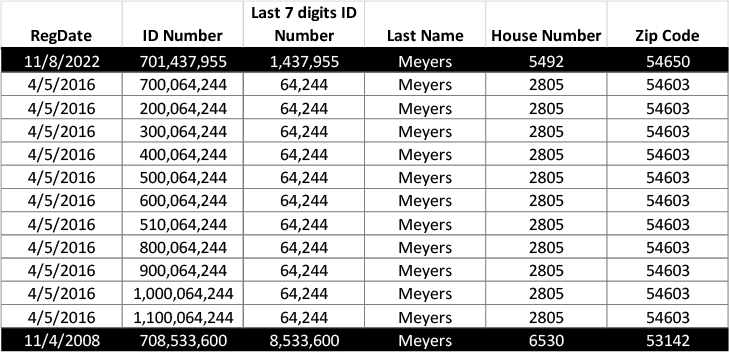
1/This is a table of voters named Meyers in Wisconsin.
Same last name. Same address. Same registration date.
Ten different ID numbers — ranging from 200 million to 1.1 billion.
One person. Ten identities. In an official government database.
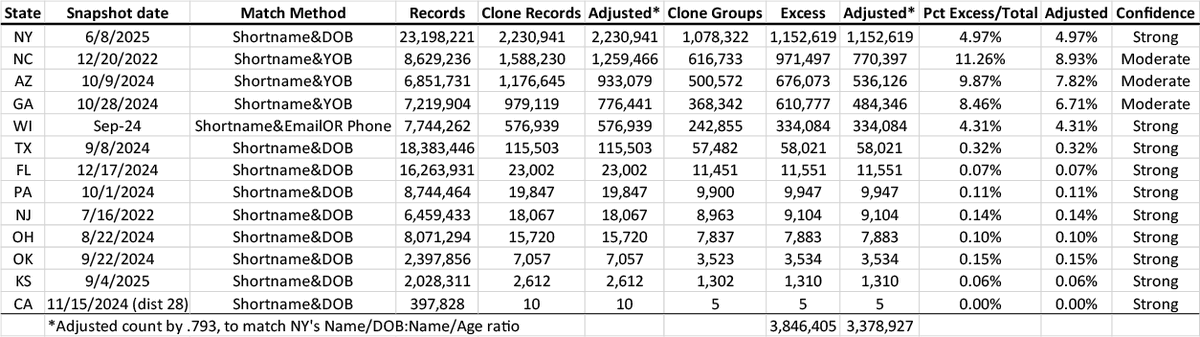
Every state in this table has duplicate voter records.
In NY alone, there are 2.23 million records tied to cloned identities — meaning over 1.07 million unique names that appear multiple times in the rolls. After accounting for the legitimate original record in each group, that leaves roughly 1.15 million excess records.
Not dozens. Thousands to millions across every state shown.
Even the smallest numbers here would trigger a bank or insurance company to get shut down for sloppy data hygiene. Government regulated industries aren't allowed this level of duplication.
Yet the systems that hand out ballots somehow are. 13 states • 3.38 million excess records
No state is clean.
THE 2028 GATEKEEPERS: WHY THE 2026 MIDTERMS ARE THE ULTIMATE STANDOFF for ELECTION VALIDITY
A massive new report dropped today, and it’s a wake-up call for anyone following the #ElectionValidity movement. In 23 states, candidates who have openly challenged the math of previous elections are now running for the very offices that will certify the 2028 Presidential Election.
We aren't just talking about politics; we are talking about the custodians of the database.
Critics are presenting this "Replacing the Refs" website as a warning, but for millions of Americans, it’s about a simple, hard-hitting question: Where is the proof?
• The "Black Box" Problem: For years, election officials have asked us to "just trust" the results. But in a world of T-SQL, snapshots, and real-time data oscillations, "trust" isn't a technical requirement—transparency is.
• The 23-State Firewall: These candidates are running for Governor, Secretary of State, and Attorney General. If they win in 2026, they hold the keys to the voter rolls and the certification stamps for 2028.
Why the Pushback?
The media labels this "divisive," but let’s look at the logic. Is it "divisive" to demand a clean Voter Roll? Is it "divisive" to ask why voter registration snapshots show unexplained "oscillations" between daily updates?
The establishment argues against these "provable" results, yet they fight every effort—like the SAVE America Act—that would bake verification into the process from Day 1.
You cannot have Election Validity without Auditability.
If the results are truly "provable," then there should be no fear of:
1. Full Data Transparency: Open up the databases for independent forensic analysis.
2. Citizen Verification: Ensure every name on the roll is an eligible, living voter in the jurisdiction they are registered.
3. Strict Certification Standards: Stop treating certification as a "rubber stamp" and start treating it as a sworn technical audit.
The "fire" of divisiveness isn't being stoked by those asking for receipts. It’s being fed by a system that refuses to show them.
2026 is the battlefield. 2028 is the payoff. It’s time to stop arguing about "feelings" and start demanding the DATA.
https://t.co/ULEVFxljwH
This website is meant to be a warning about a supposed existential crisis – Instead it should be used as a guide to know who we SHOULD vote for if we are interested in Election Validity
#ElectionValidity
#SaveAmerica
#TransparencyNow
#DataDontLie
#Midterms2026
#U4F
@edwardjohncraig@ProfMJCleveland To get into Metal from the 80’s you should probably start with the 70’s. Start with the first three Black Sabbath albums and go from there.
I can look at a voter ID number in New York's database and tell you the record is purged — without looking at the status field.
I can tell you it carries a registration date inconsistent with its algorithmic placement. I can tell you it is almost certainly a clone — a duplicate registration capable of functioning independently in the system. And I can tell you it was assigned a brand new state ID number despite being ineligible to vote at the moment that number was assigned.
In a legitimate database, an ID number is administrative. It tells you nothing about status or authenticity. You check those things by looking at the relevant fields.
Unless someone built the status into the numbers themselves.
New York assigns voters two ID numbers: a County ID (CID) and a State Board of Elections ID (SBOEID). A collaborator — a programmer who has asked not to be named — flagged an unusual geometric pattern in Nassau County's ID structure and brought it to my attention before leaving the project. The analysis that follows is entirely my own.
When I plotted Nassau County's out-of-range SBOEID numbers against their CIDs, I found something that has no business in a voter registration database.
Geometry.
Not scatter. Not noise. Overlapping rectangular bands ascending in a precise staircase formation, each block stepping up and to the right like shingles on a roof. I named it the Shingle algorithm.
Real voter data does not produce geometry. When you see a pattern this clean in a dataset this large, you are no longer looking at registrations. You are looking at generation.
Nassau County's Shingle section contains approximately 176,090 records in the 2021 database. Nassau is not unique. The Shingle algorithm appears in all of the counties that use the Metronome algorithm for their in-range records — Nassau, Erie, and Westchester — plus at least two others including Onondaga, for a statewide total of approximately 700,000 Shingle records. Nassau simply has the largest concentration and is where the pattern was first identified. Here is what all of these records have in common.
Essentially 100% are purged. Not inactive — purged. Permanently removed from the rolls, ineligible to vote. And here is the critical point: every State Board of Elections ID number in this database was newly created when New York implemented the Help America Vote Act around June 2007. Before that, only county ID numbers existed. No one had a state ID. These were not legacy numbers carried over from a prior system. They were freshly assigned.
Which means someone made a deliberate decision to assign brand new, algorithmically structured state IDs to records that were already purged — or were purged at the exact moment of assignment. I call them born purged.
The Shingle records are not all of the pre-2007 purged records. They are a minority of them. That matters enormously. If the algorithm had simply swept up every old purged record, you might construct an administrative explanation. Instead it selected a specific subset, gave them a specific mathematical identity, and left the rest alone. That is not maintenance. That is classification.
They carry pre-2007 registration dates — making them appear to be historical registrations predating the algorithm that assigned their IDs. They are the only out-of-range records with pre-2007 dates. Every other out-of-range record, across all algorithms, carries a post-2007 date. The inference that these dates are inconsistent with the records' actual origin is difficult to avoid.
In the upper half of the CID range, nearly 100% are also clones — duplicate registrations with different ID numbers, each capable of operating independently in the system. A clone is not an administrative error. An error produces a duplicate with the same ID, which is immediately visible and non-functional. A clone has a different ID and can, in principle, vote.
Their purge status, clone relationship, and algorithmic identity can all be read from their ID numbers alone — before you look at any other field.
The Shingle records share ID space with a second algorithm I named the Tartan, which governs the majority of New York's out-of-range records. The two populations occupy the same numerical territory without overlapping. Whether that reflects deliberate coordination or simply the Tartan working around numbers that were already assigned, the result is the same: the Shingle records sit in a mathematically distinct space of their own, identifiable by algorithm alone.
I don't know the operational purpose of these records. The data does not settle that question and I will not speculate beyond what it supports.
What the data does establish: Nassau County's voter database contains approximately 176,090 records that were assigned fresh state ID numbers under a specific algorithm, carry purge status that appears to have been present from the moment of assignment, hold registration dates inconsistent with the algorithmic structure they occupy, and correlate heavily with clone status in the upper ID range. They represent a minority of all pre-2007 purged records, meaning they were specifically selected for this treatment.
No legitimate database process produces this. No administrative explanation accounts for assigning new, structured state IDs to records that cannot vote.
Which leaves one question the data cannot answer.
Why would you assign a new state ID number — one embedded in a sophisticated, hidden algorithm — to a record that is already ineligible to vote? A record that should, by any normal administrative standard, have been deleted or left with its county ID and nothing more?
That question has no innocent answer I have been able to find. It is a question someone with subpoena power should be directing at the people who built this system.
Validity Over Security: Why the MEGA Act Changes Everything
The battle for the future of our elections reached a new flashpoint this past weekend. While the SAVE America Act has held the spotlight for its focus on citizenship, a much more comprehensive engine of reform is quietly gaining massive momentum: The MEGA Act.
Last week’s House Administration Committee hearings signaled a strategic pivot. Chairman Bryan Steil and state leaders didn't just talk about registration; they began building the legislative record to overhaul the entire life-cycle of a ballot.
If you are tracking the "oscillations" and "deadwood" in our voter data, the MEGA Act presents a solution. It moves beyond the surgical focus of the SAVE America Act to mandate a 30-day federal maintenance requirement, forcing states to synchronize with DHS databases every single month to ensure only valid, eligible voters remain on the rolls.
Why the MEGA Act is the broader "Validity" engine:
While both bills demand proof of citizenship, the MEGA Act addresses the systemic vulnerabilities that the SAVE America Act leaves open. It targets the "how" and the "when" of voting, not just the "who."
The Critical Differences:
• SAVE America is a laser-focused registration bill (Proof of Citizenship). MEGA is an "Omnibus" reform that dictates how elections are run on the ground.
• The MEGA Act would officially ban Ranked-Choice Voting (RCV) for federal elections, protecting the "one person, one vote" standard.
• It implements a federal ban on ballot harvesting and ends universal mail-in voting, moving the nation back to a "request-only" absentee system.
• Unlike current loose standards, the MEGA Act mandates that all ballots must be received by the close of polls on Election Day - no more waiting weeks for postmarks to trickle in.
• It requires auditable paper ballots nationwide, ensuring that electronic totals can be verified against a physical record.
The SAVE America Act is the shield for our registration rolls, but the MEGA Act is the beginning of a blueprint for a valid, transparent, and timely election result.
We are no longer just talking about security; we are finally talking about the fundamental validity of the American vote.
#ElectionValidity
#MEGAAct
#SAVEAmericaAct
#DataAnalysis
#U4F