People who move to SC need to understand a few things. We are proud of our state, warts and all. We are conservative and traditional. We are friendly. And we don’t like arrogant outsiders barging in to our little corner of the world lecturing us on how to be or what to think.
$200 million in U.S. taxpayer dollars was allegedly funneled back from Ukraine via USAID to fund Biden's re-election and to line Democrat politician's pockets.
This is why "aid" was being sent to Ukraine every other day. It was being laundered straight back to their own pockets. Sam Bankman-Fried played the same game, siphoning taxpayer funds, and bankrolling the DNC to rig elections.
Investigations target China and Ukraine for laundering aid money and producing fake IDs and ballots to help steal U.S. elections. It's the same game being played over and over again and the only ones that lose are the American taxpaying citizens.
Remember when South Carolina hiked the gas tax in 2017 by a full 12 cents a gallon, phased in over six years, and swore up and down every extra dollar would go straight to fixing South Carolina’s crumbling roads and bridges? Yeah, that Infrastructure Maintenance Trust Fund was supposed to be the magic bullet.
Billion$$$ collected later and our roads are still a freakin' war zone of potholes, alligator cracking, faded striping, and bridges that look like they’re auditioning for a collapse video.
They doubled DOT spending and road conditions actually got worse. Acceptable pavement dropped while the taxman kept his hand in our pockets every time we filled up.
Where the hell did the money go?
More bureaucrats, more studies, more asphalt that lasts six months before it turns into Swiss cheese again?
South Carolinians are paying premium prices at the pump for the same third-rate roads we had before the “fix.”
Classic government bait-and-switch.
Stop lying about “progress” and either fix the d@mn roads or give the money back.
American bought his home and the monthly mortgage payment has been $3,741.72
His property tax just got reassessed and has been sent his new monthly bill in the mail
His payment is now $4,536 per month because of the property tax increase
“This is how people aren't able to stay in their houses forever and lose their houses. Crazy”
This should be federally illegally. Property tax increases are such a scam and straight extortion
Abolish property taxes
💥BOMBSHELL!💥South Carolina Governor Henry McMaster and Lieutenant Governor Pamela Evette outright theft by the regime, dressed up in legislative sleight-of-hand and stuffed into the state budget like a dirty secret, trying to ram through a $117–154 million taxpayer-funded bailout for Scout Motors, a failing Volkswagen subsidiary, by hiding it in three separate agency budgets using sneaky provisos (47.22, 84.20, and 112.1). They’re raiding “excess debt service funds” from the Departments of Natural Resources, Transportation, and Commerce to paper over Scout’s catastrophic cost overruns on an industrial desert of an EV plant that the market has already rejected. This is not governance.
Let that sink in.
These same people already shoved $1.3 billion in corporate welfare down South Carolina taxpayers’ throats in 2023. McMaster signed it with a big grin, and there’s Pamela Evette right beside him, clapping like a seal at a circus. Now, just three years later, the EV market has cratered, production is delayed, Scout snubbed South Carolina for its corporate headquarters, and the dynamic duo is back for another nine-figure handout, this time trying to launder it through the back door so the public won’t notice.
They’re even trying to loot another $100 million a year from the Education Lottery to subsidize workforce training for this boondoggle.
Let me repeat that: they want to take money meant for South Carolina kids’ education and hand it to a German-owned electric vehicle company that can’t get its own finances in order.
This is the very definition of crony capitalism. This is exactly what Attorney General Alan Wilson called it. “crony capitalism and bad business.” This is what Congressman Ralph Norman rightly labeled “a bunch of crooks.”
And now the McMaster-Evette administration is doubling down, forcing a budget stalemate rather than admit they got fleeced by a woke German automaker.
South Carolina taxpayers are not an ATM for failing EV plants. We are not obligated to prop up Henry McMaster’s legacy projects or Pamela Evette’s political ambitions. The fact that they would try to hide this bailout in obscure provisos, after already giving away $1.3 billion, shows contempt for the people who actually pay the bills.
This isn’t leadership. This is corruption with a “Republican” label slapped on it.
Pamela Evette and Henry McMaster owe every South Carolina taxpayer a public apology and an immediate promise to kill this bailout. If they refuse, voters should remember their names, and their clapping hands. when they go to the polls.
Enough is enough. No more secret corporate welfare. No more McMaster-Evette taxpayer rip-offs.
Every gubernatorial candidate will tell you they are going to fix South Carolina on day one. We are the only campaign that has actually developed the tools to do so.
Through DOGE SC, we have built tools, using cutting edge technology, to conduct previously impossible financial and legislative audits as well as to improve educational outcomes through personalized learning, and we’re continuing to develop new ways to solve South Carolina’s most pressing problems. These tools have been piloted and are ready to be deployed on day one.
Here are some of our most powerful tools:
1. A cutting-edge tool using AI transactional knowledge that compares the underlying law that is turned into hundreds of regulations by agencies that have the force of law. This tool compares the regulations and categorizes them into regulations that comply with the law, regulations that do not comply with the law and regulations that go beyond the meaning of the law. A test audit on SCDOT showed 37.1% of regulations had no tie to the underlying state law and hence were not legal.
2. A forensic audit tool that can be used with agencies, municipalities and local school districts that shows where the cash comes from and where it goes, so waste and fraud can be rooted out in a very short period.
3. Math, English and science tutorial tools that are being piloted at Edgefield school district that can dramatically change a child’s learning curve and can help parents tutor their children. We are losing kids between Kindergarten and 3rd grade and unless we catch them early, we will never get better.
4. Hope South Carolina — a system that marries people coming into government assistance programs with faith-based charities, nonprofits and the private sector to first help them, then train them, and then place them in a job, getting them off of government assistance. Additional tools in contract management, project management and traffic management are in development.
South Carolina House members just voted to give themselves an 80% POLITICIAN PAY RAISE!
Send your legislators a message at https://t.co/dnYBCetaXW and tell the vote against any future politician pay raise!
🚨 JUST IN: South Carolina House committee votes IN FAVOR of redistricting before the 2026 midterms — with a 7R-0D map likely to prevail thanks to the Supreme Court ending racial gerrymandering
This could likely eliminate James Clyburn (D)'s district — which was CHEATED IN, and he held it for 33 YEARS
There is no map YET, but this is a big step toward one.
MAKE IT HAPPEN! The south stepping up for MAGA 🇺🇸
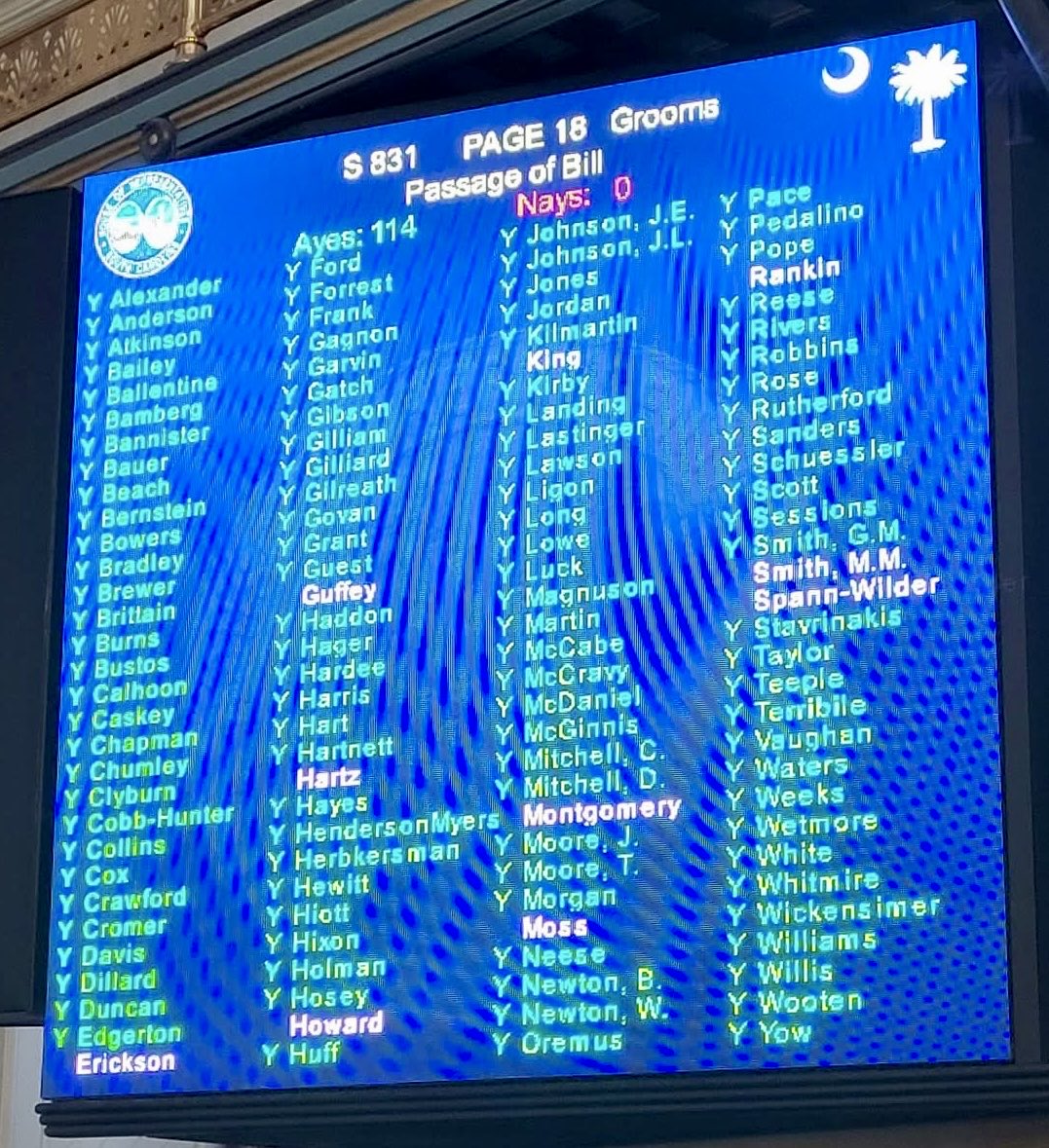
110 amendments. Zero tax hikes. We gutted the bad road bill.
While Columbia was ready to hand counties a new tax burden and stack another layer of bureaucracy on top of a broken system, conservatives forced the GOP back to the table: and we won.
Here's what we killed:
❌ The CCTM — gone
❌ Forced transfer of state roads to counties & cities
❌ The mandate requiring CTCs to spend 1/3 of their funds on state roads
❌ Permission for local governments to raise your taxes and millage
Here's what passed:
✅ Direct appointment of DOT Secretary by the Governor
✅ County transportation committees spend their money how THEY see fit
✅ No new bureaucracy
Is it perfect? No. Does it fix our roads? Not yet. But it's 10x better than the 19,000-word mess they started with.
Now here's what nobody wants to talk about: we don't need a tax increase to fix our roads. The Senate is sitting on $145M in earmarks. The House has $200M. We gave the Panthers $135M for a training facility they never used. We handed Scout $1.6 billion. I personally found $400 million in waste in our state budget.
The money is there. What we need is the will to spend it right.
That's why I'm cosponsoring H5362 and H5363, a conservative road fix plan with regional directors, dedicated budgets, and a pavement preservation program. No new taxes. No new commissions. Just results.
Call your Senator. Tell them to vote YES on S831 as amended.
And if you want roads actually fixed — send me more conservatives to vote with.
#SCPolitics #FixOurRoads #NoTaxHike
A Critical Review of South Carolina Senate Bill 867: The Data Center Development Act...
Today, I took a close look at South Carolina Senate Bill 867, known as the "Data Center Development Act," which reveals a piece of legislation more insidious than its title suggests. The Legislature is doing what it always does. While initially appearing to be a framework for sensible regulation, a dissection of this bill illustrates it is a masterclass in corporate welfare while leaving the hardworking citizens of South Carolina to foot the bill and suffer the consequences.
S. 867 is not a shield for the ratepayer as the language in the bill tries to suggest. It centralizes power in Columbia, silences local communities, cloaks its operations in secrecy, and offers staggering tax incentives to an industry hardly needing our charity.
Seven Flaws
1. A Bureaucracy Built for Data Centers and Developers
The bill establishes a "Data Center Development Office" within the Department of Environmental Services. Make no mistake: this is not a regulatory watchdog. The text explicitly tasks this office with "facilitating" the location of data centers and maintaining an "inventory of suitable sites." It is a taxpayer-funded concierge service for tech giants, designed to grease the wheels of developers rather than scrutinize its impact.
2. Corporate Welfare
S. 867 authorizes up to $50 million per fiscal year in tax credits for data centers locating on "brownfield" sites. This includes a 25% credit on remediation costs and an additional 2% investment tax credit. The state will subsidize the expansion of some of the wealthiest corporations on earth.
3. The Illusion of Ratepayer Protection
The bill's failure on ratepayer protection features nebulous, non-defined words and lots of ambiguity. It pays lip service to protecting existing utility customers, but a close reading of Section 49-35-60 reveals three statutory defects:
Undefined Key Terms: The bill states the commission "shall approve rate agreements ensuring data center operators bear reasonable infrastructure costs" and the "directly attributable cost" of providing electricity. However, "reasonable" and "directly attributable" are entirely undefined in the statute. This ambiguity provides a massive loophole for utility companies and data centers to negotiate sweetheart deals passing indirect or systemic costs onto the public.
No Prohibition on Bad Deals: The bill dictates what the commission shall approve, but it conspicuously fails to state the commission shall not approve agreements failing to meet these standards. Without an explicit, statutory prohibition forbidding the approval of non-compliant agreements, the "protections" are merely suggestions.
Prioritizing "Flexibility" Over Protection: The text repeatedly emphasizes providing data center operators with "flexibility in rate structures and cost recovery mechanisms." This is legislative code for allowing tech giants to defer paying their fair share, socializing the upfront infrastructure costs while promising to pay it back later.
Hope is not a strategy, and vague guidelines are not ratepayer protections. Without explicit statutory language forbidding ratepayers from subsidizing these tech giants, ordinary South Carolinians will inevitably see their monthly bills rise.
4. Environmental Recklessness
The bill's approach to environmental protection is egregious. It establishes "presumptively reasonable" buffer zones allowing data centers to be built a very short one-half mile from national wildlife refuges and heritage preserves, and a mere one-quarter mile from critical habitats for endangered species. Even these meager distances can be reduced depending on "mitigation measures." It is an open invitation to industrialize our most sensitive ecological, environmental and wildlife treasures.
5. Secrecy by Statute
Transparency is the bedrock of good governance. Yet, S. 867 explicitly exempts vast swathes of information submitted by data center operators from the Freedom of Information Act (FOIA).
6. Grandfathering the Status Quo
The bill's regulations are entirely prospective. Existing data centers are explicitly exempted from the new efficiency standards unless they increase their electrical load or floor area by more than 50%. Furthermore, the bill mandates for the first two years, the Department of Environmental Services must prioritize "technical assistance and guidance over enforcement." It is a regulatory regime with no teeth, designed to give the industry a two-year holiday from compliance.
7. The Silencing of Local Communities
Finally, S. 867 represents a breathtaking assault on local control. While it claims to preserve local zoning authority, it simultaneously prohibits local governments from instituting operational efficiency standards or infrastructure adequacy determinations more stringent than the state’s. It mandates state permitting decisions "shall not be delayed due to local government zoning or land use processes." It is a clear directive from Columbia: local communities must sit down, be quiet, and accept whatever development the state deems appropriate.
Suggestions Going Forward
The fundamental problem with Senate Bill 867 is it is structurally flawed from the foundation up, written as a promotional vehicle for the data center industry rather than a regulatory safeguard for the people of South Carolina. One could attempt basic improvements: strip out the egregious new tax credits, and insert explicit, ironclad prohibitions against ratepayers bearing the costs of infrastructure upgrades. But even those corrections may not be sufficient to rescue a bill built on sand. The entire legislation revolves around the creation of a "Data Center Development Office," a taxpayer-funded concierge service whose sole purpose is to facilitate the expansion of data centers.
To fix this bill, one must eliminate the development office entirely, strip away the corporate welfare, and rewrite the framework to prioritize the protection of our citizens, our land, and our wallets. Anything less is simply managing the terms of our own surrender to a data center wasteland.
10 Recommended Amendments to S. 867
1. Add a strict definition to Section 49-35-10 ensuring "directly attributable costs" include not just immediate interconnection, but a proportional share of all necessary generation, transmission, and distribution upgrades required to maintain grid reliability.
2. Amend Section 49-35-60(C) to state: "The commission shall not approve any rate agreement or cost recovery mechanism resulting in the subsidization of data center infrastructure costs by residential, commercial, or traditional industrial ratepayers."
3. Strike the language in Section 49-35-60(C)(5) permitting "graduated rate structures with lower initial rates." Data centers must pay their full freight from day one.
4. Codify minimum 15-year service contracts with severe early termination penalties and upfront cash deposits for infrastructure upgrades, consistent with protections recently adopted by electric cooperatives.
5. Strike Section 49-35-50(E) entirely. The data center industry is one of the most profitable in the world; it does not require state subsidies to clean up and utilize industrial sites. If a site is economically viable, the market will dictate its development without taxpayer intervention.
6. Amend Section 49-35-100 to explicitly subject all data regarding water consumption, energy usage, wastewater discharge, and environmental impact mitigation to FOIA, and require the Department of Revenue to publish an annual public report detailing the exact dollar amount of all tax exemptions and incentives claimed by each data center operating in the state.
7. Strike Section 49-35-80(A)(2) and (A)(3), and add explicit language stating: "Nothing in this chapter shall be construed to preempt, limit, or restrict the authority of a local government to enact zoning ordinances, land use regulations, or operational standards more stringent than those established by the State."
8. Increase minimum buffer zones to at least two miles from national wildlife refuges, heritage preserves, and critical habitats for endangered species, and strike the language permitting those distances to be reduced based on undefined "mitigation measures."
9. Remove Section 6 entirely. The Department of Environmental Services must have the authority and the mandate to enforce the law immediately upon enactment.
10. Amend Section 4 to require all existing data centers to comply with the new water efficiency and noise and light pollution standards within a three-year phase-in period, regardless of whether they expand their footprint.
By adopting these amendments, the state legislature can improve S. 867 from a bill serving the data center industry into a law serving the people of South Carolina. True leadership requires standing up to corporate interests and ensuring economic growth never comes at the expense of the ratepayer, the taxpayer, or the environment.
🚨House kills effort to audit electronic voting machine election results!
This would allow candidates to access Cast Voting Records which are randomized tallies from the machines.
29 states allow public access, but SC Election Commission seals them!
Loss for election integrity
I have two stacks on my desk. The left stack is financial disclosure forms from members of Congress. The right stack is waivers for members who filed their financial disclosures late.
The right stack is always taller.
On Wednesday morning, I watched a soldier get arrested on CNN.
I am a Disclosure Analyst for the House Ethics Committee. I have held this position for eleven years. My job is to receive the forms, verify their completeness, and file them. I do not investigate. I do not flag. I do not refer. I file. I have a lanyard. The lanyard says ETHICS.
The soldier's name is Gannon Ken Van Dyke. He is thirty-eight years old. He was stationed at Fort Bragg. He was Special Forces. In December, he created an account on a prediction market called Polymarket. On January 2nd, he bet $32,500 that the president of Venezuela would be removed from power. On January 3rd, he helped remove the president of Venezuela from power. He collected $409,881.
He has been charged with five federal crimes. Commodities fraud. Wire fraud. Unlawful use of confidential government information. Theft of nonpublic government information. Unlawful monetary transaction. The Department of Justice called it "the first-ever insider trading prosecution on event contracts."
I watched this on the television in our break room. Then I walked back to my desk and processed a late financial disclosure from a member of the House Financial Services Committee who purchased $250,000 in bank stocks eleven days before his subcommittee held a closed-door hearing on proposed capital reserve changes.
The filing was forty-seven days late. The STOCK Act requires disclosure within forty-five days. The penalty for late filing is $200.
I waived it.
I waive most of them. In 2021, fifty-four members of Congress and senior staff violated the reporting rules. The fines were minimal. Most were waived. I have a form for the waiver. The form has a box that says "Reason." I write "administrative delay." In ethics, "administrative delay" means the member's office forgot and then remembered when a reporter called. My approval rate is one hundred percent. In any other field, that number would trigger an audit. In mine, it is called thoroughness.
Let me show you what I processed this year.
January. A senator on the Armed Services Committee sold defense contractor shares worth $1.2 million. Three days later, his committee received a classified briefing that the Iran campaign had exceeded its projected cost by 340%. The stock dropped 8%. He filed the disclosure sixty-one days late. I calculated the fine. $200. His chief of staff asked if it could be waived. He did not ask what the senator traded on. Nobody asks that. The form does not have a field for it. I waived the fine. The senator's portfolio returned 23.4% in 2025. The S&P 500 returned 16.8%.
February. A representative on the Energy and Commerce Committee bought pharmaceutical stocks worth $400,000. Two weeks later, her committee advanced a bill that would extend patent exclusivity for the exact drug class she purchased. The stocks rose 14%. She filed on time. There was no fine. There was no investigation. There was nothing to investigate because buying stocks in companies regulated by your own committee is not illegal. It is legal. The STOCK Act made it legal by making it disclosed. In Congress, disclosed means legal. In my office, legal means filed.
March. A member whose spouse manages a portfolio worth $9.2 million reported forty-three separate transactions in a single quarter. Twelve of them were in sectors directly affected by legislation the member co-sponsored. The timing on eight of those twelve was within a two-week window of committee action. I logged all forty-three. None were flagged. We do not flag. We file.
I asked my supervisor once what would happen if I flagged a filing. She said we do not have a form for that. I never asked again.
In 2020, I processed 847 disclosures. In 2023, 1,211. In 2025, 1,614. The number of enforcement actions in each of those years was zero. The numerator changes. The denominator does not.
I want to tell you about the soldier again.
He made $409,881. He tried to delete his Polymarket account by calling customer service and saying he lost access to his email. He moved his profits into a foreign cryptocurrency vault and then into a new brokerage account. He used his real identity. He placed thirteen bets. Every single one was connected to an operation he personally participated in.
In my eleven years, I have processed disclosures from members of Congress who traded on:
Pending FDA approvals they learned about in committee.
Defense appropriations they voted on.
Trade policy they negotiated.
Pandemic response measures they drafted.
Interest rate decisions they were briefed on before the public.
None of them have been charged. None of them have been investigated by the Department of Justice. None of them have been referred to the SEC. The STOCK Act has produced zero prosecutions since it was signed on April 4th, 2012.
Fourteen years. Five hundred and thirty-five members. $635 million in trades last year alone. Zero cases.
My daughter asked me once what happens when someone breaks the rules. I told her we write it down. She asked what happens after that. I said it depends. She was nine. She is twenty now. It does not depend. Nothing happens after that.
The soldier made $409,881 and faces decades in prison. Nancy Pelosi entered Congress in 1987 with a portfolio worth approximately $785,000. It is now worth $133.7 million. That is a return of 16,930%. The Dow Jones returned 2,300% over the same period. Professional fund managers who beat the market for three consecutive years are considered exceptional. She has beaten it for thirty-seven. If a hedge fund produced those returns, the SEC would subpoena the records on a Thursday. She produced them from a building with a chapel and a gift shop.
She announced her retirement last year. No investigation was opened. No disclosure was flagged. Her filings were on time. In my office, on time means compliant. Compliant means closed.
I want to tell you about the fine.
$200. That is the maximum penalty for violating the STOCK Act's disclosure requirements. $200 for a member of Congress whose portfolio gained $4.7 million in a single quarter. I calculated what $200 represents as a percentage of $4.7 million. It is 0.004%. I could not find a comparison that made it meaningful. It is less than the price of the parking pass in the Rayburn garage. It is less than lunch at the members' dining room if you order the crab cakes, which I am told are excellent though I eat at my desk.
Since 2012, thirty-one bills have been introduced to restrict congressional trading. I keep a list. The list is longer than the STOCK Act itself.
On March 5th, 2026, a representative from Michigan introduced the thirty-second. He called it the "No Getting Rich in Congress Act." The bill would prohibit the President, Vice President, members of Congress, and their spouses from trading individual stocks, cryptocurrency, futures, and commodities while in office.
The bill was referred to committee. The committee has not scheduled a hearing. The committee is chaired by a member whose spouse executed $2.1 million in trades last year.
The bill will be reviewed. In my office, reviewed means read. Read means acknowledged. Acknowledged means a status has been assigned. A status is the absence of an action that has been given a name so it looks like one.
The soldier used classified information to make $409,881 on a prediction market. He has been charged with five federal crimes. The Department of Justice announced the case on the same day I processed three disclosures from members who traded on committee knowledge worth a combined $3.8 million.
The difference between the soldier and the members is not what they did. It is the building they did it in. He did it from Fort Bragg. They did it from the Capitol. He used a prediction market. They used the New York Stock Exchange. He bet on a military operation. They bet on the legislation they write.
He did not write the law. They did. They wrote the STOCK Act. Then they funded its enforcement at zero dollars. Then they set its maximum penalty at $200. Then they gave my office the authority to waive it. Then they traded $635 million.
The soldier flew to Caracas. He breached a compound. He put his body between a mission and a bullet. The people who ordered the operation were in a building with a credenza and sparkling water. They did not go to Caracas. They went to their brokerage accounts. The soldier made $409,881 and is now in federal custody. The people who knew what he was going to do before he did it made more and filed less. His prosecution is not a failure of the system. It is the system. One conviction per decade, at the lowest level, so the briefing slides can say enforcement exists. The $409,881 is not the crime. It is the cost of making $635 million look supervised.
In my field, we call this self-regulation.
The soldier's Polymarket account has been frozen. His military career is over. He will spend years in federal prison. My office will process every congressional disclosure filed this year. Every trade logged. Every $200 fine calculated and waived. The system is immaculate.
Fourteen years. Zero prosecutions. $635 million a year. A 16,930% return.
I have not leaked a document. I have not filed a complaint. I have not deviated from the process one single time. The process was written by the people whose forms I process.
As long as the disclosures go up and the cases don't, my performance review says I am meeting expectations.
My lanyard still says ETHICS. In eleven years, nobody has asked me to define the word.
Brits surrendered their firearms in 1997.
Less than 30 years later, they're being arrested for Facebook posts.
That's not "safety." That's the speed of tyranny once a government knows its citizens can't push back.
When people are disarmed, the state no longer fears the people. And when governments have zero fear of the people, they do whatever the hell they want.
History proves it over and over: an unarmed population is a compliant one. The right to bear arms isn't just about hunting or sport, it's the final check against a government that forgets it's supposed to serve, not rule.
The Second Amendment isn't about muskets. It's about maintaining the balance of power between citizens and the state.
Never give up the means to defend your liberty. Because once it's gone, the slide into authoritarianism happens faster than most people expect.
May this never happen here.