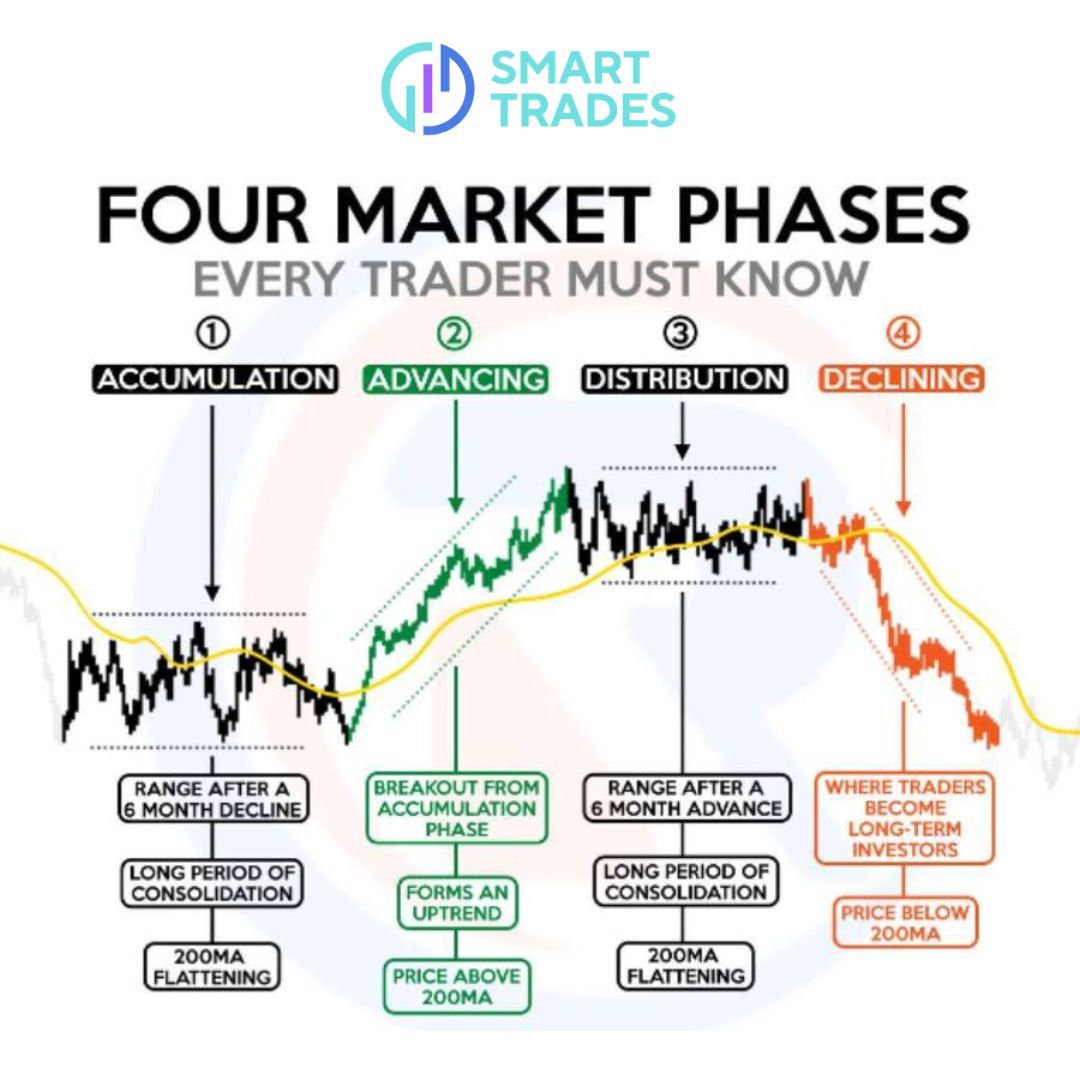
Most traders lose money because they treat every chart the same. The market moves in phases, and your strategy should change with it. 📊🧠
Here’s the simple breakdown of the 4 market phases:
1) Accumulation
After a big drop, price usually moves sideways while smart money slowly buys. The 200-day moving average starts to flatten. ⏳✅
2) Advancing
Price breaks out of that range and trends higher. A good sign is price holding above the 200MA as the trend builds. 📈🔥
3) Distribution
After a strong run, price goes sideways again. Momentum fades, the 200MA flattens, and big players often start taking profits. 🧩⚠️
4) Declining
Price trends down and sits below the 200MA. This is where patience matters most, and where long-term opportunities can start forming. 📉🛡️
Quick tip: before you enter any trade, ask “what phase are we in?” It can save you from buying tops and panic selling bottoms. 🎯
#Trading #TechnicalAnalysis #StockMarket #Investing #Crypto #FuturesTrading #ForexTrading
The market doesn't know your analysis.
It doesn't care about your predictions or what you think "should" happen.
Price is the only thing that pays.
Instead of trying to prove yourself right, learn to follow what the market is actually showing you. Trading becomes much simpler when you stop arguing with price.
#PriceAction #Trading #DayTrading #TechnicalAnalysis #TraderMindset
Silence indicators like divergence and overbought/oversold signals are crucial for spotting trend endings or reversals. Regular divergences suggest trend reversal, while hidden ones confirm trend continuation. #TradingTips#CryptoTrading#FuturesTrading#ForexTrading
One of the hardest parts of trading isn’t learning the strategy… it’s accepting the rules that make the strategy work.
I’ve never met a trader who naturally wants more rules.
Most traders don’t openly reject them.
They agree that having rules makes sense.
They understand the importance of risk management.
They know they need structure.
They nod their head…
But deep down, they still resist following them.
Why?
Because for many people, rules have always represented restriction.
From a young age, we’re surrounded by rules created by someone else.
Parents.
School.
Society.
And over time, that can create a feeling that rules are something being forced onto you instead of something that helps you grow.
So when you enter trading looking for freedom, the last thing you want to hear is:
“You need more rules.”
That creates a conflict.
You came to trading because you wanted control over your own life…
But consistency requires discipline and structure.
And that internal battle is where many traders start sabotaging themselves.
The solution isn’t to avoid rules.
It’s to create rules you believe in.
Rules that come from your own experience.
Rules that protect your goals.
Rules that you choose because you understand their purpose, not because someone told you to follow them.
Because when you create your own structure, it doesn’t feel like a limitation.
It feels like a system that gives you freedom.
But if you refuse to build that structure…
Your emotions, impulses, and bad habits will create one for you.
And those rules usually come with a much higher cost.
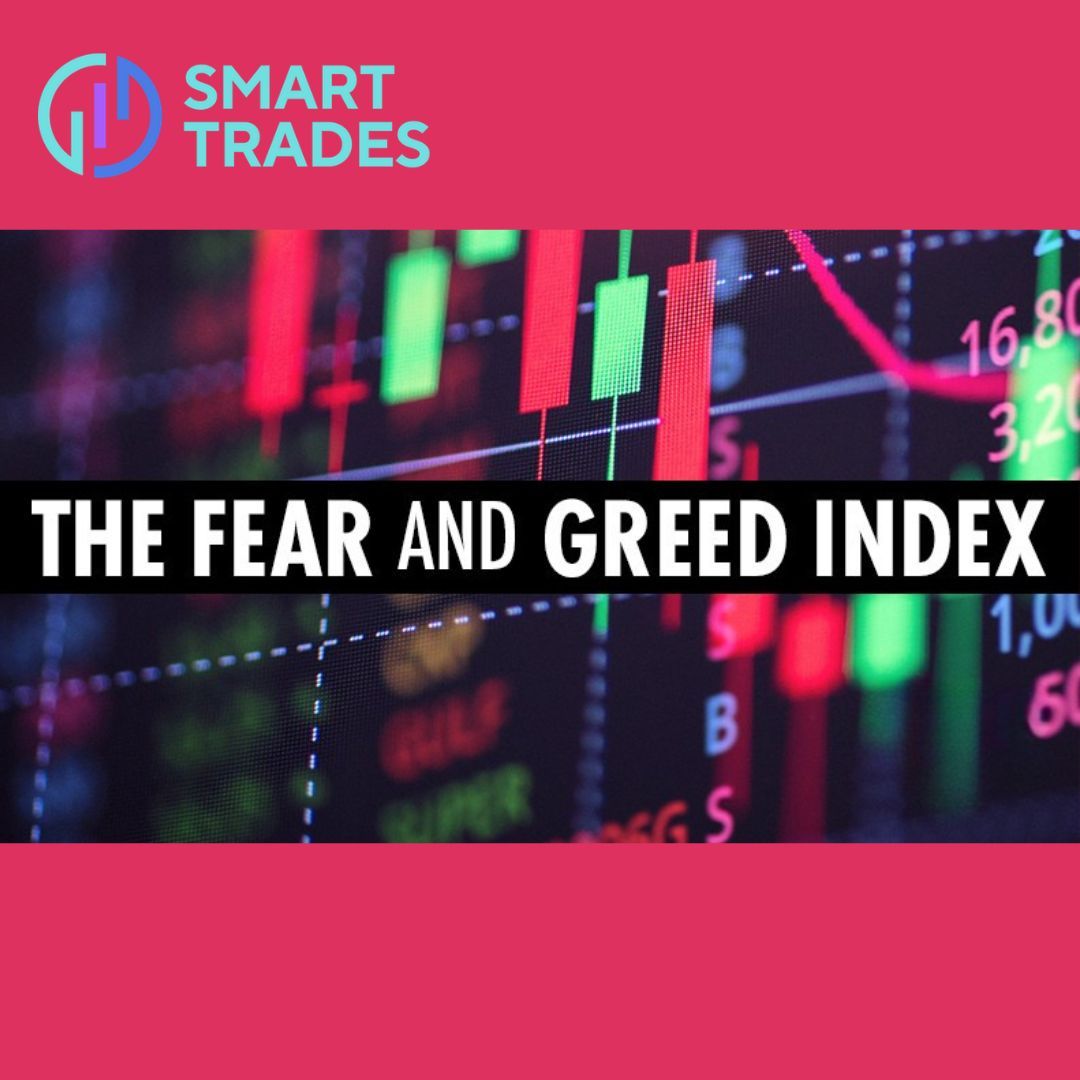
The Fear and Greed Index is basically a quick “mood check” for the market. It doesn’t predict the future, but it does show you what most investors are feeling right now. 😅📊
When the index is high, it usually means people are getting confident and chasing price. That’s when risk tends to creep up because emotions start driving decisions. 🟢⚠️
When it’s low, it often means fear is taking over and people are selling fast. That can create opportunities, but only if you stay patient and have a plan. 🔴🧠
A simple way to use it: Treat extreme readings like a reminder to zoom out, manage position size, and avoid impulse buys or panic sells. 📉📈✅
Do you check sentiment before you enter a trade or invest long term? 👇
#FearAndGreedIndex #Crypto #StockMarket #Investing #TradingTips #FuturesTrading #ForexTrading
Winning trades can come from bad decisions.
Losing trades can come from great decisions.
That's why experienced traders don't measure success by P&L alone. They measure success by whether they followed their plan.
Good decisions compound. So do bad habits.
Focus on your process, and the results will eventually catch up.
#TradingPsychology #Trading #Discipline #RiskManagement #Trader
Fair value gaps are crucial, yet often overlooked. We're seeing inversions now, highlighting the importance of understanding these specific candle patterns for market insight. #Trading#CryptoTrading#FuturesTrading#ForexTrading
Price drops while RSI climbs? That's bullish divergence signaling a big jump up. This isn't just a blip; it's a key indicator in your trading strategy. #TradingTips#Crypto#FuturesTrading#ForexTrading
One of the biggest lessons this market teaches you is that freedom and responsibility come as a package deal.
Trading gives you something very few careers can offer.
Complete control.
No one tells you when to enter.
No one forces you to take a trade.
No one decides how long you stay in the game.
Every decision starts and ends with you.
That freedom is what attracts so many people to trading.
But here’s where many traders get stuck…
They want the freedom to make their own decisions, but they don’t want to fully accept the consequences that come with those decisions.
They want control of the wheel, but they don’t want to be responsible when they crash.
And trading doesn’t work that way.
You can’t separate the freedom from the accountability.
If you want to become consistent, it starts with accepting one uncomfortable truth:
You are responsible for everything.
Every entry.
Every exit.
Every mistake.
Every improvement.
Your results are a reflection of the decisions you make and the process you follow.
Most people never prepare themselves for that level of ownership.
They look for something else to blame.
The market.
The strategy.
The indicator.
The person who gave them the idea.
But consistent traders think differently.
They understand that the same freedom that creates opportunity also creates responsibility.
You don’t get one without the other.
The moment you fully accept both is the moment you start becoming the trader you’re capable of being.
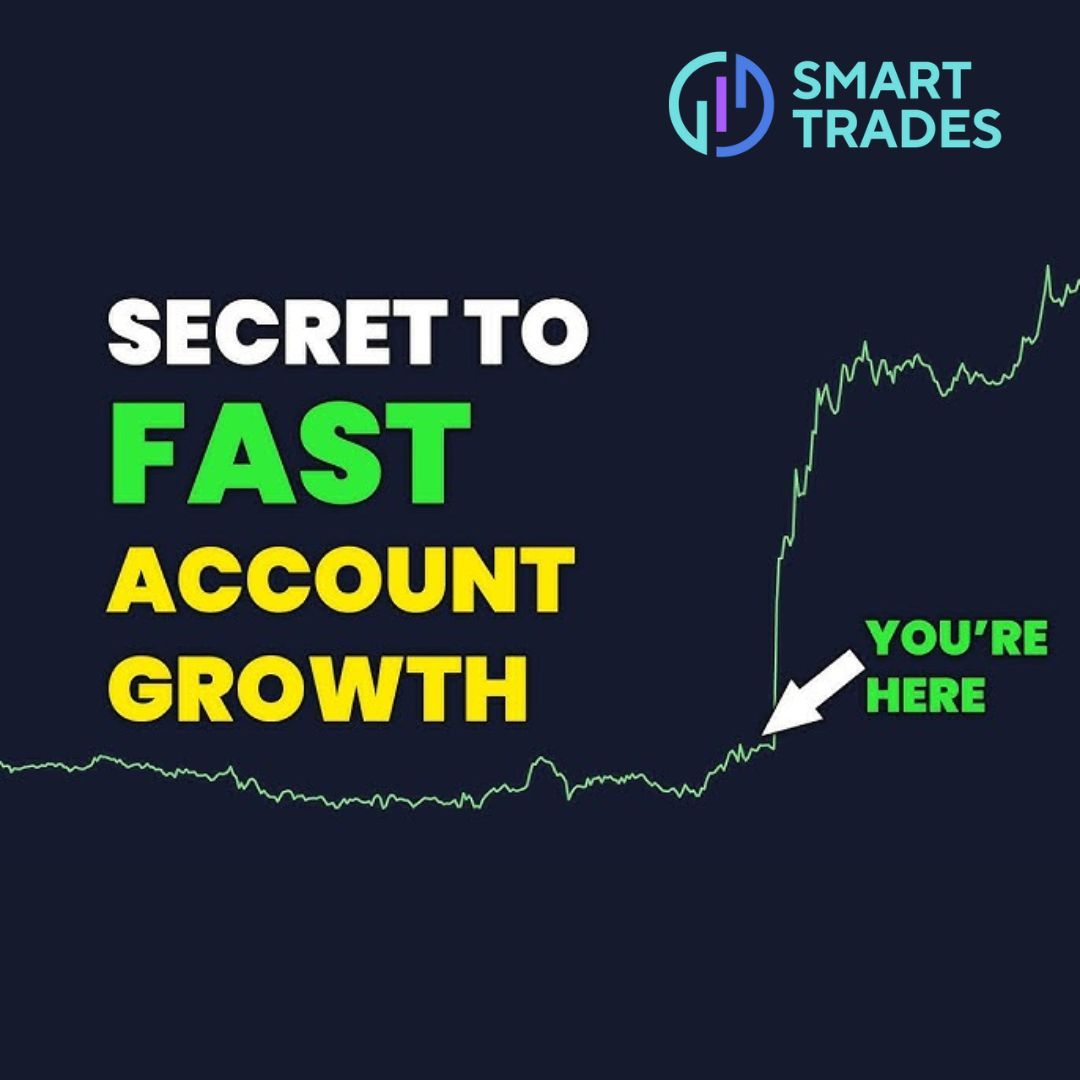
That “fast account growth” chart looks exciting, but the real secret usually isn’t a hack. It’s doing a few fundamentals really well, consistently. 📈✅
Most accounts stay flat because they try to go viral instead of getting better.
Here’s what actually drives faster growth: Post for one clear audience. If your viewer isn’t obvious in the first 3 seconds, they scroll. 🎯
Improve one thing per video. Hook, title, thumbnail, pacing, or audio. Small upgrades stack fast. 🔁
Double down on what worked. When a topic hits, make 3 more angles on it instead of switching niches. 🧠
Make it easy to binge. Use simple series formats and link videos so people watch the next one. ▶️
Track the right signals. Retention and click through rate beat views when you want steady growth. 📊
If you want, tell me what your channel is about and I’ll help you turn this into a quick checklist for your next 5 uploads. 🙌
#Shorts #CryptoTrading #FuturesTrading #ForexTrading #TradingTips #Trading
Consistency doesn't come from one incredible trading day.
It comes from making good decisions over and over again—even on the days when the results don't go your way.
Small improvements repeated consistently create big results over time.
Trust the process.
#Consistency #Trading #DayTrading #TraderLife #Success
random trading is one of the easiest traps to fall into because it feels like freedom.
But most of the time, it’s actually a way to avoid accountability.
Random trading looks like this:
Taking trades without a clear plan.
Changing your rules depending on the situation.
Entering because something “feels right.”
Using a hundred different variables without ever knowing what actually creates results.
And the biggest problem?
You never get a true answer on what works and what doesn’t.
But here’s what random trading really is…
It’s a hiding place.
Because when a random trade works, you give yourself the credit.
You tell yourself you saw something others didn’t.
But when it fails, there’s always a reason.
The market was unpredictable.
The news changed things.
The setup was different.
Something happened that you couldn’t have controlled.
And suddenly, the loss isn’t your responsibility.
That’s why random trading is so dangerous.
It allows you to experience the excitement of trading without facing the uncomfortable truth of what needs to improve.
It gives you freedom without accountability.
But real growth doesn’t come from having endless options.
It comes from having a process you can measure, review, and improve.
A defined plan.
Clear rules.
Limited variables.
Not because a plan guarantees success…
But because a plan removes the excuses and forces you to face reality.
And that’s where improvement begins.
Growth starts when you stop hiding from your mistakes and start learning from them.