Lean Startup Sydney Meetup Newsletter #LeanStartupSyd Connecting people passionate about Customer Discovery & Lean Startup Methodologies from @SGBlank @EricRies
Colombia ha seleccionado a la empresa australiana Electro Optic Systems (EOS) para suministrar las estaciones de armas de control remoto (RWS) que equiparán a los 55 vehículos blindados LAV III 8x8 del Ejército colombiano.
De acuerdo con Janes, la configuración contempla 28 estaciones R400, armadas con el cañón M230 LF de 30 mm de Northrop Grumman, y 27 estaciones R150, equipadas inicialmente con ametralladoras pesadas M2A2 QCB de 12,7 mm.
🇨🇴 El plan contempla que, a largo plazo, los 55 LAV III puedan ser equipados con la estación R400, incrementando su capacidad de fuego.
La elección de EOS se produce después de que Colombia evaluara otras alternativas, entre ellas las estaciones Samson de Rafael, de Israel, y sistemas de Kongsberg, de Noruega.
La R400 es una estación de armas estabilizada que puede integrar cañones de hasta 30 mm, ametralladoras, lanzagranadas y misiles antitanque. Además, incorpora sensores electroópticos y sistemas de control de tiro para operaciones contra objetivos terrestres y aéreos.
El proceso de selección generó retrasos en el programa. La entrega final de las estaciones, inicialmente prevista para 2026, ahora estaría proyectada para 2027.
Con esta incorporación, Colombia busca dotar a sus nuevos LAV III 8x8 de una mayor capacidad de fuego y sensores, avanzando en la modernización de sus fuerzas blindadas.
#Colombia #EjércitoColombiano #LAVIII #LAVIII8x8 #EOS #R400 #R150 #RWS #Defensa #Blindados #TecnologíaMilitar #FuerzasArmadas #Militar #FronteraMilitar
Colombia ha seleccionado a la empresa australiana Electro Optic Systems (EOS) para suministrar las estaciones de armas de control remoto (RWS) que equiparán a los 55 vehículos blindados LAV III 8x8 del Ejército colombiano.
De acuerdo con Janes, la configuración contempla 28 estaciones R400, armadas con el cañón M230 LF de 30 mm de Northrop Grumman, y 27 estaciones R150, equipadas inicialmente con ametralladoras pesadas M2A2 QCB de 12,7 mm.
🇨🇴 El plan contempla que, a largo plazo, los 55 LAV III puedan ser equipados con la estación R400, incrementando su capacidad de fuego.
La elección de EOS se produce después de que Colombia evaluara otras alternativas, entre ellas las estaciones Samson de Rafael, de Israel, y sistemas de Kongsberg, de Noruega.
La R400 es una estación de armas estabilizada que puede integrar cañones de hasta 30 mm, ametralladoras, lanzagranadas y misiles antitanque. Además, incorpora sensores electroópticos y sistemas de control de tiro para operaciones contra objetivos terrestres y aéreos.
El proceso de selección generó retrasos en el programa. La entrega final de las estaciones, inicialmente prevista para 2026, ahora estaría proyectada para 2027.
Con esta incorporación, Colombia busca dotar a sus nuevos LAV III 8x8 de una mayor capacidad de fuego y sensores, avanzando en la modernización de sus fuerzas blindadas.
#Colombia #EjércitoColombiano #LAVIII #LAVIII8x8 #EOS #R400 #R150 #RWS #Defensa #Blindados #TecnologíaMilitar #FuerzasArmadas #Militar #FronteraMilitar
We are living in the greatest time ever, in the greatest city (Sydney) to have ever existed.
How you can’t be incredibly optimistic and irrationally excited about life, I do not understand.
$EOS.AX
Excited to announce our new partnership with BAE Systems! Together, MARSS and BAE Systems are combining innovation and expertise to deliver next-generation solutions in defense and security. The future of advanced technology just got stronger. #MARSS#BAESystems
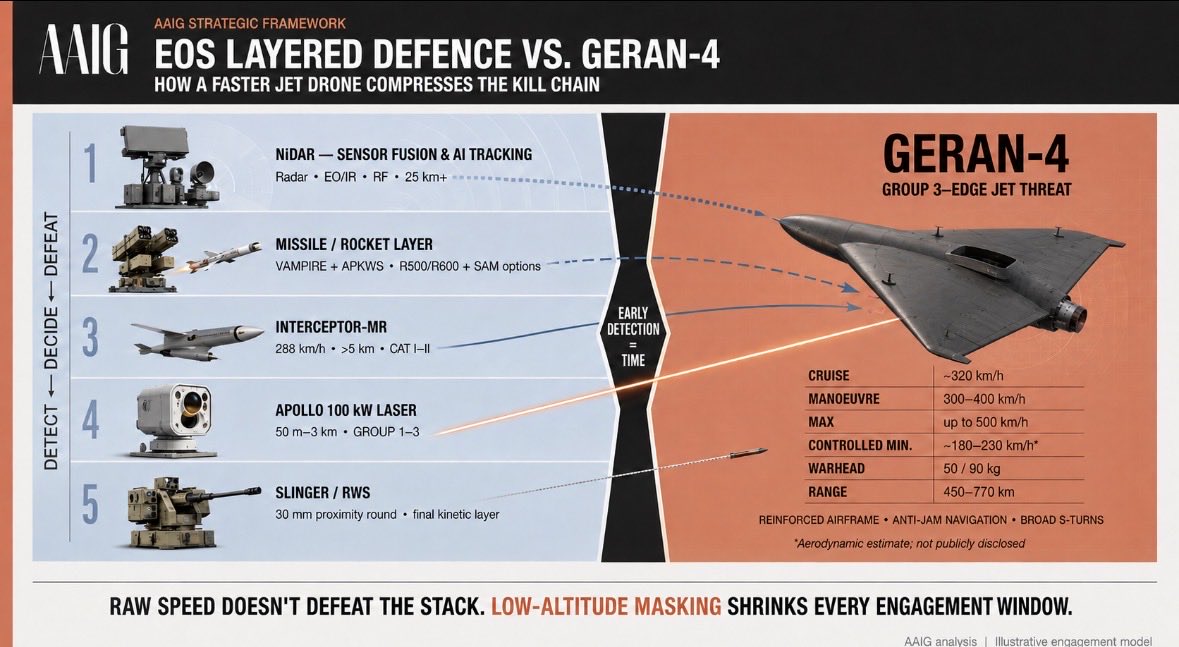
So, a few members asked me today how $EOS.AX counter-drone portfolio should be viewed against the new Geran-4 class that is now being used in Ukraine.
With the Geran-4, you essentially have a newer, jet-powered development of the Geran-2/Shahed concept. If you compare it with the propeller-driven Geran-2, it is much faster and gives defenders less time to react, classify it and engage it. These drones can fly low, use terrain and change direction, making that window even smaller.
This is, by the way, a constant dollar-for-dollar battle between the attacking side and the defending side. That is also why they use mixed-class swarms, with cheaper and more agile drones alongside heavier Geran-4 drones for greater impact. The Geran-4 weighs approximately 450 kilograms.
The most important thing is that you cannot look at one EOS product and ask whether that specific product alone can stop it. EOS is specifically building a multilayered system in which different sensors and weapons cover different distances and different types of threats.
Of course, these systems would also not be positioned next to each other in a straight line. You place sensors farther out or in elevated positions to improve visibility, while also using the landscape to your advantage around the point you are defending. The effectors are then distributed around the asset they are protecting.
Longer-range interceptors and missile or rocket solutions create the first engagement opportunities. Our Apollo laser system then provides another layer closer in, with a published hard-kill range of up to 3 kilometres against Group 1 to 3 drones. The Slinger systems, which are remote weapon systems, then operate as the close-range kinetic layer if something gets through.
The NiDAR system connects the entire fleet. That is essentially the foundation of the turnkey solution. It is the command-and-control and sensor-fusion layer that combines information from multiple radars, cameras, thermal sensors and everything else into one shared track. It then helps the operator select the most suitable effector as the drone moves through the different defensive layers.
This is also why the MARSS acquisition is so important strategically. Like I said, EOS is moving from selling individual weapons towards providing the complete counter-drone architecture: detect, identify, decide and defeat.
Because NiDAR is open and modular, EOS can combine its own lasers, remote weapon systems and interceptors with existing customer equipment or third-party missiles and sensors.
*numbers in the figure are indicative
$AVAV $LASR
So, a few members asked me today how $EOS.AX counter-drone portfolio should be viewed against the new Geran-4 class that is now being used in Ukraine.
With the Geran-4, you essentially have a newer, jet-powered development of the Geran-2/Shahed concept. If you compare it with the propeller-driven Geran-2, it is much faster and gives defenders less time to react, classify it and engage it. These drones can fly low, use terrain and change direction, making that window even smaller.
This is, by the way, a constant dollar-for-dollar battle between the attacking side and the defending side. That is also why they use mixed-class swarms, with cheaper and more agile drones alongside heavier Geran-4 drones for greater impact. The Geran-4 weighs approximately 450 kilograms.
The most important thing is that you cannot look at one EOS product and ask whether that specific product alone can stop it. EOS is specifically building a multilayered system in which different sensors and weapons cover different distances and different types of threats.
Of course, these systems would also not be positioned next to each other in a straight line. You place sensors farther out or in elevated positions to improve visibility, while also using the landscape to your advantage around the point you are defending. The effectors are then distributed around the asset they are protecting.
Longer-range interceptors and missile or rocket solutions create the first engagement opportunities. Our Apollo laser system then provides another layer closer in, with a published hard-kill range of up to 3 kilometres against Group 1 to 3 drones. The Slinger systems, which are remote weapon systems, then operate as the close-range kinetic layer if something gets through.
The NiDAR system connects the entire fleet. That is essentially the foundation of the turnkey solution. It is the command-and-control and sensor-fusion layer that combines information from multiple radars, cameras, thermal sensors and everything else into one shared track. It then helps the operator select the most suitable effector as the drone moves through the different defensive layers.
This is also why the MARSS acquisition is so important strategically. Like I said, EOS is moving from selling individual weapons towards providing the complete counter-drone architecture: detect, identify, decide and defeat.
Because NiDAR is open and modular, EOS can combine its own lasers, remote weapon systems and interceptors with existing customer equipment or third-party missiles and sensors.
*numbers in the figure are indicative
$AVAV $LASR
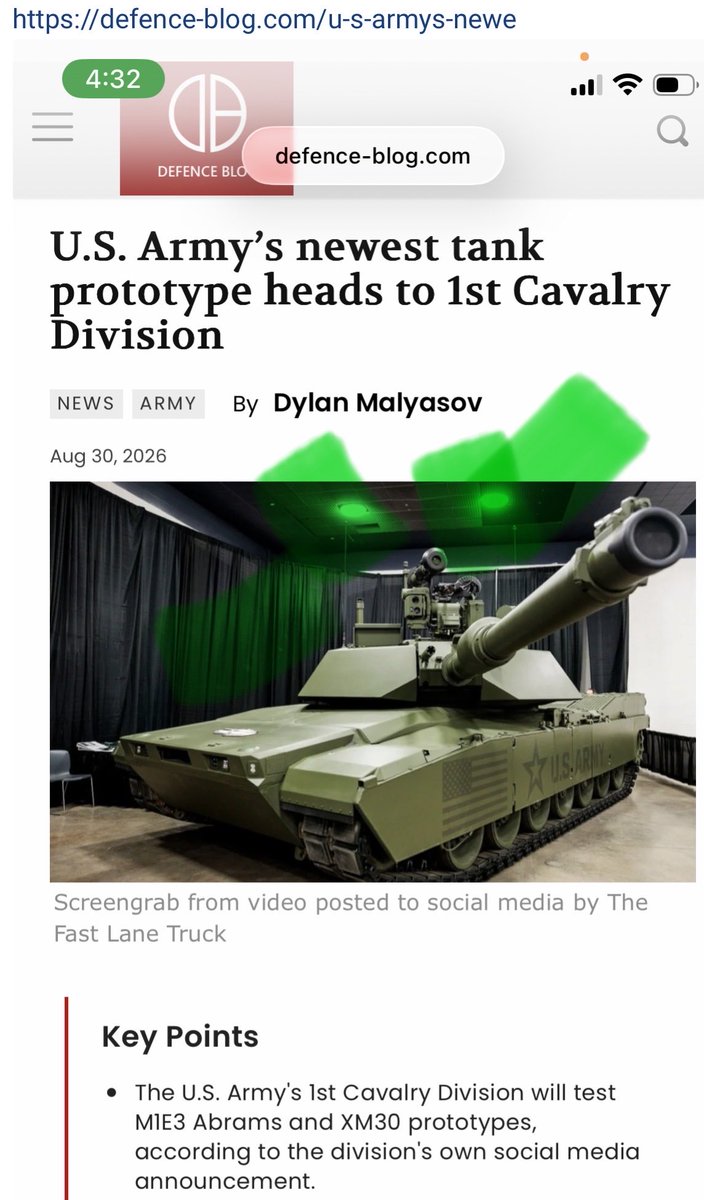
The U.S. Army's next tank moves its crew out of the exposed turret and into an armored capsule in the hull. The 1st Cavalry Division will be the first unit to test it.
Full story: https://t.co/qk3I6m2oY9
The U.S. Army's next tank moves its crew out of the exposed turret and into an armored capsule in the hull. The 1st Cavalry Division will be the first unit to test it.
Full story: https://t.co/qk3I6m2oY9
$EOS.AX is Australia’s crown jewels. They own all the legacy ‘Star Wars’ laser technology, created over 40 years ago.
They are Australia’s only home-grown Prime contractor (No $DRO isn’t a prime)
Stronger US-AUS security cooperation requires action and involvement from both sides.
EOS sits in the middle of three of the biggest, most important evolutions in modern warfare: Full-stack counter drone solutions, High-Powered Laser Weapons and Space Control.
The Wars in Iran and Ukraine have identified gaping holes in drone defence, globally. The US, gulf allies and russia have lost tens of billions in irreplaceable assets because of poor, fragmented and expensive countermeasures.
EOS has been contracted A$127m in kinetic counter-drone remote weapon systems (RWS), A$84m in naval RWS, A$200m in conditional and unconditional Laser Weapons and tens of millions in orders for Its space awareness and control systems- where outside the US, only EOS has the capability to track, dazzle and even de-orbit satellites.
Not including the multi billion dollar potential European pipeline, (RWS and Apollo Laser weapons, existing US orders- next gen Abrahams tank and $LHX vampire systems) this opens the door wide for the US to acquire billions in further orders. Some said that EOS had no chance to sell its 50-150kW Laser weapons to the US, but this statement from Marco Rubio flips the narrative. EOS is the first to receive export orders for its Laser Weapons, and is ready to deploy them NOW.
If the US thinks tensions are heating up in Taiwan and China, they will be looking for soloution to deploy right now- and for affordable prices. That is EOS. No one else currently has that capability. “Double the power, for half the price in half the time” - EOS CEO Dr. Schwer.
No one is ready for how large the international counter drone and missile market will be - and EOS will be right in the middle of it.