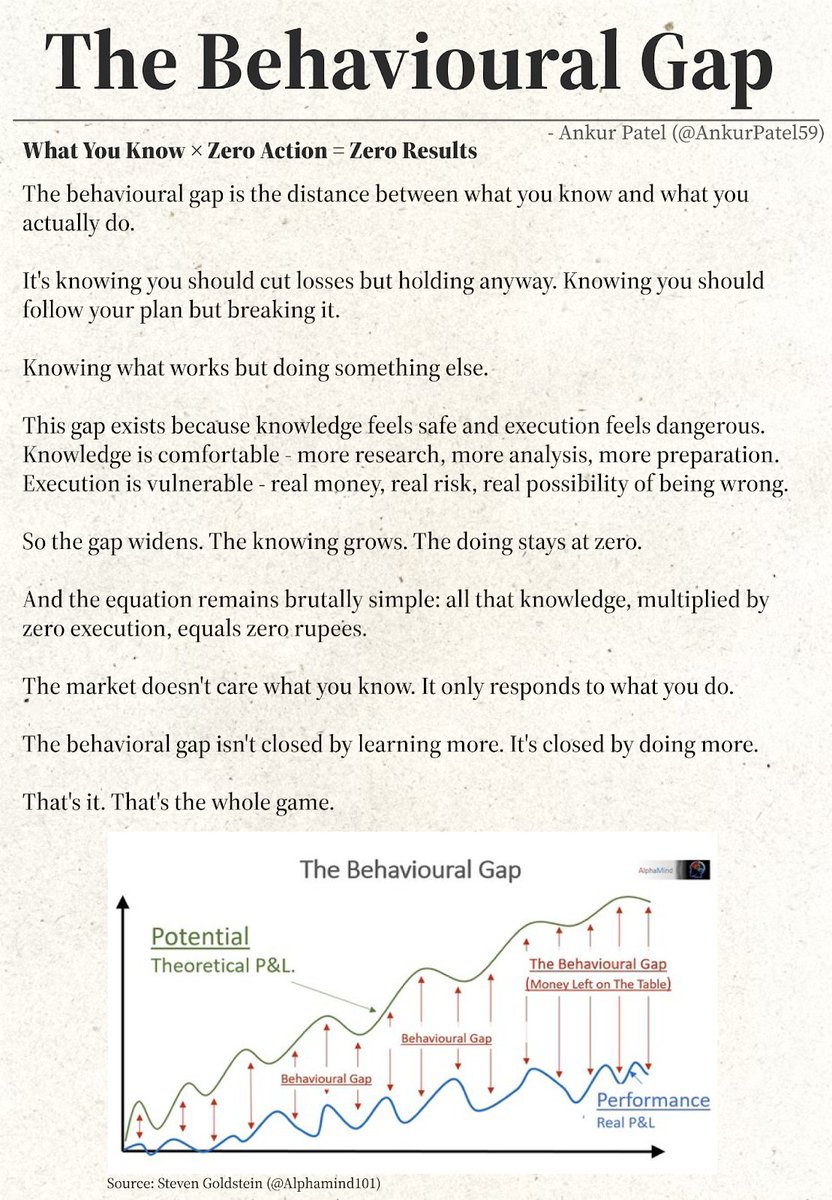
Your potential P&L and your actual P&L are never the same. The gap between them is your behavioral gap.
This one pager explains why it happens - and how to fix it.
Idea Credit - @AlphaMind101
If your buy and sell decisions are based purely on chart patterns, your performance will likely be random.
You can always find a bull flag, VCP, cup with handle — you name it.
But strong and lasting uptrends don’t happen because of pretty charts.
They’re driven by clear industry trends, solid fundamentals, and an exceptional business model behind the move.
That’s when chart setups truly matter.
Six years ago, a guy called me. Final year of college. Smart kid, genuinely curious about life.
He wanted to get into trading.
He'd been watching videos, reading books, practicing strategies. He was excited. He saw trading as his way out - his path to financial freedom, to doing something different with his life.
He wanted to go all-in after graduation. Just trading.
I told him to wait.
"Get a job first. Build some savings. Then try trading on the side while you have income coming in."
He didn't listen.
His parents supported him. They helped him financially while he figured things out. Month after month. Year after year.
Last I heard, he's buried in debt. Six years of trying. Nothing to show for it.
Trading didn't work out for him.
Here's what he didn't understand that I did.
Trading is different from a normal job. So is YouTube. So is art, writing, building an audience, even dating.
With a normal job, you trade time for money. Work eight hours, get paid for eight hours. It's predictable.
Linear. Boring, maybe, but you know what you're getting.
But trading? You could study for three months and lose money. Or you could get one good trade and make what most people earn in six months.
The same goes for YouTube. You could post videos for a year and get nowhere. Or your tenth video could blow up and change everything.
That's what makes these things exciting. The upside is huge. Way bigger than what you'd get from just working a regular job.
But there’s a downside too: you can't predict when it'll pay off.
You can't force it. You can't guarantee it. You can work incredibly hard and still get nothing for a long time.
Most people know this, somewhere in the back of their minds.
But they don't really think through what it means.
They think: "Okay, it might take time. So I'll just keep working at it. I won't give up. I'll stay committed."
And they quit everything else. They go all-in. They pour all their time and energy into this one thing.
Because that's what you're supposed to do, right? That's what all the success stories say. "Go all-in." "No B plan."
But that's where they falter.
In my view, you need two things, not one.
You need the thing with the big upside - trading, or YouTube, or whatever it is that excites you.
But you also need something stable. Something that pays the bills. Something you can rely on while you're building the other thing.
A job. A skill that brings in steady money. A Plan B.
Most people hate this idea. They think it means you're not fully committed. That you're hedging. That you don't really believe in yourself.
But they're wrong.
When you don't have anything stable, something happens.
You get stressed. You start worrying about rent, about bills, about how you're going to eat next month.
And when you're stressed like that, you can't think clearly.
In trading, you take dumb risks because you need the money now. You can't afford to be patient. You can't afford to wait for the right setup.
In content creation, you start copying whatever's trending instead of building something unique. You chase quick wins instead of playing the long game.
You make desperate decisions. And desperate decisions rarely work out.
But when you have something stable? When you know your basics are covered?
Everything changes.
You can think clearly. You can take your time learning. You can afford to fail and try again. You can be patient and wait for the right opportunities.
You're mentally free.
That guy who called me six years ago didn't have that.
His parents were helping him, which sounds good on paper. But it created this weird situation where he wasn't desperate enough to quit, but also not stable enough to think straight.
He just kept grinding. Hoping something would click. Waiting for trading to finally work out.
And it didn't. And he went into debt trying anyway.
If he'd just gotten a job first? Even something simple. Built up a few months of savings. Then learned trading while having income?
Completely different story.
He would've learned at his own pace. He could've taken losses without panicking. He would've had the mental space to actually improve instead of just surviving.
He would've been free to succeed.
So, yeah, go after the big opportunities. Learn to trade if that's your thing. Start that YouTube channel. Write. Make art. Try things that could actually change your life.
But do it smart.
Build something stable first, or build it alongside. Give yourself room to breathe. Don't put yourself in a position where you're making decisions out of desperation.
The weird thing is, having a backup actually makes you more likely to succeed at the main thing.
Because you can afford to be patient. You can afford to learn properly. You can wait for the right moment instead of forcing it.
You can stay in the game long enough to actually get good.
#Traading
Struggling with your trades and not sure what’s going wrong?
Pradeep Bonde @PradeepBonde breaks it down into 4 clear buckets: setup, market conditions, process, or trader (you).
A simple lens to reflect on your own trading.
Let’s walk through it 🧵👇
I'm a big fan of specialization.
Focusing on:
- One market
- One setup
- One time frame
Going funnel-vision on that And
getting to know it like the back of your hand.
That's a very powerful thing.
Why Do We Trade?
This isn’t just about making money.
Every trader has a story—a reason, a purpose.
Just like starting a business, if your “why” isn’t clear, you’ll get lost in the chaos.
Let’s explore why people come to the markets and why understanding your “why” is the key to success. 🧵👇
The Blindsight device from Neuralink will enable even those who have lost both eyes and their optic nerve to see.
Provided the visual cortex is intact, it will even enable those who have been blind from birth to see for the first time.
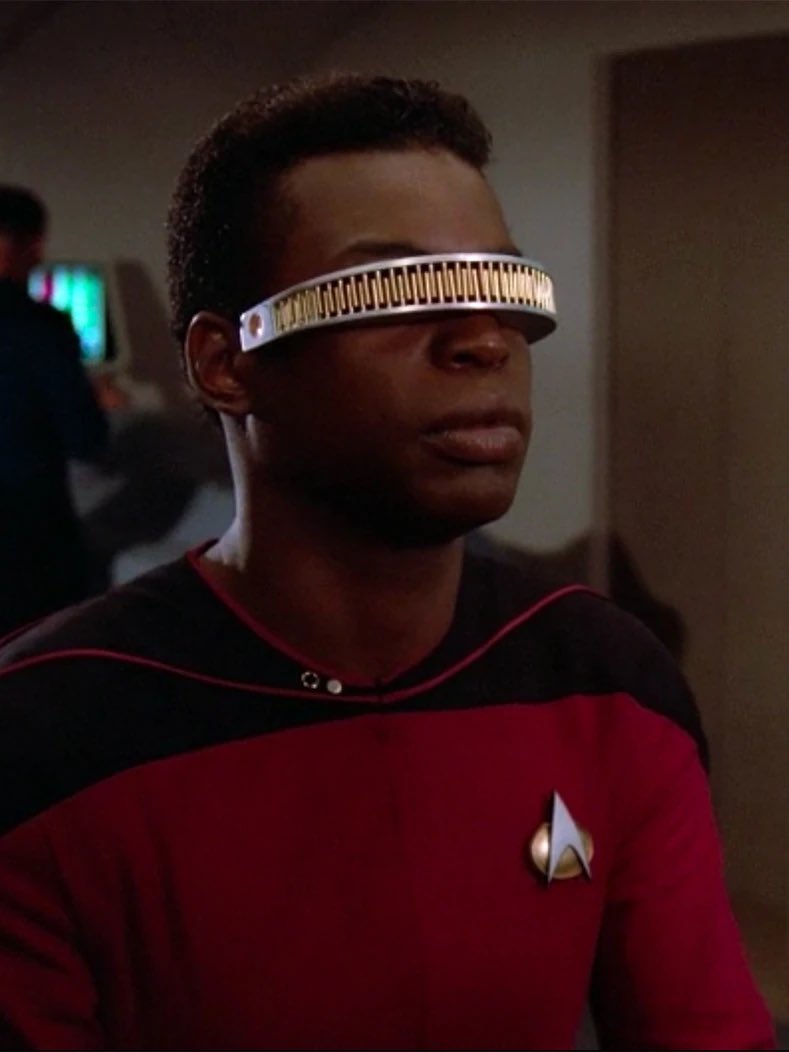
To set expectations correctly, the vision will be at first be low resolution, like Atari graphics, but eventually it has the potential be better than natural vision and enable you to see in infrared, ultraviolet or even radar wavelengths, like Geordi La Forge.
Much appreciated, @US_FDA!
My son,
Go to the gym,
Even if you’re tired.
Start that business,
Even if you’re poor.
Invest in education,
Even if you’re broke.
Approach that girl,
Even if you’re shy.
Do that work,
Even if you’re unmotivated.
You're a man,
Find a way to get things done.
Trading isn't just about numbers; it's a test of passion. When trading gets difficult, only the truly passionate persist. Remember, the greatest traders aren't born in bull markets but are forged in difficult times. 💪#StockMarket
I’ve spent endless hours studying the average reality of multiple multi-millionaires and billionaires from multiple countries and cultures.
I’ve found 14 disturbing things they sacrifice in order to get rich.
Take notes: