Greetings, #iTeachMath community. I want to announce a new website I made, https://t.co/pGgi3OGSmE. This site is free to use, with no ads, accounts or logins - just load and go. It is a library of custom-made "Labs" - interactive tools to explore and practice a math concept...
Ever wanted to learn electronics but had no idea where to begin?
I made an app to help you get started.
48 lessons with circuit diagrams, charts, the maths behind them, and plenty of things to experiment with.
Available in 13 languages.
https://t.co/AhTsvhi93h
7 CONFRONTING QUESTIONS TO ASK YOUR CHILD
Their answers may be difficult to hear...
but they can show you what your child has been feeling and struggling to say...
Must ask 👇 🧵
@jasveer10 It is not that parents should not have disagreements. It is impossible as adults to act all happy in front of kids. Pretending everything is normal will not do any good. They shd see healthy way of handling conflicts.
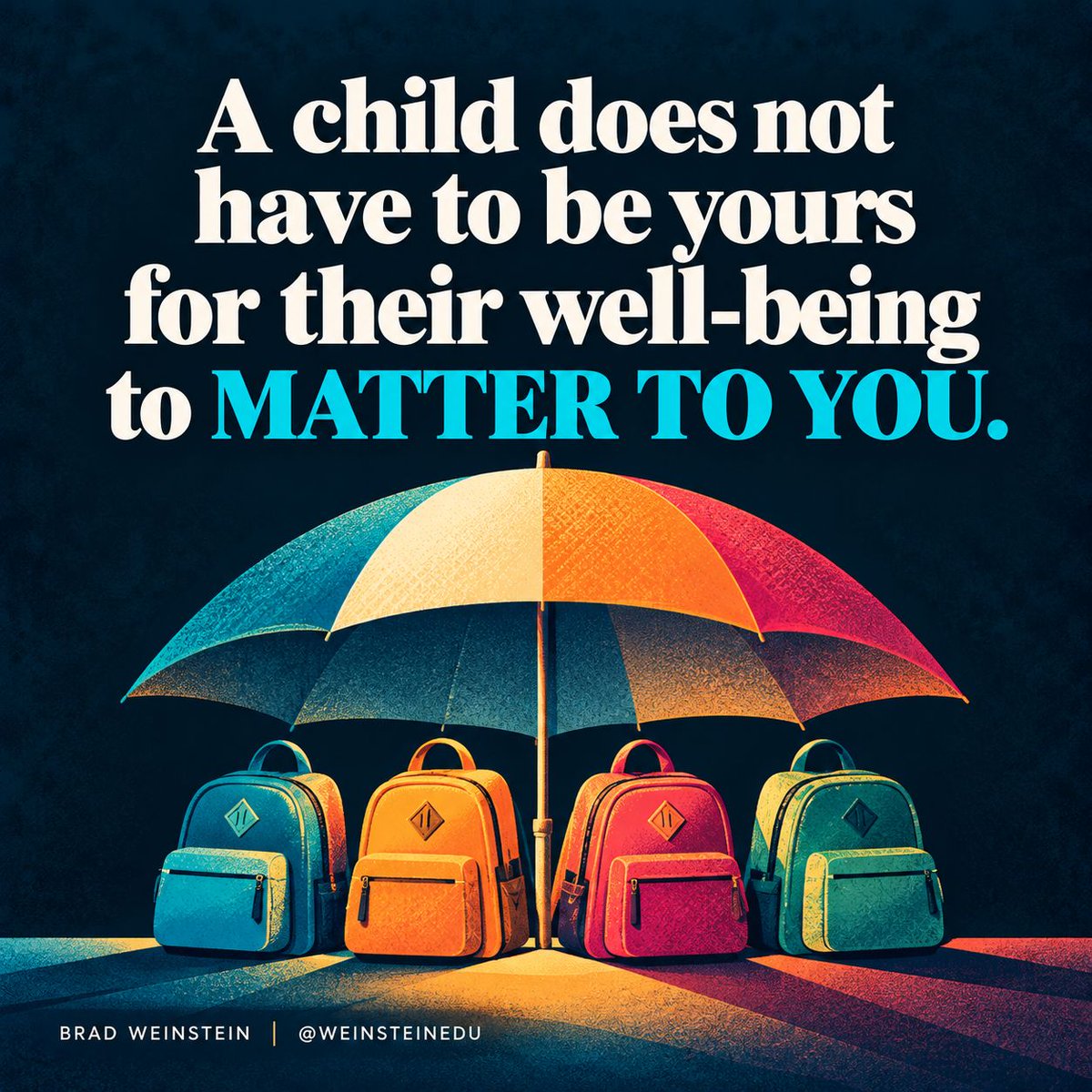
Some kids have a long list of adults looking out for them.
Others may only have one or two.
That is why the way we respond to a student who is not “ours” still matters. The kid in the hallway. The student from another class. The child at the game, bus stop, or neighborhood park who needs an adult to notice that something is off.
We do not need to replace anyone’s family to care about their well-being.
Sometimes being part of a community simply means deciding that every kid around us is worth noticing.
Fred Rogers met with a child psychologist every week for 22 years to build his show. She shaped everything: every script, prop, and song. The whole point was to give a child's nervous system time to slow down. In 1984, a single regulatory decision ended all of it.
The psychologist was Dr. Margaret McFarland, who co-founded the Arsenal Family and Children's Center alongside Benjamin Spock and Erik Erikson. She and Rogers understood that the prefrontal cortex in children, the part of the brain that controls impulse, emotion, and attention, takes decades to fully develop. At the start of every episode, Rogers tied his sneakers and changed his sweater while children settled in. Those pauses were intentional, designed to help a child's nervous system shift into a calmer, more focused state.
What ended it had nothing to do with child development science. In 1984, Reagan's FCC chairman Mark Fowler abolished the advertising limits that had protected children's programming from commercial pressure. Toy companies moved within months. Between 1984 and 1985, cartoons tied to toy lines increased by 300%, from a handful of shows to more than 40 animated series. In almost every case, the toy was designed first. The cartoon was built to sell it.
Researchers later put numbers to what parents were already noticing. A 2011 study in Pediatrics from the University of Virginia tested 60 four-year-olds across three groups: one watching SpongeBob, which cuts scene every 11 seconds; one watching a slow PBS show, which cuts scene every 34 seconds; and one drawing. Nine minutes later, all three took tests on attention, impulse control, short-term memory, and problem-solving. The SpongeBob group scored significantly worse across every measure.
In the 1970s, children began watching television around age 4. Research from pediatrician Dimitri Christakis found that by 2009, the average age of first screen exposure had dropped to 4 months, as the content got faster and the audience got younger. Researchers separately found that each additional hour of daily screen time at ages 1 or 3 raised the risk of attention problems at age 7 by 9%.
Major cheat code for life: Be patient with yourself when you’re trying to become someone you’ve never been. You’ll feel lost, unsure, and tempted to quit. Don't. Change feels chaotic because your old self is fighting for survival. Expect it to be a battle. But also expect to win.
@disco_lu "Heal beyond everything that has ever hurt you and be willing to be there for yourself, no matter what happens." It is from a book. I have sent you dm. Wish you the strength to pick yourself up again.
A therapist who spent 40 years counseling couples on the edge of divorce wrote down the one conversation she believes every couple should have before getting married.
She said, “If you have this conversation honestly, you will either save yourself decades of pain or build a foundation strong enough to survive anything.”
Here is the conversation…
We want YOU to start a company and we want to pay you for it!
We need to test our new platform that orchestrates agents to run an entire company. That's why we're launching The General Intelligence Fellowship.
Build something cool with us, keep all of it, and get free money 🌻