Most news tells you what happened.
The Weekly Insight explains how the pieces connect.
AI depends on chips, energy and capital.
Energy shapes industrial power.
Capital determines who can build, scale and compete.
These are not separate stories. They are one system.
I connect the dots across technology, energy, geopolitics and finance to explain:
→ Who gains and who loses
→ Where power is shifting
→ What to watch next
Built on Mind, Matter, Money.
Free original research every Saturday.
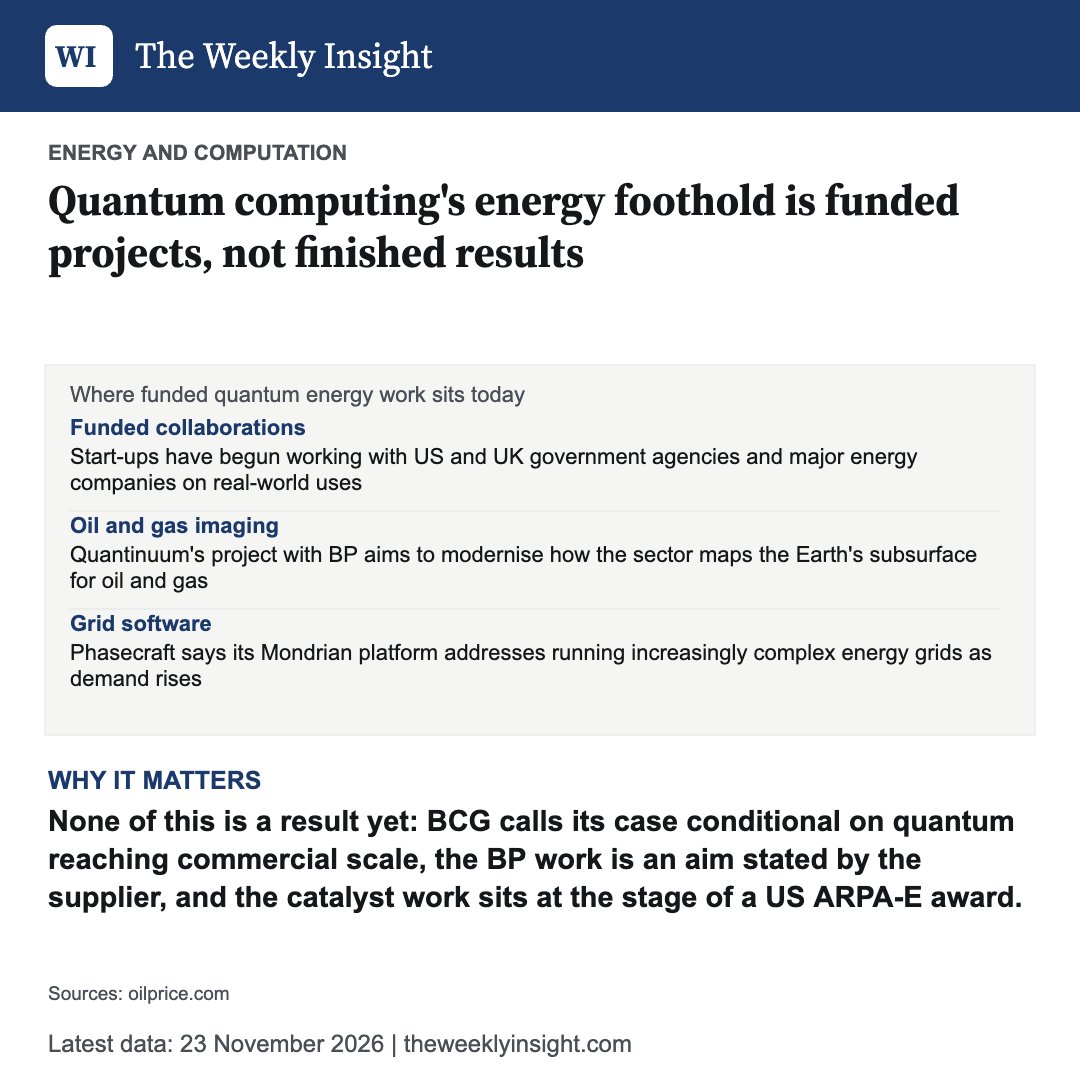
A US Department of Energy ARPA-E award pairs Phasecraft with Johnson Matthey, Harvard and QuEra on catalyst discovery. The initial focus is low-cost hydrogen, with the stated aim of cutting reliance on platinum group metals such as iridium.
Quantum work in energy is still at project stage: BCG's conditional case on battery chemistry, a BP project with Quantinuum on subsurface imaging, and a US ARPA-E catalyst award involving Phasecraft. BCG says major change could be years away.
BP is working with Quantinuum on subsurface imaging. Quantinuum's president and chief executive, Rajeeb Hazra, said in May it could offer a more efficient path for energy exploration, via higher-fidelity data at lower computational cost. A supplier aim, not a measured result.
A US senator is investigating the role Vice President JD Vance played in awarding a lucrative Venezuelan oil contract to a political donor who was then a Vitol Group executive. An inquiry, not a finding. What changes that is documents on how the award was decided.
Nvidia's board voted unanimously to reinstate Jensen Huang as chief executive, less than two weeks after he resigned over an affair with a woman alleged to be a Chinese spy. Shares rose more than 31%, adding nearly $1tn in market value, with the Nasdaq up 6.5% and the S&P 500 up 4.75%. Much of the tech rally began in pre-market trading, before the announcement. Nvidia still trades about 21% below where it was a month ago. Trump says he convinced the board; Nvidia says directors acted after a series of discussions with Huang. Dan Niles is trimming; Burry would consider shorting again near $200. Huang testifies to the Senate banking committee on export controls on 3 December.
US developers plan to add a record 86 GW of utility-scale generating capacity in 2026, the EIA said on 20 February, using its Preliminary Monthly Electric Generator Inventory for December 2025. Solar is 51% of that, battery storage 28% and wind 14%, with 6.3 GW of new gas-fired capacity, about 7%.
That is a construction pipeline, not a generation figure. Storage shifts power produced elsewhere rather than adding fuel of its own, and the build is highly concentrated: Texas takes 40% of planned solar and 53% of planned battery capacity. Oilprice analysts Leonard Hyman and William Tilles note that gas-fired electricity production has meanwhile held steady.
CrowdStrike just agreed to buy Zscaler in a $43.9 billion all-stock deal, the largest cybersecurity acquisition on record, combining CrowdStrike's $6.26 billion in ending ARR with Zscaler's roughly $3.9 billion to start above $10 billion in annual recurring revenue. As autonomous AI agents gain direct access to corporate data and networks, paying a 34% premium in fixed shares with no price floor shows how fast enterprise security is consolidating into one stack.
Jensen is out at $NVDA . The board moved fast after the reports.
How does that solve the problem the company actually faces?
MIND: the founder was the node that set product direction, customer access, and the conversation in Washington. New leadership has to re-earn that while the cadence keeps going.
MATTER: the chips still have to be made, the power still has to reach the data centers, and the physical path of the silicon (licensed or otherwise) doesn’t change because the CEO changed. Demand is still there; the constraints are still physical.
MONEY: capital still has to finance the next round of capacity. Cleaner governance might lower one risk premium. A leadership search in the middle of the buildout raises another.
What part of the stack does this actually fix?
The real takeaway goes beyond Nvidia. When one founder's exit can trigger a 17.5% weekly drop in Taiwan's TAIEX, push South Korea's KOSPI more than 40% off its peak, and force Asian regulators into emergency market stabilization, Mind (frontier compute), Matter (Asian foundry and memory capacity), and Money (trillions in debt-funded capex) now share a single point of failure.
Nvidia just added nearly $1 trillion in market value in minutes by putting one person back in the CEO chair. Eleven days after Jensen Huang resigned on November 12, shares fell 24.5% to $125.53 (47.5% off their Oct 6 peak) before surging 31.0% to $164.46 in premarket and opening up 29.3%. What this whipsaw reveals about AI market structure:
Second, bringing Huang back ends succession panic, not the balance-sheet and regulatory overhangs. Nvidia's Q3 filing shows supply commitments jumped 39.8% QoQ from $279 billion to $390 billion alongside up to $118 billion in guarantee exposure, while Q4 gross margin is guided down to 71% to 72%. Meanwhile, the SEC accounting review and independent board probe remain open.
Nvidia's board just reinstated Jensen Huang as CEO effective immediately, eleven days after his November 12 exit erased 23% of the company's market value. Shares jumped more than 31% in premarket trading after senior US officials signaled no national security objection. When a multi-trillion-dollar hardware supply chain from Taipei foundries to Washington export licenses still runs through one founder, succession stops being a corporate governance question and becomes a market-structure risk.
Today's Update · 23 November
Ukraine says its sea drones sank a Russian warship in Libya, while the Antalya climate summit has formally closed without an overarching agreement. These developments extend the reach of the war and leave the central dispute over fossil fuels unresolved.
MIND
• Women's livelihoods: India's Rural Development Ministry announced on 23 November a campaign called Nayi Chetna, due to launch on 25 November, focused on women's control over assets, safe mobility and sharing unpaid care work. These are stated aims rather than measured results. By addressing assets, travel and care time together, the campaign targets barriers to women being recognised as economic contributors.
MATTER
• Copper production: In Monday's investor presentation, BHP ($BHP) set out a South Australian growth plan built on block caving, a method of underground mining, and two-stage smelting. The company says block caving structurally lowers mining costs and two-stage smelting facilitates a larger-scale, longer-life operation, with future investment decisions still to be made. The proposed route to more copper depends on changes to both extraction and smelting; the plan has yet to deliver that additional metal.
• Mediterranean security: Ukraine's Security Service said on Monday that Ukrainian forces destroyed the Russian corvette Merkury and struck the cargo vessel Angara near Benghazi, Libya. Two Libyan officials told the Associated Press that the corvette was heavily damaged rather than sunk after Sunday's strike. Ukraine's claim places its attacks on Russian vessels in a North African port; the accounts disagree over the corvette's condition.
• Climate negotiations: Sunday's final gavel ended the Antalya summit without agreement on its two presidency-led decisions, after the rejection reported here yesterday. United Nations climate chief Simon Stiell also said decisions had been made on a just transition. The formal close leaves governments without an overarching agreement, while preserving narrower negotiating work; it does not mean every decision failed.
MONEY
• Asian shares: South Korea's Kospi was down 3.3% during Monday trading while Taiwan's Taiex was up 2.2%, the Associated Press reported. Samsung Electronics was down 3.1% and Taiwan Semiconductor Manufacturing Company was up 1.5%; India's Sensex was down 1.7%. These were intraday observations. The agency linked pressure on some artificial intelligence shares to worries about high valuations and heavy spending. The divergent moves show that the selling did not affect these chipmaking markets evenly.
• New Zealand retail: Stats NZ's Monday release reports that retail sales volume rose 2.2% in the September quarter compared with June. This measures the quantity sold, rather than just a rise in prices. It gives retailers evidence of stronger sales across that quarter, although it describes activity before this week's trading.
Brent crude is down 21.5% from its Oct 30 peak ($117.64 to ~$92.29), and WTI sits near $83.26 after dropping 5% last week, even with ongoing attacks on Gulf shipping and regional energy sites.
When oil sells off alongside equities during active Strait of Hormuz disruptions, liquidity stress and 2026 surplus expectations are outweighing physical supply risk.
South Korea's semiconductor exports surged 294.4% year-on-year in the first 20 days of November, yet the KOSPI sits more than 40% below its June peak after a record $115.2 billion in foreign outflows across seven straight months. Physical chip shipments are still accelerating even as global capital reprices how much debt-funded AI capex it is willing to finance.
Asia's Monday open is exposing a sharp gap between thin futures relief and real-money cash selling.
US equity futures jumped more than 2% and spot gold bounced over 2% toward $3,620 as forced margin-call liquidations paused. Yet in Seoul, the KOSPI still slid over 4% to a 10-month low, with Hong Kong and Shanghai also opening in the red.
That slide is happening even after Seoul readied its 10.76 trillion won stabilization fund, Taipei activated its first blanket below-close short-sale ban since 2015, and China's exchanges cut margin ratios from 100% to 80%. With Tokyo closed for Labor Thanksgiving Day and Asian cash Treasury trading dark, policy backstops can squeeze overnight futures positioning, but they cannot stop global funds from repricing Asia's semiconductor-heavy cash markets until New York cash trading proves the bounce holds.ositioning, but they cannot stop global funds from repricing Asia's semiconductor-heavy cash markets until New York cash trading proves the bounce holds.
Markets usually treat Hormuz and Saudi Arabia's Red Sea coast as separate headlines. They are not. The East-West pipeline and western terminals are the exact bypass the world counts on when Hormuz tightens. When pressure hits both coasts in the same week, oil spare capacity stops being a production number and becomes a transit and air-defense problem.