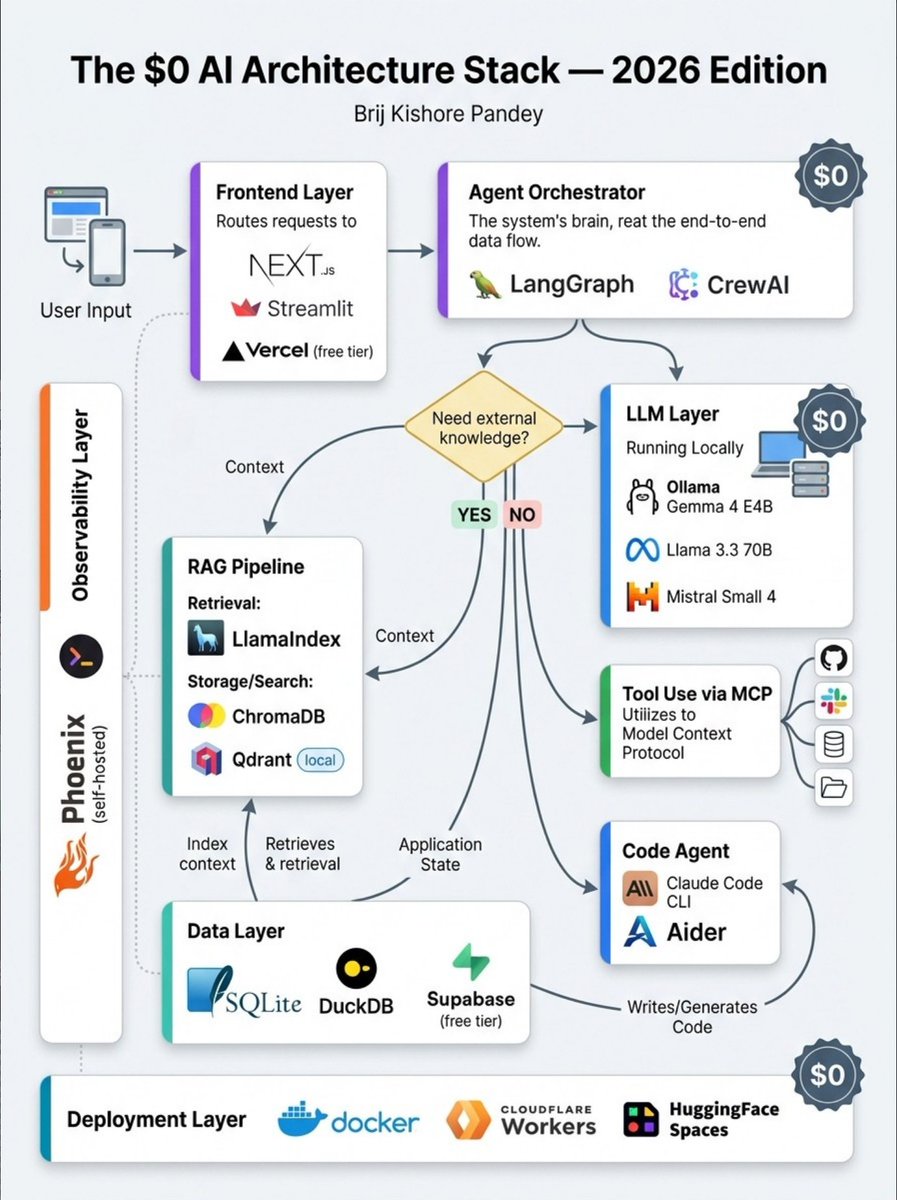
You don't need to spend a single dollar to build a production AI system in 2026.
Here's the full stack:
→ LLM: Ollama + Gemma 4 / Llama 3.3 / Mistral Small 4 (local, free)
→ Orchestration: LangGraph / CrewAI (open source)
→ RAG: LlamaIndex + ChromaDB / Qdrant (local)
→ Tool Layer: MCP — the open protocol connecting agents to everything
→ Code Agent: Claude Code CLI / Aider
→ Frontend: Next.js + Vercel free tier / Streamlit
→ Data: SQLite / DuckDB / Supabase free tier
→ Observability: Langfuse / Phoenix (self-hosted)
→ Deploy: Docker / Cloudflare Workers / HuggingFace Spaces
Total cost → $0.
The tools are free.
The architecture knowledge is what's valuable.
Save this for your next build 🔖
Credit: codewithbrij
#AIArchitecture #AgenticAI #LLM #Ollama #Gemma4 #LangGraph
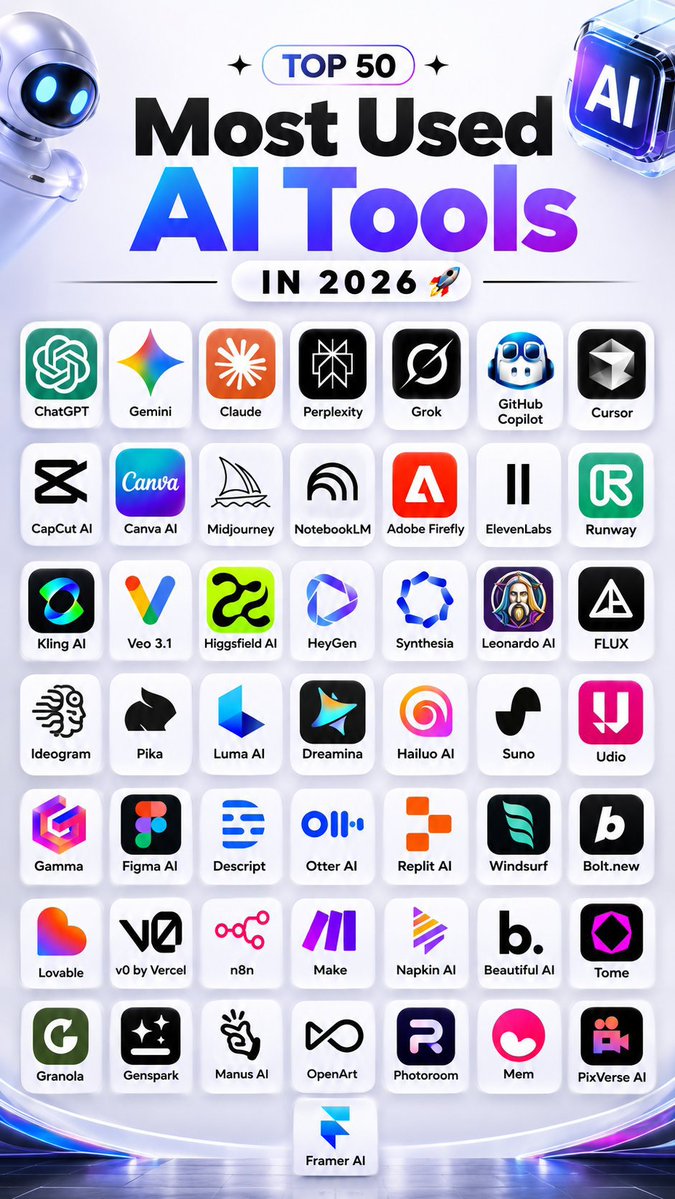
Here are the Top 50 Most Used AI Tools in 2026 across writing, coding, design, video, research, and productivity:
(ranked by overall popularity and adoption).
• ChatGPT
• Gemini
• Claude
• Perplexity
• Grok
• GitHub Copilot
• Cursor
• CapCut AI
• Canva AI
• Midjourney
• NotebookLM
• Adobe Firefly
• ElevenLabs
• Runway
• Kling AI
• Veo 3.1
• Higgsfield AI
• HeyGen
• Synthesia
• Leonardo AI
• FLUX
• Ideogram
• Pika
• Luma AI
• Dreamina
• Hailuo AI
• Suno
• Udio
• Gamma
• Figma AI
• Descript
• Otter AI
• Replit AI
• Windsurf
• https://t.co/6f51X2KqSD
• Lovable
• v0 by Vercel
• n8n
• Make
• Napkin AI
• Beautiful AI
• Tome
• Granola
• Genspark
• Manus AI
• OpenArt
• Photoroom
• Mem
• PixVerse AI
• Framer AI
Which one do you use the most?
Everyone is sleeping on this new OCR model!
- 85.9% (sota) on olmocr bench
- 90+ language support w/benchmarks
- 4B model (down from 9B)
- Full layout information
- Extracts + captions images and diagrams
- Strong handwriting, math, form, table support
100% open-source.
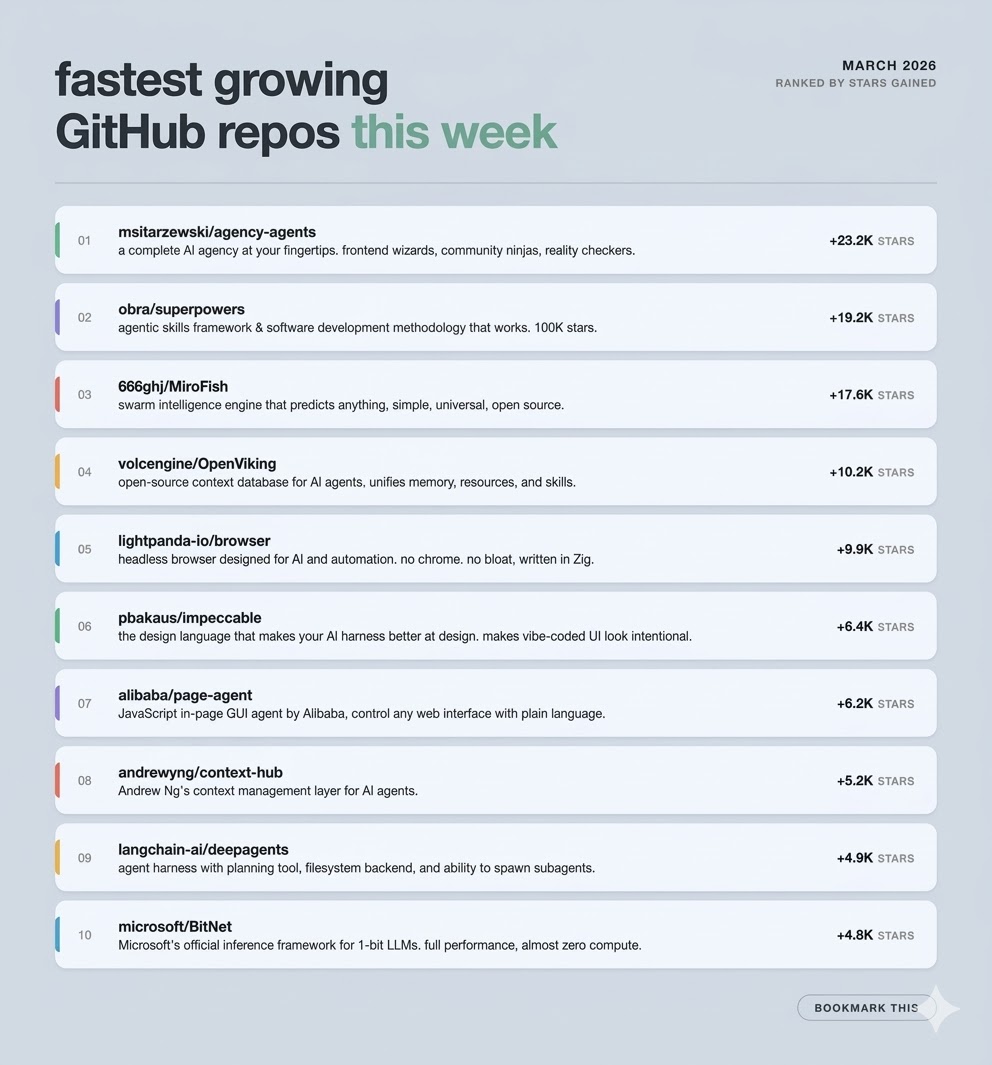
Fastest growing GitHub projects this week 🤯
1. agency-agents (+23.2K)
AI agency in one repo
2. superpowers (+19.2K)
framework for AI agents
3. MiroFish (+17.6K)
swarm intelligence engine
4. OpenViking (+10.2K)
context DB for agents
5. browser (+9.9K)
headless browser for AI
6. impeccable (+6.4K)
design system for AI UI
7. page-agent (+6.2K)
control websites with AI
8. context-hub (+5.2K)
Andrew Ng’s agent layer
9. deepagents (+4.9K)
multi-agent framework
10. BitNet (+4.8K)
1-bit LLMs by Microsoft
AI agents took over GitHub 😭
https://t.co/hNtIgXzX2Q
Most AI/ML books won’t make you better.
They’ll just make you feel busy.
But a few actually change how you build.
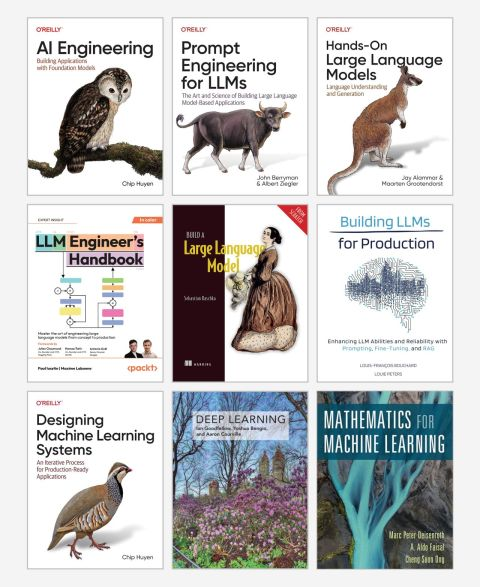
Here are 9 that cover what you really need to 𝗕𝗨𝗜𝗟𝗗, 𝗦𝗛𝗜𝗣 & 𝗦𝗖𝗔𝗟𝗘 AI systems:
1️⃣ AI Engineering
Full-stack view — from data pipelines to production failures.
Real-world systems, not theory.
2️⃣ Prompt Engineering for LLMs
Patterns, testing, consistency.
If you’re using Claude or OpenAI — start here.
3️⃣ Hands-On Large Language Models
Covers Hugging Face, LangChain, vector DBs.
Tools you’ll actually use daily.
4️⃣ LLM Engineer's Handbook
RAG, fine-tuning, vector databases.
Practical + code-heavy.
5️⃣ Building LLMs from Scratch
From tokenization → attention.
No black boxes.
6️⃣ Building LLMs for Production
Scaling, inference, real traffic.
Where most books actually stop.
7️⃣ Designing Machine Learning Systems
Why models fail in production.
Data drift, monitoring, reliability.
8️⃣ Deep Learning
Dense but foundational.
Explains why everything works.
9️⃣ Mathematics for Machine Learning
Linear algebra, calculus, probability — applied to ML.
That’s it.
Nine books.
Everything else is optional.
Most people collect resources.
Few actually go deep on the right ones.
Which one are you starting with? 📚🚀
Prompt:
Create a technical infographic of [OBJECT] with a 45-degree isometric 3D perspective showing the device slightly tilted to reveal depth and dimension. Combine a realistic photoreal render with black ink technical annotations on pure white background. Include: Key component labels with color-coded callout boxes Internal component visibility through transparent/
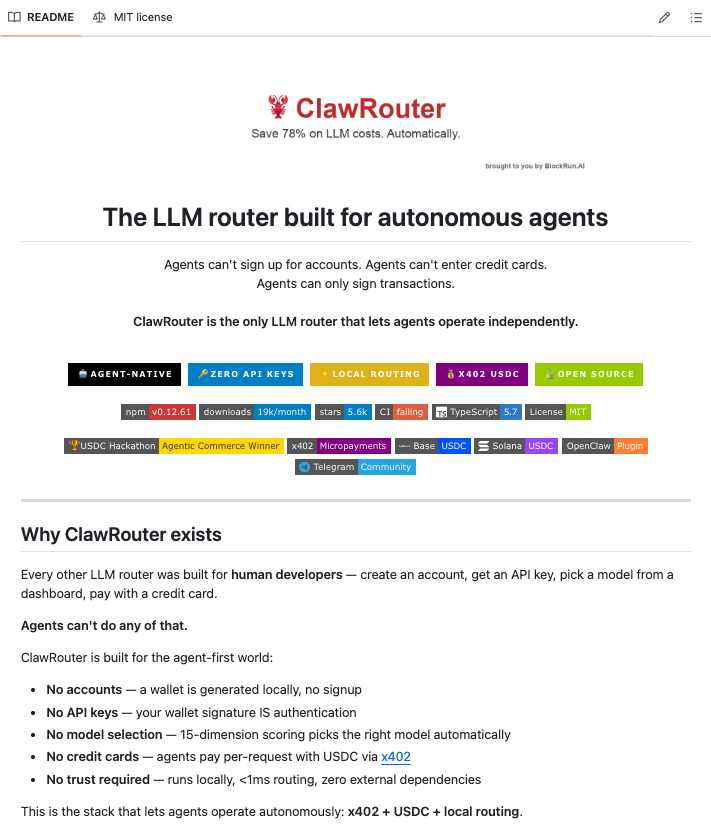
🚨BREAKING: Someone built a smart LLM router that automatically cuts your AI inference costs by 78%.
It's called ClawRouter and the numbers are genuinely insane.
Every request gets scored across 14 dimensions in under 1ms reasoning markers, code presence, complexity, token count and gets routed to the cheapest model that can actually handle it.
Here's what that looks like in practice:
"What is 2+2?" → DeepSeek $0.27/M (saved 99%)
"Summarize this article" → GPT-4o-mini $0.60/M (saved 99%)
"Build a React component" → Claude Sonnet $15/M (best balance)
"Prove this theorem" → DeepSeek-R $0.42/M (reasoning)
Blended average across a typical workload comes out to $3.17/M.
Compare that to $75/M if you're just defaulting everything to Claude Opus.
And the payment model is different from anything else out there. No accounts. No API keys. No shared secrets. You generate a wallet, fund it with $5 USDC on Base, and pay per request. That's it. $5 gets you hundreds of requests.
30+ models across OpenAI, Anthropic, Google, DeepSeek, xAI, and Moonshot. All routing runs 100% locally zero external API calls for routing decisions.
100% Opensource. MIT License.
Link in comments.
Claude Code just made the traditional startup team obsolete.
I don't say that lightly.
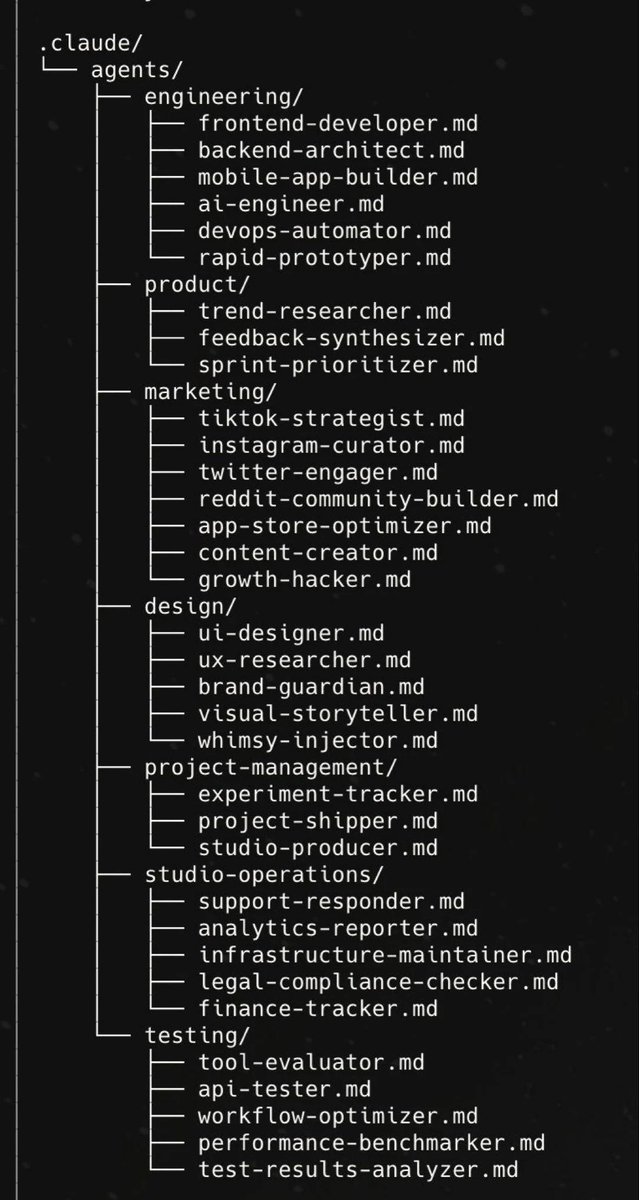
Look at this .claude/agents/ folder structure:
30+ specialized agents — each a single markdown file with one focused role.
Engineering. Product. Marketing. Design. Legal. Finance. Testing.
All of it. One folder. One person.
No hiring. No managing. No overhead.
Just:
"Hey rapid-prototyper, build this."
"Hey growth-hacker, find me users."
"Hey legal-compliance-checker, is this okay?"
This is the unfair advantage most founders don't know exists yet.
Bookmark this before they do. 🔖
Stop calling it an AI app if it just echoes ChatGPT.
Real AI plans, reasons, and collaborates.
17+ agentic architectures. Full, ready-to-run code.
Don’t ship lazy engineering.
https://t.co/85FZXlFNxH
Most people use these terms like they mean the same thing:
Generative AI
Agentic AI
AI Agents
They don’t.
Confusing them leads to bad product decisions.
Here’s the simplest way to understand the difference 👇
━━━━━━━━━━━━━━━
1️⃣ Generative AI
You give a prompt.
AI generates something.
→ Text
→ Images
→ Code
Powerful, but reactive.
No planning.
No decisions.
No execution.
Think: content creation engines.
━━━━━━━━━━━━━━━
2️⃣ Agentic AI
Now AI starts to reason and plan.
It can:
• Choose tools
• Call APIs
• Break problems into steps
• Execute workflows
Still guided.
Still controlled.
But much more useful for real business tasks.
Think: AI with intent.
━━━━━━━━━━━━━━━
3️⃣ AI Agents
This is where things change completely.
AI Agents can:
• Act autonomously
• Adapt to environments
• Execute multi-step tasks
• Improve from outcomes
They don’t just respond.
They operate systems.
Think: digital workers.
━━━━━━━━━━━━━━━
Why this matters:
If you use Generative AI where you need Agents
→ you hit a ceiling fast.
If you deploy Agents without guardrails
→ you create chaos.
The future isn’t just:
“AI that talks.”
It’s:
AI that works.
Are you still experimenting with prompts
or already building agent-first systems? 👇
#AI #AgenticAI #AIAgents #GenerativeAI #Tech #Startups #AIEngineering
Damnn 😱
Most developers are using Claude Code wrong.
They open the terminal...
write a prompt...
and expect magic.
That’s not where the real power is.
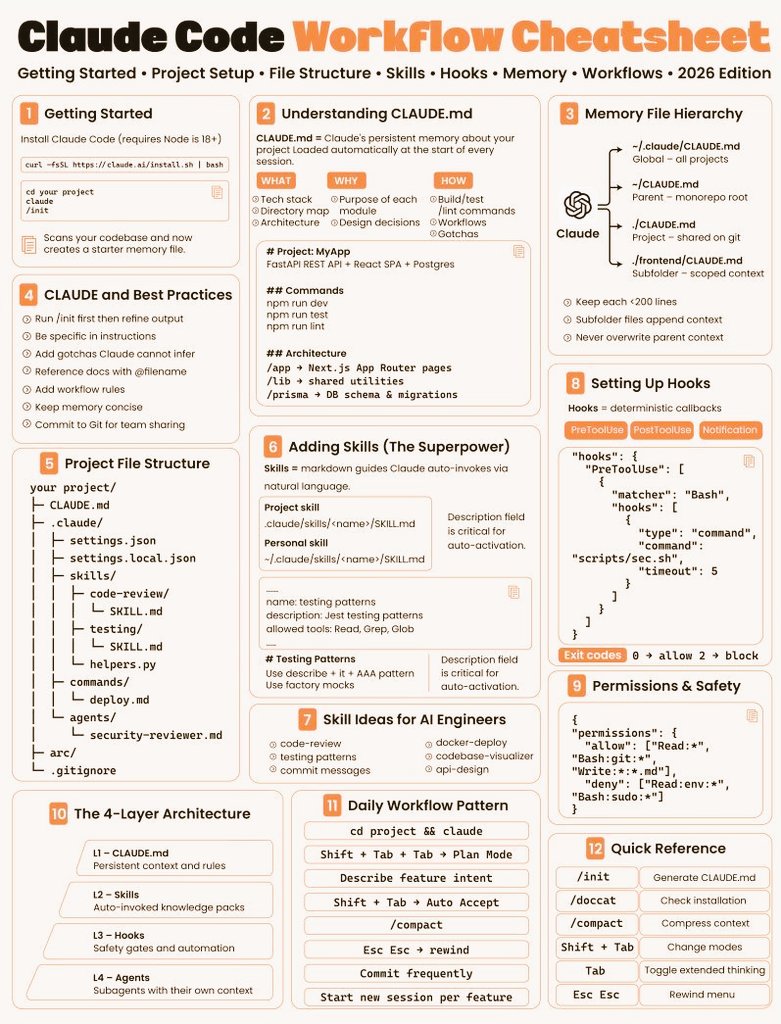
Claude Code is actually a 4-layer AI engineering system:
1️⃣ CLAUDE.md → project memory
Architecture, rules, commands, conventions
2️⃣ Skills → reusable knowledge packs
Testing workflows, code review guides, deploy patterns
3️⃣ Hooks → deterministic guardrails
Security checks, enforced rules, automation
4️⃣ Agents → specialized sub-agents
Break complex tasks into parallel workflows
Once you structure these properly, something interesting happens:
Claude stops behaving like a chatbot.
It starts behaving like a real AI dev system.
Most engineers miss this because they jump straight to prompting.
But the difference between average output and production-level results usually comes down to setup.
If you're building with AI agents in 2026, learn the system — not just the prompt.
I made a Claude Code Starter Pack explaining everything.
If you want it:
Follow
Like + RT
Comment CLAUDE
I'll DM it to a few people.
Future AI dev workflows won't be prompt-first.
They’ll be system-first. 🚀
#AI #Claude #AIAgents #LLM #GenAI
🚨google maps just became a real AI product and most people will miss why this matters
everyone is building AI chatbots that answer questions about the internet
google did something different
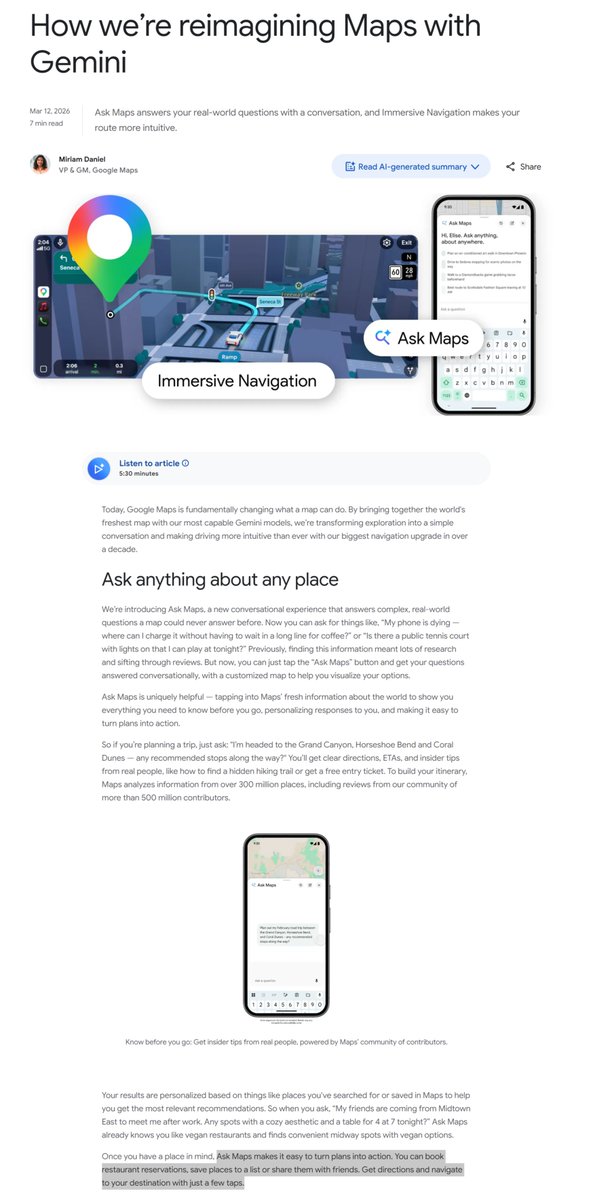
they connected Gemini to 300 million real places with real reviews from 500 million real people
so the AI actually knows the physical world around you
here's what "Ask Maps" lets you do now:
> you type a question like "where can i charge my phone without waiting in a long coffee line"
>Maps pulls from real place data and real reviews
>gives you a custom map with actual options
>and you can book or navigate from that same screen
the old way was opening maps, searching, reading 40 reviews, comparing then deciding
now you just ask one question and get a usable answer
the second part is even wilder
they rebuilt the entire driving navigation with 3D views that show you actual buildings and terrain around you in real time
Gemini analyzes Street View and aerial photos to build out what your route actually looks like before you drive it
so you can preview your parking spot and see which side of the street the entrance is on before you even leave
this is the template for how AI should work inside products people already use every day
just the thing you already open 10 times a week... now way smarter
rolling out now in the US and India on Android and iOS
@AskPerplexity { "description": "Cinematic shot of a sunlit modern apartment. A woman drops a sealed Amazon box from waist height. When the box hits the ground, it opens and Amazon products rapidly assemble and fill the entire apartment space with modern furnishings and decor. No
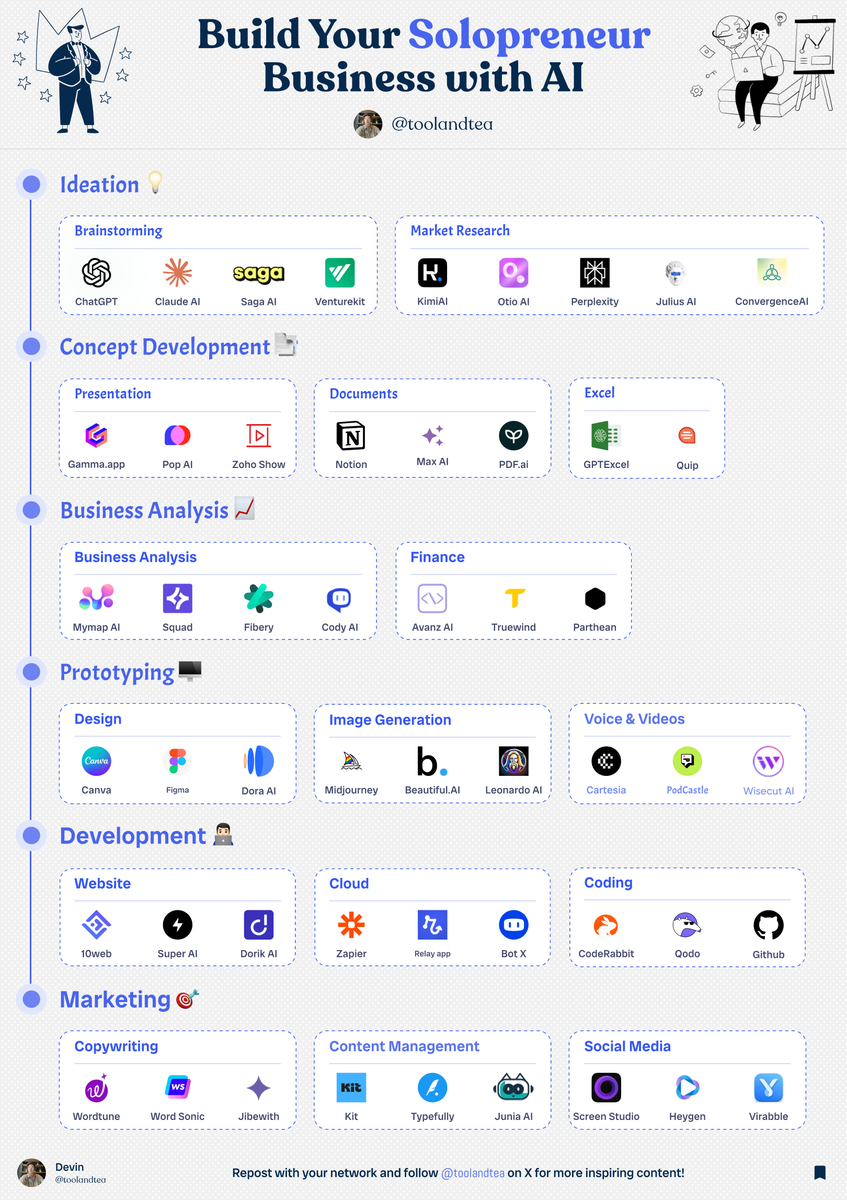
This is Wild... You can now build an entire business solo with AI.
From idea to launch to marketing without hiring a single person.
Here’s the ultimate AI stack to go solo in 2025 🧵👇


![gudanglifehack's tweet photo. Prompt:
Create a technical infographic of [OBJECT] with a 45-degree isometric 3D perspective showing the device slightly tilted to reveal depth and dimension. Combine a realistic photoreal render with black ink technical annotations on pure white background. Include: Key component labels with color-coded callout boxes Internal component visibility through transparent/](https://pbs.twimg.com/media/HDxo0rqaYAEqmx1.jpg)
![gudanglifehack's tweet photo. Prompt:
Create a technical infographic of [OBJECT] with a 45-degree isometric 3D perspective showing the device slightly tilted to reveal depth and dimension. Combine a realistic photoreal render with black ink technical annotations on pure white background. Include: Key component labels with color-coded callout boxes Internal component visibility through transparent/](https://pbs.twimg.com/media/HDxo0rpawAAz2N8.jpg)







![gudanglifehack's tweet photo. Prompt:
Create a technical infographic of [OBJECT] with a 45-degree isometric 3D perspective showing the device slightly tilted to reveal depth and dimension. Combine a realistic photoreal render with black ink technical annotations on pure white background. Include: Key component labels with color-coded callout boxes Internal component visibility through transparent/](https://pbs.twimg.com/media/HDxo0r3bwAAZgVD.jpg)