DockLog is a lightweight, self-hosted Docker log viewer for teams, with real-time streaming, RBAC and audit logging, plus optional Kubernetes visibility
➤ https://t.co/DnbgSxEZHa
This tutorial shows how Kubernetes 1.37 can unblock a deferred in-place pod resize by evicting lower-priority workloads and freeing node capacity for a higher-priority pod
➜ https://t.co/XRz2IKwGl2
This article traces a k3s Traefik crash loop on an NVIDIA Jetson to conflicting nftables support in the vendor kernel, then explains why blacklisting nf_tables fixed packet filtering
➜ https://t.co/R40nRpHjAb
This article argues that uptime, latency and error rate only tell you a system is alive, not correct, and shows which behaviour-level signals and baselines belong in dashboards and alerts instead
➤ https://t.co/ktrmKBxdo4
This tutorial shows how to run a fully local RAG system on Kubernetes with PostgreSQL and pgvector, local embeddings, and a CPU-based Qwen model without API keys
➤ https://t.co/vzeAEkAVWz
kubectl-netshoot is a kubectl plugin that spins up a netshoot container in a pod or on a node, so you can debug cluster networking without adding any tools to your own images
➤ https://t.co/EnxLD0v6wH
Hortator lets AI agents spawn sub-agents at runtime, with each agent running in its own pod with budget caps, network policies, PII redaction, and capability inheritance so children can never escalate beyond their parent's permissions
➤ https://t.co/D6FnI2Lejz
OpenTelemetry Collector receives, cleans, batches, and sends traces, metrics, and logs between applications and many observability tools without tying the pipeline to one vendor
➜ https://t.co/bap03B6X6v
This article explains why a ConfigMap you just changed via the API still appears outdated in the mounted file, and why the kubelet can take up to a minute to catch up
➤ https://t.co/65AEmlmrtx
Shell-operator turns Bash, Python, or other scripts into Kubernetes hooks that react to resource changes and handle validation or conversion webhooks
➜ https://t.co/oxpaTkodVl
This case study shows how the author built an off-hours Kubernetes operator that scales workloads down and restores them later, while using filtered API reads to keep memory use low
➜ https://t.co/M56svJ4dGJ
This article explains how Spinifex grew into a self-hosted AWS-compatible platform with EKS on K3s, load balancers, containers, databases, IAM, storage, and production-tested reliability
➜ https://t.co/LEAoARCa6s
Andrew, Staff Cloud Infrastructure Engineer at SafetyCulture, explains how his team approached migrating 250-300 applications across 20 teams from Helm to GitOps with Argo CD
Watch the full episode: https://t.co/QvGhaGWsO1
We’re giving away 2 free passes to Build It Summit!
Talks, workshops, product showcases, and networking for AI builders
📆 December 1–3, 2026
📍 CNIT Forest, Paris La Défense
Interested? Send us a DM!
More info: https://t.co/55E7PE5Ozs
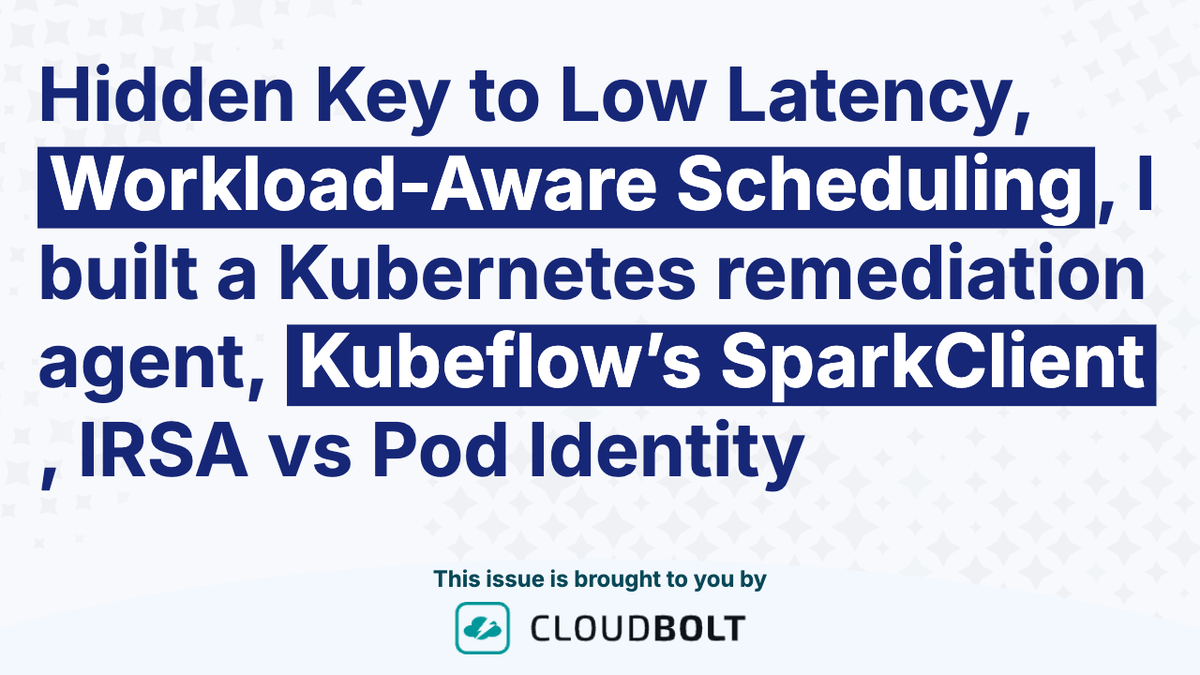
Learn Kubernetes Weekly #210: deterministic routing, workload-aware scheduling, PR-only remediation, SparkClient, and IRSA vs Pod Identity
Brought to you by StormForge by CloudBolt
https://t.co/Fs0q2SGaoQ
kopiur makes Kopia repositories and snapshots Kubernetes resources, with scheduled PVC backups, restores, retention, maintenance, and repository replication managed through CRDs
➜ https://t.co/Z0ArXf7U0v
"The probabilistic part proposes and the deterministic part disposes."
Philippe Ensarguet on AI and deterministic Kubernetes boundaries
📺: https://t.co/iebBAeYly6