🔥 CyberForge Weekly CVE Rundown #011 — The Sunday Defender Debrief
🗓️ 16th–21st November 2026
📚 6 daily editions · 6 distinct CVE IDs
Six boundaries: SQL, login attempts, decoder memory, forged authority, request streams and datastore paths. What permits the crossing, and what supports the result?
Coverage and review: dated local Forge editions #105–#110; external publication is unverified. Sunday refreshed CVE/NVD, KEV, FIRST and selected repair sources through 2026-11-22 08:21:00. Earlier patch/incident analysis keeps its dates; local outcomes remain unassessed. The separate Daily intake is outside scope.
🎯 The weekly Quick Hit:
The main lesson: verify code plus conditions: PHP's gateway/application conjunction, Java's build/intrinsic/input path and ASUS's main/agent state.
Who should check first? Applicable reachable assets, weighted by consequence and evidence. MONAI has reported exploitation; Java/PHP's new EPSS rows are forecasts.
First defender move: establish active code, access, effective authority and all instances; preserve history where incident priorities permit.
Follow the evidence: request → parser/identity → operation → effect. A failed login, crash or update alone is incomplete.
Keep this qualification: all six have KEV non-matches; that cancels neither MONAI's field report nor applicable exposure.
📚 The daily rundown:
1⃣ — Monday · Daily #105 · 16th November
CVE-2026-129171 — NginxPulse statistics SQL injection
id/locationType values in /api/stats/:type can become SQL structure. The researcher describes unauthenticated default access; configured access keys change the prerequisite. Scope is NginxPulse analytics, not every NGINX server.
🧩 Why it stood out: the researcher's official-image setup used a PostgreSQL superuser, increasing consequence; actual deployment roles vary.
🛡️ Applicability & fix: CNA >=1.5.0,<1.6.26, fixed 1.6.26. The researcher's tested range ends at 1.6.24; it does not exclude CNA-listed 1.6.25. Embedded database migration needs backup/role planning; external DB_DSN roles require separate DBA review.
🔎 SOC pivot: join requests, actual DB identity and query/file/process effects. An error or powerful role alone proves no exploitation.
📌 Status / as of: Sunday retains VulnCheck 9.3 Critical v4.0 / 9.8 Critical v3.1. Public technical reproduction exists; no field campaign was established by this review.
🔗 https://t.co/Kh23A2ZoYY
2⃣ — Tuesday · Daily #106 · 17th November
CVE-2026-104840 — OpenCTI primary-login guessing risk
Before 7.260428.0, the token GraphQL mutation lacked endpoint-specific restriction. The advisory's 10,000-requests-per-second global default is a ceiling, not a measured attack rate or meaningful login protection.
🧩 Why it stood out: attempts are not passwordless access: usable credentials and successful authentication must follow. Recovered-account rights are not automatically admin or host root.
🛡️ Applicability & fix: verify 7.260428.0 or later supported corrected code and both limiter layers. Review proxy identity, exemptions and process/store scope; do not assume per-account or cluster-wide protection from a schema label.
🔎 SOC pivot: join failures, source/proxy identity, success, session and data operations. Shared NAT/mistakes are alternatives; retain collection gaps.
📌 Status / as of: project advisory remains Moderate; CNA is 9.2 Critical v4.0, with high complexity and attack requirements present. Preserve both assessments. Sunday's EPSS row is a forecast, not a successful credential recovery.
🔗 https://t.co/v3fThJ4ydk
3⃣ — Wednesday · Daily #107 · 18th November
CVE-2026-114938 — Java4Shell accelerated Base64 memory corruption
Calif reports native Base64 buffer corruption and application-specific execution demonstrations. Applicability joins vendor/full build, reported x86-64 AVX-512 VBMI intrinsic path and untrusted input reaching it. Java installed or a CPU flag alone is insufficient.
🧩 Why it stood out: Oracle 8.1 High v3.1, Calif 9.2 Critical v4.0 and downstream assessments describe different contexts. Do not turn a lab result into universal exploitability.
🛡️ Applicability & fix: preserve Oracle's exact affected perf/build rows and each distributor's remedy. Wednesday verified Corretto 17.0.21.1.2 / 21.0.13.1.2 / 25.0.5.1.2 / 27.0.1.1.4 release/changelog pairs; they do not certify other distributions. Include bundled runtimes and every restarted JVM.
🔎 SOC pivot: join input processing, JVM faults and independent process/network effects. A crash proves no execution; absent faults prove no safety.
📌 Status / as of: Sunday NVD is Analyzed, still carrying Oracle's Secondary score. FIRST's newly returned 45.636% forecast is not a field-exploitation finding.
🔗 https://t.co/sOJNqQlUrz
4⃣ — Thursday · Daily #108 · 19th November
CVE-2026-114202 — ASUS Control Center Express forged-token access
ASUS describes a hard-coded cryptographic key enabling remote forged-token administrative access. Token format, algorithm and key are unverified; JWT/HMAC or OS execution are not inferred.
🧩 Why it stood out: console update alone leaves fleet acceptance open; administrator authority does not establish actual client compromise.
🛡️ Applicability & fix: CNA says through v1.7.27; bulletin says before v1.7.29. The 1.7.28 discrepancy remains unresolved. Install supported 1.7.29 or later, then Select Function > Client Agent Updater, and verify every agent's version/result. Track offline or failed devices.
🔎 SOC pivot: correlate caller/session, administrative job, target clients and independent endpoint effects. Approved management work is an alternative; console history may be incomplete.
📌 Status / as of: ASUS 10.0 Critical v4.0 remains the largest v4.0 value in this set. Sunday rechecked bulletin 3130; installer integrity/availability and local running state were not audited.
🔗 https://t.co/wf9T78kenB
5⃣ — Friday · Daily #109 · 20th November
CVE-2026-129289 — PHP-FPM unread-body request smuggling
Conditions: affected PHP code + reused backend FastCGI connections + a reachable path opening php://input without fully consuming it. Unread bytes can become an unauthorised backend request, enabling worker-privileged PHP execution and routing/address/settings effects.
🧩 Why it stood out: the trust boundary sits between gateway, request lifecycle and worker state. HTTP client keep-alive and TCP socket keepalive are different controls. The documented execution example also needs knowledge of an existing PHP script path.
🛡️ Applicability & fix: 8.2.36 / 8.3.37 / 8.4.28 / 8.5.13, or an explicitly fixed supported distributor revision. Pending repair, use the appropriate front end's backend-close/no-reuse policy. Reading the body completely is unreliable alone because error/resource/shutdown paths matter. Replace affected serving workers.
🔎 SOC pivot: join gateway requests to backend/worker identity and effects; access logs may miss the extra interpretation. LSAPI disruption, not LSAPI arbitrary execution, is established.
📌 Status / as of: PHP 9.2 Critical v4.0, AT:P. Sunday confirms branch fixes; no campaign or local incident established.
🔗 https://t.co/0xerDpaDdE
6⃣ — Saturday · Daily #110 · 21st November
CVE-2026-133968 — MONAI Label datastore traversal
Upload identifiers/label paths can write outside the datastore within process permissions. Auth is disabled by default; enabled auth still permits ANNOTATOR. Write and later execution are separate events.
🧩 Why it stood out: original Amazon Threat Intelligence reporting supports September exploitation involving https://t.co/ZHcdUABbaV and later Python execution. Root belongs to that observed deployment, not an inherent host-root escalation or container escape everywhere.
🛡️ Applicability & fix: affected through 0.8.5. Sunday update: upstream released 0.8.6, explicitly linking this CVE and PR 1915. PyPI advertises the release and its tag contains the correction. The older advisory still says Patched versions None. No package/container bytes or installed fix were audited. Retain trusted-network, auth/role and least-write-privilege controls regardless of version.
🔎 SOC pivot: upload → destination change → later Python effect; consider legitimate writes/hooks and protect sensitive imaging evidence.
📌 Status / as of: MITRE CNA 9.8 Critical v3.1. CNA/AWS activity conflicts with dated CISA ADP Exploitation:none; KEV non-match does not resolve it.
🔗 https://t.co/9H5TzuBqH1
🔄 Since the original editions:
Review scope: selected fields through 2026-11-22 08:21:00. All six CNAs' descriptions, affected rows, metrics, weaknesses and references match their daily captures; metadata/enrichment can change separately.
MONAI's repair update: yesterday's fixed numbered package was unverified at its cutoff. The 0.8.6 security release, published 22nd November at 01:29:24 UTC, explicitly includes this CVE/PR 1915. Its tag contains the corrective merge; PyPI advertises 0.8.6. This establishes an upstream release target, not downloaded-artifact content or installed correction. The release requires Python 3.11+. The GHSA's older None/future-release fields lag behind this evidence.
NVD: OpenCTI Received → Awaiting Analysis; Java4Shell Received → Analyzed; other four states unchanged. Processing labels prove neither a fix nor an attack. Retained numeric scores remain source-labelled Secondary assessments, without an independent NIST score.
KEV 2026.11.20, 1,790 entries: all six exact non-matches. MONAI's field reporting remains separate. NginxPulse's dated ADP PoC category is not a field campaign; PHP's ADP none and a future forecast answer different questions.
FIRST model 21st November — probability / percentile rank:
- NginxPulse 0.414% / 36.494th; OpenCTI 0.353% / 29.538th.
- Java4Shell 45.636% / 98.825th; ASUS 0.630% / 51.086th.
- PHP-FPM 16.138% / 97.005th; MONAI 3.131% / 88.189th.
OpenCTI, Java4Shell, PHP and MONAI now have rows where daily checks returned none: earlier unavailable, not zero. These next-30-day exploitation forecasts/ranks are not local incident probabilities or attack counts.
Still uncertain: ASUS 1.7.28, local deployment/incident state and artifact/backport content. No software build, upstream test or exploit was run Sunday.
🏆 This week's Forge honours:
🚨 Most Severe — CVE-2026-114202, ASUS. Its 10.0 Critical CVSS v4.0 is this set's highest v4.0 Base value. NginxPulse and MONAI tie at 9.8 v3.1. Different CVSS versions are not averaged or treated as one ranking; exposure and activity still matter.
🧩 Most Interesting Mechanism / Chain — CVE-2026-129289, PHP-FPM. Lazy input handling, unread bytes and connection reuse can give one authorised gateway request another backend interpretation. Retain the prerequisite conjunction and worker boundary.
🛡️ Most Defender-Relevant — CVE-2026-133968, MONAI Label. Original activity reporting, sensitive data, process write scope and a new security release make preservation and verified rollout practical priorities. No local compromise or suitability for untrusted networks is inferred.
💜 CyberForge Pick of the Week:
CVE-2026-129289 — PHP-FPM
Selection basis: Lee's confirmed pick for this rundown.
A front end can have one view of what it authorised while unread bytes on a reused connection acquire another meaning. An input-stream object does not prove its contents were consumed.
Which serving pool, gateway reuse policy and reachable application lifecycle satisfy the conditions? “We run PHP” is too broad; one edge request cannot settle backend effects.
Use the branch repair/verified backport, replace affected workers and accept the running service. Keep temporary backend-close policy, unreliable-alone body draining, worker privilege and narrower LSAPI disruption distinct. Our editorial favourite does not universally outrank applicable known-exploited assets.
🧠 What connected the week:
A representation is not an enforced boundary. NginxPulse selectors must remain data, MONAI's resolved path must stay inside its directory, and PHP bookkeeping must match stream state. Related lessons do not imply one shared implementation defect.
Authority sets consequence: PostgreSQL superuser, PHP worker, OpenCTI account and ASUS administrator rights differ.
The useful contrast: OpenCTI needs credential recovery/use after attempts; Java needs the relevant build/CPU/input path; PHP needs its gateway/application conjunction. MONAI supplies an attributed field procedure.
Evidence boundary: six selected editions measure neither worldwide prevalence nor local telemetry completeness.
🗺️ The ATT&CK lens:
These analytical mappings use direct MITRE definitions checked Sunday, not MITRE CVE-specific procedure entries, local observations or validated detectors.
T1190 — Exploit Public-Facing Application: conditional for applicable NginxPulse, Java, PHP or ASUS services when actual public-facing exploitation is the access path; AWS's MONAI case supplies a reported example. A network vector alone is insufficient.
T1110.001 — Password Guessing: OpenCTI's repeated attempts fit the capability. Recovered credentials, success and account operations need separate evidence.
T1546.018 — Event Triggered Execution: Python Startup Hooks: AWS reports a MONAI https://t.co/ZHcdUABbaV change and later Python execution. Reported procedure, not enduring local persistence or automatic privilege escalation; legitimate hooks need context.
Defender pivot: precursor → result, joined by time, identity and instance, with gaps preserved.
https://t.co/eHWJIFcj41
https://t.co/JOwzOsFlWi
https://t.co/yl2Upc7Jh9
🧭 The weekly SOC desk:
Question 1 — Who reached which authority?
Applies to: NginxPulse/OpenCTI/ASUS. Evidence / correlate: caller → DB identity, login/session or management job → target/effect. Interpret / escalate: unexplained operations need platform/incident owners; scheduled work/shared identity are alternatives. Limit: familiar names or failed attempts cannot clear history.
Question 2 — Did the precursor become execution?
Applies to: PHP/Java/MONAI. Evidence / correlate: request/decoder/file change → independent process/network effect. Interpret / escalate: corroborated unapproved execution needs incident handling; legitimate writes/hooks and crashes need context. Limit: one log count, fault or filename cannot establish the chain.
Question 3 — What actually changed?
Applies to: all six, especially agents/JVMs/pools. Evidence / correlate: intended artifact → active members → correction/health. Interpret / escalate: stale/failed/offline targets need owners. Limit: one new file or healthy node proves neither fleet completion nor incident closure.
🛡️ The defender's Monday plan:
1⃣. Platform/application owners: inventory affected code, actual access/input conditions, effective authority and every serving/rollback target. Resolve access keys, proxy identity, embedded JVMs, PHP reuse, MONAI roles/write scope and ASUS agents; unknown is not unaffected.
2⃣. SOC/incident lead: prioritize supported exposure/consequence. Preserve independent history where practical, recording interval, clocks, gaps and alternatives without delaying urgent containment. MONAI activity and Java/PHP forecasts inform different decisions.
3⃣. Change owners: NginxPulse 1.6.26+ with DB planning; OpenCTI 7.260428.0+; exact JVM distributor remedy; ASUS 1.7.29+ main/agents; PHP's matching branch/backport; MONAI 0.8.6 with compatibility/restricted deployment. Verify provenance/dependencies.
4⃣. Service owners: confirm active correction across intended members, restarts/replacements and normal health. MONAI keeps trusted-network/auth/least-write-privilege controls; PHP needs the actual backend policy.
5⃣. Incident/recovery owners: assess earlier unauthorized access, file changes, execution and data/secrets separately from patch acceptance. Record evidence, limits, owner and next decision. These actions are proposed; preparing this rundown performed none.
Open question: which running-state, compatibility or history gaps still need owner evidence?
🔥 CyberForge closing thought:
A source identifies a fix; an owner establishes what is running. A request shows intent; correlated evidence establishes the effect. PHP-FPM joins both lessons at the gateway/worker boundary.
> Follow the bytes, identify the authority, and verify the component that actually does the work.
🔗 Sources and further reading
Daily cards link primary sources. Sunday enrichment:
- OpenJDK: https://t.co/JJUj9Q1Nao
- PHP releases: https://t.co/pQyn2GTckd
- PHP changelog: https://t.co/YgzHk9QYrS
- Original MONAI activity report: https://t.co/O8LfNUoOky
- CISA KEV: https://t.co/3QfSyKR5Fv
- FIRST EPSS: https://t.co/iXD8nDYXfz
#CyberForge #CVE #CyberSecurity #WeeklyRundown #BlueTeam #SOC #EvidenceHandling
🔥 CyberForge CVE of the Day #110
🚨 CVE-2026-133968 Directory traversal vulnerability in MONAI Label that allows remote code execution (RCE)
🎯 The quick hit:
MONAI Label has a filesystem trust-boundary failure: a caller-controlled datastore upload identifier can escape its intended directory and write wherever the application process has permission. That write can lead to code execution or disruption when influential code, startup or configuration state is changed and later used.
CVE-2026-133968 is 9.8 Critical under the MITRE CNA's CVSS 3.1 assessment. The affected scope is MONAI Label through 0.8.5. Upstream says authentication is disabled by default; with auth enabled, ANNOTATOR is sufficient. This is a specific Label datastore issue, not every MONAI library, viewer or GPU server.
The CNA reports exploitation beginning in September 2026. Original Amazon Threat Intelligence reporting describes an upload/path-traversal discovery, arbitrary writes, then later Python startup-hook execution. Root was reported in that deployment; this is not automatic host-root escalation or container escape on every installation.
The important correction detail: PR 1915 is merged, but the maintainer lists Patched versions None and says the fix will be included in the next release. PyPI still identifies 0.8.5 and the retained recent GitHub release list begins with 0.8.5. A generic pip upgrade or latest image tag does not establish correction.
🔑 Key details:
• Identity: CVE-2026-133968, PUBLISHED; MITRE CNA; package pkg:pypi/monailabel; upstream Project-MONAI/MONAILabel.
• Scope: through 0.8.5 inclusive; defaultStatus unknown. Literal version 0 is not a verified introduced release.
• MITRE CNA CVSS 3.1 Base 9.8 CRITICAL: CVSS:3.1/AV:N/AC:L/PR:N/UI:N/S:U/C:H/I:H/A:H.
• Base conditions: network, low complexity, no privileges or interaction, Scope:Unchanged. Verify actual auth/roles and permissions.
• CNA weakness: CWE-24. Maintainer advisory: CWE-22 and qualitative Critical, without a numeric score in the retained page. No CVSS 4.0 assessment invented.
• NVD Received repeats [email protected] Secondary 9.8; no independent NIST score is supplied by the retained record.
• Upstream credits garciadias and the original @aws-sec-vdp report. The original MONAI-repository advisory route returned 404; the public MONAILabel advisory is readable.
• Source correction: PR 1915, merge 113527bf638585ee5de6a1839b985829331ea272,19th October 2026. First fixed numbered package unverified.
• KEV: exact non-match in complete catalog 2026.11.20, 1,790 entries. FIRST total: 0/data: [] means probability, percentile and score date unavailable/null, not zero.
🧬 What actually went wrong?
The maintainer describes the image query parameter on PUT /datastore/image becoming an image ID without validation. LocalDatastore.add_image appends the extension, combines the name with the image directory and copies the upload to the resolved destination. Resolving a path is not the same as proving it remains under an allowed base.
The label route, PUT /datastore/label, similarly uses image IDs and label tags. These are distinct input paths into the same kind of filesystem boundary. Authentication limits callers, but trusted or compromised annotator access does not make arbitrary path components safe.
Passive PR review shows layered correction: a helper resolves destination and allowed base, checks commonpath equality and rejects incompatible-drive/error cases; image and label destinations use it, including the label-tag directory. The image endpoint also reduces supplied IDs to a basename and rejects empty/dot-prefixed values with HTTP 400.
The PR includes regression-source cases; author-reported 174 passed/2 xfailed is attribution, not CyberForge testing. No build, exploit, binary or atomicity/symlink-race proof is claimed.
The second boundary is write → later execution. AWS reports an unauthorised https://t.co/ZHcdUABbaV change followed by a new Python process and a reverse-shell outcome. The name is an evidence pivot, not a universal malicious file: legitimate startup customisation exists. No payload, traversal depth, absolute target location or trigger request is supplied here.
📦 Which deployments belong in scope?
Find the actual MONAI Label instance, serving package/source/image revision, upload routes, effective auth/role policy, process identity and writable destinations. A language ecosystem label, mutable container tag or metadata file alone cannot prove what code is active.
Upstream's default is MONAI_LABEL_AUTH_ENABLE=False. Enabling supported authentication reduces access, but ANNOTATOR remains sufficient. Review untrusted and compromised annotator accounts, direct and proxied routes, and internal access paths. Do not assume a reverse proxy is the only entry point.
File-write consequence follows actual service permissions and mount mapping. A server able to write application or interpreter-startup locations has a different consequence from one restricted to its datastore. Configured container user, process identity, user namespaces and host mounts need evidence; a root-looking field is not proof of host-root compromise.
Keep source and release status separate. The merged confinement repair must be verified in a supported build/backport and the running instances. PyPI's 0.8.5 remains affected; no first fixed numbered release or corrected container digest was verified. Do not invent 0.8.6 as a fix.
🕰️ Exposure window and timeline:
AWS reports approximately 48 hours of operation history beginning 8th September 2026 and discovery of the exposed operator platform on 10th September. Its record-based campaign indicators are dated 8th–10th September. The original report by CJ Moses is 20th November 2026.
PR 1915 was created 2026-10-12 13:46:05 and merged 2026-10-19 13:37:36. The public maintainer advisory is 18th November 2026. A source merge date is not a shipped fixed package or local remediation date.
CVE published 2026-11-20 18:31:38. metadata/ADP updated 2026-11-20 21:46:08. Publication is not a local exposure or remediation boundary.
CISA ADP SSVC at 2026-11-20 21:34:06 says Exploitation:none, Automatable:yes, Technical Impact:total. The none category conflicts with the CNA/original AWS exploitation reporting. Preserve that dated disagreement rather than erase either source.
Cutoff: 2026-11-21 08:19:31. A local hunt window follows affected code plus reachable upload access/write scope, potentially before the reported campaign, through evidenced correction or relevant restriction. Record deployment dates, auth/role changes, clocks, retention and replica history. No local exposure interval was measured.
🗺️ MITRE ATT&CK:
Two Enterprise mappings are CyberForge analysis of attributed behaviour, not MITRE CVE-specific procedure entries.
T1190 — Exploit Public-Facing Application: the AWS-reported exposed upload exploit supports the behaviour basis. Apply locally only when actual public-facing exposure and exploitation are evidenced. A network Base metric alone does not prove the public-facing premise.
T1546.018 — Event Triggered Execution: Python Startup Hooks: AWS reports writing https://t.co/ZHcdUABbaV and later Python-process import/execution. The technique page is version 1.0, modified 21st October 2025. This is a reported-procedure mapping; persistence capability does not prove enduring local persistence or automatic privilege escalation.
Follow upload/access → actual destination write → influential state → later interpreter/effect. Generic Python, a legitimate hook or one suspicious parameter is insufficient. No blanket mappings are added for failed Redis operations, sprays, unrelated campaign activity, exfiltration or container escape.
References: https://t.co/eHWJIFcj41 and https://t.co/yl2Upc7Jh9
🧭 SOC investigation trail:
C01 — Establish serving code and access/write scope
Action: inventory active Label code, upload routes, auth/ANNOTATOR policy and process write authority. Location: package/source/image, gateway/identity and mount/permission records. Signal: affected or unresolved code reachable under the documented access conditions. Correlate: instance, process/image, account, datastore and deployment history. Benign causes/limits: unrelated MONAI components, stale metadata and mutable tags can mislead; defaultStatus unknown is not unaffected. Escalate: applicable reachable services or material unknowns to the responsible owners; exposure is separate from compromise.
C02 — Preserve the available boundary evidence
Action: retain the justified pre-change interval before cleanup/redeployment where feasible. Location: configured upload/auth logs, datastore state, filesystem copies/metadata, process/network data and changes. Signal: original timestamps, actual identifiers, file provenance and collection health. Correlate: clocks, retention, rotation, mounts and process starts. Benign causes/limits: bodies, parameters and write events may never have been logged; medical data/tokens need restricted handling. Do not casually start a suspect Python environment whose hooks may execute. Escalate: imminent loss, unavailable history or sensitive acquisition to the case owner.
C03 — Hunt for an actual destination-boundary failure
Action: review unexplained image/label uploads and resolved destinations outside the datastore. Location: real gateway/application schemas, datastore mapping and independent filesystem evidence. Signal: a questionable ID/tag/upload correlated with an unapproved write beyond its allowed directory. Correlate: time, role when present, object, process owner and canonical/mounted destination. Benign causes/limits: imports, retries, administrator moves, symlinks and encoding need context; a traversal-looking string or HTTP success is not proof of a write. Escalate: corroborated unexplained boundary-crossing effects, not every upload error.
C04 — Establish subsequent execution and identity
Action: determine whether an unauthorised write changed startup/application state and later executed. Location: trusted file/baseline evidence, Python path/startup context, process lineage/identity, job and network records. Signal: an unapproved influential-file change followed by applicable interpreter activity or another supported effect. Correlate: file bytes/hash/time, parent/child process, account/container/host scope and legitimate changes. Benign causes/limits: normal training, package upgrades and local customisation can resemble pieces. AWS's root result is deployment-specific, not inherent host-root escalation or escape. Escalate: supported unauthorised execution or continuing effects to incident response.
C05 — Restrict access and obtain verified corrected code
Action: use supported auth, restrict untrusted ANNOTATOR/network access, limit writes and obtain a maintainer-supported corrected build/backport. Location: advisory, merged PR 1915, build provenance and approved rollout/policy records. Signal: controlled upload access and verifiable confinement repair covering images and labels. Correlate: all serving instances, immutable artifacts, mounts, service permissions and health requirements. Benign causes/limits: Patched versions None/current 0.8.5 means a source merge, pip upgrade or latest tag is insufficient; auth alone leaves annotator access relevant. Escalate: unsupported correction, ambiguous provenance, failed rollout or service impact.
C06 — Verify active state and separate historical closure
Action: accept serving code/access/write scope everywhere and assign a distinct evidence-based history result. Location: active process/image provenance, replacement records, effective roles/network/permissions, approved normal health and post-change telemetry. Signal: verified correction active across every intended instance, with stale/failed/rollback targets owned. Correlate: replacement times, deployment identity, datastore mounts and prior evidence. Benign causes/limits: metadata, an on-disk patch or quiet hunt cannot prove active correction or clean history; existing hooks/data/credential effects may survive patching. Escalate: incomplete acceptance, continuing effects or historical gaps. No findings ≠ proof of a clean system.
Handover: name covered assets/period, code/access/write evidence, questioned operation, actual file/effect, benign alternatives, supported correction, health/exceptions and missing data. Keep vulnerability, incident progress and action outcome as separate fields.
🔎 Indicators and observable behaviour:
AWS lists 142[.]4.98.145 and 142[.]4.107.34 in records dated 8th–10th September 2026. Treat them as source-attributed historical campaign pivots. Exact per-address operational role, current ownership and current maliciousness were not established here; do not silently label each C2, victim, attacker-host or exfiltration infrastructure.
Correlate time/direction/asset/role; do not scan or connect. An isolated match proves neither this CVE nor actor identity.
Useful behaviours are unexpected datastore upload/destination combinations, actual writes beyond the datastore, unapproved startup/application changes and later interpreter/network effects. https://t.co/ZHcdUABbaV is an AWS-reported pivot, not a universal malicious filename. Normal annotation, training, imports, package changes and legitimate startup hooks are competing explanations.
No malicious file hash, complete hook path or universal MONAI signature is supplied. The repair SHA is not malware; request success or generic Python is insufficient.
🧰 Optional CVE checks:
Two bounded examples: source-checked syntax and assumptions only; not executed or tested against representative data. Neither uploads, probes traversal, imports MONAI Label, starts training or runs a payload.
Q01 — One offline distribution-metadata copy
Use a trusted Python 3 analysis installation and substitute the exact OWNER_CONFIRMED_METADATA_COPY. Do not invoke the suspect environment. No event-time filter; this reads acquisition-state metadata:
```sh
python3 -I -S -c "from pathlib import Path; print('\n'.join(line for line in Path('OWNER_CONFIRMED_METADATA_COPY').read_text(encoding='utf-8').splitlines() if line.startswith(('Name: ', 'Version: '))))"
```
-I isolates current/user-site paths and PYTHON variables; -S disables automatic site import. Both matter: -I alone does not disable all system startup customisation. This reads plain text, without importing the evidence package/environment.
Expect Name/Version lines; retain acquisition/hash, trusted-tool context/time, stdout/stderr and exit status. Missing file/header, decoding or other errors are unresolved. Metadata can lie and proves neither active code nor repair. Flags cannot make a compromised analysis runtime trustworthy.
Q02 — One approved existing container
Use an authorised Docker client/daemon context, one exact OWNER_CONFIRMED_CONTAINER and a client supporting --format json:
```sh
docker container inspect --format json 'OWNER_CONFIRMED_CONTAINER'
```
Expect detailed JSON: retain container/image identity, reported state/start, configured user/mounts, context/time and diagnostics. Official CLI/pinned schema support these fields. No time filter or start/exec/restart.
Image ID differs from tag; configured user is not host-root proof. Verify namespaces/permissions/code. Wrong context, denied access, absent container or unsupported format is unresolved. JSON may contain secrets: use an approved evidence store and public redaction.
🩹 Remediation and verification:
PR 1915's merged source confines image/label writes and label directories and normalises image IDs. No first fixed numbered package or corrected container digest is verified: upstream says future release/Patched versions None; current 0.8.5 remains affected.
Obtain a supported corrected build/backport with verified provenance. Do not invent 0.8.6 or certify pip upgrade/latest by name.
Use the maintainer's workarounds: enable supported authentication, withhold ANNOTATOR from untrusted users, restrict untrusted network reachability and run unprivileged with limited datastore write authority. Review legitimate model/cache/training requirements and health with the owner. Auth and least privilege reduce exposure/consequence; they do not repair missing confinement.
Replace intended serving code everywhere and verify actual code, effective access/roles, write scope and normal upload/label/training health. Account for all replicas, failed/stale targets and rollback paths. A new file/package, metadata label or running container alone is insufficient.
Investigate supported prior compromise separately. Patching does not remove an existing startup hook, revoke stolen secrets or restore altered data. Those actions need evidence and the incident/recovery process, not a blanket assumption from the public CVE.
🧾 Evidence separation:
Source facts, attributed upstream/AWS statements and CyberForge recommendations remain separate. Local findings: none.
AWS reports zero-day status with high confidence and a Chinese-nexus actor with moderate confidence. Its second-university tunnel compromise is explicitly an inference. Preserve those levels; do not import unrelated failed operations or another actor's criminal campaign into this CVE.
The CNA/original report supports exploitation while dated ADP Exploitation:none conflicts. KEV non-match does not cancel the reporting. FIRST total: 0/data: [] is unavailable, not 0%, with no probability/percentile/model date row.
Cutoff 2026-11-21 08:19:31 22 retained routes, 20 readable within scope. Original private-advisory route 404 and Docker API HTML shell are limitations; pinned schema is substantive. Connected GitHub HTTP status/wire bytes are not exposed; returned wrapper/decoded bytes are hashed instead.
No target, private victim/operator platform, product command, package build/import/test, host/container inspection, detector, mitigation, incident response, recovery or public posting occurred. Local package review is not an operational security outcome.
🔥 CyberForge verdict:
Prioritise affected reachable MONAI Label services: default unauthenticated upload access, arbitrary process-writable file effects and original exploitation reporting make this actionable. The local service identity, paths and later file use determine consequence.
Defender order of work: scope, preserve, restrict/correct, verify every instance and investigate history separately.
Handover names the corrected build, active instances, write scope and historical gaps. Source merge, package release and deployment-specific root are separate facts.
An uploaded image identifier must stay inside the datastore boundary.
🔗 Sources and further reading:
Maintainer advisory: https://t.co/eichvHW52z
CVE Program: https://t.co/U96hbGnHUG
Corrective PR: https://t.co/yxQSPzpSta
Original AWS field report: https://t.co/O8LfNUoOky
PyPI metadata: https://t.co/bantmBFprS
GitHub releases: https://t.co/3QOBCXdcPc
NVD: https://t.co/7r6W1VMbbN
CISA KEV: https://t.co/3QfSyKR5Fv
FIRST EPSS: https://t.co/ebnYTaV2ur
Python isolation/no-site flags: https://t.co/4d007r4jdt
Docker inspect: https://t.co/AKGMlaESUH
Moby API schema: https://t.co/Ma4SWwJ113
#CyberSecurity #CVE #MONAILabel #PathTraversal #Python #BlueTeam #ThreatHunting #SOC #CyberForge
🔥 CyberForge CVE of the Day #109
🚨 CVE-2026-129289 — Critical vulnerability in PHP involving request smuggling through the FastCGI Process Manager PHP-FPM
🎯 The quick hit:
PHP-FPM has a request-boundary problem. Under specific conditions, unread bytes from one HTTP body can become a separate FastCGI request that the front end never authorised. PHP says an unauthenticated attacker can execute PHP with the worker's privileges, bypass front-end routing or client-address assumptions, and affect administrator settings for later requests on that worker.
The important combination is affected PHP code, reused backend FastCGI connections and a reachable application path that opens php://input without consuming it fully. Framework setup can open the stream before routing/authentication; a path need not use the body.
PHP rates CVE-2026-129289 9.2 Critical under CVSS 4.0. Fixed upstream branches are 8.2.36, 8.3.37, 8.4.28 and 8.5.13. The official 19th November notices identify security releases, and the changelog names the fix. Use an exact supported distributor revision where it carries a backport.
The defender order is practical: identify the real serving runtime and gateway/application conditions; preserve available context; apply supported correction and replace affected workers; verify all instances and service health. Investigate unexplained backend activity separately. LSAPI disruption is documented, but the advisory does not establish arbitrary code execution through LSAPI.
🔑 Key details:
• Identity: CVE-2026-129289, PUBLISHED; PHP CNA, PHP Group PHP, component sapi-fpm. Upstream advisory GHSA-qc49-hpvq-g2w6. One CVE / one edition.
• Weaknesses: CWE-444 — Inconsistent Interpretation of HTTP Requests; CWE-670 — Always-Incorrect Control Flow Implementation. CNA also lists CAPEC-33.
• PHP CNA CVSS 4.0 Base 9.2 CRITICAL: CVSS:4.0/AV:N/AC:L/AT:P/PR:N/UI:N/VC:H/VI:H/VA:H/SC:N/SI:N/SA:N.
• Network, low complexity, attack requirements present, no privileges and no user interaction are explicit Base metrics. AT:P matters: prerequisite deployment/application conditions remain essential.
• Upstream fixes: 8.2.36 / 8.3.37 / 8.4.28 / 8.5.13 by branch. Raw CNA ranges start 0 for before 8.2.36, then 8.3.0, 8.4.0 and 8.5.0 with their respective fixed upper boundaries.
• Introduction: PHP says 5.6.0 based on code inspection. The literal version 0 range is not proof every earlier PHP release was vulnerable.
• NVD Awaiting Analysis repeats [email protected]'s 9.2 Base values with optional:X fields. No independent NVD rating, CVSS 3.1 or CVSS 2 score supplied.
• KEV: exact non-match in complete catalog 2026.11.18, 1,786 entries, checked 20th November. This does not prove no exploitation.
• FIRST EPSS: total: 0, data: []. Probability, percentile and score date unavailable/null, not zero. No forecast percentage is invented.
🧬 What actually went wrong?
Opening php://input can create a lazy request-body stream without reading all the input. Vulnerable request shutdown treated the stream's existence as evidence the body was already handled, skipping the normal unread-input drain. PHP describes an early-stopping malformed multipart parse combined with that application lifecycle.
If the backend connection is kept, PHP-FPM can start another FastCGI parse while bytes from the previous body remain. Its vulnerable state handling loses the unfinished STDIN context. The result is a backend request the gateway never created or authorised.
PHP names SCRIPT_FILENAME, REMOTE_ADDR and PHP_ADMIN_VALUE as controllable backend parameters. These also occur legitimately. Its execution example needs a known existing PHP script path. No crafted request or reproduction recipe is supplied.
Passive corrective-source review supports two safeguards: shutdown drains based on actual consumption state independently of stream existence, and FastCGI refuses a new request with an incomplete prior input record. Closing the connection also clears that record state. We inspected production hunks and regression-source intent; no build, test, exploit or target request ran.
Upstream says this does not require memory corruption, knowledge of memory addresses or a race. Code executes with worker privileges, not automatically root. LSAPI shares the cleanup fault but not the same FastCGI administrator-parameter path; keep its disruption outcome separate.
📦 Which deployments belong in scope?
Identify the PHP-FPM runtime actually serving each application: package/vendor revision or container image, pool, process provenance, gateway route and deployment history. A CLI PHP version, stored installer or newly rebuilt image can belong to a different runtime or leave old serving workers behind.
Check backend request reuse and application/framework body handling together. PHP names nginx fastcgi_keep_conn on, Apache mod_proxy_fcgi enablereuse=on and other retaining FastCGI front ends. The nginx module documents fastcgi_keep_conn off by default; Apache documents reuse as opt-in. Standard close-after-each-request nginx/Apache configurations are outside the demonstrated FPM attack.
Verify actual inherited virtual-host/location/upstream settings. HTTP keep-alive, TCP socket keepalive and request buffering are different concepts. An unfamiliar gateway needs its own policy review. If the application's complete input lifecycle is unknown, record applicability unresolved rather than assume consumption or universal vulnerability.
Preserve vendor backports. Ubuntu's page has Medium priority, separate from PHP's Critical Base severity. It lists fixed 7.0/xenial and 7.2/bionic revisions under support conditions, while other rows remain Needs evaluation. An old upstream-looking number alone cannot decide patch status; Needs evaluation cannot be treated as fixed.
🕰️ Exposure window and timeline:
PHP's advisory and four branch security-release notices are dated 19th November 2026. CVE publication: 2026-11-19 14:44:30. CNA provider update: 2026-11-19 19:37:41. CVE metadata/CISA ADP update: 2026-11-20 04:56:35.
NVD published 2026-11-19 15:17:27 and modified 2026-11-20 05:18:40; those literal strings are retained without adding a timezone absent from the fields. Status is Awaiting Analysis.
CISA ADP SSVC at 2026-11-19 00:00:00+00:00 says Exploitation:none, Automatable:yes, Technical Impact:total. These are dated provider categorisations, separate from present attacks, KEV membership and the missing forecast row. Public upstream regression material exists; no independent field campaign or standalone exploit reliability was verified in this retained primary set.
CyberForge evidence cutoff: 2026-11-20 10:02:10. A local investigation window follows the overlap of affected code, backend reuse and the relevant application path, potentially before disclosure, through evidenced correction. Deployment dates, clocks, retention gaps and worker replacement history matter. No local exposure interval was measured.
🗺️ MITRE ATT&CK:
Conditional analyst mapping: T1190 — Exploit Public-Facing Application, Enterprise ATT&CK. The direct MITRE definition was checked 20th November 2026; no frozen framework release number is asserted. The behaviour basis is the upstream application exploit capability crossing the HTTP-to-FastCGI boundary.
Apply this only where an actually public-facing affected service and exploitation behaviour support the premise. AV:N alone does not establish Internet exposure; internal-only cases need their own behaviour analysis. This tag is not a deployed detection, an observed local attack or an indicator.
Map the ingress → applicable runtime → unexplained operation → independent effect path. Do not infer a shell, Web Shell, Valid Accounts, persistence, lateral movement or exfiltration from possible PHP execution.
Reference: https://t.co/eHWJIFcj41
🧭 SOC investigation trail:
C01 — Establish applicability and reachability
Action: trace serving PHP code, backend reuse and the relevant unread-stream path. Location: package/image/process provenance, gateway configuration and application/framework review. Signal: the documented conjunction, or an unresolved prerequisite. Correlate: route, pool, deployment revision and reachable callers. Benign causes/limits: CLI versions, browser keep-alive and unused images can mislead; a stream occurrence alone proves little. Escalate: affected reachable combinations or material unknowns to runtime/gateway/application owners; do not label exposure compromise.
C02 — Preserve the available boundary evidence
Action: retain the justified pre-change interval where feasible. Location: existing edge, FPM/application, process/network and configuration/change records. Signal: timestamps, actual identifiers, worker/pool context and collection health. Correlate: clock offsets, rotation, truncation and proxy hops. Benign causes/limits: bodies/FastCGI frames may never have been logged; backend client addresses can be forged. Avoid collecting credentials or raw uploads for a routine checklist. Escalate: imminent loss, missing history or sensitive evidence to the case owner.
C03 — Hunt for unexplained backend operations
Action: review unexpected script/route/client-address context on applicable services. Location: verified local edge/FPM/application schemas. Signal: a backend operation not explained by the expected front-end route, possibly near multipart errors. Correlate: time, pool/worker and identifiers actually available, with approved routing and users. Benign causes/limits: rewrites, retries, health checks, async work and sampled logs can mimic a mismatch; a smuggled request may lack a normal edge ID. Escalate: corroborated unexplained sequences, not every malformed upload.
C04 — Establish an effect and worker context
Action: determine whether suspicious processing caused an unauthorised effect or later worker-associated anomaly. Location: application/FPM records, worker lifetimes, file/process/network telemetry and change history. Signal: independent evidence of unauthorised activity or setting effects. Correlate: stable pool/process/deployment identity and legitimate jobs. Benign causes/limits: in-process PHP need not spawn a process or write a file; PID reuse and missing data weaken attribution. Escalate: supported effects or continuing unexplained worker behaviour; no automatic root or cross-host conclusion.
C05 — Correct the serving runtime
Action: deploy the matching upstream fix or exact supported vendor backport across all targets. Location: PHP/distributor records, package/image provenance and approved rollout results. Signal: corrected code reaching every intended pool/replica. Correlate: gateway policy, worker replacement, health and rollback paths. Benign causes/limits: installed packages or new images do not prove old workers stopped; upstream-looking versions can hide backports. Interim backend close-per-request needs the supported front-end method and impact review. Escalate: unsupported branches, ambiguous status, stale targets or failed service acceptance.
C06 — Verify active state and separate incident closure
Action: accept every serving worker and assign a distinct historical investigation result. Location: process/image provenance, update/replacement records, health checks and post-change logs. Signal: supported corrected runtime active everywhere, with failed/stale/rollback targets owned. Correlate: worker start times, route/pool mapping and the prior interval. Benign causes/limits: CLI version, file on disk or a quiet hunt is insufficient; old worker-resident settings can outlive a disk config review. Escalate: incomplete correction, continuing anomalies or evidence gaps. No findings ≠ proof of a clean system.
Analyst handover: state covered instances and period, applicability evidence, questioned operations/effects, benign explanations, correction acceptance, missing data and named owners. A high score or a closed update ticket cannot supply those findings.
🔎 Indicators and observable behaviour:
Useful leads are an unexplained backend script/operation outside expected routing, a backend client-address contradiction against trusted ingress, or later behaviour tied to a suspect worker. Multipart parsing errors may add context. None is a universal CVE signature.
Check route rewrites, trusted-proxy semantics, retries, health probes, internal dispatch, application jobs and collection gaps before escalation. Prefer independent edge context over an attacker-influenced REMOTE_ADDR value.
No authoritative malicious IP, domain, file hash or universal log field is supplied. Upstream test fixture addresses/script names are laboratory data, not production IOCs. The corrective commit hash identifies source, not malware. Parameter names and php://input appear legitimately in normal software.
Worker process/file/network effects can corroborate an outcome but are not guaranteed. PHP can execute within the worker without a child process or file write. Absence of those artefacts does not exclude execution, and generic activity alone does not prove it.
🧰 Optional CVE checks:
Two bounded examples, both source-checked syntax and assumptions only; not executed or tested against representative data. They answer inventory/configuration questions, not exploitability or clean-system questions.
Q01 — One confirmed Debian-family FPM package
Use the correct host/container dpkg database and substitute one exact OWNER_CONFIRMED_FPM_PACKAGE. Requires compatible dpkg-query fields and authorised read access. Current metadata, no event-time filter:
```sh
dpkg-query --show --showformat='${binary:Package}\t${Version}\t${db:Status-Status}\n' -- 'OWNER_CONFIRMED_FPM_PACKAGE'
```
Expect package identity, distributor Version and package status. Retain execution context/time, stdout, stderr and exit status. Match the full revision, including epoch/suffix, to the correct supported vendor release. No match, wrong namespace, unsupported field or error is unresolved, not unaffected.
Installed metadata does not prove active workers, SAPI or application conditions. This is an exact package substitution, not a fleet wildcard, and executes no PHP. Source: Debian dpkg-query and vendor status.
Q02 — Configuration parsed by the selected nginx context
An authorised owner can use the actual serving binary/configuration context:
```sh
nginx -T
```
nginx documents -T as the -t syntax test plus configuration-file dump; it tries to open referenced files. Review actual virtual-host/location/upstream relationships and fastcgi_keep_conn. Default is off. HTTP keep-alive and TCP socket keepalive are separate.
Confirm binary, configuration/prefix and permissions; the example uses its selected binary's defaults. No time filter. Wrong context or failure leaves policy unresolved. Dumps can contain secrets: use an approved evidence store.
A dump describes files parsed now, not proof the running master loaded them. Deployment/change acceptance and serving-state evidence are still needed. Do not add reload/restart to this read example. Apache/other front ends need their own supported review. No universal service name, log path, event ID or scanner is invented.
🩹 Remediation and verification:
Apply PHP 8.2.36, 8.3.37, 8.4.28 or 8.5.13 according to branch, or the explicitly fixed distributor/product package. Preserve exact release/support mapping; an older upstream version can carry a backport. Needs evaluation is not a fixed finding.
Until correction, PHP recommends disabling backend connection reuse: keep nginx fastcgi_keep_conn disabled, Apache enablereuse disabled, or use the appropriate FastCGI front end's close-after-each-request policy. Review inherited routes and service/performance impact with the owner. Client HTTP keep-alive or TCP socket keepalive changes do not establish that control.
Reading php://input completely can prevent the demonstrated condition, but upstream warns error, resource and shutdown paths make it unreliable alone. Keep FPM/LSAPI listeners away from untrusted networks. Supplemental WAF/body controls need their own scope, limits and false-positive testing; an enabled label is insufficient.
Replace affected serving workers and account for every pool, replica, old image and rollback target. Verify supported corrected code is active, normal application health and intended gateway policy. A new package/file/image or CLI version is only one observation; stale processes can remain.
Investigate supported prior compromise separately; patching does not erase effects. No product update, binary/backport audit, mitigation or recovery ran here.
🧾 Evidence separation:
Public-source facts: exact published identity, PHP-labelled 9.2/vector, stated scope/fixes, current source responses and corrective production hunks. Vendor/CNA assertions: capability, introduction by code inspection, mitigation and distributor statuses. CyberForge interpretation: urgency, conditional T1190, proposed correlations and acceptance criteria. Local findings: none.
The 19 retained primary routes and their raw/decoded hashes are bounded by 2026-11-20 10:02:10. Connected GitHub responses are retained and hashed, but HTTP transport status and original wire bytes are not exposed; those are not fabricated. No build/regression result is claimed from source inspection.
KEV catalog 2026.11.18 is a dated non-match, not safety. FIRST total: 0/data: [] supplies no probability, percentile or score date; it is unavailable, not 0%. Dated ADP Exploitation:none is a provider category, not continuous proof about activity. No independent field campaign or standalone exploit reliability was verified in this source set; that is not a claim none exists.
No target, customer telemetry, crafted traffic, product command, detector trial, patch, incident response, recovery or publication was performed. Local source/document/export/visual/navigation/static checks establish the publishing package's integrity, not an operational security outcome.
🔥 CyberForge verdict:
Prioritise applicable reachable PHP-FPM services and own unresolved prerequisites. The failure lets data cross into trusted backend instructions under a documented combination; the 9.2 Critical capability warrants action without inventing a forecast, campaign or universal affected population.
Defender order of work: scope serving code and backend/application conditions; preserve useful evidence; apply supported correction and replace every affected worker; verify health/exceptions and investigate unexplained operations/effects separately.
Handover names runtime, gateway, workers, correction evidence and historical gaps. Keep FPM execution, LSAPI disruption and active-state acceptance precise.
An unread body must stay data. It must never become a second set of trusted instructions.
🔗 Sources and further reading:
PHP upstream advisory: https://t.co/0xerDpaDdE
CVE Program: https://t.co/KtJg9VWhmD
PHP release notices: https://t.co/pQyn2GTckd
PHP changelog: https://t.co/YgzHk9QYrS
Corrective commit: https://t.co/H9zhTDNPcB
nginx FastCGI module: https://t.co/Xjj2HrREI9
Apache mod_proxy_fcgi: https://t.co/pcDd5I4FFK
Ubuntu package/release status: https://t.co/8uS5EJLPDa
NVD: https://t.co/RrJLLNteti
CISA KEV: https://t.co/3QfSyKR5Fv
FIRST EPSS: https://t.co/9oS7v9v0pc
Debian dpkg-query: https://t.co/FD0P8LBTH3
nginx switches: https://t.co/90KegI9H4q
#CyberSecurity #CVE #PHP #PHPFPM #FastCGI #BlueTeam #ThreatHunting #SOC #CyberForge
🔥 CyberForge CVE of the Day #108
🚨 CVE-2026-114202 — ASUS Control Center Express
🎯 The quick hit:
ASUS Control Center Express has a cryptographic trust problem: the CNA says a remote user can gain administrative privileges using a forged authentication token because of a hard-coded cryptographic key. ASUS rates CVE-2026-114202 10.0 Critical under CVSS4.0 and urges an immediate update.
ASUS's update has two stages: install Control Center Express v1.7.29 or later, then select devices, use Select Function > Client Agent Updater and verify their updated agent versions. A console update alone is incomplete.
Preserve the scope difference: CNA through v1.7.27/defaultStatus unaffected; vendor before v1.7.29. Sources do not reconcile 1.7.28; follow the supported 1.7.29-or-later route, not a supposed fixed 1.7.28.
Prioritise applicable reachable management installations and sensitive clients. Inventory, preserve, update main/agents and verify active state. Investigate history separately; severity, KEV absence and quiet logs establish neither compromise nor safety.
🔑 Key details:
• CVE-2026-114202 is PUBLISHED; CNA/vendor ASUS; Control Center Express. Bulletin 3130: Security Update for ASUS Control Center Express Agent. One primary CVE.
• Weakness: CWE-321 — Use of Hard-coded Cryptographic Key, assigned by the ASUS CNA. Finder credit: 0x0dee.
• CNA scope: literal custom version “through v1.7.27”, status affected, defaultStatus unaffected. No lower starting release or numeric lessThan field is supplied. Preserve the raw row, not an invented range.
• Vendor scope/remedy: before v1.7.29; update main software to v1.7.29 or later, then client agents and their version verification. Do not declare the unresolved 1.7.28 fixed.
• ASUS CVSS4.0 Base 10.0 CRITICAL: CVSS:4.0/AV:N/AC:L/AT:N/PR:N/UI:N/VC:H/VI:H/VA:H/SC:H/SI:H/SA:H.
• Network/low complexity/no attack requirements/no prior privilege/no interaction are the scoring conditions, not proof of Internet exposure.
• High vulnerable/subsequent impacts do not prove client compromise or OS SYSTEM access.
• NVD: Received; displays an ASUS-orgID Secondary 10.0 metric with the same Base values and appended optional:X fields. No independent NVD rating, CVSS3.1 or CVSS2 score is supplied by the captured primary records.
• KEV: exact non-match in complete catalog 2026.11.18, 1,786 entries, checked 19th November. Not a local safety conclusion.
• FIRST EPSS: 0.006620000 = 0.662%; percentile 0.523760000 = 52.376th percentile; score date 18th November 2026, distinct from retrieval. Forecast/rank, not observed compromise.
🧬 What actually went wrong?
The boundary is untrusted input → token verification → administrative product privileges. ASUS supplies the hard-coded-key weakness and forged-token consequence; algorithm, token format, key, endpoint, port and header were not verified.
No JWT/SAML/cookie or cryptographic primitive is assumed. No key was extracted, token generated or request sent. This is source analysis, not reproduced bypass or validated detection.
Password changes or outer authentication are not proof this trust logic is repaired. Review direct paths and use the vendor correction; customer key replacement or universal token revocation is undocumented.
ASUS's shared bulletin describes management-console and managed-client consequences across three issues. For 114202 alone, retain the CNA's administrative privilege result. Do not import code execution, arbitrary file writes, persistence or a complete fleet compromise from another identifier or from the subsequent-system CVSS metrics.
📦 Which deployments belong in scope?
Inventory actual main installations and every client agent, including old servers, active provenance and offline/failed devices. Stored installers or a current main label do not prove client active state.
Keep the CNA through v1.7.27/defaultStatus and the broader before v1.7.29 bulletin side by side. The 1.7.28 gap remains unresolved. The CNA CPE embeds a custom version phrase; do not use it as a universal lexical comparison rule or invent a backport/lower boundary. Follow ASUS's supported update target and clarify ambiguous installed versions with the vendor.
The October 2024 manual locates main version at Settings > Options > General Configuration and Agent Version in the device list/Device Information. Older UI documentation is not current affected-range or exact-schema proof; confirm the installed release.
Verify actual management/authentication reachability. AV:N does not prove Internet exposure; internal untrusted access can matter. Separate inactive copies from live services. Do not extend scope to all ASUS hardware, routers, Armoury Crate or Enterprise/Datacenter products.
🕰️ Exposure window and timeline:
ASUS CNA publication/provider update: 2026-11-18 02:02:25 CVE metadata/ADP update: 2026-11-18 19:16:50. NVD published 2026-11-18 02:17:39 and modified 2026-11-18 20:18:09; those strings remain as supplied without adding Z, with status Received.
Bulletin 3130 RSS publication is 18th November 10:29:54+0800, or 02:29:54 UTC; API publication is 02:29:54. API update 01:30Z precedes publication for an unknown reason. Preserve both; landing/cache data does not override the readable bulletin.
CISA ADP SSVC at 2026-11-18 19:16:37 says Exploitation:none, Automatable:yes, Technical Impact:total. Those are dated provider categorisations, not continuous proof about present attacks or a working exploit built here. No primary original PoC/writeup or field incident was independently verified in the focused source set; search non-discovery is not proof of absence.
CyberForge evidence cutoff: 2026-11-19 07:50:22. A local hunt window follows supported affected main/client deployment and reachability history, potentially before disclosure, through evidenced correction. Record clocks, retention, cleanup and offline coverage. No local exposure interval or verified corrected-installer release date was established here.
🗺️ MITRE ATT&CK:
Conditional analyst mapping: T1190 — Exploit Public-Facing Application, Enterprise ATT&CK. The direct technique page was checked 19th November2026; no frozen release number is asserted. The behaviour basis is ASUS's network forged-token administrative capability, applied only where an actually public-facing affected installation is exploited.
Pivot from relevant access/context to accepted management actions and independent client outcomes. The technique definition is not a case-specific IOC or proof a local attack occurred. AV:N alone does not establish the public-facing premise; internal-only cases need their own behaviour analysis.
No token format was verified, so no SAML/JWT/cookie-specific forgery sub-technique is invented. A forged token does not prove a legitimate password was stolen or justify automatic Valid Accounts mapping. Client OS execution, persistence, lateral movement and exfiltration need separate supporting behaviour.
Reference: https://t.co/eHWJIFcj41
🧭 SOC investigation trail:
Objective: establish applicability, explain activity and corroborate outcomes. Name devices, UTC interval, sources, access and collection limits. Proposed work only; public sources reviewed.
C01 — Scope the main system, client agents and reachability
Action: inventory actual main/client versions and management access.
Location: supported main view, device-list Agent Version/Device Information, deployment and access records.
Signal: published affected scope with reachable functionality.
Correlate: server/client identity, owner, update/deployment dates and direct/intermediary routes.
Benign causes/limits: current console or stored installer does not prove all clients updated; offline/stale inventory and the unresolved 1.7.28 gap matter.
Escalate: affected reachability or an unresolved build/path to the service/vendor owner; exposure is not compromise.
C02 — Preserve available management and client context
Action: retain time-bounded existing records before upgrade/cleanup where feasible, subject to urgency.
Location: supported Event Log software CSV, Mission Center results, actual auth/edge/network, endpoint and change evidence.
Signal: original times, device/account/action/result context and provenance where collected.
Correlate: clocks, collector delay, logging/cleanup/retention and offline intervals.
Benign causes/limits: the older manual documents optional login logging and deletable entries, not complete token/admin audit coverage. Restrict tokens/credentials.
Escalate: imminent loss or missing outcomes, recording the coverage gap.
C03 — Hunt unexplained administrative activity
Action: review privileged actions/sessions/jobs that responsible users cannot explain.
Location: available product event/job/audit data and verified edge/network metadata.
Signal: unexpected administrative operation or client-targeted job; a hypothesis, not a signature.
Correlate: actual action/job IDs, owner/device, trusted source attribution, times and approved schedules.
Benign causes/limits: legitimate session reuse, delegation, automation and missing optional logs can explain a missing login chain; app activity need not create a Windows logon.
Escalate: a coherent unexplained sequence on an applicable installation after source-health and owner review.
C04 — Corroborate client outcomes independently
Action: determine what a suspicious operation changed on each target.
Location: actual job/result exports, endpoint process/file/configuration/service, network and approved-change records.
Signal: an unauthorised outcome, beyond a queued task or successful response.
Correlate: stable client identity, verified job IDs, process/context and clocks.
Benign causes/limits: maintenance and legitimate deployments resemble management use; PID reuse, shared proxies and missing endpoint data limit attribution. This CVE alone proves no OS SYSTEM access or fleet compromise.
Escalate: corroborated outcomes to IR with exact device/capability scope.
C05 — Apply the main update and client-agent rollout
Action: obtain supported ASUS v1.7.29-or-later software, update main installation, select devices and use Select Function > Client Agent Updater.
Location: bulletin 3130, official supported release/change evidence, device list and updater results.
Signal: main correction plus the corresponding agent update on every intended client.
Correlate: all main servers/groups, offline/failed devices and normal management health.
Benign causes/limits: installer success or a main label is incomplete; component file versions need vendor mapping. No installer was downloaded/verified here.
Escalate: missing trusted media, failed clients, version ambiguity or service degradation.
C06 — Verify active state and investigate history separately
Action: accept main/client active versions and health, then assign the historical evidence disposition.
Location: supported version views, suitably trusted endpoint/service/process provenance, updater/change and health records.
Signal: every intended active client/main instance matches the chosen corrected release mapping; offline/failed targets remain tracked.
Correlate: update/start times, executable identity, reachability and prior interval.
Benign causes/limits: cached inventory, a new disk file or Running service alone proves no active authentication fix; session/token invalidation behaviour is undocumented here.
Escalate: stale state, continuing activity, failed acceptance or missing evidence to the assigned owner.
Handover: device/owner → interval → record IDs → result/confidence → gaps → next action. Separate applicability, exposure, suspicion, compromise and insufficient telemetry. Negative results need searched scope/health. No findings ≠ proof of a clean system.
🔎 Indicators and observable behaviour:
No verified CVE-specific malicious address, domain, hash, actor infrastructure, token value/pattern or universal log signature was established. ASUS names, administrative labels and token-looking strings are context, not malicious indicators.
Hunt unexplained privileged jobs and independent endpoint changes using verified fields/time. Queued jobs differ from completed actions; HTTP success is not forgery, and Windows logon is not application token acceptance.
Valid sessions, authorised automation/delegation and routine maintenance are competing explanations. Optional login-event logging, cleanup, absent clients and retention gaps weaken negative conclusions. A no-match result cannot clear the deployment or a historical interval without an explicit evidence boundary.
🧰 Optional CVE checks:
Two Windows PowerShell examples are source-checked, not executed or tested against representative data. Confirm compatible Windows/.NET/PowerShell and authorised local access. They inspect one known file/service; they do not authenticate to ASUS, generate tokens or alter agents. Prefer supported UI/exports on other or unsupported platforms.
Check A — one agent executable's version resources. Replace OWNER_CONFIRMED_AGENT_EXE with the actual absolute path verified by the owner; it is not an ASUS default path. Use the authorised local host or approved collected file, read permission and recorded UTC/provenance.
```powershell
[System.Diagnostics.FileVersionInfo]::GetVersionInfo('OWNER_CONFIRMED_AGENT_EXE') |
Select-Object FileName, FileVersion, ProductVersion
```
FileName/FileVersion/ProductVersion are metadata resources. Compare with the chosen supported release's component mapping and Agent Version; strings may differ. Do not infer a fixed build from lexical order or any value above 1.7.27. Missing file, denied access or absent resources means incomplete evidence. This establishes neither signature/integrity, loaded code, all clients nor no compromise.
Reference: https://t.co/jx2VaO2BNX
Check B — one owner-confirmed local service registration/state. Replace OWNER_CONFIRMED_AGENT_SERVICE with the exact service Name, not a guessed display name. Retain quoted filter syntax, use approved CIM access and protect account/path output. No remote fleet session is assumed.
```powershell
Get-CimInstance -ClassName Win32_Service -Filter "Name='OWNER_CONFIRMED_AGENT_SERVICE'" |
Select-Object Name, State, ProcessId, StartName, PathName
```
Correlate Name/State/ProcessId/StartName/PathName to the real installation, version and update/start history. PID may be 0 for a stopped service. PathName may include arguments and is not automatically Q01's executable path. StartName is the configured service account, not attacker identity or established gained privilege.
No match, CIM failure or stale registration is not an unaffected result. Running state does not prove corrected token verification or historical safety. No service was started/stopped/changed. Syntax/schema: https://t.co/MsOMjSwAYy
https://t.co/QwWFauPN90
🩹 Remediation and verification:
1⃣ — Assign main/endpoint owners, confirm versions and actual paths, and restrict unnecessary management reachability through supported controls. Record residual paths; restrictions do not repair the trust flaw.
2⃣ — Preserve available event/job/auth/network/endpoint context before disruptive change where feasible. The older manual documents CSV export, optional login logging and deletable entries. Confirm current retention; do not enable/clean logs to fill a checklist.
3⃣ — Obtain/install supported ASUS Control Center Express v1.7.29 or later through the official current channel. Then select targets and use Select Function > Client Agent Updater. Check each updated agent version and result. Main-system installation alone is incomplete; offline/failed clients require named follow-up and return-to-service acceptance.
4⃣ — Verify the active main/client versions against the selected release/agent mapping, required service/restart completion and normal owner-approved management workflows. A new disk file, cached inventory or Running service alone is insufficient. Corroborate with trusted independent endpoint evidence where suspected compromise makes console data questionable.
5⃣ — Ask ASUS about token/session/key lifecycle when needed; universal revocation/customer key replacement is undocumented. Password reset, logout or restart is not a verified repair. Credential/data/rebuild work follows evidence and its owner.
Download limitation: direct representative ASUS portal retrieval returned HTTP 501; search indexed 1.7.29 while a cached reader showed 1.7.24. No installer, hash/signature or current artifact availability was independently verified. Obtain trusted supported media/integrity guidance at change time; the readable bulletin still establishes the 1.7.29-or-later target.
Completion means main/client running-state acceptance and health, outstanding devices tracked, and a separately bounded investigation disposition. No findings ≠ proof of a clean system.
🧾 Evidence separation:
Vendor/CNA: ASUS identity, CWE-321, exact 10.0 CVSS4.0 model, finder 0x0dee, literal CNA row and broader bulletin scope/update route. Public API/RSS are two ASUS channels, not independent researchers. NVD repeats the ASUS assessment.
Documentation: the older manual supports version/export/logging context, not 2026 scope or complete audit coverage. Microsoft supports syntax, not an ASUS detector.
CyberForge: priority, six evidence questions, conditional mapping and acceptance guidance. Not established: local applicability, verified primary PoC/field campaign, corrective hunk, token format/key, universal session invalidation or client OS compromise. No product command, forged token, login attempt, mitigation, response, recovery or publication ran here.
🔥 CyberForge verdict:
CVE-2026-114202 undermines a management authentication boundary. ASUS's 10.0 assessment and update urgency support prompt action, with actual versions, reachability and client population established by the owner.
Prove the main/client state and relevant reachability; preserve and explain administrative activity; apply the supported main update and agent rollout; verify active versions and normal health. Resolve historical outcomes separately and retain gaps. Do not replace evidence with a score, optional missing login event or catalog absence.
A corrected console is only one milestone: account for the agents, the active trust boundary and the evidence of what happened before the update.
🔗 Sources and further reading:
ASUS bulletin: Security Update for ASUS Control Center Express Agent
https://t.co/wf9T78kenB
Official full bulletin via RSS/API, selected item 3130:
https://t.co/CHw5TCXBar
https://t.co/pggso6eiId
CVE record:
https://t.co/1MjmFqi1r2
NVD:
https://t.co/WUBbDitf0U
ASUS October 2024 manual — older documentation context:
https://t.co/wmrdESnCNl
CWE-321 definition:
https://t.co/HOS025bhoe
CISA KEV:
https://t.co/3QfSyKR5Fv
FIRST exact dated forecast:
https://t.co/UfZk11BpBx
FIRST interpretation:
https://t.co/NJXRqe50zM
Command method/schema links and MITRE T1190 reference are beside the relevant sections above.
#CyberSecurity #CVE #ASUS #ControlCenterExpress #Authentication #BlueTeam #ThreatHunting #SOC #CyberForge
The attacker may already be signed in.
Reduce the useful life of stolen admin sessions, require fresh proof for dangerous changes, and test what actually happens.
https://t.co/xG6FlKddYe
#Cybersecurity#InfoSec#IdentitySecurity
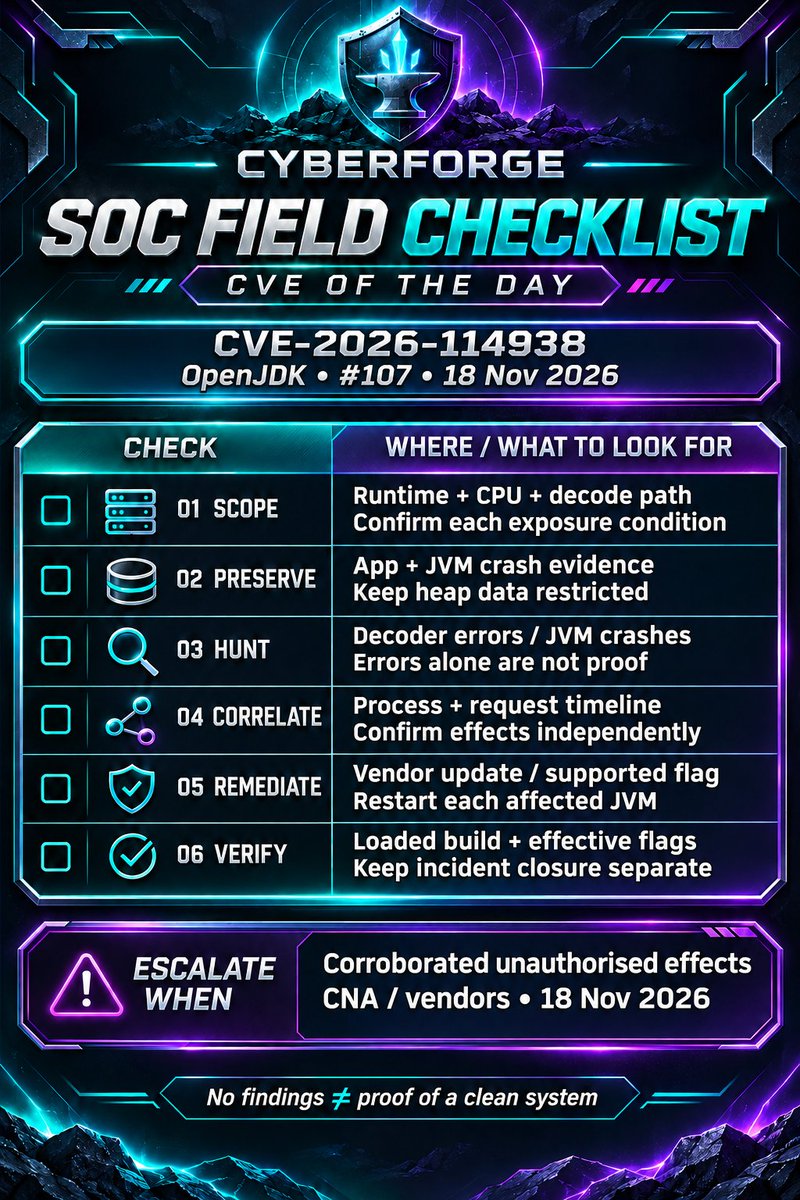
🔥 CyberForge CVE of the Day #107
🚨 CVE-2026-114938 — Java4Shell / OpenJDK
🎯 The quick hit:
Java4Shell is a memory-corruption vulnerability in an accelerated OpenJDK Base64 decoder. The normal boundary is simple: externally supplied encoded data should become decoded bytes inside a correctly bounded buffer. Calif reports that the affected native intrinsic can cross that boundary, with application-specific code-execution demonstrations.
Applicability joins vendor/full running build, the reported x86-64 AVX-512 VBMI intrinsic path and untrusted Base64 reaching decoding. Java installed or one CPU flag alone is insufficient. Include bundled runtimes and sensitive clients.
Oracle's 8.1 High CVSS3.1, Calif's 9.2 Critical CVSS4.0 and downstream assessments have distinct contexts. Lab RCE is not universal exploitability or a finding of compromise.
Prioritise applicable exposed services and sensitive clients: inventory, preserve, apply the correct vendor remedy and verify every restarted JVM. CISA urges patching; missing KEV/EPSS data proves no safety.
🔑 Key details:
• Identity: CVE-2026-114938, PUBLISHED, Oracle CNA. Oracle component: Compiler; OpenJDK labels hotspot/compiler. “Java4Shell” is Calif's name. The CNA has no title field, so this edition's title is editorial.
• Weakness: CWE-122, Heap-based Buffer Overflow, from CISA ADP; do not attribute that structured assignment to the Oracle CNA.
• Oracle Java SE affected rows: 8u511b33-perf, 17.0.21.0.3, 21.0.13.0.3, 25.0.5.0.3, 27.0.1.0.3. Oracle GraalVM for JDK: 17.0.21.0.3, 21.0.13.0.3. Oracle GraalVM Enterprise Edition: 21.3.20.0.3. These are literal listed builds, not an invented <= range.
• Oracle CNA CVSS3.1 Base: 8.1 HIGH — CVSS:3.1/AV:N/AC:H/PR:N/UI:N/S:U/C:H/I:H/A:H. High complexity, no privileges and no interaction are explicit in Oracle's context.
• NVD: Received; displays Oracle's 8.1 as a Secondary metric sourced to [email protected]. No independent NVD score was captured.
• Calif: CVSS4.0 9.2 CRITICAL; full vector not verified in the retained article. Credit: Quang Luong / Calif.
• Amazon Linux: vendor label Important, CVSS3.1 8.8 — CVSS:3.1/AV:N/AC:L/PR:L/UI:N/S:U/C:H/I:H/A:H. Its authenticated low-privilege RCE model differs from Oracle's assessment.
• Red Hat: Critical qualitative. Atlassian Data Center: 9.2 Critical, but the retained post does not state CVSS version/vector. Do not merge or convert these ratings.
• Corretto published fixed builds: 17.0.21.1.2, 21.0.13.1.2, 25.0.5.1.2, 27.0.1.1.4. Each has a stable release and pinned CVE-specific changelog entry. These are not universal fixed versions for other vendors.
• KEV: exact non-match in the complete captured 1,782-row catalog, version 2026.11.17, checked 18th November. No local safety conclusion follows.
• EPSS: successful exact request returned total:0, data:[]. Probability, percentile and score date are unavailable, not zero.
🧬 What actually went wrong?
The reported flaw is in the x86-64 HotSpot intrinsic used by java.util.Base64.Decoder on the relevant AVX-512 VBMI path. Calif describes incorrect padded-tail and output-length/store bookkeeping that can lead to a write beyond the intended heap buffer. This is an attributed high-level mechanism, not an independently reproduced exploit.
Oracle says supplying data to component APIs can suffice without untrusted Web Start applications/applets. Normal service parsing can expose the runtime; actual build, selected path and data flow still matter.
Calif reports pre-authentication RCE labs for Keycloak, Jira, Confluence, JFrog Artifactory, Jenkins and PingFederate, and post-authentication labs for Kafka, Solr, Elasticsearch, Gerrit and Spinnaker. The article says there is no universal exploit. It also credits samczsun with a client-side TLS exploit. These are source-reported capabilities with application-specific conditions, not verified field incidents or a guarantee for all named product releases.
Review scope: advisories, stable releases and pinned changelogs. No independently isolated corrective hunk, built/downloaded runtime or PoC execution; mechanism remains attributed research.
📦 Which deployments belong in scope?
Inventory each application's actual JVM, including clients, containers, agents and secondary nodes. Host updates can leave bundled Java untouched. Retain vendor/full build, process/node mapping and deployment history; stored image tags are not loaded state.
The OpenJDK 17 November individual-CVE row marks branches 17/21/25/27; its 8/11 cells are blank. The advisory introduction lists a wider set for the whole bundle and must not become this CVE's range. Red Hat describes affected OpenJDK 17.0.6 and later in the relevant family and says its 8/11 are not affected. Oracle separately lists 8u511b33-perf. Keep these product/build scopes; “all Java 8 is safe” is unsupported.
Confirm the real execution context: reported x86-64 AVX-512 VBMI availability, effective intrinsic/AVX settings, and externally controlled data reaching decoding. A VM's exposed CPU features may differ from the host's. CPU capability alone does not establish selected code, and a disabled path does not reconstruct the historical state. ARM64 is outside the reported vulnerable path; do not generalise that to all Java security questions.
Amazon Linux marks supported Corretto 17/21/25/27 package rows Fixed on 17th November. Its ordinary 8/11 Corretto rows are Not Affected, but some other rows say No Fix Planned; that status is not Not Affected. Atlassian's Data Center post covers relevant products and auxiliary JVMs with interim guidance. Its Cloud investigation/no-customer-action statement is not a finding that Cloud is unaffected.
🕰️ Exposure window and timeline:
Oracle CNA published 2026-11-17; CVE metadata updated 2026-11-18. NVD remains Received; publication 2026-11-17 and modification 2026-11-18 are retained as supplied without adding Z.
OpenJDK's matrix and the four Corretto fixed releases are dated 17th November. Release/CVE publication is separate from a customer's loaded protection; no local update time was verified.
JPCERT/CC's 18th November note reports public memory-corruption PoC material and researcher demonstrations, while saying it had not confirmed actual attacks as of that date. CISA ADP's 17th November 21:53:20 SSVC entry says Exploitation:none, Automatable:no, TechnicalImpact:total. Preserve both as dated attributed states, not a continuous claim that attacks or public code are absent.
CyberForge evidence cutoff: 2026-11-18. A local hunt interval should follow supported affected deployment, CPU/configuration and input-path history, including the period before disclosure where records support it. End it with evidence of effective correction or changed applicability. Document retention, clocks and missing nodes; no local exposure interval was established here.
🗺️ MITRE ATT&CK:
Conditional analyst mapping: T1190 — Exploit Public-Facing Application, Enterprise ATT&CK. The direct technique page was checked 18th November 2026; no frozen release number is asserted. Calif's labs supply the behaviour basis; applicability requires an actually public-facing affected app.
Defender pivot: join the relevant input and runtime context to independent unauthorised process/file/network effects. A technique definition or JVM crash is not an IOC or proof T1190 occurred. The separately reported TLS client and post-authentication paths need their own behaviour/access analysis; this edition invents no client technique or full intrusion chain.
Reference: https://t.co/eHWJIFcj41
🧭 SOC investigation trail:
Objective: establish applicability and corroborate effects. Name assets, UTC interval, sources, permissions and clock/collection limits. These cards are proposed work; only public sources were reviewed.
C01 — Scope the running JVM and decode route
Action: inventory each serving/client JVM, including bundled copies and auxiliaries.
Location: supported version views, deployment provenance, CPU/VM inventory, effective flags and data-flow records.
Signal: affected vendor/full build plus selected VBMI path plus untrusted decoding.
Correlate: process/node, route/authentication and dates.
Benign causes/limits: a stale binary, generic version or CPU flag alone is incomplete; Oracle 8u511b33-perf and vendor backports matter.
Escalate: affected reachability or an unresolved gate to the service/platform owner; exposure is separate from compromise.
C02 — Preserve context before restart or rotation
Action: retain existing evidence for the justified interval, subject to urgent containment.
Location: actual app/edge/auth, configured JVM fatal-error/core, process/network and change records.
Signal: original timezones, request/process context, runtime identity and acquisition provenance.
Correlate: clocks, rotation, replicas and restarts.
Benign causes/limits: no universal log path or complete body capture is assumed; heap/core material may contain secrets. Do not trigger a dump/crash to fill a checklist.
Escalate: imminent evidence loss or missing sources, retaining the coverage gap.
C03 — Hunt decoder and JVM anomalies
Action: review the affected interval without sending payloads.
Location: verified exception, existing fatal-error, edge and service-health records.
Signal: decoder failures, native faults or restart clusters around a real untrusted decode route; behavioural leads, not a signature.
Correlate: trusted client/request context, time, instance and process lifecycle.
Benign causes/limits: bad legitimate data, unrelated defects, memory pressure and maintenance can explain events; corruption may produce no useful exception/crash.
Escalate: an unexplained coherent sequence on an applicable runtime, not one HTTP error.
C04 — Corroborate possible effects
Action: investigate independent unauthorised effects.
Location: available process lineage, file/configuration audit, egress, app audit and approved changes.
Signal: unexpected child process, connection, sensitive operation or persistent change linked to the JVM.
Correlate: node/container, process, permissions and request interval; allow for PID reuse/clocks.
Benign causes/limits: helpers, integrations and maintenance may explain activity; names/IPs/proximity alone are not attribution.
Escalate: corroborated unauthorised outcomes to IR; scope actual process access, not assumed root or data theft.
C05 — Apply the correct vendor remedy
Action: select the supported fixed runtime/application or vendor interim control.
Location: advisory, pinned release/changelog, startup settings and change record.
Signal: product-specific correction or intended intrinsic restriction.
Correlate: every JVM/agent/sidecar/node, restart and normal workload/performance.
Benign causes/limits: Corretto numbers do not certify other vendors; a flag in a file is not loaded state, and ignored unknown options prove no protection.
Escalate: no supported remedy, missed processes, incompatible flags or degraded service to the vendor/owner.
C06 — Verify loaded protection and investigation gaps
Action: accept running state per instance, then review historical disposition separately.
Location: supported runtime/diagnostic views, provenance, CPU context, change and health records.
Signal: intended supported fixed build or effective temporary control on all relevant JVMs.
Correlate: start time, auxiliaries, replicas and input route.
Benign causes/limits: new image/package or one good node is insufficient; flag/CPU values alone do not prove path selection. No operational check ran here.
Escalate: stale state, failed acceptance, continuing anomalies or unresolved evidence to the assigned owner.
Handover: asset/owner → interval → record IDs → result/confidence → gaps → next action/owner. Separate applicability, exposure, suspicion, compromise and insufficient telemetry. Negative results need searched scope and collection health. No findings ≠ proof of a clean system.
🔎 Indicators and observable behaviour:
No verified CVE-specific malicious domain/address/hash, actor infrastructure or universal log signature was established. Java names and decoder exceptions are context, not IOCs.
Useful behavioural leads include unusual decoder failures, native JVM faults/restart clusters and independent unexpected process, file or egress activity. Ordinary invalid input, other JIT/native defects, memory pressure, helpers, integrations and maintenance are competing explanations. Confirm each dataset's real fields and paths; do not invent a cross-product event ID or assume request bodies/fatal-error files are always retained.
A crash proves failure, not cause or successful code execution. No crash or no indicator match cannot clear a runtime or an interval. Attribute any new indicator to its original source and period before operational use, and corroborate it against the affected process and authorised change context.
🧰 Optional CVE checks:
These two examples are source-checked against Oracle's JDK17 jcmd manual, not executed or tested against representative JVM output. Confirm another vendor/runtime's supported tooling. Diagnostic attachment can create an audit/operational footprint; use an owner-supported interface where direct attach is unsupported.
Check A — one running JVM's version/build. Replace JAVA_PID with the actual authorised process ID in the correct host/container namespace. Oracle requires same-machine and matching effective user/group context. Confirm tool compatibility and access; no fleet-wide attachment is assumed.
```bash
jcmd JAVA_PID VM.version
```
Retain output/status, vendor provenance, process/node mapping and UTC time; compare the complete build to its own advisory. A short version may need more supported identity evidence. Attach failure, missing tool or access denial means unavailable evidence. One process output proves neither all replicas nor CPU/input applicability or absence of compromise.
Check B — that same JVM's effective options, under the same approved access and process mapping.
```bash
jcmd JAVA_PID VM.flags -all
```
VM.flags reports current values; -all prints supported flags. Review UseBASE64Intrinsics and UseAVX where present with vendor guidance. Join build, start time, architecture, guest-visible CPU evidence and all relevant processes. A flag value alone does not prove a particular intrinsic was selected, that every JVM is covered or that past activity was benign. Missing/unknown flags are not a safe-state result. No option was changed here.
Official syntax: https://t.co/2123ai8i6S
🩹 Remediation and verification:
1⃣ — Assign app/platform owners, resolve build/CPU/input applicability and restrict relevant paths where supported; include bundled runtimes and clients.
2⃣ — Preserve existing app/edge/auth, JVM fault and host/network context where feasible before disruptive changes, according to urgency. Restrict memory/credential evidence.
3⃣ — Obtain the product vendor's supported correction from its trusted channel. Corretto 17.0.21.1.2, 21.0.13.1.2, 25.0.5.1.2 and 27.0.1.1.4 have verified release/changelog pairs. They do not certify other distributions. Retained Red Hat guidance says fixes are expedited; Atlassian's Data Center post awaits Temurin-based out-of-cycle patches. Refresh the actual vendor before changing production.
4⃣ — If an update cannot be applied immediately, assess supported temporary guidance. Red Hat prefers -XX:-UseBASE64Intrinsics; -XX:UseAVX=2 disables AVX-512 broadly and is x86-64-only, with startup-failure risk on ARM64. Atlassian provides its own product-specific pair with -XX:+IgnoreUnrecognizedVMOptions. Follow the correct vendor/component procedure; ignoring an unknown option is not protection evidence.
5⃣ — Restart/redeploy every relevant JVM and verify loaded vendor/build or effective supported mitigation, including agents, sidecars and secondary nodes. Accept normal workload, integration and performance behaviour with the service owner. A changed startup file, new image or successful package installation is not full running-state acceptance.
6⃣ — Keep temporary-control ownership/review dates and review removal after permanent correction. Historical investigation has its own bounded conclusion. Credentials, sessions, rebuilds and data review follow evidence and the incident owner; none occurred here. A WAF rule or generic size limit may reduce some routes but does not repair the decoder or cover every client.
🧾 Evidence separation:
Vendor/CNA: exact identity/builds/score, distributor scope, remedy and release statements. NVD repeats Oracle's metric; no independent rating.
Researcher/CERT: Calif's attributed mechanism and application-specific lab results, credited client-side TLS contribution, and JPCERT's public-material reporting/non-confirmation of actual attacks as of 18th November. No universal exploit, field incident or local outcome is established.
CyberForge: proposed priority, SOC questions, conditional mapping and acceptance guidance; no executed findings or validated detector.
Access limits: exact OSV and Red Hat structured API routes returned HTTP 404; readable Oracle/OpenJDK/Red Hat bulletin and other sources remain separate. No CPU inventory, logs, payload, JVM command, mitigation, detector, response, recovery or publication was executed.
🔥 CyberForge verdict:
CVE-2026-114938 can turn untrusted decoding into native corruption on the reported path. Impact, lab demonstrations and official urgency justify prompt owner action, with build/CPU/input conditions preserved.
Defender order: prove the running JVM and relevant path; preserve/correlate available context; apply the correct supported remedy to every process; verify loaded protection and service health. Give suspicious effects a separate investigation and keep missing telemetry visible.
A published correction, loaded protection and an evidenced incident conclusion are separate milestones. KEV/EPSS resolve none alone.
Find the JVM that is running, prove the path that matters, and verify the remedy that process actually loaded.
🔗 Sources and further reading:
Oracle advisory / affected scope:
https://t.co/sOJNqQlUrz
OpenJDK individual-CVE matrix:
https://t.co/JJUj9Q1Nao
Original research — Quang Luong / Calif:
https://t.co/TsDtlOGmAe
Red Hat guidance:
https://t.co/36p3iAaByG
Amazon Linux vendor status:
https://t.co/ty5tUsqRPR
Atlassian Data Center guidance:
https://t.co/1KmnmXlLYv
Corretto pinned fixed-build changelogs:
https://t.co/vMir6H5Nnn
https://t.co/E4imZZvHck
https://t.co/CtrSDpoLPe
https://t.co/iYKJc3c96S
CISA alert, separate from KEV:
https://t.co/G9vxdiNzg1
JPCERT/CC, 18th November:
https://t.co/kTrSJl7w4Q
CVE record:
https://t.co/iYEACOyJJn
NVD:
https://t.co/hSonIYvb3G
CISA KEV:
https://t.co/3QfSyKR5Fv
FIRST exact request — no row returned:
https://t.co/vZorqvhyKP
#CyberSecurity #CVE #Java #OpenJDK #Java4Shell #BlueTeam #ThreatHunting #SOC #CyberForge
🛡️🔎 Another Sherlock Solved! | PhishNet — Hack The Box 🙂
Another fantastic Sherlock investigation completed, and this time the focus was on SOC-based phishing and malicious email analysis! 📧
Following yesterday's deep dive into Windows filesystem forensics, PhishNet offered a refreshing change of investigative discipline, examining suspicious email evidence, message headers and a potentially malicious ZIP attachment.
For this investigation, I also wanted to explore a new tool: Sublime Security's Message Analyzer. (https://t.co/SiOljABJri)
And what an excellent discovery it was! 🔬
The clear presentation of email headers and the overall analysis interface made it a particularly enjoyable tool to explore while working through the evidence.
🔍 Key Investigation Areas:
- Email header analysis and message routing
- Sender information and potential spoofing indicators
- Email authentication and security-related header fields
- Suspicious attachment investigation
- Correlating evidence to answer SOC investigation questions
One of the things I enjoy most about Hack The Box Sherlocks is the opportunity to experiment with unfamiliar tools while developing a deeper understanding of the evidence itself.
Rather than simply finding the answers, I want to understand how and why the evidence leads to those conclusions.
PhishNet provided another excellent opportunity to practise that approach, combining structured analysis, research and a little experimentation.
🏆 PhishNet — Solved!
Another enjoyable couple of hours, another completed investigation, and another useful tool discovered for my growing digital forensics workflow.
On to the next investigation! 🚀💙
https://t.co/vcoenouyok
#HackTheBox #Sherlock #PhishNet #CyberSecurity #DFIR #SOC #EmailSecurity #PhishingAnalysis #ThreatHunting #SublimeSecurity #TheCyberForge
🔥 CyberForge CVE of the Day #106
🚨 CVE-2026-104840 — OpenCTI: repeated login attempts and conditional account access
🎯 The quick hit:
OpenCTI’s primary login uses the GraphQL token mutation. Before 7.260428.0, it lacked the endpoint-specific restriction described in the advisory, while the global Express limiter defaulted to 10,000 requests per one-second window. That broad ceiling is not a measured password-guessing rate or a useful promise about account-login protection.
An unauthenticated caller can repeatedly try passwords against an account. The consequential step is conditional: a usable credential must be recovered and account authentication/use must succeed under the actual controls. This is not passwordless login. The permitted data and operations depend on the recovered account; administrator rights, all CTI data and host execution are not automatic outcomes.
Inventory the actual serving backend and primary-login reachability, preserve available authentication context and apply a supported fixed artifact. Review proxy identity, exemptions and both limiter layers. Investigate suspicious account use separately from the software change.
Two source boundaries matter today. The project labels the advisory Moderate, while the CNA supplies a 9.2 Critical CVSS v4.0 assessment. FIRST returned no EPSS row: unavailable, not zero. The correction was released in April, before the July project advisory date and November CVE publication. Check what is already serving before planning a change.
🔑 Key details:
• Identity: CVE-2026-104840; PUBLISHED; CNA GitHub_M; publisher OpenCTI-Platform; product opencti / OpenCTI. Advisory GHSA-74jw-q47r-q5pv. Reporter credit: jeroengui.
• Weakness: CWE-307 — Improper Restriction of Excessive Authentication Attempts. Surface: primary-login token GraphQL mutation.
• Affected: literal CNA row “< 7.260428.0”; no lower bound or defaultStatus supplied. Project patched scope: >=7.260428.0. Do not invent a starting release or compare this calendar-like version lexically.
• CNA CVSS v4.0: 9.2 CRITICAL — CVSS:4.0/AV:N/AC:H/AT:P/PR:N/UI:N/VC:H/VI:H/VA:H/SC:N/SI:N/SA:N.
• AC:H and AT:P are explicit. Do not replace them with low complexity or no attack conditions. PR:N/UI:N describe starting access, not guaranteed credential success.
• Project advisory: Moderate, with no separate numeric vector on the captured page. Preserve the difference; do not average or silently replace it.
• NVD: Received, with a Secondary metric attributed to [email protected]; no independent NVD-authored score captured. Its expanded undefined optional v4 fields do not create another assessment. No CVSS v3.1 score was supplied.
• Repair: 7.260428.0 source tag resolves to 8a99a8f461a2faf9fc9c12a8e92cd32e2935a40d. Both linked corrective commits are ancestors, and the fixed-tag schema contains the login directive. Source ancestry is not binary or running-image attestation.
• KEV: exact non-match in the complete captured 1,781-row catalog, version 2026.11.13, checked 17th November. Not a local safety result.
• FIRST EPSS: successful exact request returned total:0, data:[]. Probability, percentile and score date are unavailable; no 0% or low forecast is asserted.
🧬 What actually went wrong?
Checking one password correctly does not protect an account from excessive repeated checks. The flaw is the missing or ineffective restriction on attempts at primary login. The documented consequence is access if guessing recovers usable credentials, bounded by the account and any applicable authentication controls.
The repair has two layers. Commit 8599366319532dbdc1cfd553c55a518ad146c3df moves the global Express limiter to the first middleware registration, before sessions and GraphQL. The shared builder keeps a default of 10,000 requests/1,000ms and adds an exact-string req.ip skip list. Its handler returns HTTP429 and emits a debug-level over-quota message.
Commit d7dfab4c264e36addf215b413924cb77f0827070 adds @rateLimit(limit: 1, duration: 1) to token. The fixed schema confirms it. OpenCTI wires the directive’s onLimit hook to throw a FunctionalError. A GraphQL rejection therefore needs its actual error/outcome interpretation; HTTP429 is not the only possible evidence, and HTTP200 does not prove every GraphQL operation succeeded.
There is a useful source-derived limit on what to promise. OpenCTI’s reviewed wiring only overrides onLimit. The pinned graphql-rate-limit-directive 2.0.6 source defaults to a schema-coordinate key and RateLimiterMemory. That supports a field-level, in-process interpretation, not a demonstrated per-account lockout or shared counter across replicas. This was passive source analysis, not a measured capacity problem or a new bypass finding.
📦 Which deployments belong in scope?
Identify the backend actually serving primary login, its active release/artifact and every replica. A stored fixed image, frontend label, connector/worker component or updated checkout alone does not establish the serving authentication code. Include restart and deployment history for the relevant interval.
Use the published range before 7.260428.0, with vendor/fork evidence for exceptions. The generated OSV Git range and version list are derivative context, not an independent experiment covering every historical release. The fixed tag includes both corrections; a particular distributed binary/image still needs provenance and runtime mapping.
Establish direct and proxied reachability, private/VPN boundaries, native credential policy and the actual SSO/MFA path. An SSO-facing screen does not prove native token login is unreachable. This review proves neither universal MFA bypass nor universal protection. Current configuration cannot reconstruct previous access conditions by itself.
Then review global settings, IP exemptions, trusted forwarding and replica/counter scope. Shared NAT or a proxy can collapse several legitimate users into one apparent client. The global skip list affects the reviewed Express layer; it does not automatically configure the separate login-field directive. Actual configuration and workload are unknown here.
🕰️ Exposure window and timeline:
Issue15666 opened on 23rd April. The middleware/configuration correction was committed 27th April at 11:19:28. Issue15735 and the login correction followed on 28th April; the latter committed at 06:47:07. The 7.260428.0 release was published on 28th April at 15:03:22.
The project advisory displays 28th July 2026. The CVE record says reserved 2nd October and published 16th November at 21:00:01; NVD received it later that evening. Keep those source dates separate. The project publication preceding the displayed reservation date is retained without an invented disclosure explanation.
A local exposure interval starts with supported affected deployment and relevant reachability, not CVE publication. End it only when fixed serving state or the changed boundary is established. Preserve deployment/provider/route history and identify any period outside log retention. This 17th November source snapshot does not establish when a client installed, exposed or repaired the service.
🗺️ MITRE ATT&CK:
T1110.001 — Password Guessing, Credential Access — is a conditional CyberForge mapping of the repeated attempts described by the CNA/project. Pivot to real authentication failures by account/time, then trustworthy client context, instance and rate pattern. A GraphQL request count alone does not establish a failed password check or malicious guessing.
T1078 — Valid Accounts, Initial Access when applicable — is conditional only after recovered credentials are successfully used for unauthorised access. Pivot to successful authentication/session evidence and subsequent account actions under actual permissions. Password recovery, a normal user’s success or temporal proximity to failures does not by itself establish malicious use.
MITRE’s current technique pages were checked 17th November; the case behaviour comes separately from the advisory/CNA. No local ATT&CK finding, actor, campaign, persistence, exfiltration method or host-execution chain is asserted. CWE-307 classifies the weakness, not an entire intrusion.
🧭 SOC investigation trail:
Six proposed checks follow. Keep applicability, exposure, suspicion, corroborated unauthorised effects and unavailable telemetry separate. These are evidence questions, not completed operational tasks.
C01 — Scope the serving build and login path
Action: inventory each active release, replica, primary-login route and identity controls. Location: deployment history, app/proxy policy and runtime records. Signal: before 7.260428.0 with relevant reachability. Correlate: upgrades, restarts, direct/proxied paths and provider changes. Limits: a fixed stored image or SSO screen proves neither serving repair nor native-path history. Escalate: affected exposure, unknown build or undocumented access needs an owner.
C02 — Preserve context without credentials
Action: collect bounded available evidence before rotation/restart, subject to urgency. Location: proxy/app/audit/identity records and configuration/deployment exports. Signal: original times, outcomes, account/client context and provenance. Correlate: clocks, transports, replicas and retention. Limits: ./logs and retained-file defaults do not guarantee a complete login history; redact passwords/tokens. Escalate: imminent loss, missing outcome fields or uncovered intervals; retain the gap.
C03 — Hunt for repeated failed logins
Action: review confirmed primary-login failures by target account/time without sending guesses. Location: verified authentication/audit fields and related proxy/app records. Signal: a coherent suspicious failure pattern. Correlate: account, trusted client attribution, route, instance and existing alerts. Limits: forgotten passwords, stale automation, NAT and sanctioned tests can explain activity; GraphQL traffic or status alone proves no credential failure. Escalate: a supported suspicious sequence after benign/coverage review.
C04 — Correlate success and account actions
Action: examine nearby successful authentication and later activity. Location: available identity/session, audit and CTI records with confirmed schema. Signal: unexplained successful account use or a sensitive operation tied to the interval. Correlate: account, sessions, trusted client context, normal behaviour and permissions. Limits: success after failures can be legitimate; IP/proximity alone proves no attacker or data loss. Escalate: corroborated unauthorised use/effects to incident response.
C05 — Repair both limiter layers
Action: select supported fixed code and review global/login-field controls. Location: release/provenance, two corrections, active policy and proxy topology. Signal: correction included in 7.260428.0-or-later serving plan with intended identity/exemptions. Correlate: first HTTP middleware, token directive, global settings, skip list and replicas. Limits: lowering a ceiling or enabling logging is not completed repair; shared proxy identities can affect users. Escalate: stale replicas, unexplained exemptions or auth availability problems.
C06 — Verify and hand over separately
Action: confirm each serving artifact and intended normal auth behaviour; assign historical gaps. Location: runtime/deployment, policy and case records. Signal: provenance/running state agree and normal login remains usable. Correlate: replicas, restarts, direct paths and pre-change interval. Limits: reviewed defaults are field-scoped/in-memory, not proven per-account or shared-cluster protection; no live test ran here. Escalate: ineffective controls, unexplained success or gaps preventing a defensible disposition.
Handover the owner, asset/account, UTC interval, evidence references, benign explanations, coverage limits and next decision. A suspicious failure pattern, successful authentication and unauthorised CTI operation support different conclusions. Missing evidence remains an explicit limitation after an upgrade.
🔎 Indicators and observable behaviour:
No validated malicious IP, domain, hash, actor or campaign IOC set is supplied by the retained primary sources. Contextual leads are repeated confirmed primary-login failures, unexplained success and account operations that can be tied to the interval. Forgotten passwords, stale automation, shared egress, normal analyst work and sanctioned testing need consideration.
The global debug message begins [RATE-LIMIT] over quota for; its HTTP handler returns 429. It is general traffic evidence, not a login-specific signature. Default app logging is info, so a missing debug line does not establish that limiting never occurred. The GraphQL directive’s Too many requests FunctionalError follows a separate path. Verify the actual outcome schema and transport.
Do not capture passwords, tokens or raw login bodies merely to make a detector easier. Default redacted-input settings are source evidence, not proof every custom proxy or log transport redacts correctly. No findings ≠ proof of a clean system.
🧰 Optional CVE checks:
Both examples are documentation-checked and unexecuted. Use the authorised management context, known backend container and justified interval. They do not test passwords or limiter effectiveness; errors and absent records remain unknowns.
Q01 — Created-container image inventory:
```bash
docker compose images
```
Docker lists image information for containers created in the selected Compose project. Reconcile service/image identifiers with release/digest, actual backend, replicas and restart records. This excludes other projects and standalone binaries; a listed image or mutable tag does not establish loaded code, current serving state or that every instance is fixed. Output may disclose topology.
Q02 — One known backend’s bounded console records:
```bash
docker logs --since '2026-11-16T00:00:00Z' --until '2026-11-17T08:55:07Z' --timestamps --tail 200 OPENCTI_CONTAINER
```
Replace OPENCTI_CONTAINER with the known backend name/ID and the example times with the supported investigation bounds. These dates are not an asserted client exposure interval. Expect available stdout/stderr records or an error, subject to Docker permissions and logging driver. The 200-line tail cap, rotation and source configuration can omit evidence. File-only audit records are not collected by this command. Default info may omit the global limiter’s debug diagnostic; an empty result does not establish historical cleanliness. Protect identities, tokens and sensitive CTI context.
Neither command was run against representative data or a deployment. No login request, password list, guessing loop, rate benchmark, account mutation, token operation or detector was executed. A useful SIEM query needs the real schema and coverage; this article does not invent authentication event fields.
🩹 Remediation and verification:
Upgrade affected services to 7.260428.0 or later supported software containing the correction, with traceable provenance and the owner’s supported procedure. Some systems may already have the April repair; verify what is serving. Restrict untrusted primary-login reachability while pending through supported controls and preserve evidence according to urgency/incident procedure.
Review APP__RATE_PROTECTION__MAX_REQUESTS, APP__RATE_PROTECTION__TIME_WINDOW and APP__RATE_PROTECTION__IP_SKIP_LIST against workload and active configuration. The source skip list matches exact IP strings; do not invent CIDR semantics. Review the actual proxy trust/hop chain and direct paths before interpreting req.ip. Do not broaden trust or weaken authentication as a shortcut; shared identity can also affect legitimate-user availability.
Confirm both repair layers, all serving artifacts and required restarts. Review login-field key/store/process scope and normal authentication usability through approved owner checks. Schema limit 1/duration 1 is not proof of per-account or cluster-wide state. Avoid generating production password guesses to demonstrate a fix; behavioural testing belongs in an approved environment.
Keep historical incident closure separate. If unauthorised account/data effects are corroborated, the incident owner should determine credential/session response, permission/data integrity and recovery scope. An upgraded container does not settle those questions. No mitigation, account reset, session revocation or recovery was performed for this briefing.
🧾 Evidence separation:
The CNA supplies exact identity, range, CWE and 9.2 vector. The project supplies its Moderate label, reporter credit, conditional impact statement and displayed publication date. Repository diffs, fixed-tag content and ancestry supply passive repair evidence. Pinned dependency source supports an implementation inference, not a deployment measurement. NVD repeats source-labelled scoring; OSV is generated context.
KEV is a dated exact catalog non-match; EPSS has no row. The global GHSA API returned 404 while project HTML remained readable, which does not prove withdrawal. CyberForge supplies proposed SOC checks, conditional ATT&CK mappings and prioritisation. No local asset, login, credential, rate test, detector, incident or publication was assessed operationally.
🔥 CyberForge verdict:
Give reachable affected OpenCTI primary-login services prompt repair ownership, especially where native credentials and sensitive CTI permissions are in use. The basis is the documented repeated-attempt weakness, conditional account consequences and a published correction. Actual urgency still needs build, exposure, identity controls and business context.
Identify the serving backend, preserve useful outcomes, repair and verify both limiter layers under the real proxy/replica model. Investigate supported account anomalies with privacy and attribution intact. A KEV non-match or unavailable score establishes no safety; a critical score establishes no local incident.
🔗 Sources and further reading:
• Project advisory: https://t.co/v3fThJ4ydk
• CNA record: https://t.co/QnCxrsDOnK
• HTTP correction: https://t.co/Aq7eLhQAST
• Login correction: https://t.co/OtnNqTeSYB
• Fixed release: https://t.co/2RC4RB4mbf
• Configuration: https://t.co/ivxmJgWYgd
• NVD: https://t.co/NSmjjPRW0U
• KEV: https://t.co/3QfSyKR5Fv
• EPSS: https://t.co/GxYGdeZd7T
• ATT&CK: https://t.co/JOwzOsFlWi and https://t.co/Why7RFkj6B
• Pinned directive source: https://t.co/2JxU1KkR6T
• Command references: https://t.co/YMBHi0Cr0F and https://t.co/OgenX3A2XN
#CyberForge #CVE2026104840 #OpenCTI #GraphQL #Authentication #BlueTeam #SOC
🔬 Another Sherlock Solved! | RomCom — Hack The Box 🛡️💙
Another fantastic digital forensics investigation completed, and this one certainly put my analytical skills to the test!
The RomCom Sherlock explores an attack involving the WinRAR vulnerability CVE-20**-**** with the investigation centred around Windows filesystem evidence and uncovering the attacker's activity.
This time, I decided to move away from my usual GUI-heavy approach and challenge myself with a more command-line-focused workflow.
🔎 Tools & Techniques Used:
- Kali Linux for mounting and examining VHDX evidence
- Eric Zimmerman's MFTECmd for NTFS metadata extraction
- $MFT analysis to investigate filesystem records and timestamps
- $UsnJrnl:$J analysis to trace filesystem changes
- PowerShell for CSV filtering, timeline analysis and evidence correlation
The biggest takeaway was discovering just how powerful PowerShell becomes when working with large forensic datasets.
There were plenty of challenging moments, enormous amounts of log data, and more than a few searches that needed refining! 😅
But by progressively narrowing the evidence through filenames, directory paths and timestamps, the investigation started revealing its answers.
Over six hours of hands-on investigation, and every minute was worth it.👌
What started as another Sherlock became an excellent practical learning experience in NTFS forensics, PowerShell and evidence-driven investigation.🙂
🏆 RomCom — Solved!
Another case closed, another collection of skills strengthened, and plenty of new techniques to carry forward into future investigations.
On to the next challenge! 🚀
#HackTheBox #Sherlock #DigitalForensics #DFIR #CyberSecurity #PowerShell #NTFS #IncidentResponse #ThreatHunting #TheCyberForge
https://t.co/WpHSNn1F4d
SAST analyzes code for weakness patterns. SCA identifies components and checks what is known about them. You need both, plus controls for the gaps neither covers.
https://t.co/QsGZ54JOkj
#Cybersecurity#InfoSec#AppSec#SCA
🔥 CyberForge CVE of the Day #105
🚨 CVE-2026-129171 — NginxPulse: when statistics selectors become SQL
🎯 The quick hit:
NginxPulse, the application that turns NGINX logs into analytics, has a critical SQL-injection flaw in its statistics API. The CNA’s range is 1.5.0 up to, but excluding, 1.6.26. Request-controlled id and locationType values can cross into SQL structure. In the researcher’s account, no credentials are needed by default; if system access keys are configured, the caller needs a key.
Establish the serving NginxPulse build, route access history and actual PostgreSQL identity. An NGINX banner alone does not establish scope. The researcher’s official-image setup used a database superuser, materially increasing potential impact.
Prioritise exposed affected services, preserve available request/application/database records and move to a supported fixed artifact. A supported access boundary can reduce reachability while repair is pending, but access-key enforcement does not remove the SQL defect. Embedded PostgreSQL upgrade planning must account for role migration and backup; external database roles need their own review.
Public technical reproduction exists. This briefing did not execute it. The captured KEV catalog has no exact entry, and the latest returned EPSS probability is 0.414% for 15th November. Those are dated signals, not a clean-system result or permission to ignore an applicable critical flaw.
🔑 Key details:
• Identity: CVE-2026-129171; PUBLISHED; CNA VulnCheck; publisher likaia; product NginxPulse. Credit: Wu Yulun.
• Surface: /api/stats/:type; id and locationType parameters. Weakness: CWE-89, SQL Injection.
• Published affected range: >=1.5.0,<1.6.26. The original researcher’s stated range ends at 1.6.24; the CNA’s range includes 1.6.25. Keep that distinction visible rather than assuming the narrower report excludes the later version.
• Repair: v1.6.26. Its source tag resolves to corrective commit f9416bea3be892a394cd24a6d4a2afbd8397e926. Source identity is not proof that a downloaded binary or running image contains the fix.
• CNA CVSS v4.0: 9.3 CRITICAL — CVSS:4.0/AV:N/AC:L/AT:N/PR:N/UI:N/VC:H/VI:H/VA:H/SC:N/SI:N/SA:N.
• CNA CVSS v3.1: 9.8 CRITICAL — CVSS:3.1/AV:N/AC:L/PR:N/UI:N/S:U/C:H/I:H/A:H.
• NVD status: Received. Captured metrics are attributed to VulnCheck, with v3.1 Primary and v4.0 Secondary entries. No separate NVD-authored score was present. Its v4 string expands undefined optional metrics; that does not make it a new independent assessment.
• KEV: exact non-match in the complete captured 1,781-row catalog, version 2026.11.13, checked 16th November.
• FIRST EPSS: probability 0.004140000 (0.414%); percentile 0.362610000 (36.261%); score date 2026-11-15; retrieved 16th November. Percentile is a relative rank, not the probability.
🧬 What actually went wrong?
The site selector should choose a configured site and the location selector a known reporting mode. Instead, they influence a quoted table identifier or column expression. SQL placeholders protecting other values do not validate those separately constructed structural positions.
The researcher describes error-based disclosure through the site-ID path and a direct output path through location statistics. The CNA describes database-content access and server-file reads/writes through powerful PostgreSQL functions. The issue also discusses further execution consequences under its deployment conditions. Keep attribution and privilege boundaries attached: this review did not reproduce those effects, establish a reliable universal exploit or prove host-root access.
The corrective code does several useful things. It validates website IDs against the configuration’s known site registry, including runtime collision-suffixed IDs. It constrains locationType to domestic, city or global and rejects unsupported values. It replaces detailed query-error responses with a generic HTTP error while retaining diagnostic context in server logs. Describing the fix as only hiding an error message would miss the input-boundary repairs.
There is also a database-privilege layer. The patch inspects direct and reachable role power, warns about excessive privileges or inspection failure and separates administrator/application roles for embedded PostgreSQL. A warning is configuration evidence, not evidence of an attacker. Startup continues for compatibility; external DSN accounts are not automatically demoted. The SQL fixes do not depend on that demotion.
The important consequence boundary is the PostgreSQL server. Its filesystem, operating-system account and mounts may be inside a container or on an external database host. A database superuser does not automatically identify an OS root identity or demonstrate container escape. Broader host/process claims need their own evidence.
📦 Which deployments belong in scope?
Inventory NginxPulse’s active release/artifact, every replica and its deployment interval. A fixed checkout, unused image or updated tag does not establish the serving process. Reconcile release/digest provenance with the active instance.
Use the CNA range, including 1.6.25 unless vendor evidence establishes a particular repaired artifact. OSV’s generated commit range and the unreviewed GHSA mirror are derivative context, not independent range validation.
Establish historical direct/proxied routes, edge controls, system.accessKeys and potential key holders. Protect keys and credential-bearing DSNs. Current policy cannot reconstruct earlier exposure; a configured key does not make the code unaffected.
Finally split embedded PostgreSQL from external DB_DSN deployments. The database identity, inherited/SET ROLE privileges, server location, mounts and file permissions determine how far an injected query could reach. These are local inventory questions, all unknown in this research package. A powerful role warrants review; it proves neither exploitation nor that every adjacent service was affected.
🕰️ Exposure window and timeline:
The public issue was created on 30th October at 09:29:06. The corrective commit was authored on 4th November at 11:06:39 and committed at 11:06:48; v1.6.26 was released at 11:10:00. The maintainer’s acknowledgement followed that day. The CVE was published on 13th November at 17:21:48, and NVD received it later that day.
That is a disclosure/repair timeline, not a local exposure window. An installation may have served affected code before the public report. Reconstruct deployment, route and key-policy changes; end the interval only when the fixed serving state or relevant access boundary is supported by evidence. Explicitly record any portion outside available log retention.
EPSS is dated 15th November; retrieval/cutoff is 16th November; the KEV catalog release is 13th November. A later refresh needs a new cutoff and review of dependent claims.
🗺️ MITRE ATT&CK:
T1190 — Exploit Public-Facing Application, Initial Access — is a conditional CyberForge mapping for an Internet-facing affected NginxPulse statistics service that is exploited through this SQL injection. The behaviour basis is the original research/issue; the technique definition is MITRE’s current page, checked 16th November. Local Internet-facing exposure is still an evidence question.
Pivot from historical build/access to requests, app errors, DB sessions and corroborated effects. A CVE match or query punctuation does not establish initial access; internal-only services need their own context.
No execution, persistence, lateral movement, exfiltration or actor/campaign mapping is claimed here. A possible consequence discussed by a researcher is not proof that a later intrusion stage happened. CWE-89 supplies the weakness classification, not a complete ATT&CK chain. Keep the reference and the behaviour evidence separate.
🧭 SOC investigation trail:
Use these six proposed checks as a handover. Keep exposure, suspicion, corroborated unauthorised effects and unavailable telemetry separate. No task is marked complete here.
C01 — Scope the serving application
Action: inventory each active build, route and key policy. Location: deployment history, app/proxy configuration and serving process/container. Signal: >=1.5.0,<1.6.26 during a reachable interval. Correlate: route, restart and key-policy changes. Limits: an NGINX banner, unused image or access key does not establish a repaired app. Escalate: affected reachability, unknown build or undocumented access needs an owner and deadline.
C02 — Preserve the affected interval
Action: arrange bounded collection before rotation, restarts or migration, subject to urgent containment. Location: available proxy/app/PG logs, configuration, deployment exports and approved backups. Signal: records with original timestamps and provenance. Correlate: clocks, instances, database host and retention. Limits: query strings, SQL or bodies may be absent; protect secrets/personal data. Escalate: imminent loss, failed collection or uncovered time; retain gaps explicitly.
C03 — Hunt for request-to-SQL anomalies
Action: examine retained statistics-route id/locationType inputs without sending payloads. Location: proxy records, app query-error context and PG errors if collected. Signal: unusual selector structure with related conversion/query failures. Correlate: request time/ID, route, site, instance and DB session where available. Limits: malformed clients, stale sites, setup changes and authorised tests can explain errors; HTTP500 proves no outcome. Escalate: a coherent sequence with corroborating DB behaviour.
C04 — Bound privilege and consequence
Action: have the DBA establish actual app login/effective roles and inherited/SET ROLE power. Location: DSN identity, PG role/audit records, DB host/container and mounts. Signal: powerful access plus independently supported unusual statements or data/file/process effects. Correlate: original requests, DB session, filesystem permissions and lineage. Limits: a superuser/warning is configuration evidence; DB-server files do not establish app-host/root compromise. Escalate: corroborated unauthorised effects to incident response.
C05 — Repair under the correct database plan
Action: select a supported fixed artifact, preserve rollback material and reduce reachability while pending. Location: release/provenance, deployment records and embedded/external guidance. Signal: approved 1.6.26-or-later repair plan; embedded pgdata backup and role-migration ownership. Correlate: change logs, administrator/app separation and restart results. Limits: external roles are untouched automatically; SQL repair does not require demotion. Escalate: migration errors, unsupported rollback or suspected unauthorised changes.
C06 — Verify and hand over
Action: confirm every serving instance, normal analytics, intended access and remaining evidence questions. Location: active artifact/process mapping, restarts, configuration and case records. Signal: provenance and running state agree; applicable role/migration review is recorded. Correlate: replicas, failover, stale jobs and pre-change interval. Limits: stored images or absence of errors prove neither a running repair nor historical cleanliness. Escalate: stale copies, failed health, unexplained changes or gaps preventing a defensible disposition.
Record the owner, asset, UTC interval, evidence references and next decision. A suspicious request, a correlated database event and a corroborated unauthorised effect support different conclusions. No validated malicious IOC set or local incident is established. Missing evidence remains a visibility gap, even after an upgrade.
🔎 Indicators and observable behaviour:
The useful leads are contextual: the affected statistics route, structurally unusual id/locationType values, related query/conversion errors and independently supported database/file/process effects. None is a standalone compromise signature. Normal analytics uses the same route; stale site IDs, malformed clients, setup changes and authorised testing can explain failures.
The fixed startup events security_event=postgres_role_privileges and security_event=postgres_role_check_failed concern privilege inspection. The first can flag a powerful role; the second means inspection did not complete. They do not show exploitation, and absence of a warning cannot replace a role review. Generic HTTP500 output also cannot fingerprint the fixed release reliably.
Query strings, SQL, bodies and role changes may not have been logged. Record missing fields and joins explicitly. No findings ≠ proof of a clean system.
🧰 Optional CVE checks:
These are source-checked, read-only examples, not commands run by CyberForge. Use the authorised owner/DBA, choose the intended asset/project/connection and time-bound the evidence you retain. Access errors and missing output remain unknowns.
Q01 — Created-container image inventory:
```bash
docker compose images
```
Docker documents this as listing images used by created containers in the selected Compose project. Run only in that project’s established management context. Reconcile the returned service/image identifiers with release/digest and deployment records. It does not cover other projects or standalone binaries, prove a listed container is serving, attest a mutable tag or verify every replica. It is an inventory lead, not a CVE test.
Q02 — Direct flags for the actual application session/login identities:
```sql
SELECT current_user AS effective_role,
session_user AS login_role,
r.rolname,
r.rolsuper, r.rolcreatedb, r.rolcreaterole,
r.rolreplication, r.rolbypassrls
FROM pg_catalog.pg_roles AS r
WHERE r.rolname IN (current_user, session_user);
```
Use a DBA-approved PostgreSQL connection representing the actual app identity, with approved credential handling and readable catalog metadata. An unrelated administrator session reports that administrator. Expect one or two role rows; powerful flags warrant design review. This query does not enumerate memberships, inherited/SET ROLE power, server-file/program roles, grants, OS permissions or historical role state. False direct flags therefore do not establish least privilege. The fixed app’s inspection is broader and recursive.
Both examples were checked against official documentation; neither was executed or validated against representative data. No injection, file primitive, role mutation, migration or disposable-container security-test script was run. Keep operational output containing topology or identities in the restricted case record.
🩹 Remediation and verification:
Upgrade to 1.6.26 or a later supported artifact containing the correction, with traceable provenance. Restrict untrusted statistics access while pending and verify the actual control boundary, including forwarded/direct paths. Do not treat an enabled access key as the patch. Preserve available evidence according to urgency and the incident procedure before disruptive changes erase it.
Embedded PostgreSQL needs explicit planning. The fixed deployment guide separates an administrator, default nginxpulse_admin, from the application account. Existing-cluster migration renames the old bootstrap superuser, recreates an ordinary application login and transfers object ownership. Back up pgdata before upgrading. The documentation warns against directly rolling back to an old image after migration: the old entrypoint expects database-creation power on the application identity. Those are vendor design statements, not a migration tested here.
External PostgreSQL / DB_DSN behaves differently. The upgrade leaves external roles and memberships unchanged. The SQL fixes are independent of role demotion, and privilege hardening is separate DBA work, not an upgrade prerequisite. Identify the actual login/effective roles and direct/indirect power; a bootstrap superuser requires a supported separate ordinary-app-role design rather than an assumed simple demotion.
Acceptance needs every serving artifact, completed restarts, intended access, normal analytics and applicable backup/migration/role records. A stored image, generic error or absent alert is insufficient.
Keep historical incident closure separate. A patch does not restore altered data or settle credential response/recovery. Hand over findings, interval, retained/lost evidence, gaps and owner. No remediation or recovery was performed here.
🧾 Evidence separation:
CNA statements supply identity, range, scores and impact assessment. Wu Yulun’s report supplies attributed reproduction and access conditions. The project commit/tag/files supply passive repair and deployment evidence. NVD repeats source-labelled CNA metrics; OSV and the unreviewed GHSA mirror are derivative context. KEV and EPSS are dated catalog/model snapshots.
CyberForge supplies the conditional ATT&CK mapping, prioritisation and proposed evidence trail. No local asset, database, exploit, source build, detector, migration or incident was tested. Source-reviewed maintainer tests are not locally passed tests. This is a reviewed local publishing draft; platform/composer acceptance and posting are separate activities.
🔥 CyberForge verdict:
Give reachable affected NginxPulse services urgent ownership, especially where the app’s database connection has powerful privileges. The basis is a critical request-to-SQL failure, default no-key access in the research account, public technical detail and a published correction. A low forecast and a catalog non-match do not undo that consequence if the deployment is applicable.
The practical route is clear: identify the serving app, establish access history, preserve useful records, repair under the right database-mode plan and verify the running result. Review database power and investigate supported anomalies with the correct server boundary. Keep the vulnerability repair and historical incident disposition independently defensible.
🔗 Sources and further reading:
• VulnCheck CNA: https://t.co/11JNh03elG
• Original research, Wu Yulun: https://t.co/Kh23A2ZoYY
• Maintainer issue: https://t.co/ZEaIUL0zv4
• Corrective commit: https://t.co/c3ZC6JT2ne
• Fixed release: https://t.co/gUddeVvasY
• Deployment/migration guide: https://t.co/K1nk8LeuEs
• NVD: https://t.co/zf81tQmcrE
• KEV: https://t.co/3QfSyKR5Fv
• EPSS: https://t.co/eGhpdZaeGn
• ATT&CK: https://t.co/eHWJIFcj41
• Command references: https://t.co/YMBHi0Cr0F
#CyberForge #CVE2026129171 #NginxPulse #PostgreSQL #SQLInjection #BlueTeam #SOC
🚀🔥 THE CYBERFORGE IS LEVELING UP!
What started as a small Zeek timestamp converter is growing into a proper DFIR toolkit! 😎💙
🛡️ Custom Telnet forensic scripts
🔎 TCP stream reconstruction
⏱️ Epoch-to-UTC conversion
📂 Zeek file-extraction cheat sheet
🛠️ Practical, investigation-driven tooling
Built in the lab. Tested through real forensic challenges. Shared with the community.
And we're only getting started! 🔥
🔗 https://t.co/k7025RU64B
#Zeek #DFIR #CyberSecurity #OpenSource
🔥 CyberForge Weekly CVE Rundown #010 — The Sunday Defender Debrief
🗓️ 9th–14th November 2026
📚 6 daily editions · 6 distinct CVE IDs
From Kubernetes controller authority to Outlook authentication exposure and a root appliance daemon, the useful question was: who crossed which boundary, in the component actually doing the work?
Coverage and review: six dated local Forge editions, #099–#104; external publication is unverified. Sunday refreshed CVE/NVD, KEV, FIRST and selected correction guidance through 2026-11-15 09:33:41. Earlier incident/patch analysis keeps its dates; local outcomes remain unassessed.
🎯 The weekly Quick Hit:
The main lesson: identify the initiator, effective authority and supported outcome. Controller, application-admin, server-process and OS-root contexts differ.
Who should check first? Owners of applicable, exposed deployments. Faspex, Outlook and DynamicCLI are in KEV. Keep known exploitation separate from numeric severity or our editorial pick; affected Apache and Aspire services still deserve prompt review.
First defender move: establish the actual serving component and supported correction across every member and promotable instance.
Follow the evidence: correlate the initiating request or file opening with the privileged action and result. Preserve independent history where deletion, temporary storage or root access can affect trust.
Keep this qualification: patch acceptance and incident closure require different evidence. A blank graph, blocked call or version banner answers a limited question.
📚 The daily rundown:
1⃣ — Monday · Daily #099 · 9th November
CVE-2026-124440 — Kyverno apiCall namespace-clamp bypass
An authenticated namespace tenant with applicable classic Policy authoring can cross into controller authority. The clamp checks one path representation while the request uses another; the admission-controller ServiceAccount can reach cross-namespace/cluster-scoped resources and a route toward cluster admin.
🧩 Why it stood out: the logged controller identity can hide a lower-privileged initiator.
🛡️ Applicability & fix: CNA 1.19.1 to before 1.19.2; corrected 1.19.2. Retain the maintainer's open-ended range and patched field separately. Later migrations need proof that intended policies still enforce.
🔎 SOC pivot: author → evaluation → controller request → object/result. Correlate webhook/role effects separately; cluster admin does not establish OS root.
📌 Status / as of: Sunday CNA 9.9 v3.1 / 9.4 v4.0, Critical. No exact KEV match. Public research is not a verified field campaign or a locally tested exploit.
🔗 https://t.co/Gxg5zOrFX1
2⃣ — Tuesday · Daily #100 · 10th November
CVE-2026-123218 — IBM Aspera Faspex authorization bypass
A crafted-message authorization failure can grant full Faspex administration. IBM's prose refers to an authorized/authenticated user; its 9.8 Critical v3.1 vector has PR:N. Retain both, without claiming a demonstrated unauthenticated exploit or host code execution.
🧩 Why it stood out: the corrected component shares a base version with affected software; the patch/build identity matters.
🛡️ Applicability & fix: IBM lists 5.0.0–5.0.19, corrected by 5.0.19 PL1 on Linux. Verify faspex-core 5.0.19 (1ce4b13, Fix Pack: 1) on every serving instance.
🔎 SOC pivot: correlate application/session identity, the unresolved access prerequisite and unauthorized administrative results. The exact crafted route and full attacker chain remain unverified.
📌 Status / as of: Sunday confirms KEV, added 9th November, catalog due 12th November, forensicTriage Yes, ransomware-use Unknown. NVD is now Analyzed; that label resolves neither the prose/vector conflict nor local compromise.
🔗 https://t.co/to2xrxeNi0
3⃣ — Wednesday · Daily #101 · 11th November
CVE-2026-124194 — Microsoft Outlook authentication exposure
A user must open a crafted message file in an affected client. Outlook can then connect to an attacker-controlled location without the usual warning, disclosing NTLMv2 authentication material. The Preview Pane is excluded. Delivery, opening, exposure and successful impersonation are separate stages.
🧩 Why it stood out: 6.5 Medium v3.1, with Microsoft's separate Moderate label, coexists with reported exploitation.
🛡️ Applicability & fix: match the Office SKU/architecture/channel. CVRF fixes include LTSC 2021: 16.0.14334.21048 and LTSC 2024: 16.0.17932.21140. Microsoft 365 needs its own channel/version row.
🔎 SOC pivot: link file opening to the actual client, destination and authentication history, then investigate reuse. A connection alone proves neither capture nor account compromise.
📌 Status / as of: Sunday CVRF retains Exploited:Yes. KEV added 10th November, catalog due 24 November, forensicTriage No, ransomware-use Unknown.
🔗 https://t.co/ed1o6A3wiQ
4⃣ — Thursday · Daily #102 · 12th November
CVE-2026-119618 — Apache mod_http2 race / possible RCE
Improper synchronization in assign_headers() can corrupt heap memory and lead to RCE. Actual HTTP/2 processing and module provenance matter. Research-exploit reporting does not establish field attacks; server-process execution is not automatically root.
🧩 Why it stood out: an edge's protocol/banner does not characterize every h2/h2c origin path or the serving module.
🛡️ Applicability & fix: upstream httpd 2.4.55–2.4.70 → 2.4.71. Separate GitHub mod_h2 2.0.8–2.0.42 needs its own supported route. Distribution backports keep their product/package scope.
🔎 SOC pivot: correlate protocol/configuration and requests with available crash, process and network evidence. A crash is not proof of RCE; quiet access logs cannot clear the service.
📌 Status / as of: Apache Critical; Red Hat 9.8 v3.1, with RHEL 9/10 separately Important. Sunday CISA-ADP 8.1 High / AC:H is repeated as NVD Secondary. Keep those scopes distinct. No exact KEV match.
🔗 https://t.co/tdj6bLBZQT
5⃣ — Friday · Daily #103 · 13th November
CVE-2026-118740 — Microsoft Aspire Dashboard authorization bypass
An unauthenticated NotFound route can permit telemetry deletion in standalone and AppHost-hosted dashboards. Additional browser-token exposure applies to standalone deployments using browser-token authentication. No host RCE, root control or separate OTLP/API-key bypass is established.
🧩 Why it stood out: observability tooling can itself lose evidence; missing graphs need an independent timeline.
🛡️ Applicability & fix: actual Dashboard 13.6.5+; 13.6.3/13.6.4 are not fixed. SDK, CLI-bundle, custom-path and container routes select different artifacts. A .NET or AppHost update cannot replace every pinned image/binary.
🔎 SOC pivot: join frontend reachability/auth context to the same instance/run and unauthorized outcome. Check legitimate clears, retention, temporary storage, new runs and ingestion failure.
📌 Status / as of: Microsoft 9.1 Critical v3.1; CVRF product rating Important. Sunday retains Exploited:No and KEV non-match, dated states rather than assurance about an exposed deployment.
🔗 https://t.co/BUcwoGJIlT
6⃣ — Saturday · Daily #104 · 14th November
CVE-2026-123039 — Check Point Gaia DynamicCLI local root escalation
Existing authenticated local access/code execution can reach an inadequately protected Unix socket and ask a root daemon to execute commands. This is local escalation, not standalone unauthenticated remote entry. The investigated PHP2Shell/malware/ESXi sequence remains separately attributed case context.
🧩 Why it stood out: root access can undermine trust in appliance history and restore material.
🛡️ Applicability & fix: R82.20 Take 14; R82.10 Take 52; R82 Take 132; R81.20 Take 174. No ceiling-plus-one fix inference. Retain broader Gaia roles, R81/R81.10 EOS route gaps and this-CVE-only Spark/Smart-1 Cloud exclusions.
🔎 SOC pivot: UID/process/time → root outcome, with independent records. Rejected connection from unauthorized uid is a blocked call. Expected root:config/0660 metadata alone proves neither installed correction nor a clean earlier interval.
📌 Status / as of: 7.8 High v3.1, vendor-reported exploitation. KEV added 13th November, catalog due 16th November, forensicTriage Yes, ransomware-use Unknown.
🔗 https://t.co/k2u7SNcW8J
🔄 Since the original editions:
Review scope: selected fields through 2026-11-15 09:33:41. Descriptions, CNA affected rows, CNA metrics, weaknesses and references match the daily captures for all six. Metadata/enrichment can still change.
NVD moved Kyverno: Received → Awaiting Analysis, Faspex: Undergoing Analysis → Analyzed, and Apache: Received → Modified. The other three workflow states match their daily notes. Processing states are not fixes or exposure findings.
Apache: Sunday's CISA-ADP 8.1 High / AC:H, repeated as NVD Secondary, remains separate from Apache's Critical wording and Red Hat 9.8 / AC:L. RHEL 9/10 Important is product-specific. Do not average them or call CISA's score an independent NIST assessment.
KEV catalog 2026.11.13, 1,781 rows: Faspex, Outlook and DynamicCLI match; the other three do not. Non-match does not prove safety. Due dates/triage fields retain their applicable-organizational context, not an inferred UK legal obligation or completed local triage. All three ransomware-use fields are Unknown.
FIRST model 14th November — probability / percentile:
- Kyverno 0.548% / 46.478th; Faspex 0.535% / 45.707th.
- Outlook 1.620% / 76.470th; Apache 1.330% / 71.529th.
- Aspire 0.923% / 60.947th; DynamicCLI 2.191% / 82.739th.
Outlook and Apache now have rows where their daily checks had none. Newly available forecasts are not new attack observations. Probability, rank, base severity and known exploitation answer different questions.
Still uncertain: Faspex access wording, unsupported/custom/EOS correction routes, local running state and incidents. Earlier detailed patch/incident analysis was not independently reproduced on Sunday.
🏆 This week's Forge honours:
🚨 Most Severe — CVE-2026-124440, Kyverno. Its CNA 9.9 v3.1 is this set's largest retained v3.1 base value, alongside a separate 9.4 v4.0. Different CVSS versions are not averaged or ranked as one scale. This honour does not replace deployment/exploitation-based priority.
🧩 Most Interesting Mechanism / Chain — CVE-2026-124440, Kyverno. Checking one path representation and acting on another defeats a namespace boundary while retaining a trusted controller identity. Correlate the author, effective request and result; reported examples are not proof of every cluster's exploitability.
🛡️ Most Defender-Relevant — CVE-2026-123039, DynamicCLI. Known exploitation, root authority and potentially untrustworthy local history sharpen preservation and recovery decisions. Blocked calls, metadata, patch acceptance and incident closure each answer different questions. No universal malware finding is inferred.
💜 CyberForge Pick of the Week:
CVE-2026-118740 — Microsoft Aspire Dashboard
Selection basis: Lee's confirmed pick for this rundown.
The defender's observability tool can have its own authorization and evidence-integrity problem. The additional browser-token consequence is narrower: standalone BrowserToken deployments. That combination rewards deployment inventory and independent history rather than a generic “update .NET” instruction.
Which Dashboard serves this frontend, and what survives independently if its telemetry changes? Resolve the SDK package, CLI bundle, custom path or image, correct the selected Dashboard to 13.6.5+, and verify its running state/access policy. Keep possible token exposure, confirmed disclosure and unauthorized use separate.
Our editorial pick does not universally outrank known-exploited assets. Its dated public states remain Exploited:No and KEV non-match.
🧠 What connected the week:
Follow the initiator behind the service identity. Kyverno can carry tenant intent under a controller ServiceAccount; Faspex can cross into application administration; DynamicCLI can act as root for a local caller. The effective actor and supported result need correlation.
Correct the selected component. Aspire's package reference is not every pinned image. Apache's upstream release is not every backport or separately built module. Faspex's PL1 marker and Gaia's branch Takes both demand more than a base-version string.
The useful contrast: Outlook needs file opening; the other services retain their own reachability/access conditions. Application admin, cluster admin, server-process execution and OS root are different outcomes.
Evidence boundary: six selected editions cannot measure global attack prevalence or an organization's telemetry completeness.
🗺️ The ATT&CK lens:
These are source-supported analytical lenses, not local observations, validated detectors or a reconstructed six-case chain.
T1068 — Exploitation for Privilege Escalation: DynamicCLI's local lower-privilege caller → root-daemon execution. Preserve the existing foothold; Kyverno's cluster-authority story does not establish host root.
T1190 — Exploit Public-Facing Application: conditional for applicable public-facing Faspex, Apache or Aspire services where exploitation is the access path. Reachability, missing telemetry or a research demonstration alone proves no successful intrusion.
T1187 — Forced Authentication: Outlook's opening-to-attacker-location/authentication-material sequence. Relay, cracking or successful account use needs separate evidence; Preview Pane is not substituted for opening.
Defender pivot: join caller/request or file handling to a supported result, keeping collection gaps and benign alternatives visible. MITRE references checked Sunday:
https://t.co/gUtWxU8wGe
https://t.co/eHWJIFcj41
https://t.co/FIRcptlped
🧭 The weekly SOC desk:
Question 1 — Who initiated the privileged operation?
Applies to: Kyverno, Faspex and DynamicCLI, with separate prerequisites. Evidence / correlate: author/session/process, service identity, target and result. Interpret / escalate: corroborated unauthorized privilege/scope crossing needs platform and incident owners; approved automation remains an alternative. Limit: a familiar identity or blocked call cannot clear earlier activity.
Question 2 — Why did evidence disappear?
Applies to: Aspire runs and potentially root-controlled appliance records. Evidence / correlate: independent requests/identity history, collector health, retention and the same run/member. Interpret / escalate: unexplained gaps plus unauthorized actions warrant attention; clears, rotation, temporary storage and forwarding failure remain alternatives. Limit: no findings do not establish a clean system.
Question 3 — Did a precursor produce the claimed outcome?
Applies to: Outlook and HTTP/2 Apache. Evidence / correlate: actual file opening or protocol processing, then authentication/process/crash/network results. Interpret / escalate: distinguish delivery from opening, exposure from reuse and a crash from RCE. Limit: retention and collection define what can be concluded.
🛡️ The defender's Monday plan:
1⃣. Platform/application owners: inventory applicable components, every serving/promotable member, permissions and exposed intervals. Assign unsupported/custom routes and evidence gaps.
2⃣. SOC/incident lead: prioritize applicable known-exploited Faspex, Outlook and DynamicCLI using actual exposure. Preserve independent history before disruptive changes where incident priorities permit, without delaying urgent containment.
3⃣. Change owners: use the supported Kyverno correction, precise Faspex PL1 build, correct Office SKU/channel, httpd/vendor module route, selected Aspire 13.6.5+ artifact and matching Gaia Jumbo.
4⃣. Service owners: collect running-state and intended authorization/enforcement acceptance across all members. Downloads or one corrected node do not establish the whole service.
5⃣. Incident/recovery owners: assess earlier compromise, authentication reuse, persistence and restore trust separately from software acceptance. Record evidence, gaps, owner and next decision. These actions are proposed; preparing this rundown performed none of them.
🔥 CyberForge closing thought:
Which identity crosses which boundary, in the component actually doing the work, and what supports the result?
Correct that component, retain the qualifications and keep an independent view of what happened. Give Monday's defenders a decision they can substantiate.
🔗 Sources and further reading:
The six daily cards link the responsible primary advisories. Sunday enrichment and assessment sources:
- NVD data: https://t.co/8FlBMMeQNM
- Red Hat Apache assessment: https://t.co/o06ibsbNAd
- Microsoft CVRF: https://t.co/26sIKZyPnI
- CISA KEV: https://t.co/3QfSyKR5Fv
- FIRST EPSS: https://t.co/KZNJNggWLs
#CyberForge #CVE #CyberSecurity #WeeklyRundown #BlueTeam #SOC #EvidenceHandling
🛡️ Hack The Box Sherlock — Telly | SOLVED! 🔥
Seven hours. One PCAP. Zeek at the heart of the investigation. And two CyberForge utilities helping uncover the evidence. 😎
This has genuinely been one of my favourite DFIR investigations so far!
I set myself a challenge when starting this Sherlock: investigate the network evidence using Zeek rather than relying on Wireshark.
What followed was an incredibly rewarding investigation that pushed me well beyond the standard Zeek logs.
🔎 The investigation
Starting with baseline Zeek analysis, I identified suspicious network activity and began reconstructing the attack timeline.
Our newly released CyberForge epochutc utility immediately proved its worth, converting Zeek timestamps into readable UTC values and helping establish the historical context needed to progress.
But then things became considerably more interesting!
The standard logs could only take the investigation so far. I needed visibility into what was actually happening inside an interactive Telnet session.
Rather than switching to Wireshark's Follow TCP Stream feature, I decided to build the capability myself.
🛠️ Enter our second CyberForge utility!
Using Zeek's TCP content-delivery capabilities, I developed a custom Telnet stream inspector to reconstruct the captured session and reveal the commands exchanged during the intrusion.
And it WORKED! 🔥
Suddenly, activity that wasn't visible in the baseline logs became accessible for investigation.
From there, further evidence correlation led into HTTP traffic analysis, transferred-file identification and recovery using Zeek's file-extraction capabilities, followed by read-only SQLite examination of the recovered database.
The entire network-forensic analysis remained Zeek-driven, with SQLite used to examine the extracted database.
No shortcuts. No published answers. Just investigation, experimentation, custom scripting and following the evidence.
💙 What made this Sherlock special?
It wasn't simply reaching the final answer.
It was recognising when the existing analysis wasn't sufficient, understanding what additional visibility was needed, and developing a tool to provide it.
That is precisely what I enjoy about cybersecurity and digital forensics.
And there's another exciting development...
🚀 Our CyberForge Telnet stream inspector is now working in the lab!
Following further testing, documentation and refinement, I plan to make it available through our new public CyberForge Zeek Tools repository, alongside epochutc.
🔗 CyberForge Zeek Tools:
(https://t.co/k7025RU64B)
The repository is only just getting started, but this investigation has already demonstrated why I wanted to create it.
Build tools from real investigative challenges. Test them. Learn from them. Share what works.
An absolutely brilliant seven-hour investigation, 195 XP earned, and another Hack The Box Sherlock completed! 🏆
Onwards to the next investigation. 🔎💙
#CyberForge #HackTheBox #Zeek #DFIR #DigitalForensics #NetworkForensics #CyberSecurity #OpenSource
https://t.co/STFAAU9Nqb