Maria Bartiromo has been fired from Fox News after she was about to report on China's involvement in the 2020 stolen election. She was working with the White House to prepare this story. Maria has hired a high profile attorney. This is a developing story, but I would like to point out that the White House never went through Laura Ingraham, Jesse Watters or Sean Hannity to get this story out. They only went through Maria because she is the only journalist who will risk it all for America and President Trump. She has always been a MAGA patriot. God bless, Maria Bartiromo.
白宫晚宴的曲目才是美国人精心烹制的最靓的一盘菜。
《悲惨世界》之后就是《图兰朵》,《One Day More》唱的是“再过一天”,背景是革命前夜;《图兰朵》的《Nessun Dorma》唱的是“今夜无人入睡”,最后以“我将胜利”达到高潮。
更巧的是,《图兰朵》的故事本身就发生在一个西方人想象中的古代北京。当“今夜无人入睡”激昂的旋律响起时,与《One Day More》交相呼应、珠联璧合,确实耐人寻味:
如果说第一首只是巧合,那么以第二首为国宴收尾,至少让这个夜晚有了更多可供解读的余味。
曲中有曲,弦外有音。至于白宫有没有这个意思,恐怕只有选曲的人自己知道。
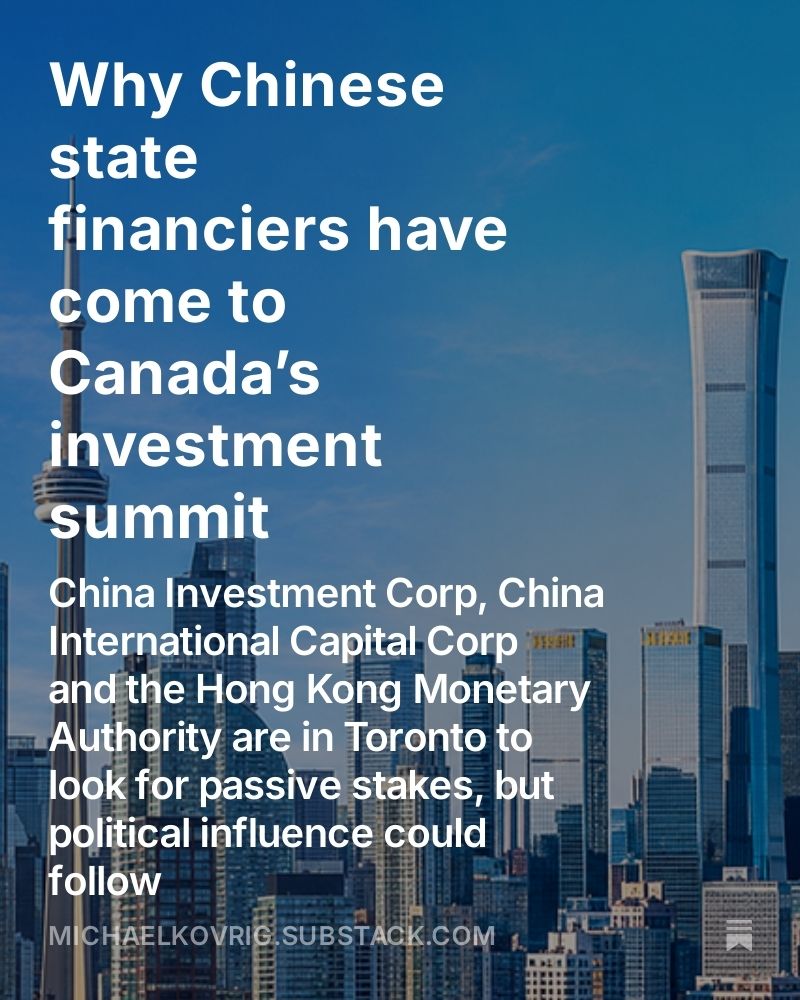
Why are three Chinese state financial institutions at Canada’s investment summit this week? They’re likely hunting for passive stakes in permitted sectors and hoping for a whitelist to clarify their options. 1/2
And this is why you do not mix tech bros and policy bros. Those are very different skill sets, and tech bros are terrible at understanding policy, let alone geopolitics.
Anyone with a functioning political brain knows, as an immutable fact, that China will forge ahead regardless of what promises are made or agreements are signed. That is simply a fact of life.
All of this reminds me of the Covid era, when health bros and even some supposed intelligence bros kept insisting that we needed to be nice to China to secure their cooperation. Definitely do not point out that the virus may have come from a Chinese lab. Definitely do not push Beijing too hard. Definitely do not say anything that might upset them.
It was some of the most breathtakingly stupid thinking imaginable then, and it is no smarter now.
PETER THIEL CALLED IT.
The Antichrist wouldn’t build the doomsday machine.
This clip aged terrifyingly well.
Peter Thiel predicted in June, 26, 2025 exactly what is happening right now with Anthropic, Coxon and the AI-safety landscape.
“The way the Antichrist would take over the world is you talk about Armageddon non-stop, you talk about existential risk non-stop.”
The 'Antichrist' wouldn’t seize power by creating an AI apocalypse, but by CONVINCING everyone that the apocalypse was coming and then offering safety in exchange for CONTROL.
A must watch.
China's embassy just hosted a roundtable in Vancouver pitching economic cooperation with First Nations communities, while Canada's own land-rights disputes over much of British Columbia remain unresolved.
On September 3, the Chinese Embassy guided a trade roundtable organized by the Bank of China and hosted by the Canada China Chamber of Commerce. About 60 attendees heard Ambassador Wang Di's written remarks calling for Chinese and Canadian businesses and First Nations communities to strengthen collaboration under a "China-Canada new strategic partnership."
The guest list is what makes this notable. Former federal Finance Minister Bill Morneau attended. So did Senator Yuen Pau Woo, former senator Victor Oh, and Ernie Daniels, president of the First Nations Finance Authority, a body that manages $4.4 billion in loans for Indigenous infrastructure, housing, land purchases, and energy projects like the Haisla Nation's Cedar LNG stake.
No deals were announced. The embassy described it as a discussion of future cooperation. But the framing was explicit: Chinese institutions, Canadian financial figures, and Indigenous finance leaders in the same room, invited by China's diplomatic mission, specifically discussing First Nations economic development at a moment when much of British Columbia's land remains under unresolved Aboriginal title claims.
When a foreign government's embassy organizes a meeting that specifically targets Indigenous finance and land development, is that economic outreach or something worth looking at more carefully?
There’s an arrogance in Canada that I’ve grown tired of.
This constant attitude that somehow we’re morally superior to Americans. That we’re smarter, kinder, more civilized — simply because we’re Canadian.
It’s pompous. And frankly, it’s embarrassing.
America isn’t perfect. Neither is Canada.
But Americans openly celebrate their country, defend their freedoms, reward ambition and actually debate what their nation stands for.
Meanwhile, too much of Canadian identity has become:
“At least we’re not American.”
That’s not an identity. That’s insecurity disguised as superiority.
What exactly do we stand for anymore?
Being Canadian should mean something more than looking down our noses at the people next door.
I want a Canada that earns our pride — not one that assumes it.
🇨🇦🇺🇸
A Canadian defense official warned that restarting military talks with China would hurt ties with the US. Weeks later, she was fired.
Raquel Garbers, the principal author of Canada's 2024 defence policy, published an op-ed in October 2025 warning that anti-US rhetoric from Western leaders was splitting the alliance while China and Russia waged a covert campaign against both countries. Two days later, Canada's foreign minister called China a "strategic partner" while in Beijing. One month after her op-ed, Garbers was told her position was being declared surplus, with no alternative post offered. Her employment ended in May 2026.
She's since filed a $2 million wrongful-dismissal claim, arguing the "surplus" explanation is pretextual and that her firing chilled dissent inside Ottawa's bureaucracy. The Department of National Defence has declined to comment, citing litigation, and the allegations haven't been tested in court.
Then, on September 4, 2026, Canada and China held their first defense dialogue in eight years, first announced only by Beijing. Garbers called this exactly what she'd warned about: Ottawa's silence handed China a propaganda win while reinforcing Washington's suspicion that Canada functions as Beijing's back door into US security and markets.
The U.S. is Canada’s largest export market, by far.
We buy 16x as much stuff as China.
Tariffs on your biggest trade partner may not have been the smartest move, Carney. Just sayin’.
I mean… at this rate, you’re making Trudeau look smart. And, that’s saying something… 😉
Is Trump Insane? Or Is He On To Something?
Canadians thought they were voting for Canada’s Liberal Party in the last election, but that’s not what they got, according to our guest, Canadian investigative journalist Sam Cooper. He says the party is Liberal on its face, but behind the scenes it’s working for outside interests—directly opposite to Canadian’s.
Canada Needs an Economic Overton Window Reset
Canada’s economic debate has become strangely moralized. Raise a conventional question about investment, productivity, manufacturing, energy, deficits, or trade, and the response is too often not an argument but an accusation: un-Canadian, Trumpian, MAGA, anti-worker, anti-public service.
That is how the Overton Window closes.
The Overton Window describes the range of ideas considered respectable in public debate. In Canada, it increasingly excludes economic realism, not because the evidence is absent, but because the language of patriotism has been captured by the assumption that more government spending is synonymous with national strength.
It is not.
The private sector creates the wealth that finances the public sector. Businesses invest, hire, export, innovate, and pay the taxes that sustain health care, pensions, infrastructure, defence, and social programs. Government has an indispensable role, but it cannot indefinitely distribute wealth that the economy has failed to produce.
It is politically expedient to blame Canada’s current economic predicament on Donald Trump. Tariffs, trade threats, and American protectionism create real risks and deserve a serious response.
But Trump did not create the Canadian industrial-policy failures that weakened our competitive advantage. He did not create years of weak business investment, slow permitting, costly regulation, inadequate infrastructure, unaffordable housing, poor productivity growth, or the habit of responding to every structural weakness with another subsidy.
Nor did Trump hollow out Canadian manufacturing on his own. China’s entry into the World Trade
Organization reshaped global trade, and Canadian industry absorbed a significant adjustment shock. Research has found that rising Chinese import competition was associated with substantial Canadian manufacturing job losses between 2001 and 2011. Recognizing that fact is neither extremist nor xenophobic. It is an economic observation. The irony is missed by the economic elite in Canada!
The United States is confronting two long-running vulnerabilities: its massive debt burden and the erosion of parts of its manufacturing base. That is what lies behind the renewed American emphasis on tariffs, procurement rules, reshoring incentives, subsidies, strategic supply chains, and national-security industrial policy. Canada may object to particular measures and should defend its interests firmly. But retaliation against this modern Hamiltonian turn is not a long-term dominant strategy.
The United States retains the world’s deepest capital markets, the reserve currency, enormous energy resources, global technology leaders, a vast domestic market, and military power.
Betting Canada’s economic strategy on Trump losing the Mid-terms is wishful thinking. This is a generational economic pivot.
Canada needs a modern Hamiltonian agenda of its own: not blanket protectionism, but national capacity.
That means competitive taxes, faster permits, reliable energy, infrastructure that gets products to markets, deeper capital markets, selective strategic procurement, and a country open to productive foreign investment.
Economic sovereignty is not achieved by announcing more programs in Ottawa. It is achieved when Canada can attract capital, build things, develop its advantages, and finance its own ambitions.
Our relationship with the United States remains central. Canada should not seek economic detachment from its largest market; it should seek to become indispensable to North America, as a supplier of energy, critical minerals, food, electricity, advanced manufacturing, and trusted technology.
Calling these arguments un-Canadian is not a rebuttal. It is an attempt to place them outside the Overton Window before Canadians can judge them on their merits.