🧵Why are Velo and Lightnet quietly building in Indonesia?
The answer starts with shrimp 🦐
Here’s why,
most people still see @veloprotocol as just another crypto project
But the bigger story isn’t crypto.
It’s financial infrastructure.
For years, @lightnetgroup has quietly built licensed payment rails across ASEAN
Velo provides the blockchain settlement layer, enabling faster, cheaper and compliant cross-border payments behind the scenes.
Now look at Indonesia.
Orbit Plus has launched its first fiat off-ramp beta, allowing users to convert digital assets into Indonesian Rupiah and settle directly to local bank accounts.
Indonesia is one of ASEAN’s busiest remittance corridors
For PayFi, this isn’t just another market.
It’s one of the most important proving grounds.
Indonesia is also strengthening its regulatory framework.
Moving crypto oversight to the OJK reflects the country’s push to integrate digital assets into its financial system.
That trend is becoming increasingly visible
BTSE recently launched BTSE Indonesia through a regulated joint venture, expanding licensed IDR fiat rails.
This isn’t about BTSE partnering with Velo.
It’s about Indonesia rapidly becoming a hub for regulated digital financial infrastructure.
But the story doesn’t stop with regulation.
It also reaches into banking.
Lightnet has built strategic relationships across Southeast Asia’s financial ecosystem, including its partnership with WeLab.
WeLab entered Indonesia in 2018 through a joint venture with Astra Financial, acquired Bank Jasa Jakarta in 2022 and transformed it into Bank Saqu in 2023.
Bank Saqu is now one of Indonesia’s fastest-growing digital banks.
It shows how digital banking and next-generation payment infrastructure are converging across ASEAN.
Another key piece is remittances.
Velo Labs partnered with Inception to modernize cross-border payment corridors across Southeast Asia.
Indonesia sits at the center of one of the region’s busiest remittance networks.
For millions of migrant workers, faster settlement means lower costs and quicker access to money.
Then there’s the enterprise layer.
The CP Group, one of Southeast Asia’s largest conglomerates, has operated across Indonesia for decades.
Its businesses span agriculture, food production, logistics and aquaculture.
Yes… even shrimp. 🦐
That may sound amusing.
But this is exactly where blockchain becomes real economic infrastructure.
These industries move enormous value across borders every day.
To be clear, there is no public evidence that CP Indonesia currently settles its operations through Lightnet or the Velo Protocol.
However, Chatchaval Jiaravanon, co-founder of Lightnet, comes from the family behind @CPGroup_Live.
That doesn’t prove adoption.
But it illustrates the scale Lightnet was designed to support.
Now add Orbit Plus, bringing together consumer wallets, fiat off-ramps, merchant payments and planned virtual debit cards.
This is far more than another wallet launch.
It looks like another layer of ASEAN’s emerging PayFi stack.
Licensed payments.
Digital banking.
Blockchain settlement.
Stablecoins.
Fiat rails.
Enterprise payments.
All moving in the same direction.
The question isn’t whether someone pays with Bitcoin.
It’s whether blockchain settlement becomes invisible.
Customers pay digitally.
Merchants receive local fiat.
Banks remain part of the system.
The blockchain simply becomes infrastructure.
Indonesia may be the first major domino.
Because when regulated financial infrastructure, banking networks, enterprise ecosystems, remittance corridors and consumer payment applications begin converging in the same market…
it’s worth paying attention.
This isn’t just Velo.
It’s Southeast Asia quietly building the next generation of financial infrastructure.
And sometimes…
the future of finance doesn’t begin on Wall Street.
Sometimes it starts with migrant workers, digital banks, food supply chains…
and Shrimps 🦐
Exciting news! 🌏 we are exploring a strategic collaboration with @lightnetgroup to accelerate digital asset & payment infrastructure across Southeast Asia.
By combining our global ecosystem with Lightnet’s cross-border payment expertise, we’re building a more inclusive financial future. 🚀
Read more: https://t.co/nLQaeJ4PgC
Lightnet and KuCoin are exploring a collaboration to connect digital asset markets with cross-border payment infrastructure across Southeast Asia.
By combining exchange liquidity with real-world payment rails.
Read more: https://t.co/shY1nkU3Af
Vietnam is preparing to launch its first regulated crypto market.
But the bigger question is:
Where do @veloprotocol,
Lightnet, HashKey, VPBank, CAEX and OpenEden fit into this picture?
Most people still look at crypto as isolated projects.
But something much bigger is forming in Asia right now.
It’s not about one coin.
It’s about infrastructure.
CAEX, part of the VPBank ecosystem, increased its capital to ~$380M to meet regulatory requirements.
In April 2026, OKX Ventures and HashKey Capital joined CAEX as strategic investors.
Founding shareholders include VPBank Securities and LynkiD.
This creates a direct bridge between crypto infrastructure and traditional banking.
That matters.
Because CAEX sits inside the VPBank ecosystem, one of Vietnam’s major banking groups.
This is where crypto moves into regulated domestic financial infrastructure.
HashKey is not just investing.
It is building its own infrastructure:
HashKey Chain, focused on institutions and real-world assets,
and HashKey Global, expanding its regulated international footprint.
HashKey Capital was also an early investor in @lightnetgroup
Lightnet is closely connected to
@veloprotocol
That link matters.
Important detail:
Lightnet and Velo are not random partners.
They sit inside the same ecosystem around Chatchaval Jiaravanon.
Lightnet = licensed fintech layer
Velo = blockchain-based settlement & credit layer
In September 2025, Velo, Lightnet and OpenEden launched a joint venture.
The goal:
Build an ASEAN settlement network powered by tokenized U.S. Treasuries.
The system is designed around:
Tokenized U.S. Treasuries
Stablecoins in multiple currencies
Real-time cross-border payments
Institutional-grade compliance
And with USDV reserves including BlackRock’s BUIDL fund and OpenEden’s tokenized T-Bills, it also adds something important:
A yield layer.
Velo says USDV is backed in part by BlackRock’s USD Institutional Digital Liquidity Fund, tokenized by Securitize, and OpenEden’s TBILL collateral.
That matters.
Because this is not just stablecoin settlement.
It brings tokenized Treasury yield into the payment and settlement stack.
Capital inside the ecosystem does not just sit idle.
It can be connected to real-world yield while still being used across payments, transfers and liquidity flows.
Another important piece:
Velo, Lightnet and @Visa announced a strategic collaboration focused on payment solutions in Asia.
The idea is powerful:
VELO tokens as collateral
→ enabling digital credit
→ bridging into existing payment networks
This is the credit layer.
Then there is LynkiD.
A key shareholder in CAEX and one of Vietnam’s leading loyalty ecosystems.
This is the adoption layer.
Because real adoption does not start with buy crypto.
It starts with apps, rewards, payments and financial products people already use.
Crypto becomes invisible.
And finally:
HashKey’s global expansion adds another dimension.
With a regulated international footprint, it can connect regional markets to global liquidity.
So what do we have?
Exchange layer → CAEX
Banking layer → VPBank
Adoption layer → LynkiD
Institutional layer → HashKey
Settlement layer → Velo & Lightnet
Liquidity layer → OpenEden
Credit layer → Velo + payment integrations
No direct confirmation that all pieces are fully integrated.
But the architecture is becoming very clear.
Asia is not just adopting crypto.
Asia is building financial rails.
Trading.
Liquidity.
Settlement.
Credit.
Banking access.
Adoption.
All layers are starting to take shape.
Most will notice it when it is already built.
Some are starting to see it now.
Pay attention to the rails.
@Gx_interstellar great research 🔥
🧵 How Velo, Lightnet, and Asia’s Billionaire Networks Are Quietly Rebuilding the Financial System
👇 Let’s dive in.
Who is Chatchaval Jiaravanon?
He comes from the CP Group Dynasty (Charoen Pokphand) — one of Asia’s most powerful family conglomerates with investments across telecom, finance, retail, agriculture, and tech.
That gives him access to 1+ billion consumers across Asia.
But he’s not just an investor.
He’s building the next generation of financial infrastructure.
Lightnet & Velo — The Ripple-Stellar Connection
Founded in 2018, Lightnet was designed as a blockchain-based remittance network — a direct challenger to SWIFT & Western Union.
It leverages decentralized systems for instant cross-border payments, fully integrated with @StellarOrg (XLM).
Parallel to that, Jiaravanon founded Velo Labs, built on top of Stellar to provide:
• Tokenized assets
• Stablecoin infrastructure
• DeFi payment rails
In 2021, Velo acquired Interstellar, Stellar’s commercial arm founded by
Jed McCaleb (Ripple & Stellar co-founder) —
making Velo effectively the Stellar-based Ripple of Asia.
🤝 Partnerships
• Visa (payments network)
• Paxos (stablecoins & tokenization)
• Chainlink (oracle infrastructure)
• CP Group (massive business network across Asia)
With the Orbit App and Universe DEX (nearly 500k users), Velo already operates a full DeFi payment ecosystem.
Bitcoin Treasury via DV8
In July 2025, Jiaravanon became Chairman of DV8 Public Company Limited (Thailand).
His plan?
Turn DV8 into a Bitcoin Treasury company — like a Southeast Asian version of MicroStrategy. But it goes further:
DV8 will also invest in DeFi banking, tokenized finance, and digital asset infrastructure across Southeast Asia.
The Masterplan
• Velo → Stellar infrastructure (Asia’s Ripple)
• Lightnet → Payment rails / remittances
• DV8 → Treasury & institutional bridge
• Fortune → Narrative control
• Jiaravanon → The connector of TradFi, DeFi & Media Power
Everything points toward a fusion of traditional finance, tokenized assets, and decentralized payment networks —
led by Asian market powerhouses tied to Ripple, Stellar, and Chainlink.
Fundamental Strength
Velo isn’t a random altcoin — it’s a financial infrastructure project.
• Stellar-based settlement layer
• Acquisition of Interstellar
• Partnerships with Visa, Paxos, CP Group & Lightnet
• Real-world use cases: remittances, tokenization, DeFi banking
• Backed by one of Asia’s wealthiest dynasties (CP Group)
Velo’s fundamentals are stronger than 90% of tokens with similar market caps.
Tokenomics — The Sell-Off Was Inevitable
~75% of supply already in circulation.
👉 Token inflation pressure is dropping fast.
Once the last allocations are out, there’s minimal sell pressure left.
Organic price discovery follows.
And major players — CP Group, Lightnet, Velo Labs — aren’t panic-selling.
They’re consolidating and restructuring the ecosystem.
The Current Price (~$0.0082) — Technically Weak, Strategically Golden
Yes, the chart looks ugly
But this is exactly the kind of pre-catalyst accumulation zone you look for in fundamentally strong projects.
• Supply almost distributed → reduced pressure
• Fundamentals improving → asymmetric upside
• Media exposure via Fortune, Lightnet & McCaleb → narrative expansion
Every time Velo traded below $0.01, it marked accumulation before the next expansion.
What Comes Next
• Velo + Lightnet expanding across Southeast Asia & MENA
• DV8 Group integrating BTC Treasury + DeFi banking
• Ripple & Stellar narratives gaining traction with ISO 20022 regulatory frameworks
It’s a perfect mid-term setup once liquidity returns to the Layer-1 / Payment narrative.
The price isn’t the value — it’s a reflection of market liquidity during transition.
Fundamentally:
✅ Strong network
✅ Real partnerships
✅ Token distribution nearly complete
✅ Institutional narrative formingIf you think long-ter, this is the diamonds in the dust phase for VELO.
I've said this before and I'll say it again. The extended version:
$VELO isn't chasing retail applause or the daily drama, it's engineered for institutional grade, real world financial infrastructure, and that deliberate focus sets it apart in this noisy space we call crypto. The project navigates complex regulatory grey zones (especially across SEA and Thailand), where even casual replies risk being misread as advice, guidance, promises, or manipulation. In cultures where business moves quietly and compliance is non negotiable, over-engaging on socials isn't maturity it's a liability. Silence on every retail query isn't neglect; it's strategic caution to protect long-term delivery.
They've shipped more substance than most: detailed whitepapers, verifiable milestones, PayFi rails bridging TradFi/DeFi, RWA integrations (e.g., tokenized assets via partners like Securitize and BlackRock exposure in the region), cross-border settlements powered by heavyweights (CP Group, Visa ties, Lightnet backbone potential), and ecosystem growth targeting enterprises over hype. Price dips tie to macro crypto conditions, thin liquidity, and market-wide sentiment not project-specific failures.
Contrast this with the broader space: many low caps and mid caps flood X/Telegram with constant Q&A, memes, and hand-holding to fuel retail buzz and short-term pumps. Large caps like BTC/ETH rely almost entirely on community/decentralized chatter, with minimal direct team retail engagement. $VELO aligns more with the latter, prioritizing execution for institutions that demand audited progress, compliant rails, and utility over endless community babysitting.
Retail often wants noise and quick reassurance; serious players want results without the sookiness. By staying focused on building superfinancial highways for underserved markets, $VELO positions itself squarely for the institutional wave, not retail demands. That's not disengagement; that's an Asian Fintech company. You have to understand our cultures are different. In the west we announce everything. In the East. They take the more subtle route.
If you cant handle it. Sell out and move onto something more within your risk appetite.
NFA. Just my opinion.
[ $VELO ]
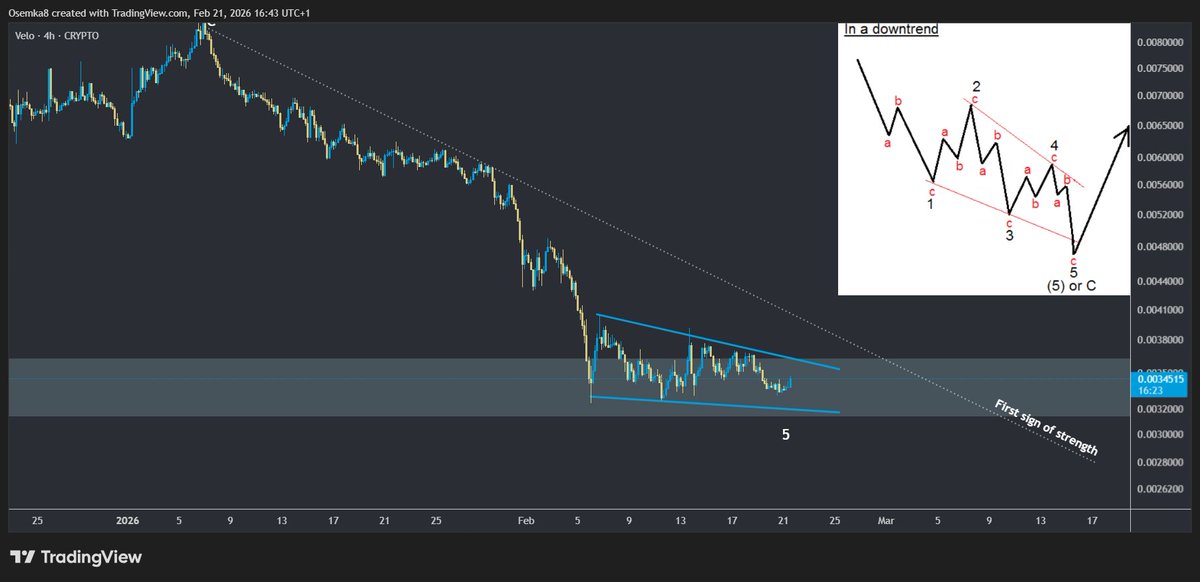
While you may say there are no reactions at the bottom and the PA is weak, I think it is quite constructive.
Let's zoom in. This is the entire correction from the top. Very, very clear wave structure.
To me this looks like a finished classic ABC correction with 5 waves of A, 3 corrective waves of B and 5 waves of C all complete. Compared with a visual so you can see for yourself:
It's also respecting channel perfectly.
OK, so why no reactions? In my opinion we're working on an ending diagonal: A move at the end where the bottom looks more like a minor accumulation rather than a capitulation wick/candle and resembles a triangle. If another minor low comes in, no problem.
If this triangle breaks to the upside, that'd be a first sign of a macro trend reversal occuring. I think we'll know very soon as we seem to be at an apex of the triangle.
For reference, this was $BTC's ending diagonal at 2021 April top (inversed for comparison with $VELO).
$Velo bridges @solana (speed + performance) & Stellar (payments + asset issuance) for seamless cross-border transfers, FX on-chain, and real-world liquidity.
• Cutting out middlemen → from 20 parties in traditional finance to direct P2P/B2B.
• 24/7 settlement, cheap/fast, perfect for emerging markets in Asia fighting currency volatility & underbanking.
DeFi isn't replacing TradFi — it's a superset with tokenized assets, new money types, and instant global movement.
Adding $VELO to the collection of Elliott Wave counts due to relative strength since Dec 22 lows. Nice completed leading diagonal wave 1, and subsequent sharp wave 2. Text book. High probability bottom in Nov, as not pulled lower in Dec sell-off (eg. ADA, AVAX). Medium term targets ~0.2-0.4, but with good fundamental growth for long term believers, multi-year target is 1.618 extension for wave 3 at 2.2, prior highs.
From on/off-ramps to real-time swaps and RWA access, Velo’s 2026 roadmap is designed to connect payments, investing, and everyday transactions inside Orbit Plus while supporting partners through future wallet technology.
Infrastructure that scales with users and institutions.
#VeloNetwork #Cryptocurrency #Infrastructure
🧵 Velo x USD1 x WLFI — why the CP Group angle matters
@veloprotocol just announced an integration of USD1 with @worldlibertyfi (WLFI) to strengthen PayFi infrastructure across Asia. That’s not a random collab, it’s a distribution play.
The key line people are missing:
VELO explicitly mentions strategic support from @CPGroup_Live while building an Asia-tailored PayFi ecosystem. Support here signals access, partnerships, and rails — not just marketing.
CP Group (Charoen Pokphand Group) is one of Thailand’s most powerful conglomerates, with major reach across retail and telecom distribution, the kind of footprint you need for real payments adoption.
Now connect the dots: @lightnetgroup is the fintech layer tied into this story, and Lightnet’s co-founder is Chatchaval Jiaravanon — from the CP family ecosystem.
So VELO isn’t just a token narrative. It’s aiming at a closed-loop, high-velocity financial network: consumer payments → FX → digital asset management, designed for mass adoption.
Where USD1 comes in: stablecoins are the cleanest settlement primitive for PayFi — liquidity + settlement layers that can move across apps, partners, and corridors without rebuilding everything.
World Liberty Financial (WLFI) is a U.S.-based DeFi project co-founded by members of the Trump family. That makes the integration politically visible and could attract aligned liquidity + partners — whether you like the politics or not.
Here’s the strategic read: CP/Asia distribution + WLFI USD liquidity branding + VELO/Lightnet rails = a potential fast-track into real merchant/user networks across the region.
If you’re thinking “does this open doors into Asia?” — that’s the right question. In payments, distribution beats tech. You can have the best chain/stack in the world, but adoption needs embedded partners.
Bottom line: This looks like a real-world PayFi distribution thesis: stablecoin settlement + institutional backing + Asia-native rails.
If this converts into live flows, it’s not just “bullish” — it’s utility demand.
⚠️ $VELO SCAM ALERT ⚠️
VELO’s price hasn’t moved much because the circulating supply has increased while liquidity hasn’t yet flooded in.
This is textbook accumulation phase behaviour.
When the price stays flat but the market cap and on-chain activity slowly rise, it usually means smart money and insiders are accumulating quietly... building positions over time, not chasing price, but absorbing supply from impatient holders.
That’s why you see:
Low volatility
Tight-range price movement
Gradually rising market cap or volume base
No parabolic candles yet
Disbelief, boredom, and the “nothing’s happening” phase are actually the best conditions for accumulation because they filter out speculators before the breakout stage.
Once liquidity rotation begins and the token supply stabilizes, the price catches up...and that’s when the crowd finally realizes accumulation is over and expansion has begun.
But of course, that’s when the “scam token” talk starts...because apparently, backers like CP Group don’t value their reputation, have endless free time, and just for fun decided to get involved in a scam…
Or maybe Binance Velo wallet deposits, partnerships, and $USDV pairings are all part of the “scam support system” too?
If people can’t understand what’s involved in an undervalued low-cap project that’s been around for less than five years and hasn’t even had its first full market cycle yet, then this simply isn’t for them.
Stick to large caps and play it safe…
or run from this “scam token”...fast!
$XRP $HBAR $XLM $VELO