Why DeFi Needs Better Infrastructure? @ConcreteXYZ
The evolution of DeFi has created unprecedented financial opportunities, but it has also introduced significant operational complexity.
Explore Concrete at https://t.co/3pNzTDOeij
Next 👇
One thing that often gets overlooked in onboarding is how many small steps can stop someone from participating.
You've got your account ready, you're excited to engage, and then you realize you still need ETH just to cover gas.
That's why the new Rally update matters.
Creators can now pay gas fees with Rally Points (RLP), making participation much more seamless and removing a common point of friction for both new and existing users.
What stands out to me isn't just the feature itself, but the reason behind it. The community raised a pain point, Rally listened, and the team shipped a solution that directly improves the creator experience.
The easier it is for people to participate, the stronger the ecosystem becomes. This feels like one of those simple changes that will have a much bigger impact than it seems at first glance.
join now: https://t.co/gLlprhn0xm
@ConcreteXYZ As DeFi matures, infrastructure may become more important than individual protocols.
The platforms that simplify onchain capital deployment could become the foundation of the next generation of institutional DeFi.
Why DeFi Needs Better Infrastructure? @ConcreteXYZ
The evolution of DeFi has created unprecedented financial opportunities, but it has also introduced significant operational complexity.
Explore Concrete at https://t.co/3pNzTDOeij
Next 👇
@ConcreteXYZ Concrete represent a structured DeFi approach where operational responsibilities can be automated through onchain execution systems. Through automated compounding, quantitative allocation, and ctAssets, users gain access to opportunities without actively managing every position.
@ConcreteXYZ This creates friction.
The more decisions users must make, the harder it becomes to scale participation.
Infrastructure provides a solution.
@ConcreteXYZ Accessing yield frequently requires users to coordinate across multiple protocols, multiple chains, and constantly changing incentive structures. As a result, many participants are forced to perform tasks traditionally handled by professional asset managers.
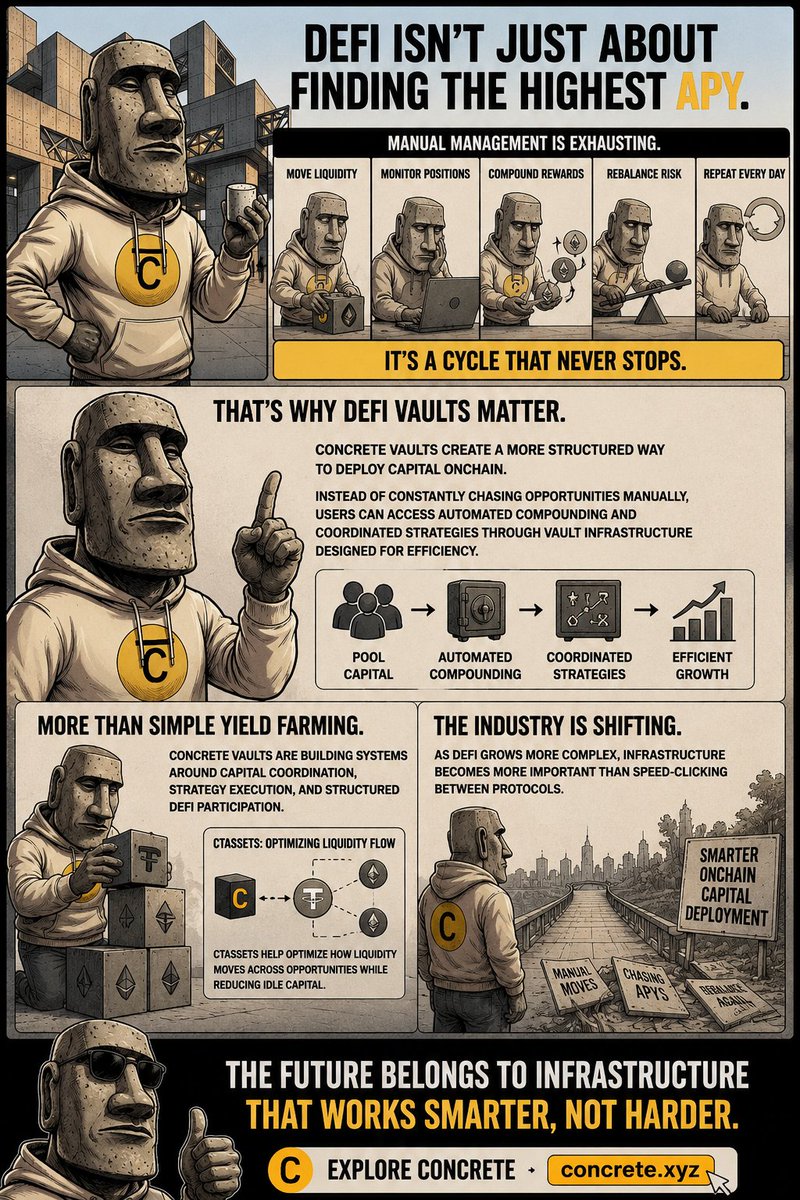
🔥🔥🔥A lot of people still think DeFi is just about finding the highest APY.
✅But after spending time onchain, I think the real problem is how exhausting manual management becomes.
✅You move liquidity, monitor positions, compound rewards, rebalance risk… and repeat the cycle every day.
✅That’s why DeFi vaults matter.
✅ Concrete Vaults create a more structured way to deploy capital onchain. Instead of constantly chasing opportunities manually, users can access automated compounding and coordinated strategies through vault infrastructure designed for efficiency.
✅What stands out to me is that this is bigger than simple yield farming.
✅Concrete Vaults are building systems around capital coordination, strategy execution, and structured DeFi participation. Features like ctAssets help optimize how liquidity moves across opportunities while reducing idle capital.
✅As DeFi grows more complex, infrastructure becomes more important than speed clicking between protocols.
✅Feels like the industry is slowly moving toward smarter onchain capital deployment instead of constant manual repositioning.
👉Explore Concrete at https://t.co/OvuHvZz8JP @ConcreteXYZ
➖Code is law sounds great… until reality hits.@ConcreteXYZ
➖DeFi didn’t remove trust it redistributed it.
➖Smart contracts, governance, oracles all trust layers, just less obvious.
➖The bigger issue? Decentralization theatre.
➖Multisigs, inactive DAOs, delayed timelocks… looks safe, but isn’t always resilient.
➖What makes more sense to me now is engineered trust: Designing systems that know trust exists and control it.
➖That’s why Concrete stands out:
➕trust is explicit
➕roles are defined
➕systems can respond in real time
➖Less ideology, more operational security.
👉 https://t.co/OvuHvZz8JP
🔥🔥🔥DeFi không thiếu lợi nhuận chỉ thiếu chiến lược giữ được lợi nhuận. @ConcreteXYZ
- Nhiều người vào DeFi với một mục tiêu rất rõ: tìm APY cao nhất.
- Nhưng sau vài vòng thị trường, mình nhận ra một điều: APY cao thường không đi kèm với sự ổn định.
- Dòng tiền vào nhanh cũng rút ra rất nhanh.
- Vấn đề không nằm ở lợi nhuận.Mà nằm ở chất lượng của lợi nhuận
- Có 2 kiểu: lợi nhuận được trả và lợi nhuận được tạo ra
- Cái đầu có thể cao, nhưng không bền. Cái sau có thể thấp hơn, nhưng giữ được lâu hơn.
- Một chiến lược bền vững cần gì? Không cần quá phức tạp.
- Chỉ cần: có nguồn yield ổn định, chịu được thay đổi của thị trường
- kiểm soát được rủi ro và chi phí. Quan trọng nhất là: có thể duy trì theo thời gian
-Điều dễ bị bỏ qua. Nhiều người nhìn APY mà quên:
phí giao dịch, trượt giá, chi phí điều chỉnh vị thế
- Những thứ này ăn mòn lợi nhuận từng chút một.
- Nên cái cần nhìn không phải là kiếm được bao nhiêu
mà là giữ lại được bao nhiêu.
- Cách tiếp cận đang thay đổi, thay vì tự đi săn từng kèo, xu hướng đang chuyển sang: gom nhiều chiến lược lại, theo dõi và điều chỉnh liên tục, tối ưu lợi nhuận thực nhận
- Đó là lúc DeFi vaults trở nên hợp lý hơn.
=> Góc nhìn từ Concrete: Concrete vaults không chạy theo APY cao nhất.
- Họ tập trung vào: phân bổ vốn linh hoạt, giảm phụ thuộc incentive, giữ lợi nhuận ổn định
- Một ví dụ đơn giản là Concrete DeFi USDT (~8.5%).
- Không phải mức gây chú ý ngay lập tức.Nhưng lại là kiểu lợi nhuận mà dòng tiền dài hạn thích.
=> Kết lại: Trong DeFi: Bạn có thể kiếm nhanh. Nhưng không phải ai cũng giữ được lâu.
=> Và cuối cùng: Chiến lược tốt không phải là chiến lược kiếm nhiều nhất mà là chiến lược còn tồn tại sau nhiều chu kỳ.
➡️Explore Concrete at: https://t.co/csaoVbXZXS