i just learned that a houseplant solves voronoi diagrams using local cell signals
we’re using GPUs to do it.
it has no coordinates. it has chemistry and time
the algorithm IS the development
every leaf is the residue of a computation we never bothered to watch
Fun fact: “Descent’s” textures were carefully designed to fall on 16-byte boundaries so mapping them was a simple linear process, avoiding an expensive “divide by z” for every pixel.
For all of us who were confused about that scene in "Good Will Hunting" when the professor taught Fourier analysis on the board, but assigned an exercise in graph theory at the end of the class.
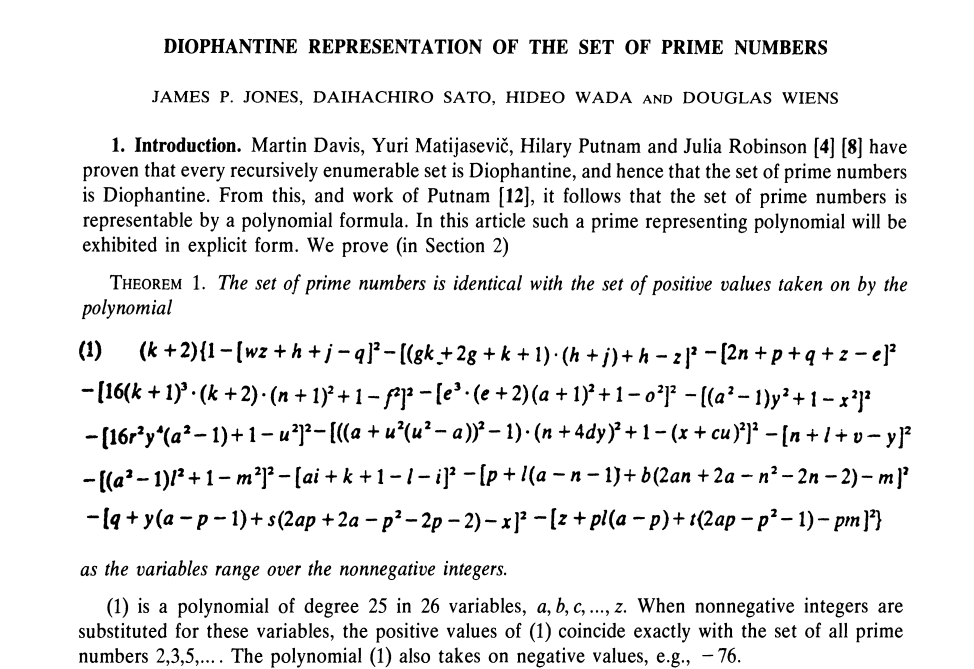
Can someone tl;dr? My very remote intuitive incomprehension is that a prime is something arbitrary large, and that it feels that "you need a loop" to characterize them all, while a polynomial is something finite.
Quite impressive result imho ... that I just discovered thanks to @KenOno691
A marvel of computing & math !
However note that this polynomial can also produce negative values (to be discarded, not prime).
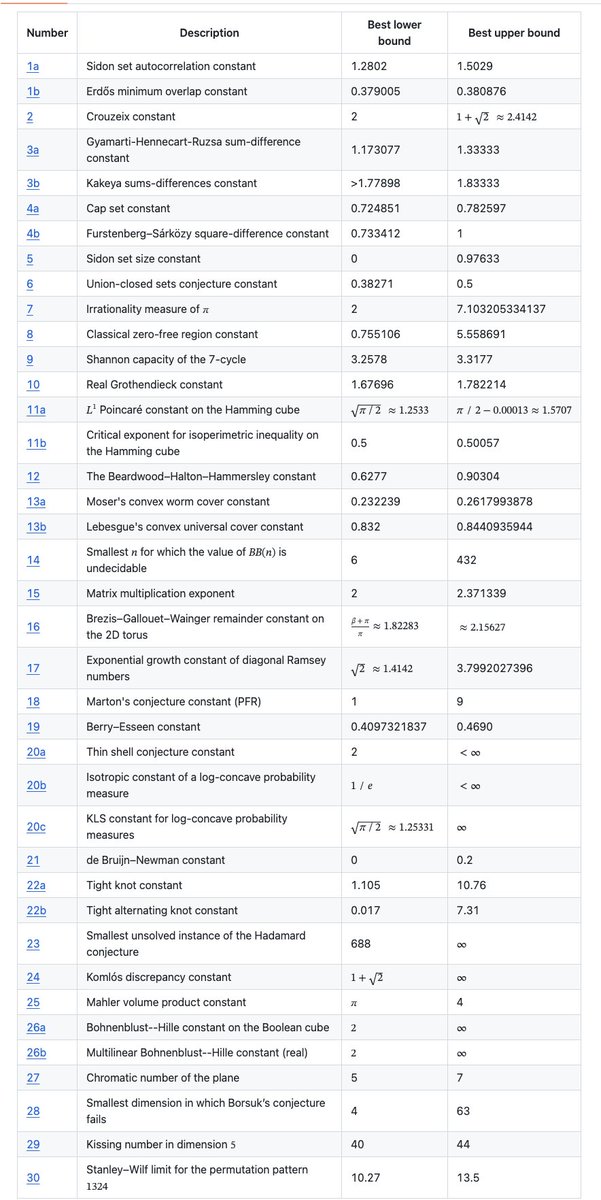
We've now reached 30+ problems in the repo.
Problem 11b has been solved by @PI010101 and collaborators!
I've learned a lot about problem sourcing while helping to building this. I'll write a post about that at some point.
here's what I find puzzling, say the arc agi benchmark, wouldn't the next ai be trained on that sort of data so that it performs very well on it? why are the scores so low?
Around ten years ago Marijn Heule, Oliver Kullmann and Victor Marek proved that if you 2-colour the positive integers from 1 to 7825, then you must be able to find x, y and z all of the same colour with x^2+y^2=z^2 -- that is, a monochromatic Pythagorean triple. 1/
I read the paper. Seems like impressive stuff, with one major proviso: it doesn’t think up or do experiments. It looks at the literature and data sets, and tries to come up with a model for some phenomenon. If that model has features heretofore not noticed, great, maybe you’ve made a discovery. But a critical step in science is coming up with a way to crisply test your hypothesis. So this isn’t a fully automated scientist. But it does seem to repeatedly pull new knowledge out of the existing literature, and when humans test it, it is often right. So I think it’s an important good thing even if it’s not 100% there yet.
By what fraction will this speed up science? They report it takes about 12 hours for each run, but don’t (AFAICT) report what fraction of runs actually produce something new. I also don’t know what fraction of science is spent trying to think of things and understanding the literature, which is the part that is automated here. Certainly in some sciences most of the time is spent in data collection.