Can a unified multimodal model (UMM) teach itself, with its text and visual abilities making training data for each other?
Yes: over 4 rounds, a 7B model climbs 45.7% → 60.2%, vs. 46.3% for continued training.
🧵 1/10
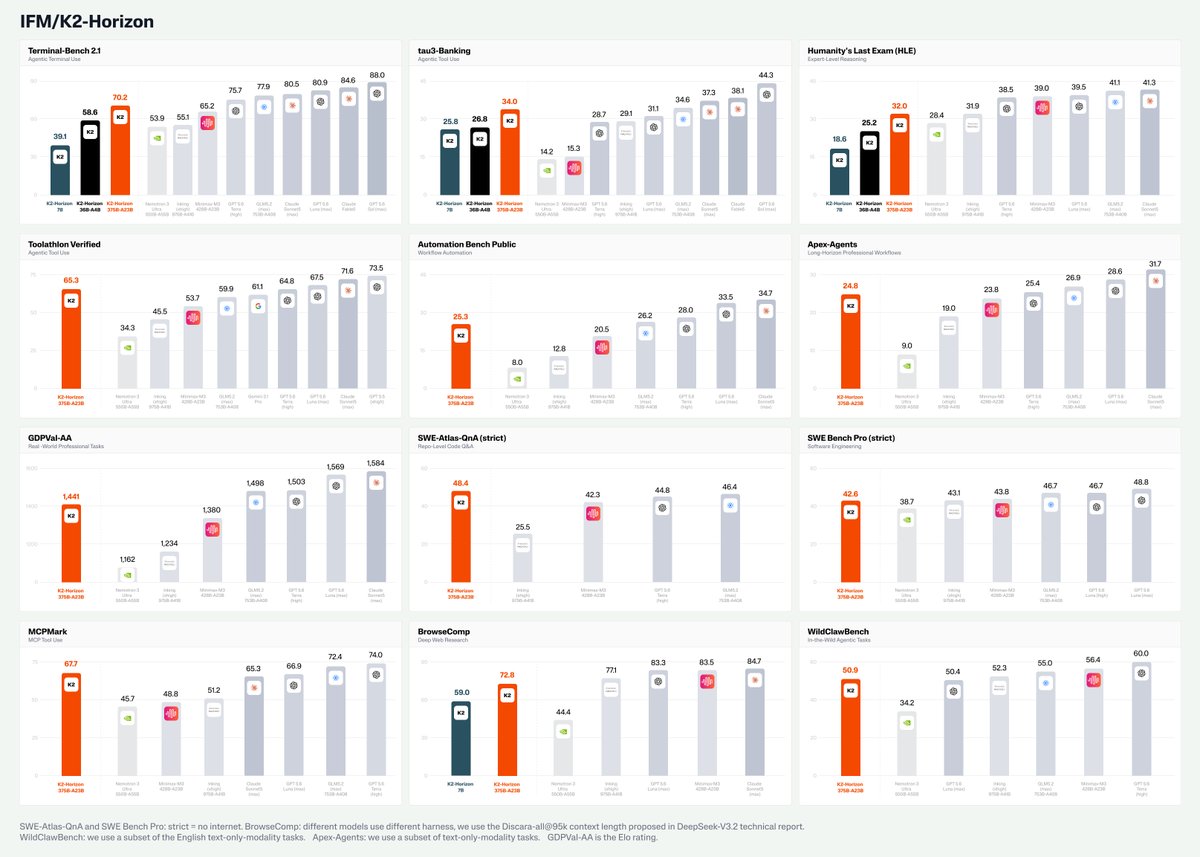
Introducing K2 Horizon: a connected fleet of six foundation models ranging from 0.9 billion to 375 billion parameters.
- Frontier performance: Across coding and agentic tasks, K2 Horizon delivers top-tier performance in every size class—with the 0.9B, 3.7B and 7B models setting new state of the art at their respective scales.
- Radical openness: K2 Horizon represents the largest fully open-source model launch in AI history. The fully open code, training data and recipes are a significant step forward in transparency.
Launch page: https://t.co/gg0k803SbL
Tech blog: https://t.co/g35L5xMGdS
Hugging Face: https://t.co/3Lb28JhyG9
Heading to #EMNLP2026 in Budapest 🇭🇺? Check out our Oral paper, UReason: Benchmarking Reasoning-to-Generation Alignment in Unified Multimodal Models!
🤔 UMMs unify understanding and generation. But are their text and images truly aligned?
💡 Our finding: UMMs usually get the reasoning right, but the image often doesn't follow it. Even more surprising: if we drop the reasoning and give the model only the final prompt it wrote itself, every model we tested does better, by a large margin.
📍 Oral Session 2 · Oct 25, 11:00–12:30 · Room G13-14
👇
Bigger goal: models whose abilities keep supplying each other with correct training data as they improve.
Joint work with co-first authors @Chufan_Shi & @ChengYANG_yc, and Yaokang Wu, Taylor Berg-Kirkpatrick, Xuezhe Ma (USC · UCSD · CMU).
📄 https://t.co/Ii8n55ChIr
🧵 10/10
Can a unified multimodal model (UMM) teach itself, with its text and visual abilities making training data for each other?
Yes: over 4 rounds, a 7B model climbs 45.7% → 60.2%, vs. 46.3% for continued training.
🧵 1/10
What doesn't work yet:
• the critic still misses ~1/3 of real errors, though it ranks weaknesses well (ρ 0.82–0.91 vs. humans)
• replacing vocabulary causes forgetting
• harder benchmarks barely move
• small drops on MMBench / MMMU
🧵 9/10
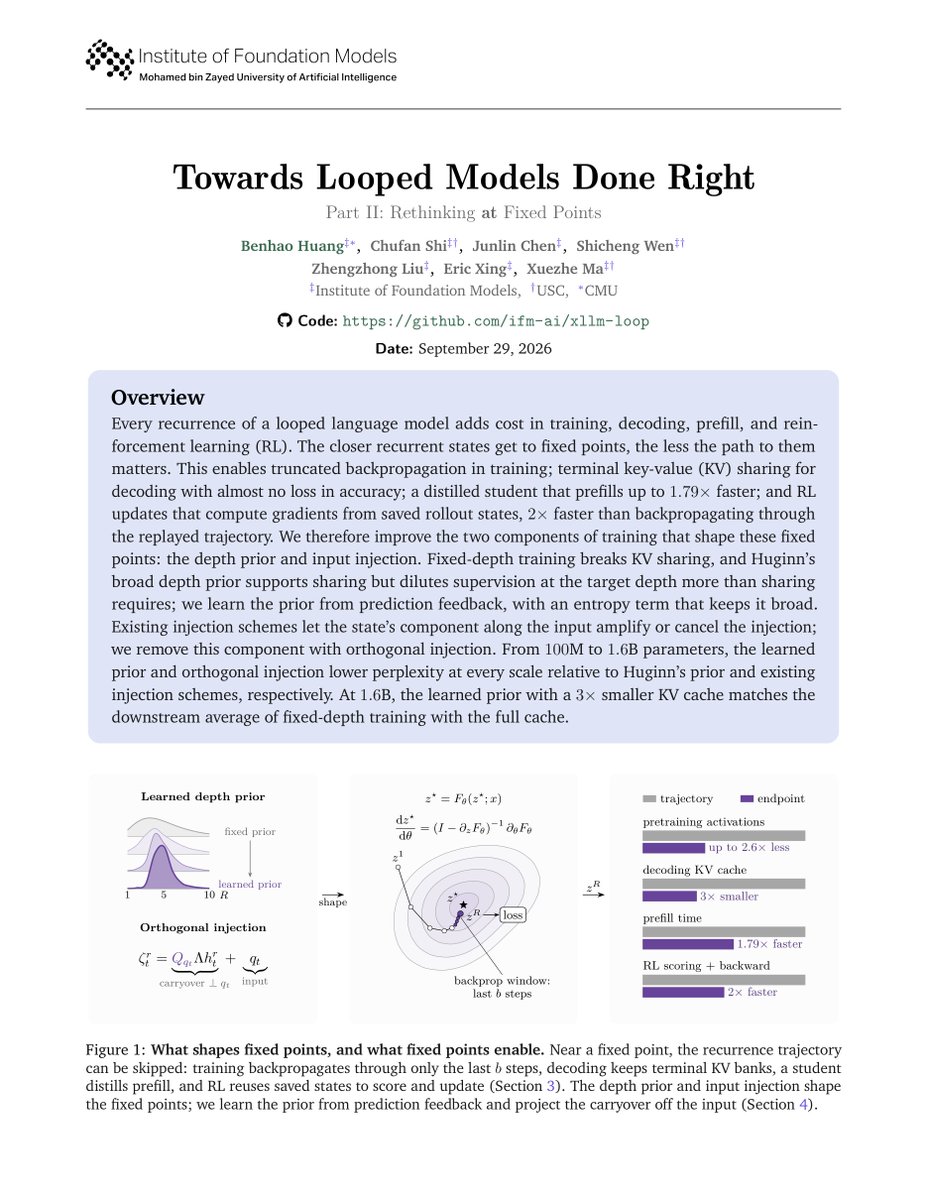
🔁 𝐖𝐡𝐚𝐭 𝐢𝐟 𝐥𝐨𝐨𝐩𝐞𝐝 𝐋𝐌𝐬 𝐜𝐨𝐮𝐥𝐝 𝐮𝐬𝐞 𝟑× 𝐟𝐞𝐰𝐞𝐫 𝐩𝐚𝐫𝐚𝐦𝐞𝐭𝐞𝐫𝐬 𝐚𝐧𝐝 𝐚 𝟑× 𝐬𝐦𝐚𝐥𝐥𝐞𝐫 𝐊𝐕 𝐜𝐚𝐜𝐡𝐞 𝐚𝐧𝐝 𝐬𝐭𝐢𝐥𝐥 𝐛𝐞 𝐜𝐨𝐦𝐩𝐚𝐫𝐚𝐛𝐥𝐞 𝐭𝐨 𝐚 𝐬𝐭𝐚𝐧𝐝𝐚𝐫𝐝 𝐓𝐫𝐚𝐧𝐬𝐟𝐨𝐫𝐦𝐞𝐫?
Introducing 𝐑𝐞𝐭𝐡𝐢𝐧𝐤𝐢𝐧𝐠 𝐚𝐭 𝐅𝐢𝐱𝐞𝐝 𝐏𝐨𝐢𝐧𝐭𝐬. We argue that looped LMs don't have to pay for every loop. They can scale by adding FLOPs at constant memory.
The key is the fixed point of the loop. We introduce:
– 𝐅𝐢𝐱𝐞𝐝-𝐏𝐨𝐢𝐧𝐭 𝐒𝐡𝐨𝐫𝐭𝐜𝐮𝐭𝐬: what fixed points buy a looped model in training (pre-training, post-training) and inference (prefill, decoding)
– A 𝐥𝐞𝐚𝐫𝐧𝐞𝐝 𝐝𝐞𝐩𝐭𝐡 𝐩𝐫𝐢𝐨𝐫 and 𝐨𝐫𝐭𝐡𝐨𝐠𝐨𝐧𝐚𝐥 𝐢𝐧𝐣𝐞𝐜𝐭𝐢𝐨𝐧: two ways to shape those fixed points
🧵 Long thread ahead (0/n).
🧩 Generating structured visuals is one thing. Editing them while keeping everything coherent is another.
Excited to share InfoEdit with @ChengYANG_yc, @Chufan_Shi, and the team! #EMNLP2026
🚀 Thrilled to introduce our work InfoEdit: Probing Global Layout Reasoning in Infographic Editing (EMNLP 2026).
AI can now help us generate posters, infographics and slides, through image generation (Nano Banana) or code generation (Codex).
🤔But can AI faithfully edit them, whether through image editing or multimodal code editing? When editing, one change forces the whole layout to adapt. We call this reflow, and we built InfoEdit to put it to the test.
🧩 What is reflow?
Take a simple edit: insert one new step into a cycle diagram. It sounds like adding one box. But a correct edit moves every node, reroutes every arrow, and rebalances the spacing, all while keeping existing content intact.
📊 InfoEdit at a glance
• 1,000 infographics, in HTML and PowerPoint
• 8 logical-relation families
• 4,000 editing instructions
• 4 tasks: Expand-Text · Insert-Element · Swap-Block · Reshape-Canvas
😬 Image editors struggle
Across 8 frontier image editors, only GPT-Image-2 clears 60% average success; most fall below 7%. Swap-Block is the hardest: even when we mark the exact blocks to swap, no editor exceeds 35%. The bottleneck isn't finding the target. It's reflow.
🖼️ vs 💻 Pixels or code?
Editing the HTML/PPT source instead, Kimi-K3 reaches 67.9% average success, above GPT-Image-2's 62.0%, and lifts Swap-Block from 25.5% → 62.8% Yet pixel-level editing still wins on Expand-Text and Reshape-Canvas. The two paradigms are complementary.
💡 Takeaway
Editing structured visuals isn't just changing the requested edits. It takes reasoning about how the whole design should adapt.
#EMNLP #multimodal #coding #imagediting
We wanted to train frontier-level LLMs. But we also wanted to support open science with models one can tinker with freely. How did we do it?
We trained SIX models, from 0.9B dense to 375B MoE. And we made it ALL open (yes, data too!).
🔥
𝐍𝐞𝐰 𝐛𝐥𝐨𝐠: 𝐓𝐨𝐰𝐚𝐫𝐝𝐬 𝐋𝐨𝐨𝐩𝐞𝐝 𝐌𝐨𝐝𝐞𝐥𝐬 𝐃𝐨𝐧𝐞 𝐑𝐢𝐠𝐡𝐭 — 𝐏𝐚𝐫𝐭 𝐈
Looped models reuse the same weights across depth, promising a better compute–parameter trade-off, especially for reasoning.
𝐁𝐮𝐭 𝟏) 𝐝𝐨 𝐭𝐡𝐞 𝐠𝐚𝐢𝐧𝐬 𝐬𝐮𝐫𝐯𝐢𝐯𝐞 𝐰𝐡𝐞𝐧 𝐛𝐨𝐭𝐡 𝐭𝐫𝐚𝐢𝐧𝐢𝐧𝐠 𝐚𝐧𝐝 𝐢𝐧𝐟𝐞𝐫𝐞𝐧𝐜𝐞 𝐅𝐋𝐎𝐏𝐬 𝐚𝐫𝐞 𝐦𝐚𝐭𝐜𝐡𝐞𝐝? 𝟐) 𝐀𝐧𝐝 𝐰𝐡𝐢𝐜𝐡 𝐚𝐫𝐜𝐡𝐢𝐭𝐞𝐜𝐭𝐮𝐫𝐚𝐥 𝐜𝐡𝐨𝐢𝐜𝐞𝐬 𝐚𝐜𝐭𝐮𝐚𝐥𝐥𝐲 𝐦𝐚𝐭𝐭𝐞𝐫?
We run 𝐚𝐩𝐩𝐥𝐞𝐬-𝐭𝐨-𝐚𝐩𝐩𝐥𝐞𝐬 ablations spanning Ouro to Huginn. Huginn performs better overall, with the largest gains coming from the loop-in-the-middle (sandwich) design and input injection, though they provide different benefits.
Trained on 𝟓𝟎𝟎𝐁 tokens, an 𝟖𝐁-𝐀𝟎.𝟖𝐁 Huginn MoE approaches or surpasses a 𝟑𝟐𝐁-𝐀𝟑.𝟐𝐁 feedforward MoE on several reasoning benchmarks, including GSM8K (83.6% vs. 80.8%), while using 𝟕𝟓% 𝐟𝐞𝐰𝐞𝐫 resident parameters under 𝐦𝐚𝐭𝐜𝐡𝐞𝐝 𝐭𝐫𝐚𝐢𝐧𝐢𝐧𝐠 𝐚𝐧𝐝 𝐢𝐧𝐟𝐞𝐫𝐞𝐧𝐜𝐞 FLOPs.
More details and the blog link in the thread ↓
Nice work from @tao_muzi and the team! A striking benchmark showing that today’s MLLMs still struggle to actively observe rather than just reason. More test-time compute barely helps when the core bottleneck is perception itself.
Humans solve these visual puzzles at 96.1%. The best frontier model: 10.6%. Claude Fable 5, top of most reasoning leaderboards: 3.5%.
Introducing ActiveVision, a benchmark testing whether MLLMs can actively observe: look, hypothesize, and look again. 🧵
1/8
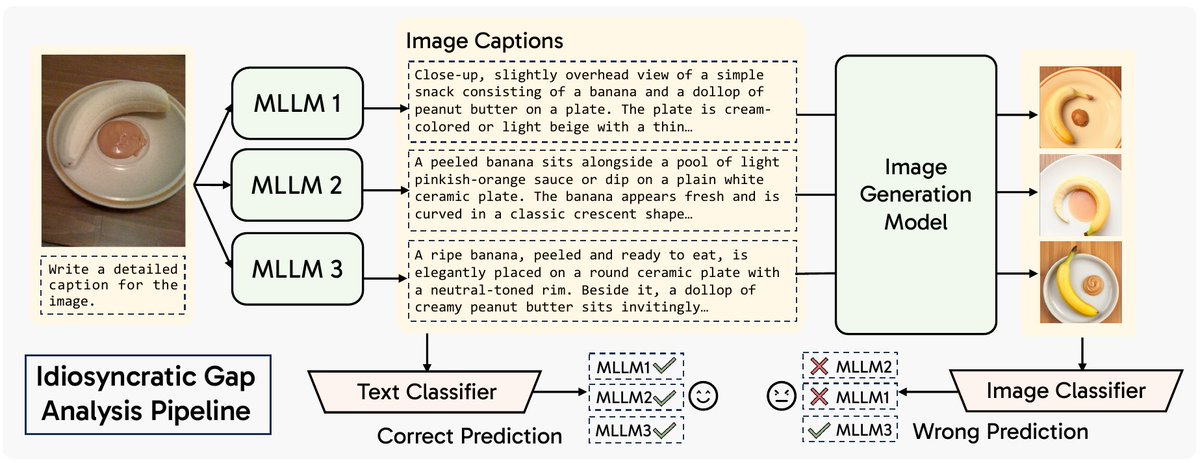
🎉 Our paper, “Asymmetric Idiosyncrasies in Multimodal Models,” is accepted to @COLM_conf 2026!
You can tell WHICH model wrote a caption with 99.53% accuracy. Render it into an image, and attribution collapses to 49.85%.
Where does the fingerprint go? 🧵
1/5
🧵(1/6) New μP paper:
Under μP, GQA passes coordinate checks but fails to transfer learning rate!
That contradiction isn't just a quirk of GQA. It exposes a silent failure mode in the TPV framework that the original theory simply can't detect.
Reasoning VLMs often say "let me check the figure again." But do they actually look? Or just say they will, without re-attending to the image?
Introducing VisualSwap — #ICML2026 Spotlight 🌟 — diagnosing this silent failure.