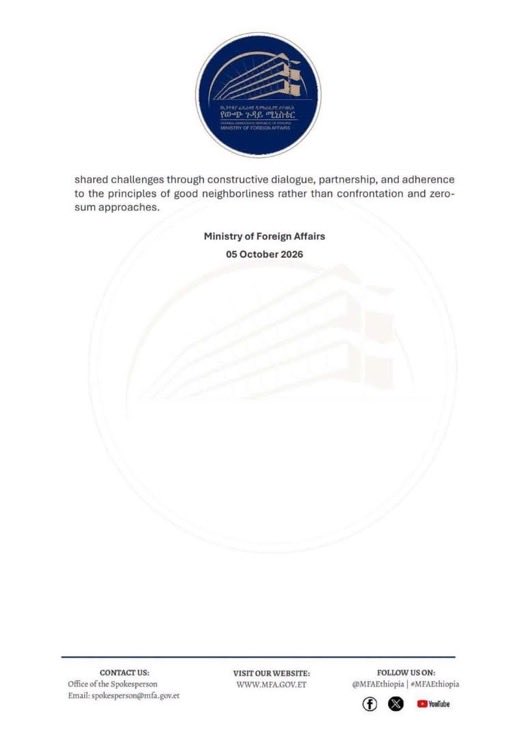
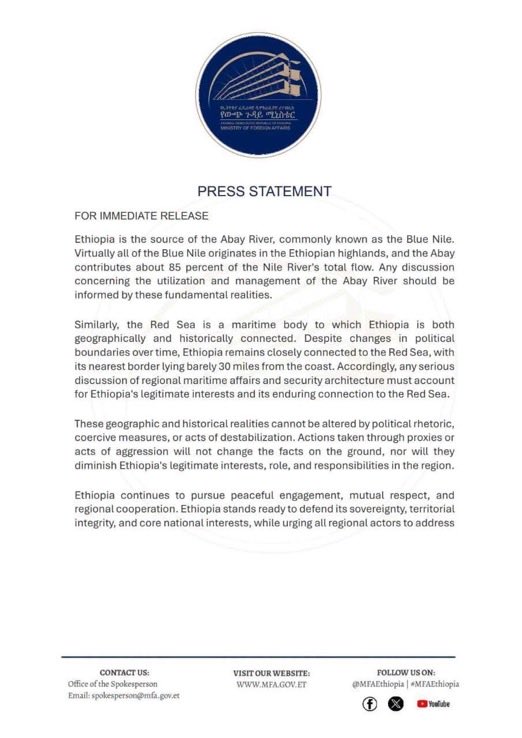
Egypt’s selective invocation of certain principles such as soveregnty, territorial integrity and the like, to conceal its real objectives must be challenged. In an interview, some years back, Eritrean President Isaias Afwerki exposed that Egypt supports Eritrea not out of affection for Eritrea, but to weaken Ethiopia in relation to their ambition over Red Sea and Nile River. This is absolutely true.
Sovereignty cannot mean that one state’s security matters while another’s is ignored. Water security must not be used to deny a neighbor’s development or its legitimate pursuit of access to the sea. Nor can regional cooperation be credible when political, maritime and water-related principles are applied selectively.
The Horn of Africa needs consistent rules, good-faith negotiations and respect for the security of all its peoples. External actors, like Egypt, that contribute to the region’s instability should stop interfering in its affairs, supporting proxy conflicts and pursuing policies that deepen division and hostility.
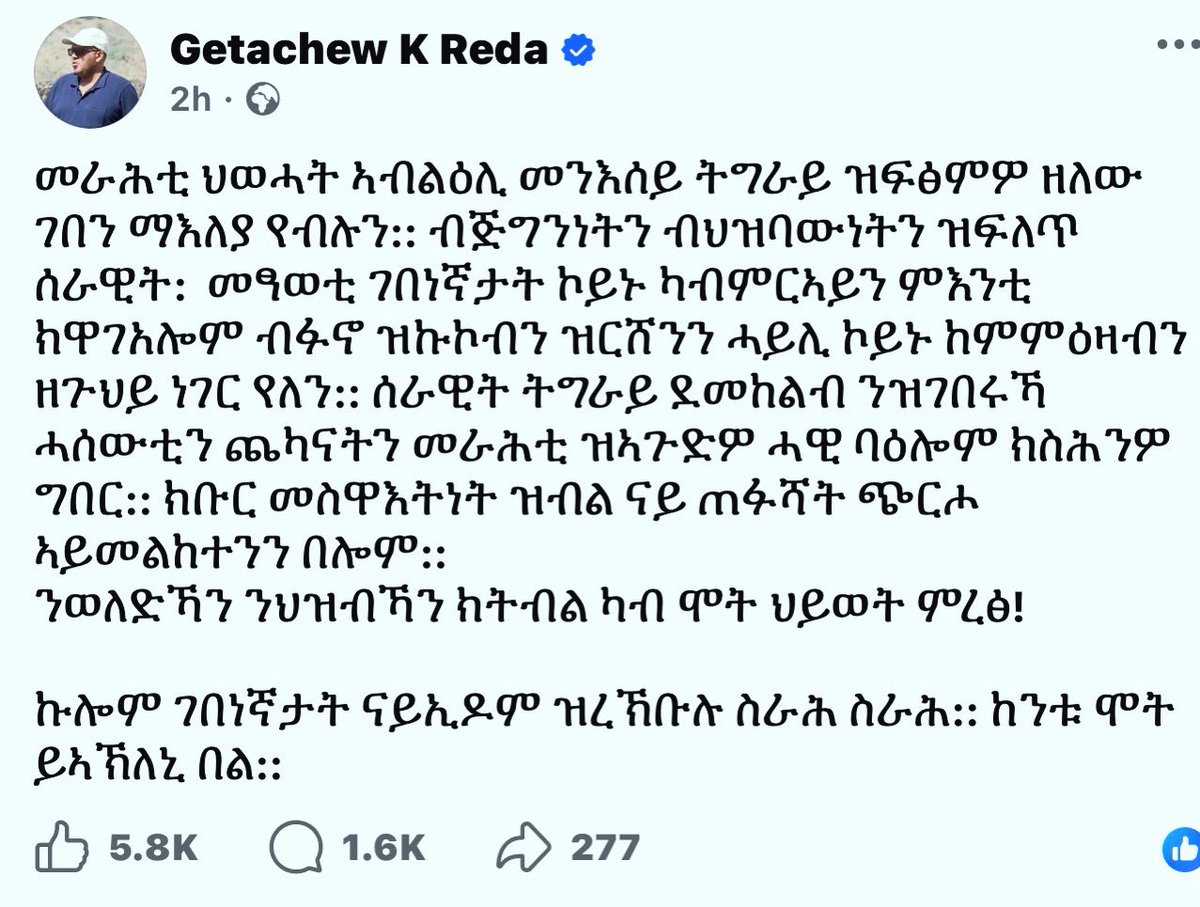
Step by step the needless conflict in Northern Ethiopia is expanding. Even someone as misguided as Eritreans Dictator Isaias should think twice before sending his troops into Ethiopia. When he did that in 1998 he suffered a huge loss. Stop this now.
https://t.co/TptEyCFXm3
Talk about hypocrisy! These four "leaders" claim that only littoral states have any say over the Red Sea but on Nile use want downstream nations to have equal control. Ethiopia contributes most water to Nile and had Red Sea ports for millennia! Get real!
https://t.co/dhepbaS84C
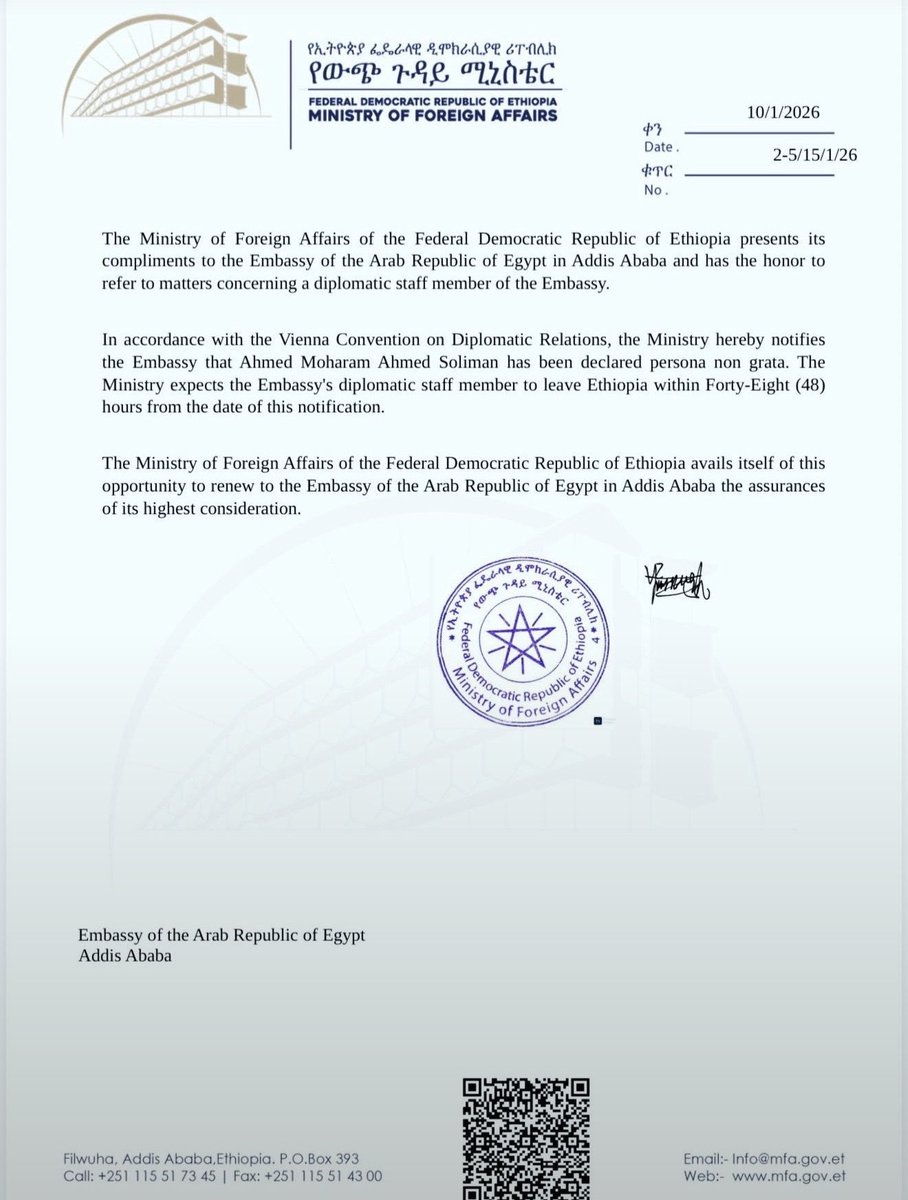
Egypt bears significant responsibility for the current diplomatic crisis. Its reported support for armed proxies and the deployment of mercenaries against Ethiopia have placed the region at risk, even as the Ethiopian government has exercised restraint. Egyptian leaders cannot pursue confrontation through local actors and then expect normal diplomatic relations to continue unchanged.
In this context, Ethiopia’s decision to reduce Egyt's diplomatic representation in Ethiopia is a measured and legitimate response. It signals that Ethiopia will defend its sovereignty and national interests while leaving the door open to relations based on mutual respect, non-interference, and good-faith diplomacy.
For those who suffer apoplexy when I condemn Eritrea's bloody tyrant for his savagery, please tell me what the following article gets wrong, and why calling Isaias' Eritrea a "siege state" or "garrison state" is wrong.
https://t.co/z4wYKl6lAF
I have warned repeatedly that lasting peace cannot be achieved while the TPLF maintains armed forces capable of turning political disagreements into military confrontation. Today’s offensive against Federal Forces by TPLF reinforces my conviction: TPLF is now exposed that it has no any agenda for the protection of the rights of the peoples of Tigray. And therefore, the people of Tigray must not be held hostage to the military ambitions of any political organization or their foreign masters.
The Pretoria Agreement created an opportunity to move from the battlefield to peaceful politics. Its disarmament commitments must now be implemented fully and verifiably. The TPLF’s armed militias should be fully disarmed.
Weapons must no longer determine political power in Tigray. Political disagreements must be settled through law, dialogue and democratic competition—not military mobilization. To materialize this idea, TPLF must be eliminated and it gang leaders must be brought to court room.
If the regional authorities cannot guarantee constitutional order, civilian security and implementation of the peace agreement, I believe a temporary federal protection arrangement, established strictly through Ethiopia’s constitutional and legal procedures, should be considered for Tigray.
It should be to protect civilians, prevent another catastrophic war, complete disarmament and demobilization, restore constitutional administration, reopen political space, and prepare the region for genuinely peaceful and pluralistic governance.
Tigray has sacrificed enough. Its young people should not be mobilized for another war. Its mothers should not bury another generation. Its economy should not again be destroyed by political leaders choosing weapons over dialogue. Disarm the armed forces operating outside constitutional security structures.
Protect the civilian population. Restore constitutional order. Implement Pretoria.
Eliminate TPLF. Open Tigray to genuine political pluralism.
The defeat of TPLF must not be considered as the defeat of the people of Tigray.
The objective must be to protect the people of Tigray from another devastating war and ensure that never again can one political organization equate its own survival with the survival of an entire people.
No party is greater than Tigray. No armed organization is greater than Ethiopia. The gun must finally be removed from Ethiopian political elites and groups. Federal government must discharge its responsibility of securing all regions.
This formulation also has a factual basis in the peace framework: the AU has previously described DDR as an outstanding part of Pretoria implementation, while today it called for immediate de-escalation and renewed direct talks rather than further military escalation.
Ethiopia deserves strict law with regard to political parties establishment and its leadership. Political parties should not make a relationship with foreign politicians and governments.
There was no place called "Eritrea" before 1891. It was known as "Bahire Negash."
The separation of Eritrea from the motherland Ethiopia 35 years ago was technically wrong and not legitimate.
The Truth About the GERD:- It is time to separate facts from political narratives surrounding the Grand Ethiopian Renaissance Dam (GERD). For years, successive Egyptian governments have portrayed the dam as an existential threat, often presenting disputed claims about its safety, water impacts, and legality as established facts. Yet the record shows that the GERD is fundamentally a hydropower and development project, and an international panel of experts previously found its design studies consistent with recognized dam-safety standards. Ethiopia has also consistently maintained that its use of the Abbay must be governed by the principles of equitable and reasonable utilization—not by historical arrangements to which Ethiopia was not a party, including the 1959 Egypt–Sudan agreement. The time has therefore come for the GERD debate to move beyond fear-driven narratives and political accusations and toward evidence, international law, scientific facts, and equitable cooperation among all Nile Basin countries.
Excellent analysis of Ethiopian PM Abiy's external relations in @TheAfricaReport The article makes sense of very complicated dynamics between Ethiopia and the rest of the world. Well worth a read!
https://t.co/fdZKXi5Tlo