"Que pasa con la gente que le gusta nuestra música? La "entienden"? Qué es lo que "deben" "entender"? Algunos artistas son famosos y algunas obras de ellos no se consideran tan buenas pero quizás me gustan más esas obras (...) Lo que te gusta te gusta, es extraño..."
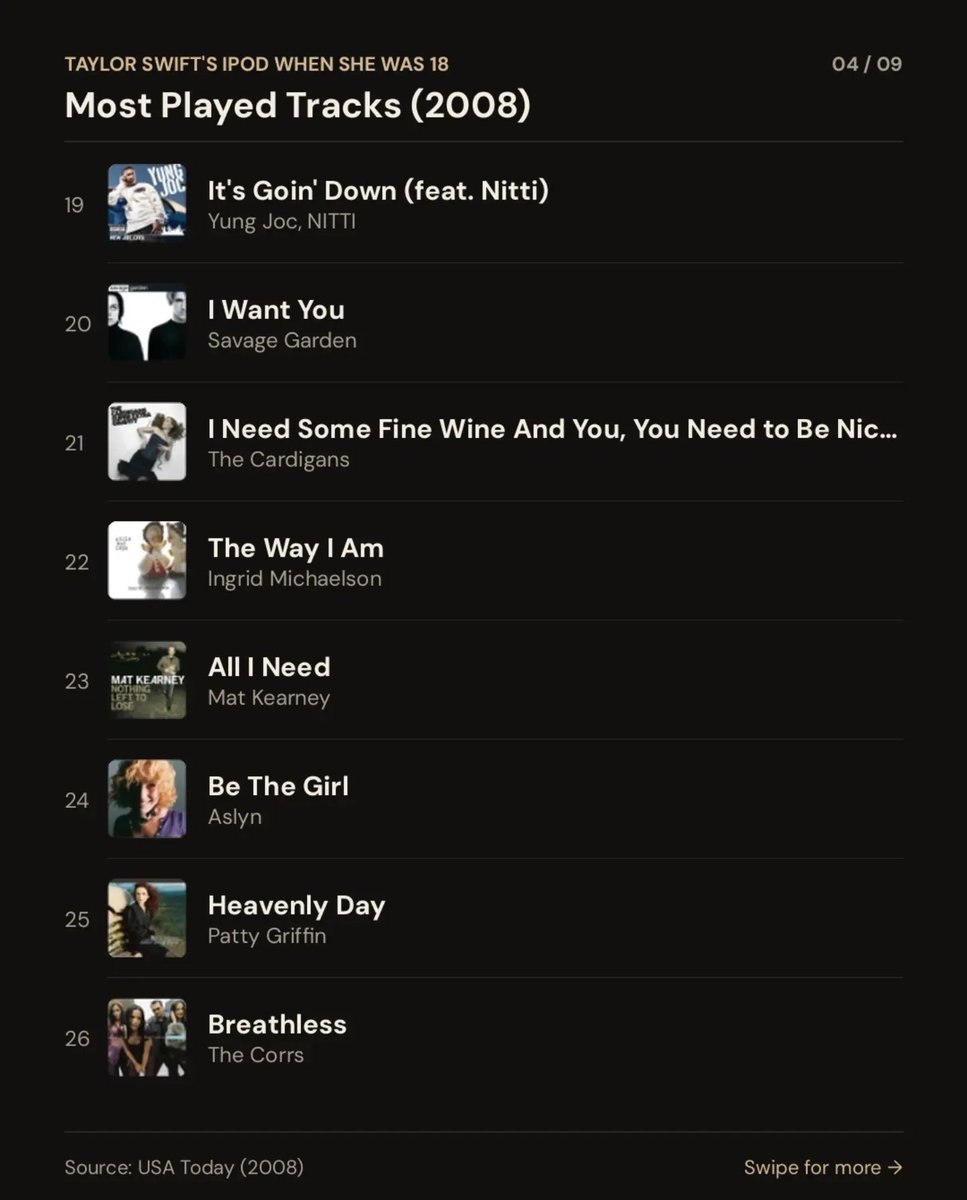
Taylor Swift's iPod when she was 18
In 2008, an 18-year-old Taylor Swift shared the data from her iPod for a USA Today article, showcasing the tracks she played most often (in no particular order).
Netflix VP of Content for Asia Min Young Kim explains how plots preferences differ by region.
Traditionally, for mystery films:
▫️Western markets emphasize “who”
▫️Japan emphasizes “how”
▫️Koreans are about “why”
In romance, Korean romances tend to have happy endings while Chinese language are more sad.
Ahí viene un artículo mio.
Fue bien chistoso ver como las ventas se fueron para arriba y hasta andaban buscando inside info de los colaboradores para seguir con el mame.
Good times.
Nada como el pánico satánico como estrategia de rating.
Me gusta que cada intro de Bond refleja la época. En la de Casino Royale estaba el auge de las motion graphics y la estética frutiger metro. También es raro no ver siluetas de mujeres bailando por única vez. Se ve que le echaron ganas a renovar al personaje.
O gráfico do Financial Times mostra os países ricos sufocados pelo gasto com idosos, mas esconde o principal: eles estão quebrando porque insistiram no modelo errado de previdência.
Quando colocamos Brasil, Suécia, Austrália, Holanda e Chile na mesma mesa (como lembrou o @SchumpExplains), o jogo muda completamente.
Para quem não é da área, a diferença é simples:
1. Repartição (Brasil, França, EUA, Japão) = Caixa d'água sem reserva
O dinheiro descontado do seu salário hoje não é guardado: vai direto pagar quem já parou. Quando havia 8 jovens para cada idoso, funcionava.
Hoje, com famílias menores e gente vivendo até os 90 anos, a conta estoura. O governo só tem duas saídas: aumentar impostos ou cortar investimentos (obras, hospitais, escolas).
• França e Itália já gastam 13,7% a 16% do PIB só com pensões públicas.
• O Brasil, ainda demograficamente jovem comparado à Europa, já gasta quase 12% do PIB — um padrão de país rico envelhecido que trava nosso crescimento.
2. Capitalização (Austrália, Chile, Holanda) = Cofre individual
O dinheiro vai para uma conta no seu nome, é investido na economia e rende juros compostos por décadas. Na aposentadoria, você saca o seu próprio patrimônio, não o imposto do jovem que acabou de entrar no mercado.
• Austrália: Acumulou poupança privada acima de 130% do PIB, tirou Nota A no Global Pension Index 2026 e mantém o gasto público com aposentadorias abaixo de 4% do PIB.
• Holanda e Dinamarca (1º e 2º lugares no mundo em 2026): Combinam um piso básico estatal com fundos capitalizados que somam 150,9% do PIB (Holanda) e 198% do PIB (Dinamarca). Como os idosos vivem do retorno desses ativos, o orçamento do governo fica livre para investir.
• Chile: Derrubou o gasto público previdenciário para menos de 4% do PIB com a capitalização e criou um mercado de capitais forte, reforçando recentemente um piso solidário (PGU) para os mais pobres sem destruir a poupança individual.
3. Modelo Híbrido com trava automática (Suécia)
Nos anos 1990, a Suécia viu que ia quebrar e reformou tudo. Misturou capitalização financeira com uma trava matemática: se a população envelhece ou a economia desacelera, o reajuste das pensões freia sozinho para nunca gerar rombo no Tesouro. Segundo a OCDE, é um dos raríssimos países ricos onde o gasto público com aposentadorias vai cair até 2050.
Conclusão:
O problema que trava o Brasil e a Europa não é "cobrar pouco imposto". É matemática demográfica.
Na repartição, o envelhecimento vira um buraco negro fiscal. Na capitalização e nos modelos híbridos bem desenhados, cada geração financia a si mesma e deixa o Estado livre para investir no futuro.
Fontes: OCDE (Pensions at a Glance 2025 / Pension Markets in Focus 2025), Marsh & CFA Institute (Global Pension Index 2026) e Tesouro Nacional.
Britain and Japan are in shockingly similar economic situations.
But then, why does it feel like Japan is a wonderland while Britain is in stagnation?
Part of it is that Japan still builds housing🧵
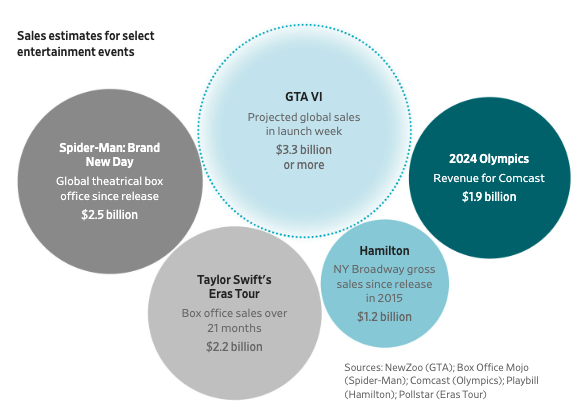
I've always thought it's interesting how little critical-media attention video games get, compared to movies and books, when you adjust for popularity and revenue. The coverage of Grand Theft Auto VI clearly puts that idea to the test, since everybody seems to be talking about it.
But these numbers are still insane. GTA VI is projected to make more in its first week of sales than the biggest movies and concert tours make in their entire existence.
The biggest, most influential videogame on the planet teaching young men how to have a girlfriend and be socially normal is an extinction level threat for these mutants lol
El gob. de Chile hizo un anuncio anti tabaco con IA. Ok. Es pesadillesco, no lo vean. La cosa es que salió carísimo y juran que fue hecho a mano por un montón de creativos y hasta sacaron un BTS donde solitos se delatan. Qué ratas y qué mentirosos. La canción está sus también
It's literally what I talked about last week. The super secret KGB training is "just be nice" and it one shots Western men who have never experienced a woman being kind to them.
In an alternative reality, the Grammys created a Best European Pop Category and lumped in British, Irish, Nordic, German, Albanian, French, Portugese, Spanish, Austrian, Romanian, Greek, Russian music into 1 category and you'll be watching me, an asian, call it a very good idea.
Okay, I think I understand the basics of datacenter economics and here's a thread to explain.
First, to build a data center, you need four things: compute (chips/GPU), land, water, and electricity. In other words, it's capital intensive and takes about 2 years to build. If you got land and water and no chips or no electricity, you got a problem.
Now, let's talk about scale and competitiveness. America is where it's happening. Why? The US got land (esp states like Texas etc), got natural resources like natural gas to power cheap electricity, and under Trump (before Blue Wave), got pretty willing investors and regulators, and finally, it got chips (Nvidia and also others). We'll talk about outside of America soon (Asia).
Okay, what is the scale we are talking about here?
Lo peor es que ni siquiera es la primera vez que he visto a alguien confundir las fragatas con pterosaurios
Eso significa dos cosas, que son animales bastante impresionantes la verdad, y que la gente está desconectadísima de la naturaleza
@lorenadelagarza Un error lo comete cualquiera , mi sentir es que si bien el hecho es triste tampoco hay que cruxificarte así que todos aquellos que te critican primero se miren a sí mismos y esperen que dios les permita jamás equivocarse.
United Airlines ordered 100 electric planes almost identical to this one back in 2021, with the same 19 seats and the same 400 km range. Five years later United still doesn't have a single one, and the company that was supposed to build them doesn't even make that plane anymore.
China just flew it with two pilots and an engineer on board. They got there first because of who's building the batteries.
Here's the thing about battery planes. A pound of jet fuel holds roughly 50 times the energy of a pound of good EV battery. Electric motors win some of that back because they're light and way more efficient than a jet engine, which is why Elon figured back in 2019 that batteries need to hit about 400 watt-hours per kilo before they can beat jet fuel. Most car batteries today sit around 250. On top of that, a battery plane lands exactly as heavy as it took off, and it has to carry backup power for a diversion on every single flight whether it needs it or not.
The company United bet on was Heart Aerospace, a Swedish startup, and it hit that wall hard. In 2022 they dropped the 19-seater for a bigger 30-seat plane with gas turbine generators bolted on as backup. Then it grew again, to 36 seats. On batteries alone it now goes about 200 km once you count reserves. They moved the whole company to LA, and first passenger service got pushed from 2026 to 2031. Their own CEO called the new design "an electric airplane the industry can actually use," which kind of tells you how he felt about the old one.
So who built the one in this video?
COMAC, China's state airplane maker, teamed up with CATL, the biggest EV battery company in the world, and Shanghai Jiao Tong University. They formed the joint venture in July 2023 with about $80 million and named one of the C919's deputy chief designers as its legal representative. Three months before that, CATL showed off a new battery it says hits 500 watt-hours per kilo. That's past Elon's 400 line, and CATL said it was testing the battery to aircraft standards. COMAC hasn't said which battery is in this plane.
That's the part that explains everything. Heart had to build a plane United could make money on from day one, and it had to buy its batteries from somebody else at their markup. When the battery maker co-owns the plane, the math looks completely different. Every hour this thing spends in the air is test data on cells CATL will be selling for decades, so the plane doesn't need to pay for itself anytime soon.
Watch the wings. There are ten little ducted fans, five on each side, where you'd expect two big propellers. Electric motors stay efficient when you shrink them and jet engines don't, so you can spread the thrust across a bunch of small fans. If one quits, it's a much smaller deal than losing an engine on a twin. This plane had also flown 19 times with nobody on board, going back to February, before they ever put a crew in it.
To be fair, this first crewed flight lasted 16 minutes and 38 seconds and went 60.4 km, and certification is barely underway. Plenty can still go wrong.
Heart's original pitch was a 19-seat electric airliner carrying passengers by 2026. That plane exists now, and it's sitting on a runway in Shandong.