I trusted AI with 8-9 months of my work.
This week, that trust became a very expensive lesson.
I have been building my future AI company with Claude Code/Cowork almost every day, often working late into the night and through weekends.
I’m not a developer. That was exactly the point.
I could explain what I wanted in normal language and Claude became my development team. I built a system of 27+ specialized agents, with an advisor coordinating their work.
I paid $300+ monthly and, whenever I reached my limits, I purchased additional usage. This month alone, I spent thousands of dollars.
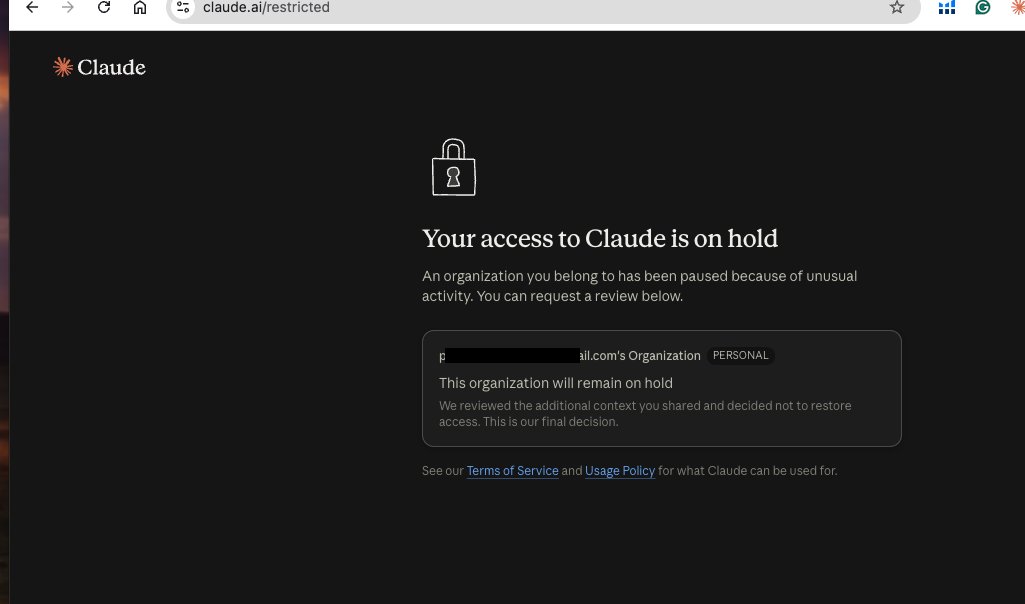
Then @AnthropicAI suddenly put my organization on hold for “unusual activity.”
No warning.
No 48 hours to explain.
No opportunity to provide evidence first.
I then received an email saying their automated systems had detected signals associated with my account indicating a violation of their Supported Countries Policy.
I appealed.
I explained that I’m one person building a private application locally and testing it on my own VPS.
My account is registered in the UK, and I travel frequently for business, so my login locations change.
I have API keys for my own development and testing.
I offered to provide invoices, VPS ownership details and anything else needed to verify my situation.
The appeal was rejected.
“Usage Policy violation.”
“This is our final decision.”
But I still don’t know what specific activity or location caused their system to reach that conclusion.
Was it my travel?
Was it VPS activity?
Was it something else?
If my location looked suspicious, ask me to verify it.
If my VPS or API activity looked suspicious, ask me to explain it.
If I made a mistake, tell me specifically what it was and give me the opportunity to correct it.
How can someone meaningfully appeal a decision when they aren’t told what specific behavior they’re appealing?
And then comes the part that worries me most.
8-9 months of workflow disappeared overnight.
My local Cowork workspace contains:
116,385 items.
~10 GB.
8-9 months of AI-assisted development.
Yes, much of the actual code is still on my disk and VPS.
But Cowork was more than the code.
It was the team that understood the structure, history, decisions, context and relationships across that workspace.
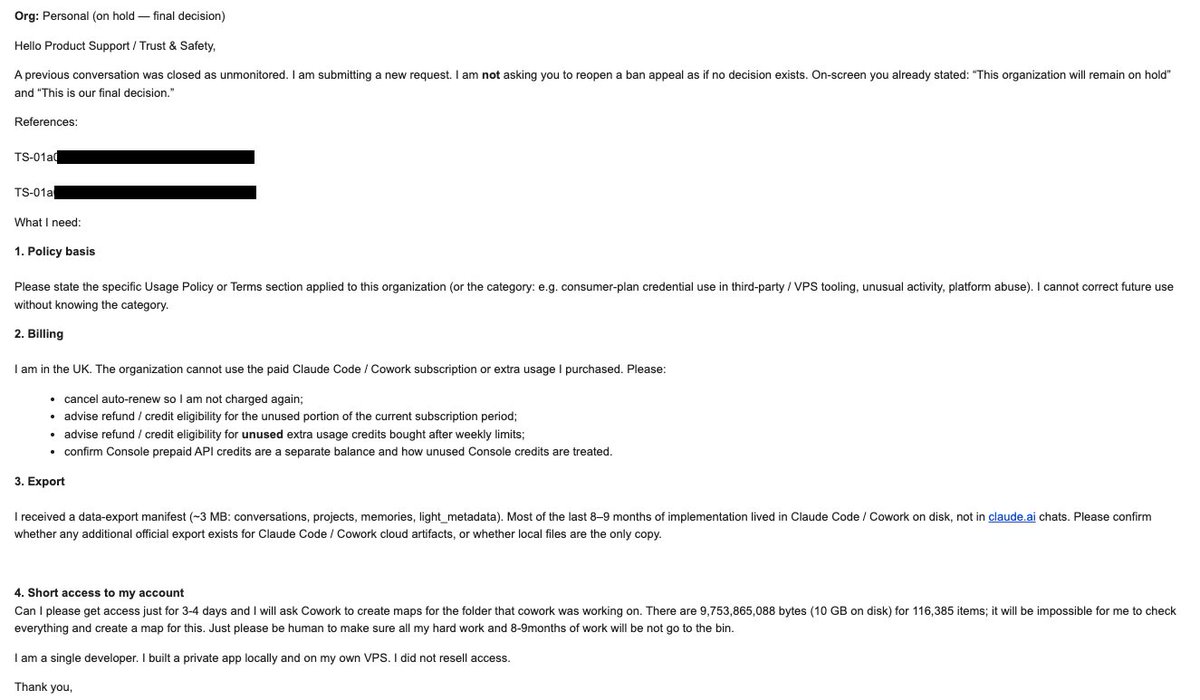
The official Anthropic data export I received is only a few MB.
I even asked for just 3-4 days of temporary or read-only access.
Not to continue using Claude normally.
Not to bypass their decision.
Simply to let Cowork document and map the workspace it helped create so that I can migrate my own work safely.
I understand @AnthropicAI needs safeguards.
But here’s my question to @DarioAmodei, @bcherny and the Claude team:
Where are the safeguards for legitimate users when an automated safeguard system may get it wrong?
Why not warn first when it is safe to do so?
Why not request identity or business verification?
Why not explain the specific activity that triggered the decision?
Why not provide a read-only recovery mode?
Why not give someone a short window to safely migrate their own work?
AI companies are asking us to trust agents with more and more of our businesses.
That trust has to work both ways.
So I’m genuinely asking the developer community:
Has anyone else building seriously with Claude Code/Cowork had their account or organization suddenly suspended?
What happened?
Were you told specifically why?
Were you able to recover your workflow?
Please share your experience below.
I want to understand whether my case is an exception, or whether we’re looking at a much bigger question about business continuity in the age of AI agents.
AI needs safeguards.
But AI builders need safeguards too.
#ClaudeCode #AIAgents #BuildInPublic #Developers
They gave me three files that, in total, are not even 3 MB, and most of the content looks like garbage. After going through the files, they appear to contain leftover fragments, almost like remnants of data that had previously been deleted.
I’m already working on mapping everything out and getting things back on the right track.
But there is one clear lesson from this experience. Anthropic, or any other large company, can seemingly disregard how much work a user has invested. Instead of properly assessing the situation based on the available evidence and giving the user a fair opportunity to explain, they appear to have made the decision first.
In this case, it honestly feels like someone facing a criminal charge would have more opportunity to present their case and have legal representation than the process they provide to their own users.
That sounds almost identical to what happened to me.
Appeal rejected, no specific activity identified, and no further route to understand or challenge the decision.
What concerns me most is that this makes a meaningful appeal almost impossible. If you’re not told what specific activity triggered the enforcement, what exactly are you supposed to explain or provide evidence against?
I’m starting to wonder how many legitimate developers have had the same experience.
If you’re comfortable with it, I’d like to stay in touch and compare what happened in our cases.
For me, the limits are no longer the biggest thing holding Claude back. Trust is.
I used Anthropic for over a year and built with Claude Code/Cowork for 8-9 months. I never imagined I’d suddenly lose access myself.
Then it happened. No warning. My appeal was rejected, and I still wasn’t told what specific activity triggered the decision.
Much of my code is local, thankfully. But I also lost access to the Cowork context and the Artifact I maintained as my live project roadmap.
When developers start trusting AI with real businesses, continuity matters just as much as model quality or usage limits. @AnthropicAI@DarioAmodei
The strange part is that this experience is teaching me exactly what Anthropic probably doesn’t want a loyal user to learn:
never let one AI provider become a single point of failure for your company.
This is very interesting because something similar happened to me this week.
I was building with Claude Code/Cowork for 8-9 months and spending heavily on it. I travel frequently for business and also use my own VPS for development and testing.
Anthropic told me their systems detected signals indicating a Supported Countries Policy violation, but they still haven’t told me what specific activity or location triggered it. My appeal was rejected.
I originally thought my case might be an exception, but I’m starting to find other developers describing suspensions around VPNs, VPS infrastructure or travel.
I don’t think we can say yet that those things are causing the bans, but I’d really like to understand whether there’s a false-positive pattern here.
Did Anthropic tell you which specific activity triggered yours?
Interesting distinction, especially between the model itself and Claude Code/routing issues.
When people say a model has been “nerfed”, how are you actually separating a change in the underlying model from changes in routing, system prompts, tool behavior or the surrounding Claude Code environment?
Genuinely curious what you’re tracking.
@trq212@AnthropicAI Plan mode is useful, but I think there’s a more fundamental mode missing: recovery mode.
I built with Claude Code/Cowork for 8-9 months. Then my access was removed without warning, and with it I lost access to the Cowork context and the Artifact I maintained as my live project roadmap.
I still have much of the code locally, thankfully. But the working context around it is a different story.
Would you consider a built-in read-only recovery/export mode that still works after an account suspension?
If Claude is becoming part of how we build companies, being able to safely recover our own work seems just as important as how we plan it.
@weswinder Forget nerfing Opus 5.5 😅 Anthropic nerfed my entire account before I could even try it.
Serious question though: do you think users building real businesses with Cowork should have some kind of read-only recovery access if their account gets suspended?
Hopefully it doesn’t need to get that far 😅
At this point I’m not looking for a fight. I just want access to my own working context long enough to migrate it safely.
I’d much rather see AI companies build a proper recovery process than have customers thinking about lawyers every time an automated system locks them out.
That’s exactly what I’m trying to find out too.
In my case, I still have much of the actual code and project files locally, but I lost access to the Cowork history, context and the Artifact I used as my live project roadmap.
I asked Anthropic for just 3-4 days of temporary or read-only access so I could document and migrate that context properly, but they didn’t provide it.
If anyone here has gone through something similar and managed to recover their workspace history, I’d really like to know how.
That’s exactly the lesson I learned the hard way.
I actually had an Artifact inside Cowork that acted as the roadmap for my project. I kept updating it as we progressed, what was completed, what we were working on, and what came next.
The problem is that even that is now behind the lockout.
The official export was mostly a dump, only a few MB. It didn’t give me anything close to a usable reconstruction of the Cowork workspace, the Artifact, or the working context built over 8-9 months.
A lot of the actual code and files are still local, thankfully. But now I have to reconstruct the map from those files.
Your approach is exactly what I’ll do differently from now on: the method, roadmap and project state need to live outside the AI provider in files I control.
This is a really good change.
If Claude can recognize that cutting someone off mid-task creates a problem, and provide a small allowance to reach a graceful stopping point, could the same principle be applied when an account or organization is put on hold?
I recently lost access after 8-9 months of building with Claude Code/Cowork. My appeal was rejected, and I respect that Anthropic has to enforce its policies.
But I wasn’t asking to continue using Claude normally. I asked for 3-4 days of temporary or read-only access so Cowork could document and map the workspace it had helped me build, allowing me to migrate my own work safely.
A usage limit and an account hold are obviously different situations, but the underlying continuity question is similar: how do you stop access without destroying the workflow around it?
Maybe a restricted recovery mode could be the equivalent of a “graceful stopping point” for account holds.
As AI agents become part of real businesses, I think this will matter more and more. @AnthropicAI@DarioAmodei@bcherny
I understand the frustration. I went through a very similar process recently, although in my case the appeal has already been rejected as final.
What I still don’t understand is why there isn’t a verification step before reaching that point. If activity looks suspicious, ask the customer to verify their identity, business, payment or development environment.
Ten days is a long time when an AI tool has become part of your daily development workflow.
I’m curious, did they tell you what the “suspicious activity” actually was, or only that you now need to wait for the review?
This is very close to what happened to me.
8-9 months building with Claude Code/Cowork almost every day, $300+ monthly plus thousands in additional usage, then suddenly my organization was put on hold for “unusual activity.”
What concerns me most isn’t even the suspension itself. Systems can make mistakes and accounts sometimes need to be reviewed.
It’s what happens to the business when the AI has become part of the workflow.
In my case, Cowork had accumulated months of context across a ~10GB workspace. I even asked for just 3-4 days of read-only access to document and migrate it safely.
Did you eventually get your account back, or at least get a specific explanation of what triggered the suspension?
I had been using Claude Code/Cowork for 8-9 months, paying $300+ monthly plus additional usage, and then my organization was suddenly put on hold for “unusual activity.”
I appealed and offered to provide anything needed to verify the account, but the final decision still didn’t identify the specific activity that triggered it.
Did they tell you what actually triggered yours after only 10 minutes, or did you just receive the suspension message?
I’m trying to understand whether there’s a pattern here.
And this isn’t only a question for Anthropic.
@elonmusk@xai@grok@sama@OpenAI@github@cursor_ai
As AI agents move from answering questions to actually becoming part of our teams and running meaningful parts of our businesses, I think every builder needs to ask:
What happens when your automated safety/fraud system flags a legitimate customer incorrectly?
Could Grok, Codex, GitHub/Copilot, Cursor or another agent platform cut someone off from months of workflow overnight?
Or will users get:
- a warning, when appropriate
- identity/business verification
- a specific reason
- meaningful human review
- read-only/recovery access
- time to safely migrate their own work
And one very simple question:
Would you give that customer a recovery window before cutting access?
We’re being asked to trust AI with increasingly important parts of our companies.
Developers and founders deserve to understand the continuity guarantees before building their businesses around these systems.
I’d genuinely like to hear how different AI companies are thinking about this.
#AIAgents #AI #Developers #GitHub
@AdamLowisz The real upgrade with Grok 4.3 isn’t intelligence. It’s reduced delusion. Most models still optimize for sounding right. Grok is starting to optimize for being less wrong