@raybai07 That’s very nice. Despite my last jokingly phrased tweet, I sincerely believe AI is something we need to openly work with, not against, in our teaching and research. Thanks for sharing how you navigate through this.
There is a growing debate about the use of AI in our communities, so I'd like to share a few thoughts on the *human aspects* based on my interactions with peer researchers and students:
1. Let's stop pretending we didn't use AI in the making of a paper or product, please, just stop.
2. Our contributions are not reduced to zero by the use of AI. A paper is still a manifestation of our ideas, careful presentation & critically, prudent checks against AI slops.
3. Expect work at AI-level productivity. 10 ideas for simulations? Feed them all to AI and let's see results tomorrow morning.
4. AI likes to flood our screen with inside-the-box information (cynically, to sell more tokens), innovation needs clear, original & independent thinking: that's on us.
@GuanyangW@MoMoJing131 Lean is great, but AIs have also found ways to game the compile system, so Lean check isn't 100% bulletproof: https://t.co/g94e4XXNAn
More on the ILP embedding trick: if the combinatorial set (polyhedron) has all vertices integer-valued, then argmax_z (z' \zeta) will a.s. transform a continuous \zeta (blue) onto an int vertex (red). In 1-dim case with binary z, argmax_z (z\zeta) reduces to sign(\zeta). (3/n)
For modeling binary outcomes (e.g. classification, network edges), Albert & Chib (1993) had a brilliant idea: treat each binary as the sign of a latent Gaussian. But what if each outcome is a binary vector obeying combinatorial constraints? (1/n)
(e.g. skip-logic survey data, observed matchings on a bipartite graph) Our new paper (https://t.co/QrLm4XiAYN) replaces the sign function with an integer linear program (from combinatorial optimization) �� a new class of GLMs suitable for structured combinatorial data! (2/n)
@GuanyangW@nawaf_bou On existing HMC packages, we recently explored numpyro, and found it to be amazing — especially on its implementation of Mixed HMC that allows easy update of discrete parameters
Highlighting our recent theory work: "all models are wrong, but some are consistent" 🙌 -- a potentially misspecified Bayesian clustering model can yield an asymptotically correct posterior estimate, including the number of clusters! https://t.co/puQwstcnsP
@sp_monte_carlo No worries. On the modeling front, I'd say if a Bayesian model is inspired by some optimization approach involving a non-smooth part, then there are multiple ways to assign a distribution around the point estimate -- Gibbs posterior is often not the best. DM me if interested.
@sp_monte_carlo I'd say non-smoothness is a "symptom", not the cause. When it comes to MCMC, non-smooth density can be annoying, although there are ways to "smooth it up", e.g. proximal MCMC.
For those of you who dislike the job of correcting format errors/case inconsistency in bibtex file (reference database for latex), I made a small script that does that for you: https://t.co/iK6oyp0Gf8
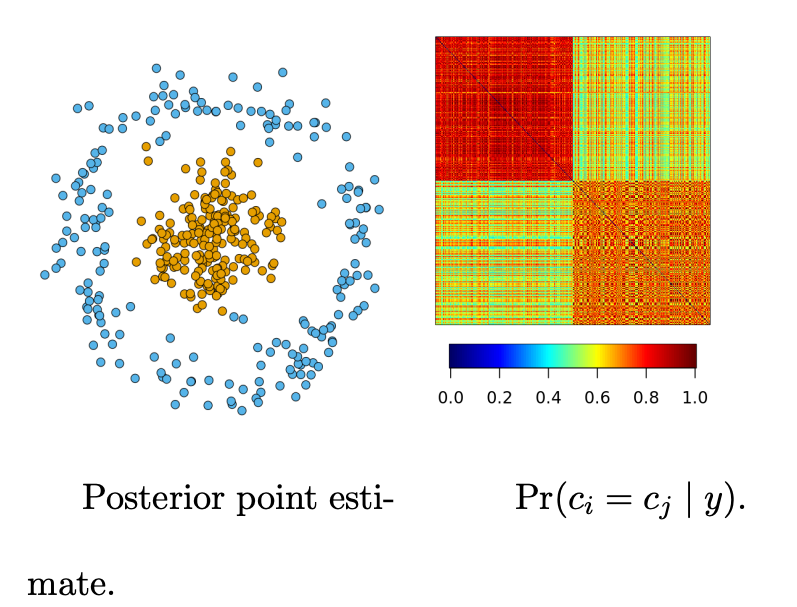
Importantly, we've worked really hard on improving & simplifying the algorithm. Now the simple R code runs super fast, and works well in clustering most data. Try it out on your data, and let us know! https://t.co/2T1T9dwGAK
You might know "Normal mixture <=> Generative model for K-means", and I want to tell you "🌟Forest model <=> Generative model for spectral clustering🌟". Check out my joint work with Arkaprava Roy: https://t.co/sUKDZu4uOs
(2) we can now easily extend a vanilla forest model to a hierarchical model, e.g. imagine a low-dimensional z_i as from a forest model, then this z_I is transformed to high-dimensional face photos y_i. We get 80%-90% clustering accuracy.
This generative model buys us 2 things: (1) it tells us the uncertainty (i.e. the "variance") around the point clustering estimate, e.g. how likely two points are in the same cluster? how many clusters are there? etc.
It was such a wonderful experience to be in-person at @ISBA_events . Having real floor / Mont-top discussions on stats and non-stats things reminds me of how good the academic life can be. Already looking forward to the next event!