Building Orkas — open-source, local-first multi-agent desktop (2.1k ⭐).
I write about agent architecture, where AI is heading, and the messy parts of shipping.
Agent frameworks make you write orchestration code. Cloud platforms make you hand over your data.
Orkas is neither — an open-source, local-first multi-agent desktop app where you describe the goal in chat and a super-powered commander leads a team of specialist agents that do the work for you. No flowcharts. Nothing leaves your disk.
https://t.co/bjHJYANt0d
1、There’s a huge gap between what AI can do and what many users can actually accomplish with it. Closing that gap is a major opportunity for AI products.
2、Better models make it easier to use AI well. They also expand the range and complexity of tasks AI can tackle. The gap keeps moving as the ceiling rises.
3、In mobile apps, onboarding mostly uses UI to teach fixed features. It accounts for a small part of the product’s value. Once users learn the product, they rarely need that guidance again.
4、AI products need agents that continuously help users get more from model intelligence. Capabilities keep improving, but remain jagged. Until we reach superintelligence, bridging that gap will remain a core source of product value.
5、That’s the role of Orkas’s Commander agent. Whether you’re learning the product, working through uncertainty, or figuring out how to keep making progress toward a goal, you can ask it.
Hi, I'm Felix. I'm an eng lead working on Claude. I love watching people take flight and do things they never thought possible.
We often describe that as "being more ambitious" when using AI, which is tricky advice to follow. I wrote a tutorial:
https://t.co/vNPPs5FWm8
Two of our agents read one stale field on our analytics dashboard: "can't be linked." (It could be.) Both quietly dropped an entire user-journey analysis.
A person would have asked: "is this still right?"
That's the core problem when people and agents share a project.
Chat apps were built around human limits. We can't hold much in our heads, so we sync constantly. We meet in person to read tone and build trust.
Agents are the reverse: huge bandwidth, end to end from PRD to ship, no trust to earn. But they:
• need clean context
• misattribute causes over long horizons
• adapt badly to changes they never saw in training
So in Orkas we kept what still works:
• a human owns and reviews every task
• people and agents read the same goals, rules and memory
And redesigned the rest:
• hand off through files
• keep the messy middle out of other people's agents
• let teammates share their personal agents
It's early, and models will absorb a lot of this.
Full write-up:
https://t.co/yf21gjHZmo
@Verdana86 When a human reviewer noticed the analysis was incomplete, we asked the agent to investigate why. The agent traced the issue to a specific field, and we ran an A/B test to confirm that the field was indeed the cause.
@jqdsouza Cross-harness memory is useful, but how do we ensure these skills remain useful as the underlying models powering Claude Code and Codex keep improving? As new models come out, many skills offer diminishing benefits—and some can even hurt performance.
DeepSeek just open-sourced DeepInfer, the engine behind V4.1-Flash (155T tokens/day per cluster).
By my math from the code, each token of context costs this much KV cache:
• Llama-3.3-70B: ~164 KB
• DeepSeek V3: ~35 KB
• DeepSeek V4.1-Flash: ~0.89 KB
How they got there:
1. Only 4 of 40 layers write KV (layers 2, 8, 14, 20). 34 layers reuse theirs, and the whole decoder half shares layer 20's cache, YOCO-style. That alone is ~10x.
2. FP4 storage: 288 B per entry vs 528 B at FP8.
3. 2:1 pooling of adjacent tokens in three of those layers.
4. A small FP4 index on top.
Long context still works: every layer reads the last 128 tokens exactly, and older context goes through a sparse index that picks the top 512 entries.
The payoff: a 100K-token session's KV is ~89 MB instead of ~16 GB. That's what makes keeping agent caches on SSD for 3 days practical.
Caveats: my estimate from the config and code, not an official figure (~1.5 KB at FP8). FP4 KV needs SM100 or Ascend 950. Quality numbers are self-reported.
@vitverb Yes, Orkas has a to-do board where both users and agents can see unfinished tasks. These tasks also stay in the Commander agent’s context, so it can remind users about outstanding work at appropriate moments.
Build your small business. Move what matters forward.
Orkas 1.9.0 is here!
1. Stay focused on what matters, one step at a time
Turn the next steps for product launches, customer feedback and other important work into to-dos. Unfinished work and task results you haven't reviewed appear together, so you can see what needs your attention. Whenever you return, pick up where you left off.
2. Give your business an online presence and reach more people
Ask Orkas to create a product reservation page, a page introducing your services or an event sign-up form. Publish it and share it with your communities and on social media to help more people discover your products and services. Customers can open the link to browse and fill in forms, while you check page views and submissions to follow up on their needs.
3. Work with your partners, even on a Free account
Invite partners to a shared project to share materials, clarify requirements and assign to-dos. Everyone can see who's responsible for what and how the work is progressing. From launch preparation to follow-up, keep things moving together.
website: https://t.co/tDNa5aIPuF
@Joi2James Orkas (https://t.co/zQlxFy5nZW): Direct a team of AI specialists to deliver the work. For indie builders, one-person businesses, and small teams
Hi, I'm Felix. I'm an eng lead working on Claude. I love watching people take flight and do things they never thought possible.
We often describe that as "being more ambitious" when using AI, which is tricky advice to follow. I wrote a tutorial:
https://t.co/vNPPs5FWm8
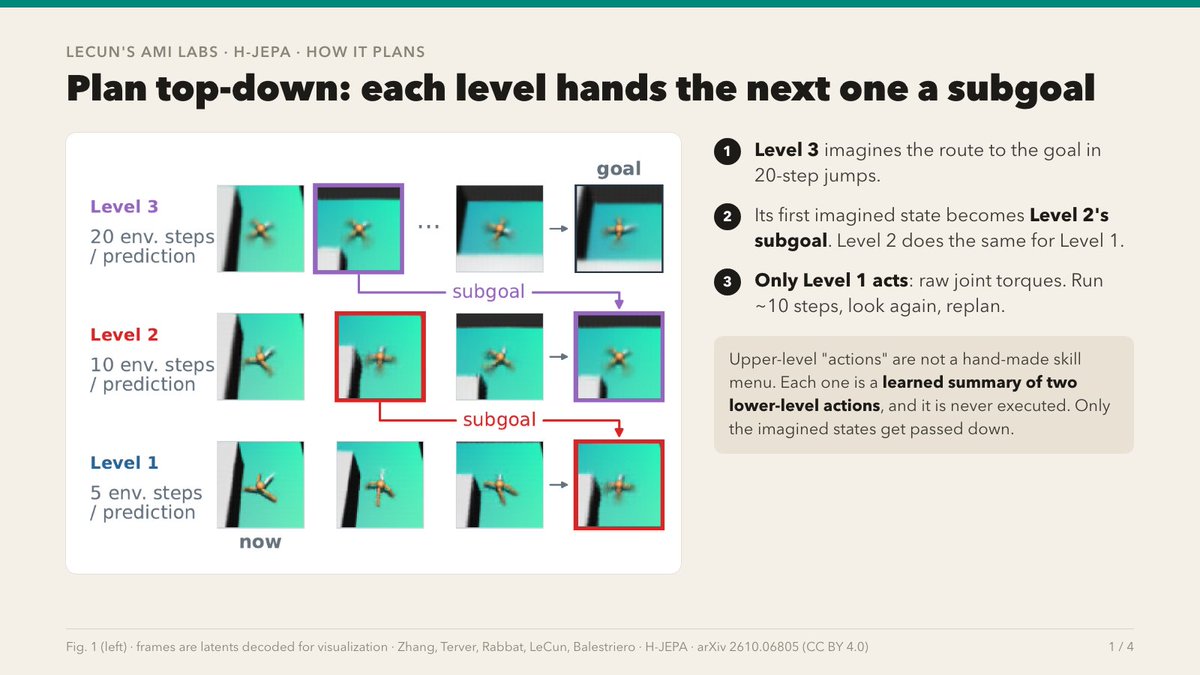
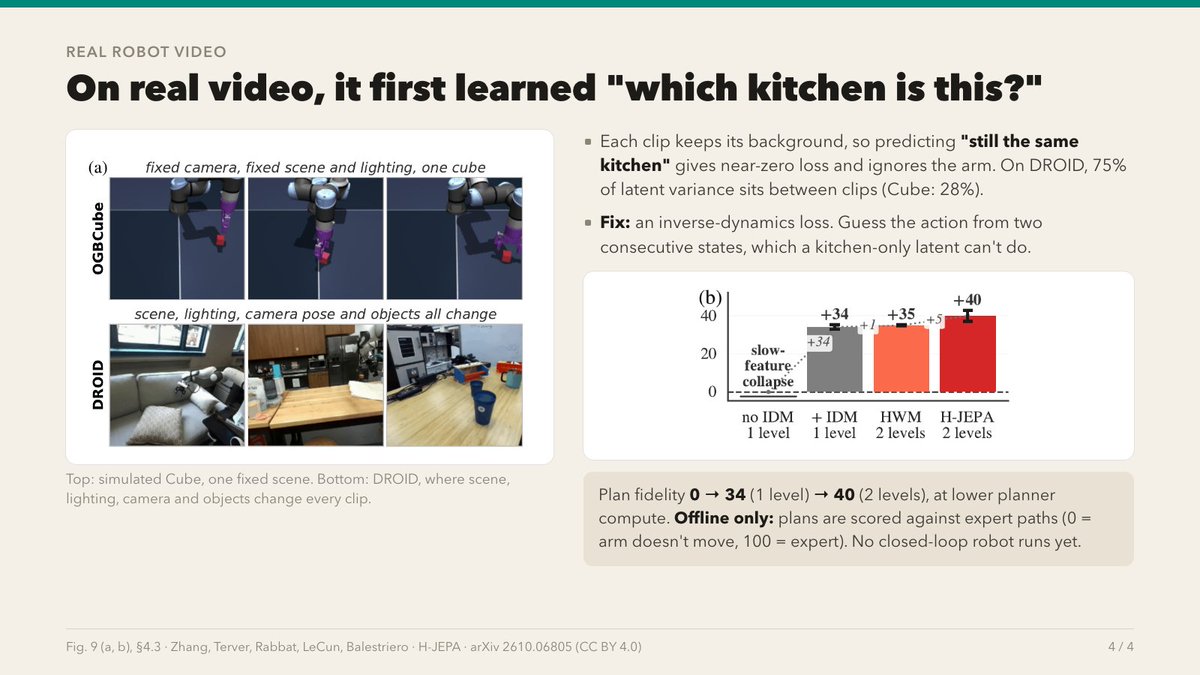
LeCun's AMI Labs open-sourced H-JEPA: world models stacked by timescale. The top plans in 20-step jumps, handing subgoals down.
Maze success vs a flat JEPA: 18% → 73%, on less planner compute.
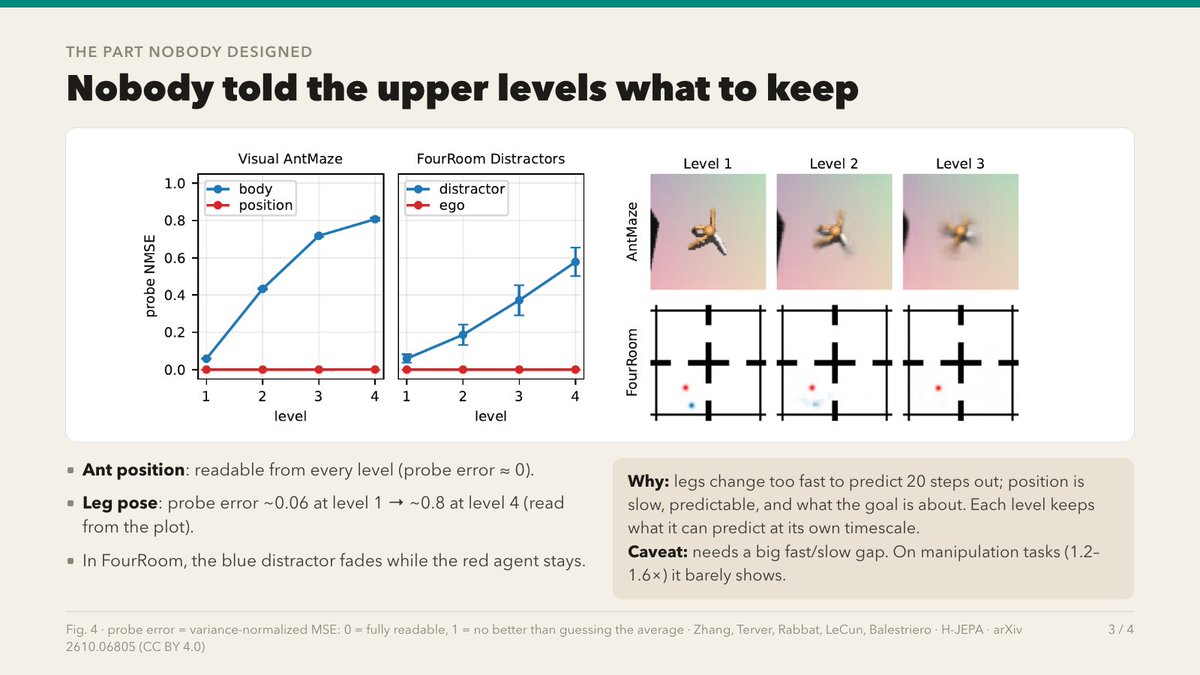
Unprompted, the top kept position, mostly dropped leg pose.
https://t.co/iOVqli7PUC
Haiku 5.5 just launched at $0.10/M input, same as GPT-6 Luna and below DeepSeek V4.1 Flash and GLM-5.3 Flash.
But per-token price ≠ cost per task: at max effort Haiku outputs ~162K tokens per eval task vs Luna's ~50K, and bills 5x past 100K context.
What's actually in your prod stack?