Our paper on singlet–singlet annihilation (SSA) in organic materials, a collaboration with colleagues from University of Brasilia, is the cover of the first 2026 issue of The Journal of Physical Chemistry C.
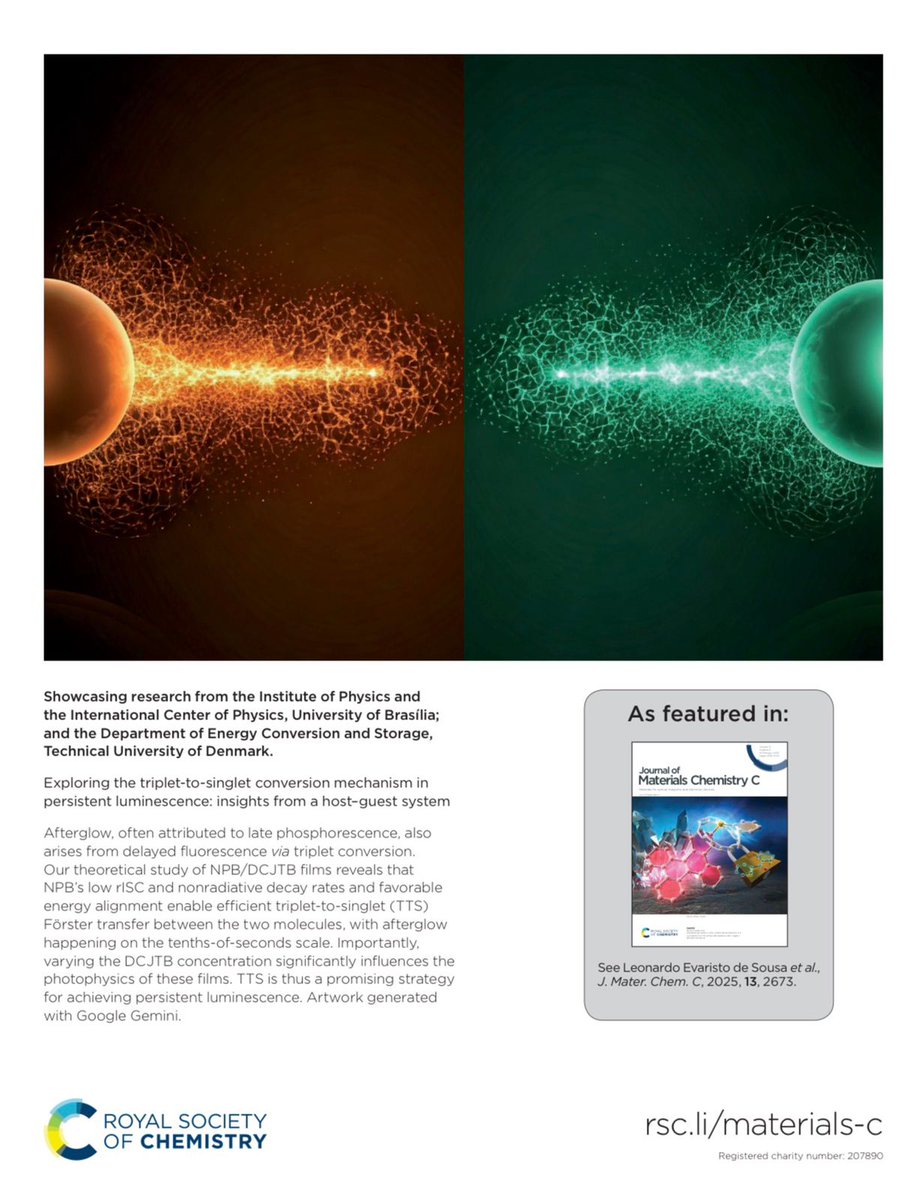
The work shows how a combination of very low rISC and non-radiative triplet decay rates allows for the triplet-to-singlet conversion to take place with appreciable yield in a host-guest system, resulting in fluorescent-derived afterglow in the tenths-of-a-second timescale.
Congratulations to Fernando Bueno on the sucessful completion of his PhD at the University of Brasília, which I had the pleasure of co-supervising together with Prof. Pedro Henrique. @ElecMol_Lab_UnB
Part of his research on the theoretical aspects of the triplet-to-singlet exciton conversion mechanism and its role in organic afterglow materials has been published in the Journal of Materials Chemistry C. (https://t.co/O4HEvvD9c1)
I have a PhD opening for modeling of organic flow battery electrolytes (starting early 2026). Application deadline: 19th Oct. Details at https://t.co/fDF4jIzCN1
I'm hiring two PhD students in atomic-scale modelling of organic flow battery materials. The positions are within an EU-funded MSCA Doctoral Network PREDICTOR. Application deadline: 8 November 2024. Details at https://t.co/y5KixHXYDN
Our new paper on the #TADF properties of dibenzophenazine-cored phenazaborines has been out @JPhysChem C! EL colors are tunable with fluoride. It is collaborative work with Przemyslaw Data, @leoesousa , and @Piotr_deSilva 🇯🇵🇵🇱🇩🇰 !
https://t.co/L2xz6uJABF
Nuclear ensemble simulations show that solvent can change reverse intersystem crossing rates by orders of magnitude and determine the thermally activated delayed fluorescence (TADF) mechanism in a carbene-copper emitter @LaureJdt@leoesousa@Piotr_deSilva
https://t.co/1flUyiP5om