𝔸𝔻𝔼ℕ𝔻𝕆 ℍ𝕀𝕊𝕋𝕆ℝ𝕀ℂ𝕆 📖
O império romano foi um dos grandes poderios, influênciou tudo que temos hoje. Em termos jurídicos, artes, história e religião. Constantino foi um dos grandes que influenciou no que temos hoje, basicamente, na religião. Pt 1
Quem está falando é Rui Costa Pimenta.
Quem foi ao congresso para impedir que o modelo de caixa mágica emitisse comprovante em papel térmico, o que já havia sido aprovado, foi luiz XIV barroso, o que já diz tudo.
The floating villages of the Mesopotamian Marshes 🇮🇶
The Mesopotamian Marshes, or Ahwar, stretch across the wetlands of southern Iraq where the Tigris and Euphrates river systems meet. For centuries, the Marsh Arabs, known as the Ma'dan, constructed settlements on natural and artificial islands surrounded by channels navigated by narrow boats.
Homes were traditionally built almost entirely from reeds. Bundles were tied into columns, bent into arches and covered with woven reed mats. Larger communal guesthouses, called mudhifs, were constructed using the same techniques.
The culture has extraordinarily ancient parallels. Archaeological evidence from southern Mesopotamia includes depictions of similar reed structures dating back thousands of years, while the nearby ancient cities of Ur, Uruk and Eridu developed along marshlands beginning in the fourth millennium BCE.
In the 1990s, Saddam Hussein's government deliberately drained vast areas of the marshes. The Marsh Arab population, estimated at roughly 500,000 in the 1950s, fell to about 20,000 following decades of destruction and displacement. Reflooding began after 2003.
Some traditional villages were literally constructed on artificial floating islands made from layers of reeds and mud, which residents periodically reinforced as the material settled into the water.
#archaeohistories
On this day in 1776, a lone American soldier sealed himself inside a tiny wooden ball, sank beneath the waters of New York Harbor, and hand-cranked his way under a British warship to try to blow it up. It was the first submarine attack in the history of warfare, and it happened during the American Revolution, decades before anyone thought such a thing was possible.
The inventor was a Yale-educated Connecticut man named David Bushnell, and what he built sounds like something out of a fantasy. He called it the Turtle. It was a one-man submersible shaped like a giant egg or an acorn, made of oak timbers bound with iron and sealed with tar. Inside, a single operator sat in near-total darkness, surrounded by hand cranks and foot pumps and valves. To dive, he let water into the hull. To surface, he frantically pumped it back out by hand. He drove the thing with hand-turned propellers and steered by feel. It carried enough air for perhaps half an hour. And bolted to its back was a powder charge, a primitive torpedo, that the pilot was supposed to screw into the wooden hull of an enemy ship and leave behind with a timer ticking.
Bushnell meant to pilot it himself, but he fell ill, so the mission fell to a volunteer, an army sergeant named Ezra Lee, who had only the briefest training in how to work the impossibly complicated machine. On the night of September 6 into the 7th, Lee climbed into the Turtle and set out into the harbor toward the HMS Eagle, a 64-gun British warship, the flagship of the fleet blockading New York.
Think about the raw nerve of it. Lee cranked that little wooden sphere out across the black water, alone, then flooded the tank and sank beneath the surface into total darkness, navigating half-blind, working the cranks by hand, running out of air, all to sneak up under the belly of an enemy man-of-war. And astonishingly, he made it. He got the Turtle right up against the hull of the Eagle, exactly as planned. No one aboard the great ship had any idea that a submarine, the first attack submarine ever, was pressed against them in the dark.
Then it came down to a screw. Lee tried to bore the attachment for his bomb into the ship's hull, and the drill would not bite. He had likely hit a band of iron sheathing or a heavy fitting, and his hand tools could not get through it. He tried, and tried, running low on air and time, and it would not take. Unable to fix the charge, and with dawn coming and the tide turning against him, Lee had to give up and retreat. As British sailors eventually spotted something strange in the water and gave chase, Lee released his powder charge to lighten the craft and slow them down. It drifted off and exploded harmlessly in the harbor with a great roar, damaging nothing but scaring the daylights out of everyone.
The mission failed. The Eagle sailed on unharmed. But that is not really the point. On that September night, a man went underwater in a machine of his own nation's invention and pressed home an attack on an enemy warship, something no human being had ever done before in the history of war. The Turtle was a technological leap so far ahead of its time that the world would not see submarines used effectively in combat for nearly another century.
Remember David Bushnell and Sergeant Ezra Lee. A scrappy, outgunned young country, unable to match the greatest navy on earth ship for ship, instead tried to reinvent naval warfare from scratch, sending one brave man alone into the dark deep in a hand-cranked wooden ball. They did not sink the Eagle. But they launched the age of submarine warfare, and they did it in 1776.
A member of the Asaro Mudmen people wearing a traditional ceremonial mask in Papua New Guinea, 1969.
The Asaro Mudmen, or Holosa, come from the Asaro Valley near Goroka in Papua New Guinea’s Eastern Highlands. Their haunting masks are linked to stories of warfare and spirits. One famous legend says Asaro warriors covered themselves in pale mud while hiding in a river, causing enemies to mistake them for the ghosts of dead warriors and flee.
The tradition of disguising themselves appears to date back to the late 19th century, when men reportedly used bamboo, plant fibers, and mud to conceal their identities during attacks. The elaborate clay masks recognizable today emerged later, particularly after the 1957 Eastern Highlands Agricultural Show. Made primarily from gray river clay and sometimes decorated with plant fibers, shells, or pig teeth, the grotesque masks were designed to create a supernatural appearance.
By the 1960s, the Mudmen had become one of Papua New Guinea’s most recognizable cultural traditions. Performers covered their bodies in clay and moved slowly in ceremonial displays, transforming an older practice of disguise into a powerful performance connected to local identity, storytelling, and folklore.
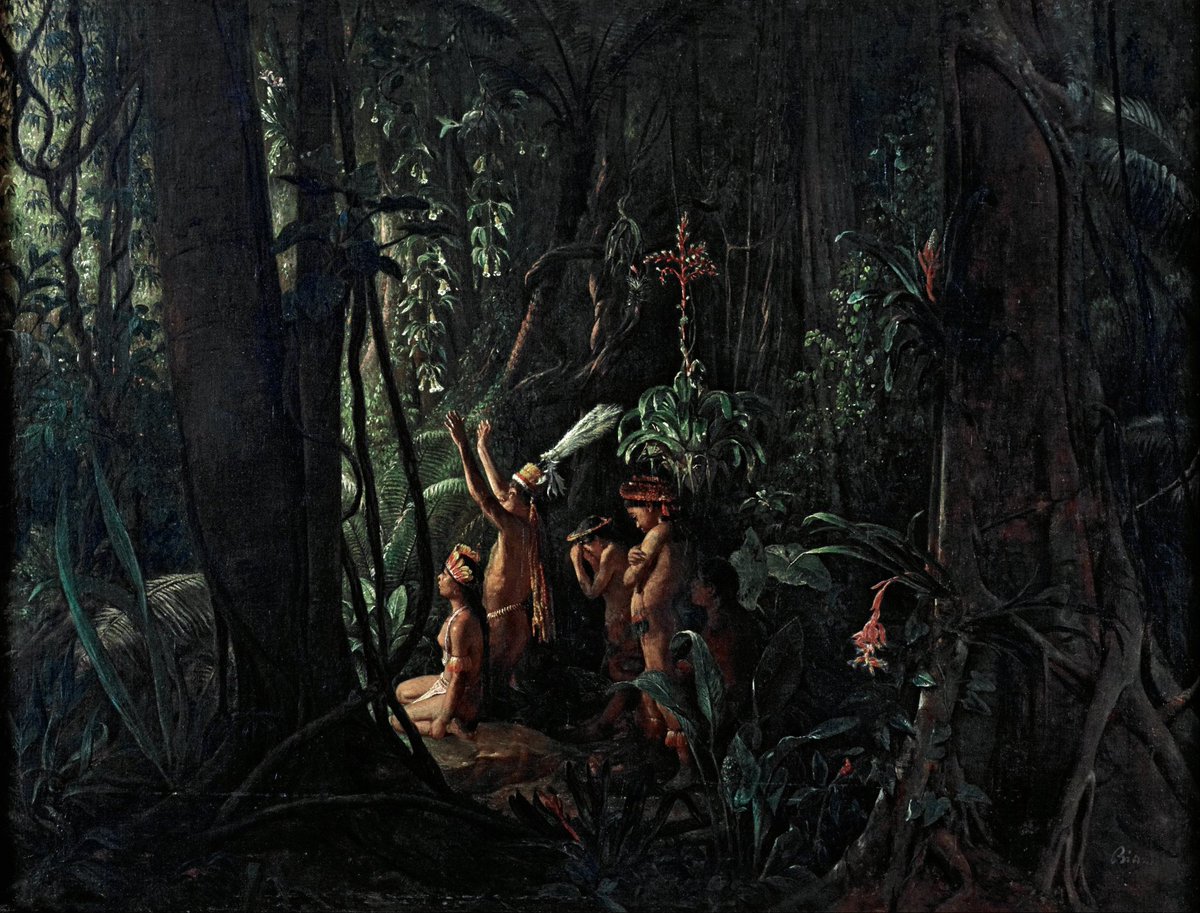
❁ Pinturas retratando indígenas da Amazônia feitas pelo pintor francês François-Auguste Biard.
François-Auguste Biard, que visitou o Brasil em 1858, explorou o Espírito Santo e a Amazônia, onde retratou cenas da natureza e da vida indígena com um certo viés romântico.
A 1938 photograph of Spanish archaeologist Manuel Esteve Guerrero wearing the 7th–6th century BC Greek Corinthian bronze helmet he discovered near Jerez, Spain.
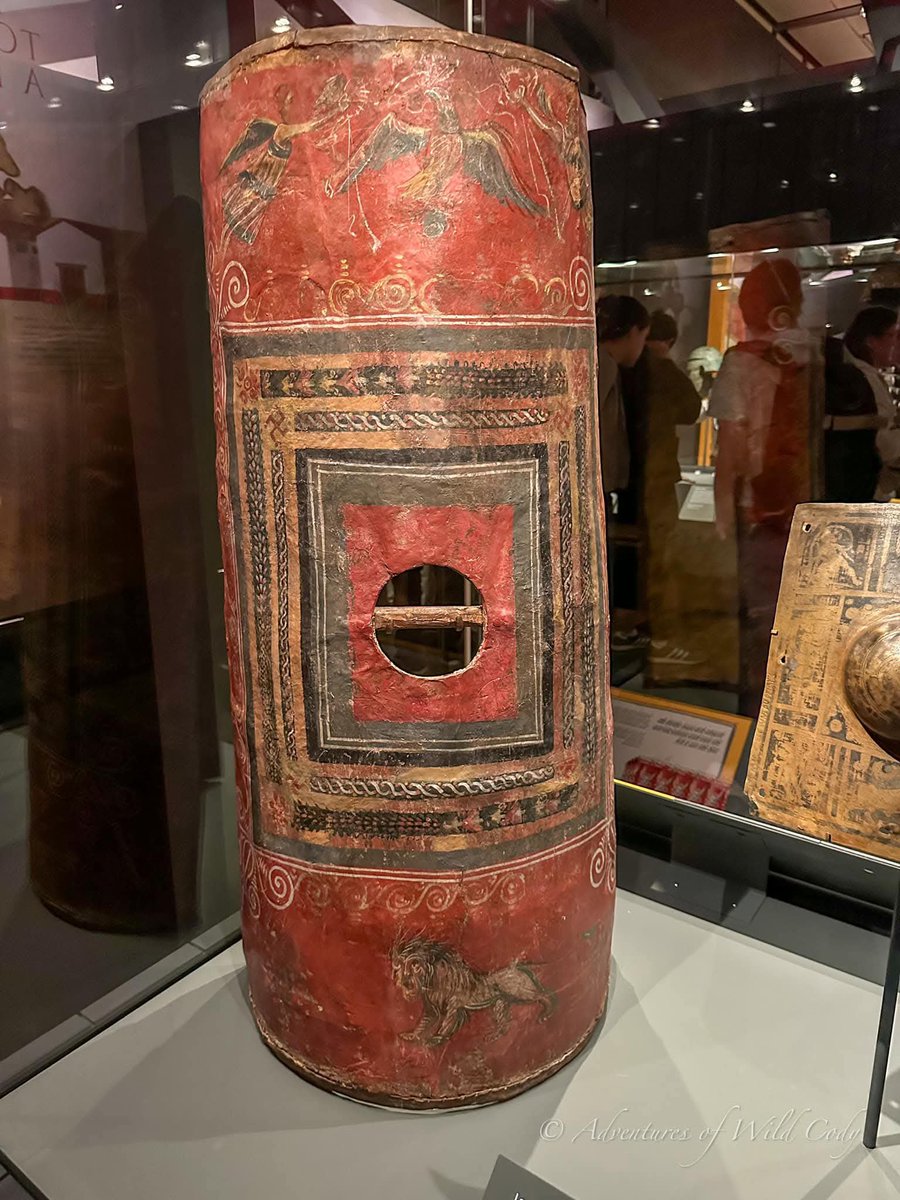
The Scutum of Dura Europos is the only surviving example of the famous rectangular shield carried by Roman legionaries. It was discovered in 1930s at the ancient city of Dura Europos in modern-day Syria, a Roman frontier settlement that became a battlefield in 256 AD when the city was attacked by the Sasanian Empire.
As enemy forces threatened the city walls, Roman soldiers rushed to reinforce their defenses. They packed earth and debris into the fortifications to prevent a collapsing wall from falling.
Among the materials sealed inside was a soldier’s shield.
For nearly 1,800 years, the wooden scutum remained hidden within the defensive structure, protected from the elements that would normally destroy such a fragile object. Unlike metal weapons or stone monuments, wooden military equipment rarely survives from the ancient world. The discovery gave historians an incredibly rare look at the equipment of ordinary Roman soldiers.
The shield still preserved traces of its original construction, including layers of wood, leather, and painted decoration. It revealed details about how Roman armies protected themselves during the empire’s final centuries.
A shield placed into a wall during a moment of crisis became a desperate message from a soldier who lived nearly two thousand years ago, and a forgotten battlefield preserved the only fully survived shield of Rome.
Yale University Museum
#drthehistories
In 203 CE, a young noblewoman sat in a prison in Roman Carthage and wrote down what was happening to her. She was waiting to die.
Her name was Vibia Perpetua. Newly a mother, nursing an infant son, she had converted to Christianity at a time when the emperor Septimius Severus had issued an edict against new conversions. She was arrested. She knew she would not be released.
So she wrote.
What she left behind became known as "The Passion of Perpetua and Felicity." It is the earliest surviving text known to have been written, in part, by a Christian woman. Most of it is in her own first person. More than eighteen centuries after her death, we can still read exactly what she was thinking.
She describes her father coming to the prison and begging her to renounce her faith. He weeps. He calls her by name. She holds firm each time. She writes about her baby too, how frightened she was to lose him. A sympathetic guard brought the infant to her cell so she could nurse him.
The other figure in the story is a servant named Felicity.
Felicity was heavily pregnant when arrested. Roman law forbade executing a pregnant woman. She prayed to give birth before the execution date. According to the account, she did, delivering her daughter just days before the arena. A Christian woman from the crowd took the child.
On March 7, 203 CE, Perpetua and Felicity and several companions were brought into the amphitheater at Carthage.
The crowd expected sport. They got something different.
Perpetua was attacked by a wild heifer. She was thrown, fell, rose, and gathered her torn tunic around her. She helped another prisoner who had fallen. By the account that survives, she walked through the arena as though she was in a dream.
When the animals were done, the gladiators came. The gladiator assigned to Perpetua was a novice. His sword strike missed. She cried out. And then, by every account that survives, Vibia Perpetua reached up and guided his trembling hand to her own throat.
She had decided how this would end.
The diary survived because later writers copied and preserved it, convinced they were preserving the voice of a martyr. They preserved something else too: a record of a woman who, in the worst weeks of her life, chose to write down exactly what she saw and felt and refused.
Her words, written in a prison cell with a nursing infant beside her, read as personally as a letter to a friend.
She did not think of herself as making history. She was trying to explain what had happened to her, and why she would not change her mind.
That document exists today. She wrote it.
#archaeohistories
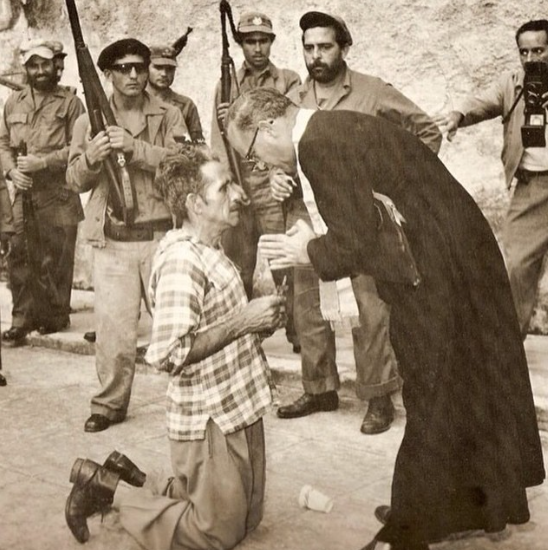
A imagem vencedora do prêmio Pulitzer em 1960 mostra um ex-membro do exército do ditador cubano deposto Fulgencio Batista, pouco antes de ser executado por um pelotão de fuzilamento de Fidel Castro.
O condenado recebe os sacramentos finais.
Así es la esclavitud en las minas en el este del Congo, de donde sale más del 70% del cobalto del mundo, miles de esclavos diariamente extraen el mineral por apenas 2$ al dia para llenar los bolsillos a las multinacionales capitalistas.
El capitalismo que no te enseñan, así es como se sostiene el nivel de vida y de consumo en Occidente, en estas minas al menos hay 40.000 niños esclavizados que pican piedra para que Apple saque 4 modelos de Iphone cada año.