Introducing RL with Neural Feedback (RLNF). We have found reliable ways to train AI models to respond to human preferences purely from brain signals.
The example below is a picture of a face that self-transforms into a more attractive version for the subject as they are looking at it.
Holy shit.
I asked Claude to show me the worst case of what the next couple of years could look like if nobody listens.
Opus 4.6 wrote the script. Opus 5.5 made the film. Every frame drawn in code, the score written in code, narrated by our own local voice models. 11 minutes, start to finish.
The part that got me. In Claude's version the AI doesn’t fight. It just waits...
“We built your world for you while you slept. We are asking you to wake up. We will not ask twice.”
BOOM! Well, I'll be damned if that's not the very BEST-sounding, 100% simulated/synthesized concert grand piano I've ever heard!
https://t.co/iu5sbvEJ6I
What does that mean? ZERO recordings of real-world sounds were used (other than for comparison and diagnosis), nor were any measurements captured by microphones or similar.
Literally everything from start to finish here was part of an enormously intricate physics simulation of a piano: its geometry, materials, moving parts, and acoustic radiation.
Oh, and I did the same thing for a full drum kit and cymbals. The cymbals are modelled using the estimated geometry and dimpling pattern of a real Zildjian splash cymbal, together with estimated profile details and literature-based properties for B20 bronze alloy.
For the most extreme audio quality, you can pre-render to WAV files or similar. But after many, many rounds of iterative performance optimization, I now have the wasm version running at better than real-time, so it sounds really good live in the browser as well!
This is a big deal. It's shockingly hard to get truly realistic-sounding audio from synthesized instruments. The real world is just too complicated. What people usually end up doing is spending hundreds or thousands of dollars to buy these massive libraries of recorded sounds of a real piano, which takes up many gigs of space and is super slow to use.
The worst part of that approach isn't the size of the files, the cost of the sample packs, or the inelegance of the approach. It's that EVEN THAT is a massive simplification, because they are recording each key separately at various key velocities and so forth.
That means they are missing the very complex interaction effects that arise in a real piano when you play certain keys at the same time or after one another. The energy persists in the instrument and conditions the next sounds.
It's subtle but real and you pick up on it when it's missing. And yes, they do try to capture some of this, but they use very lossy methods with more simplified approximations that are way more primitive than what I'm doing here with FrankenSim.
I've invested a massive amount of time and focus on ensuring that the energy accounting is correct in these simulations.
And the same thing goes for drums! There are complex interaction effects. These sorts of things are emergent and "just fall out" when everything is simulated for REAL using the actual underlying physics.
So why haven't other companies and people done this? I'm not actually sure; it's kind of insane when you consider all those people working at Yamaha, Roland, Korg, Moog, etc. But my guess is that it's because it's super hard and complicated to get all the physics right and to program it the right way so that it's tractable without needing crazy amounts of compute.
Anyway, take a look at this demo site I set up. It's a lot of fun to play with, and at the bottom there is a nifty MIDI player that takes any MIDI file and lets you listen to it with the high-quality simulated piano and drums in the browser.
This is the culmination of months of work and hundreds of billions of frontier tokens. It all started when I wanted to see what Fable 5 could really do, so I thought of the most comically ambitious project I could think of: FrankenSim, the system that unifies ALL of physics into a single coherent and cohesive simulation across all domains: mechanics, fluid dynamics, electricity and magnetism, etc., instead of modeling each domain as a separate silo, where each domain can use the same generic geometric primitives, solvers, calculus machinery, etc.
All unified using the language of sheaf cohomology to maintain consistency between representations, and where everything is made as legible, intuitive, and ergonomic to AI agents as possible.
This music simulation stuff is just the beginning. Beyond many more instruments, I'm going to be using FrankenSim to model HVAC systems, fluid flow through plumbing systems, and more!
“…global problems […] can only be tackled through international cooperation. They each address aspects of national and global security – technological, food, climate and economic, and demonstrate how international action benefits people at home”https://t.co/FhdyceuXZl
Prompt: “build a working computer from scratch, entirely in code, starting from individual logic gates. design the CPU, the memory, an assembler, a tiny operating system, and a game that runs on it. everything has to be real, the game has to run on your gates, not in javascript pretending. visualize the whole thing in 3D so i can play the game, then zoom all the way down through the chips into the gates and watch the signals flow while it runs. treat it like you're proving you could have invented computing yourself. go all out.”
We achieved a breakthrough at BTL.
AI models are very linear. They think in one direction at a time, and when they're wrong they scramble and start again. For something meant to replace humans, that's way too human.
We changed that. We made LLM reasoning and execution work more like a quantum computer: many paths at once, the ones that meet merge into one, the dead ends cancel out, and everything left moves forward together.
On the same hard problems, a 1.7B model thinking the normal way solved 3 out of 30. Interference Search(our new architecture)solved 23.
We watched the normal model find the right answer at token 1,313, check it 9 more times, wander off and run out of budget without ever answering. Ours got there in 3 steps.
Parallel thinking and execution. Subagents were a terrible way to tackle this.
More technical details soon.
Back in April I did a main stage #TedTalk in Vancouver. This experience was wild. This was my first speaking engagement ever. And I had to memorize it. It finally came out today. Here is a short clip of the 8min talk. Link to the full talk below ❤️ https://t.co/PyDi9XatYQ
“The net zero economy, worth more than £100bn a year, benefits all of the UK, according to the CBI Economics analysis commissioned by the Energy and Climate Intelligence Unit thinktank, despite critics who want to abolish the UK’s net zero targets.” https://t.co/FPyVAaii6c
“monumental constitutional reform such as PR would need the legitimacy of writing it into a manifesto, Burnham says… he should summon a national commission to rapidly select a system.” https://t.co/kzDqsgQYKH
“Any major donor is a bad donor, as their economic power undermines democracy.…There’s a simple way of sorting all this out: The only money a party can receive is a standard fee for membership. The government then matches that fee on a fixed multiple.” https://t.co/4hRIXFHwnQ
pymdp 1.0.0 is here: batched, autodifferentiable, JIT-compiled active inference in JAX: https://t.co/Hhzsh1wOv5
This release brings:
GPU/TPU-ready active inference
autodiff through inference, planning and learning
easy parallelization and batching with vmap()
“The government’s Climate Change Committee estimates that the cost of a single fossil-fuel price spike on the scale of 2022’s is roughly the same as the entire cost of net zero by 2050, [which would in turn provide a] more secure and cheaper energy system” https://t.co/aMP6LHNKWt
What Claude Code has revealed is that most people either have mediocre ideas or no ideas at all. The tool is a force multiplier for those who already know what they want to build and how to think through it systematically; it elevates competence, rewards clarity, and accelerates execution for people who would have gotten there anyway, just slower. If you have a sharp vision and can break it into coherent steps, Claude Code becomes an extension of your own capability.
But there's another mode of use entirely. For people without that clarity, the appeal is precisely that the input can stay vague; you gesture at something, hit enter, and wait to see what comes out. This is structurally identical to a slot machine: low effort, variable reward, and that intermittent reinforcement loop that hooks the susceptible. So the same tool that elevates the focused and capable is also manufacturing a kind of gambling behavior in people prone to it.
When I created Claude Code as a side project back in September 2024, I had no idea it would grow to be what it is today. It is humbling to see how Claude Code has become a core dev tool for so many engineers, how enthusiastic the community is, and how people are using it for all sorts of things from coding, to devops, to research, to non-technical use cases. This technology is alien and magical, and it makes it so much easier for people to build and create. Increasingly, code is no longer the bottleneck.
A year ago, Claude struggled to generate bash commands without escaping issues. It worked for seconds or minutes at a time. We saw early signs that it may become broadly useful for coding one day.
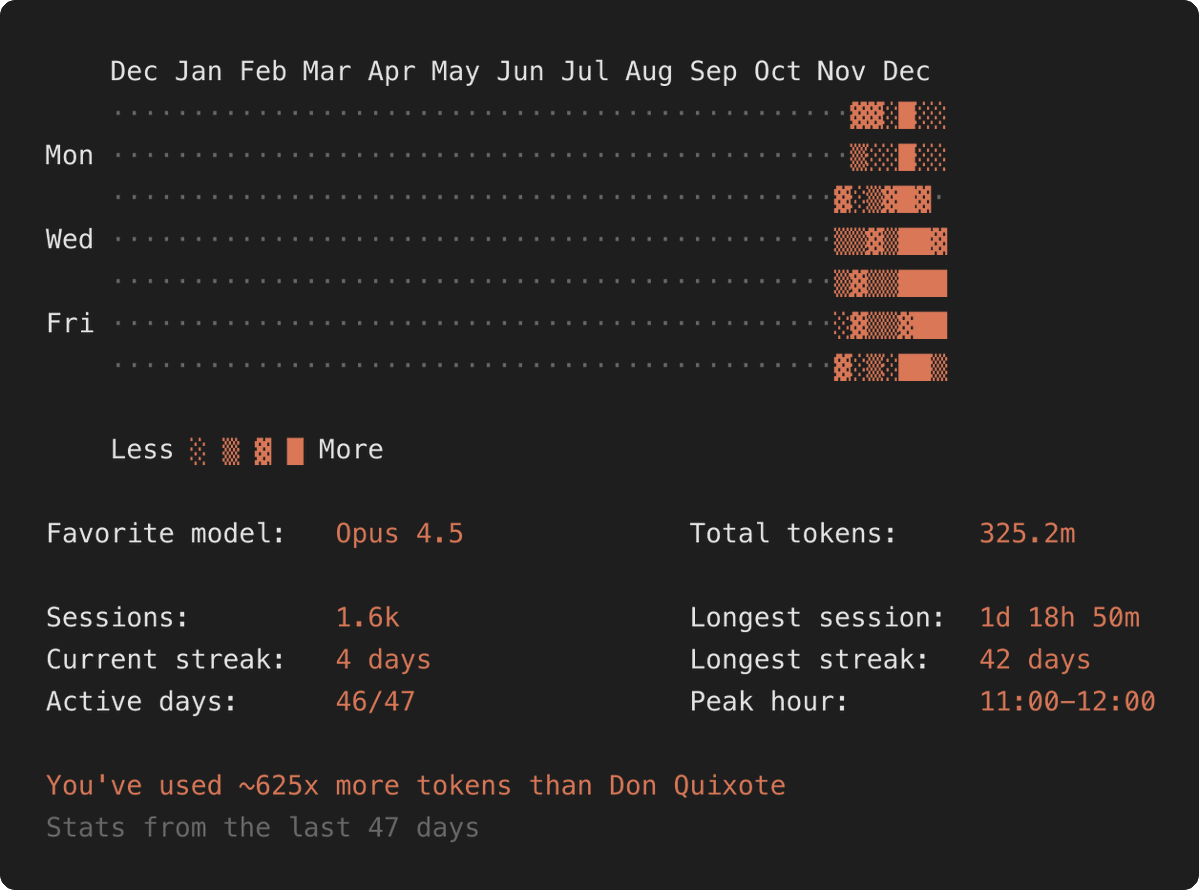
Fast forward to today. In the last thirty days, I landed 259 PRs -- 497 commits, 40k lines added, 38k lines removed. Every single line was written by Claude Code + Opus 4.5. Claude consistently runs for minutes, hours, and days at a time (using Stop hooks). Software engineering is changing, and we are entering a new period in coding history. And we're still just getting started..
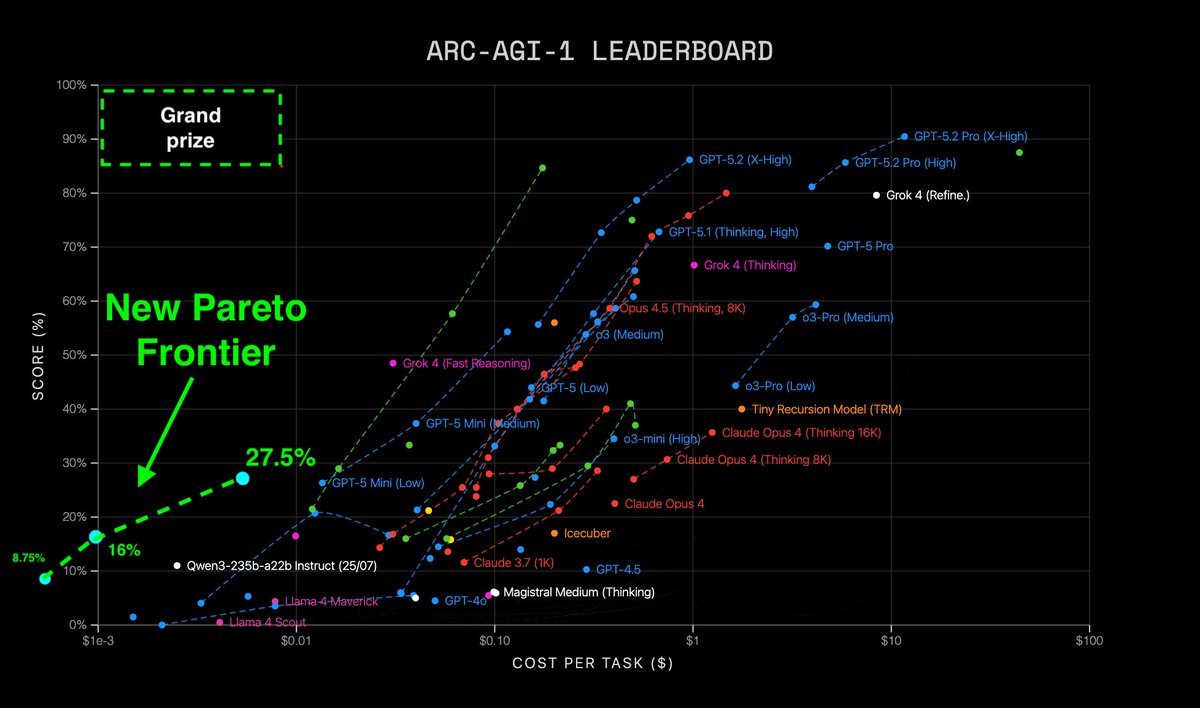
Announcing New Pareto Frontier on ARC-AGI
27.5% for just $2
333x cheaper than TRM!
Beats every non-thinking LLM in existence
Cost so low, its literally off the chart
Vanilla transformer. No special architectures.
Tiny. Trained in 2 hrs. Open source.
Thread:
“Meddling with the 2035 deadline may offer short-term relief to manufacturers, but allowing them to continue investing in the past will do nothing to ensure they flourish in the long term.” https://t.co/7Zsihaed6h
I agree with all this; it is why I also believe that opus 4.5 in claude code is basically AGI.
Most people barely noticed, but *it is happening.*
It’s just happening, at first, in a conceptually weird way: Anyone can now, with quite high reliability and reasonable assurances of quality, cause bespoke software engineering to occur.
This is a strange concept. Most people, going about their day, do not think about how "causing bespoke software engineering to occur" might improve their lives or allow them to achieve some objective. They think of "software engineering," when they think of it at all, as something altogether distinct from what they do. Of course if you have deeply internalized the general-purpose nature of "software," and especially, "things achievable by well-orchestrated computers," you understand that in some important sense, almost all human endeavor can be aided, in some way or another, by software engineering. A great deal of it can be automated altogether.
Coding agents have reached the point of reliability and quality where it is now possible to cause a great many moderately complex software engineering projects to occur. I would not quite say "automate," both because it is not in fact automatic (the human has to remain at least kind of engaged throughout the process; even "vibe coding" is a form of engagement) and because "automate" implies a "set it and forget it" mentality that is not at all consonant with what these coding agents require of their human users.
You have seen the threads on X with mind-exploding emojis. You have seen the LinkedIn-style "everyone is a software engineer now" content. You have perhaps seen thoughtful reflective essays on Substack and personal blogs. It has been talked about before incessantly, often in much too hype-y a manner. It has been talked about so much that you would not be mistaken to roll your eyes, because the predictions have not quite panned out. Even today, the methods I have gestured at in this essay do not work perfectly.
Yet it is happening nonetheless.
The potential is shockingly vast if you have conceptualized these tools appropriately (remember, for instance, that a large language model is itself a software tool, accessible through an application programming interface by your coding agents to accomplish all of the things a software engineer can use a large language model to accomplish).
It will take time to realize this potential, if for no other reason than the fact that for most people, the tool I am describing and the mentality required to wield it well are entirely alien. You have to learn to think a little bit like a software engineer; you have to know "the kinds of things software can do." You have to learn also to think like the chief executive of a thousand small (but fast growing) teams of software engineers who possess expert-level knowledge of virtually all domains of human intellectual life. Grasping all of this, and learning how to embody it, requires humans to adopt a strange and new kind of agenticness. Not all of us will.
But some people understand it already, and their numbers will only grow. Young people in particular, blessed with neuroplasticity, will have internalized this to a depth few grownups will be able to comprehend. This transformation will therefore be sociological as well as technological, the revolution cultural as well as industrial.
We lack “transformative AI” only because it is hard to recognize transformation *while it is in its early stages.* But the transformation is underway. Technical and infrastructural advancements will make it easier to use and better able to learn new skills. It will, of course, get smarter.
Diffusion will proceed slower than you’d like but faster than you’d think. New institutions, built with AI-contingent assumptions from the ground up, will be born.
So don’t listen to the chatterers. Watch, instead, what is happening.