Really enjoyed writing this short piece @thenewdigest on Good Government and the Common Good. I examine the 14th century frescoes of Ambrogio Lorenzetti to explore the theory behind the common good.
Thanks to @Caseyco231 and @Vermeullarmine!
https://t.co/wb37ByhLoT
Amnesty have written to people saying
“We regret ‘A growing threat: the anti-rights movement in the UK’ briefing was uploaded to our website without going through the established internal review processes that are in place to ensure consistency, accuracy and alignment with Amnesty International UK's positions. It's use of language does not reflect the position of Amnesty International UK which is why it was promptly removed.”
“We remain committed to defending human rights, including both the rights of women and the rights of trans people.”
This is insulting double-speak.
Michel Houellebecq, France’s most celebrated living novelist, has devoted his career to chronicling the spiritual exhaustion of the West and the crises of modernity.
Now, as France prepares to vote on whether to legalise euthanasia, he delivers an impassioned plea for life exclusively for UnHerd. Assisted dying, he argues, marks the moral apotheosis of a species apparently set on its own destruction.
‘It is true that I have devoted myself to examining the symptoms of the suicide of the West and the rise of nihilism,’ he writes. ‘But I do not recall ever having rejoiced in any of it.’
Read more ⬇️
https://t.co/cDCYxF2rec
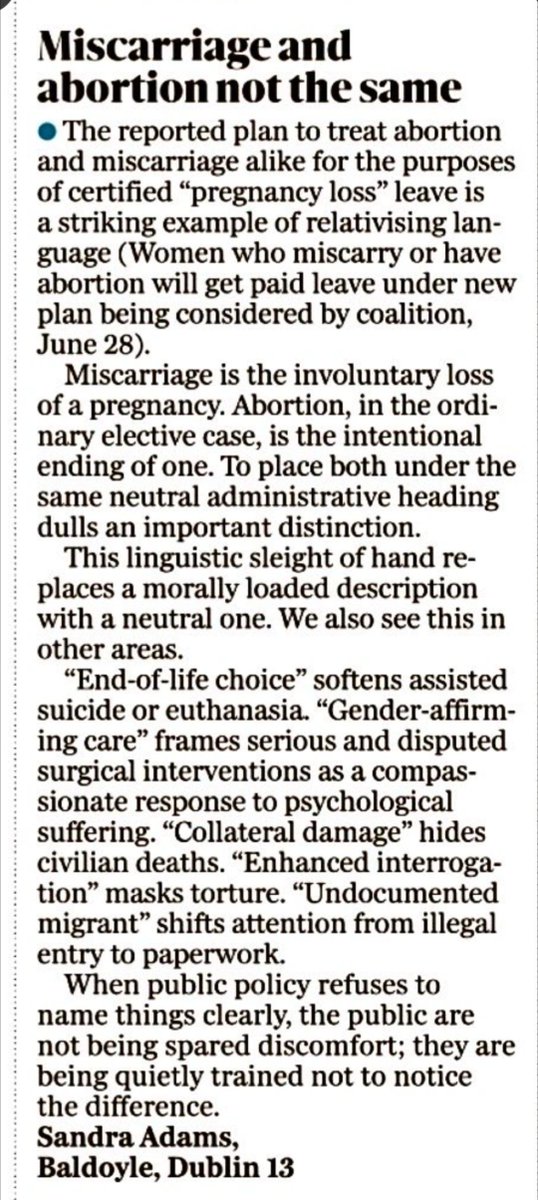
Abortion and miscarriage are not the same. Proposed 'pregnancy loss' leave flattens the difference using a linguistic sleight of hand.
My letter in today's
@Independent_ie
The @BBC brain-dead Eurovision commentators neglected to say that the Croatian group LELEK’s song ‘Andromeda’ recalls the women and girls in South East Europe in the 18th and 19th centuries who opted to tattoo Christian symbols on their faces in order to escape the Ottoman (Turkish) Empire's forced conversions to Islam or the attentions of Muslim slavers.
@declanganley@TheMandyGall@OdohertyI64991@helerina
A 79-year-old Catholic priest, Fr. Larry Holland, who is recovering from a hip fracture at Vancouver General Hospital in Canada, said he was offered Medical Assistance in Dying (MAiD) twice by hospital staff, even though he made clear he is a Catholic priest and morally opposed to euthanasia.
Image: BC Catholic
Jess Asato MP secured amendments on domestic abuse training which Lord Falconer tried to unpick in the Lords. He did the same for safeguards for those with learning disabilities. Both changes would have saved the government money at the expense of vulnerable people.
Latest accounts for Dignity in Dying show that in 2024 their total campaign expenditure was £2,734,414 (average £50k per week).
Campaign expenditure increased massively from 2023 to 2024 - by >£1million (or, 75% increase).
This escalation in spend meant that in 2024 they made a *loss* of £680,244.
Consider how much they’ll have thrown at the campaign in 2025 and 2026…
It makes you think…
@RajivShah90 Thank you that's really kind, I'm really glad its been read, and you enjoyed it.
Well I don't agree with him in so many ways but I certainly listen to the sentiments of his interviewees and mood of his audience. There is lot to learn from that!
Disappointed with Alasdair Campbell, as someone who enjoys his podcast. Clearly he hasn't followed the debate in the House of Lords, or listened to the sense of dismay of many at the cavalier approach of the advocates to the fate of those who might apply, esp the poor.
The conduct of a tiny minority in the House of Lords who have used every tactic imaginable to make sure the Assisted Dying Bill fails has been awful. I have long believed the Lords is simply not fit for purpose as a second chamber. This has cemented my view hard, and I imagine will make others realise just how ludicrous our legislative systems are. Sad day.
Many supporters of the bill have said that assisted suicide wouldn't come at the expense of good palliative care. Now that assisted suicide is dead - having been rejected by the Scottish Parliament, the Senedd, and Westminster - I hope we can focus on improving palliative care.
@ChobhamEagle It was a terrible piece of law, and unworthy to be put before the house of Lords, the very point is they established that time and again in the debates. I watched and listened carefully. If Leadbeater and co had their way, it would have been railroaded, just like in the commons.
This a great tread on the Assisted Dying Bill. It took an enormous amount of effort to defeat it and great courage. They defended the most vulnerable in society from a dangerous and exploitative proposed law.
1. The dark heart of the bill and the essence of the whole debate. Lord Harper puts Lord Falconer on the spot:
“Is he really saying that he’s OK with poor people ending their lives with the assistance of others *because they’re poor?*”
Falconer: “I’m saying it’s their choice.”
Remarkable to think they would have accepted poverty as a reason for access to assisted dying/euthanasia, with no consideration that poverty could also be the motive.
4. Falconer says any motive, including poverty, is within the bill’s remit:
“Where the reason…is because in your mind you are influenced by your circumstances—for example, because you are poor—should you be barred from having an assisted death...? In my view [you should] not.”
8. Baroness Debbonaire’s speech:
“But this bill actually isn’t worded so as to end suffering. It’s worded so as to end life.”
“If it was a bill about ending suffering and alleviating suffering, then the provisions of the…bill would be about palliative care, and they are not.”
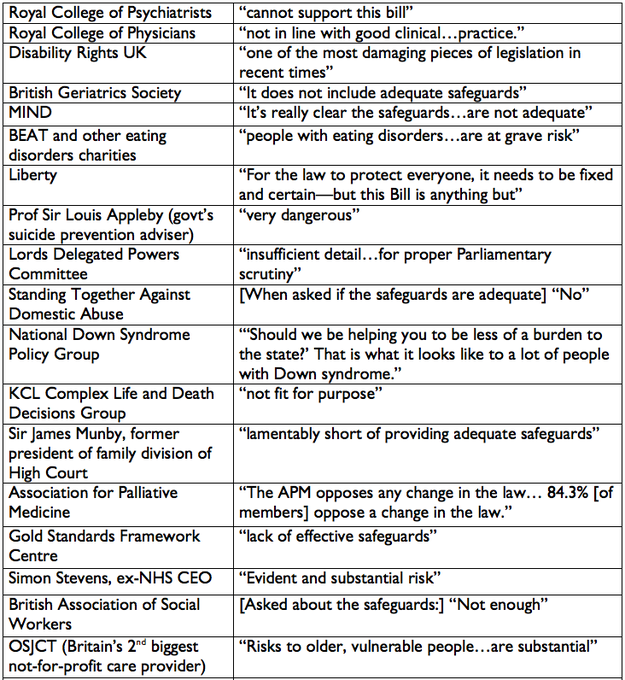
This is the basic reason why the AS bill failed. One impartial expert organisation after another looked at the detail and concluded that it was a nightmare in the making:
Speech of the day from former attorney general Baroness Prentis, who is undergoing chemotherapy:
“When I’ve been waiting, literally on the floor, having fainted, of a less than perfectly clean NHS corridor, I have had a vision in my head of crisp white sheets and certainty that would come from knowing you were instantly going to die.
“For me, and I suspect for most vulnerable people, that vision passes and life becomes worth living and good again. But I don’t think we should deny for one minute that that vision is briefly an attractive one.
“My Lords, we owe the dying better than this bill.”
The Catholic Church has consistently taught that each human life, from the moment of conception until natural death, is sacred and deserves to be protected. Indeed, the right to life is the very foundation of every other human right. For this reason, only when a society safeguards the sanctity of human life will it flourish and prosper.