BREAKING: CHINA JUST SENT A HUGE WARNING TO U.S. STOCK INVESTORS
If you own AI stocks, this is a MUST READ.
After 14 years of trading, here’s what I want you to understand before you buy another dip.
China has been reducing its U.S. Treasury holdings while adding gold.
Meanwhile, Hong Kong began testing a government-backed gold clearing system in July.
The bigger picture:
China is expanding its financial options and reducing dependence on the dollar-centered system.
Here’s how that connects to YOUR portfolio.
AMERICA BORROWS BY SELLING TREASURIES.
When China reduces its holdings, other buyers need to absorb that supply.
If demand falls short, bond prices can fall and yields can rise to attract buyers.
Higher yields can raise borrowing costs and put pressure on stock valuations.
China doesn’t control American interest rates. Other buyers, inflation, and Fed policy matter.
But demand for U.S. debt is part of the equation.
GOLD CHANGES WHAT CHINA DEPENDS ON.
Treasuries are a promise from the U.S. government to repay.
Physical gold held domestically doesn’t depend on a foreign government making that payment.
Adding gold diversifies those reserves.
Building gold trading and settlement infrastructure expands China’s financial options.
That’s a long-term shift—not proof the dollar is about to collapse.
YOUR AI COMPANY CAN GROW WHILE YOUR STOCK FALLS.
“The company keeps delivering. Why am I still losing money?”
Because business growth is only half the equation.
The other half is what investors will PAY for that growth.
Higher yields give investors more attractive interest-paying alternatives.
They also reduce the value today of profits expected years into the future.
That can hit expensive AI and growth stocks especially hard.
You can be right about the next 10 YEARS and still overpay today.
And a stock falling 40% doesn’t automatically make it cheap.
WATCH WHAT HAPPENS NEXT.
The combination I’m watching closely:
GROWTH STOCKS FALLING WHILE TREASURY YIELDS RISE.
Then I check whether the weakness is spreading:
$SMH: Are chip stocks stabilizing or leading lower?
$QQQ: Are major growth companies holding support?
$HYG: Is corporate credit weakening too?
Weak stocks alongside weakening credit would raise my concern beyond an ordinary sector pullback.
Then I bring it back to execution:
Daily 8/21 bearish cross: trend weakening.
Support breaks.
Price bounces back.
Former support becomes resistance.
Retest rejects: potential bearish setup.
Price reclaims the zone: reassess.
For a recovery, I want reclaimed levels to HOLD and more stocks participating.
China’s reserve decisions aren’t a precise crash signal.
But the connection between Treasury demand, yields, and your stocks deserves attention—especially when your positions are already under pressure.
Follow me through this selloff.
I’ll share the levels I’m watching, where bounces fail, and what needs to change before I trust the recovery.
Heading into the midterm elections, I thought this was an interesting analog chart.
The blue line is the 10 year yield during Trump's first term midterm year, July 2018 through January 2019. The orange line is the 10 year yield now, as we head into the current midterms.
What stands out to me is that the ramp higher started at about the same time in both years, in late August.
If this analog holds up, we could be nearing a local top between now and October 5th.
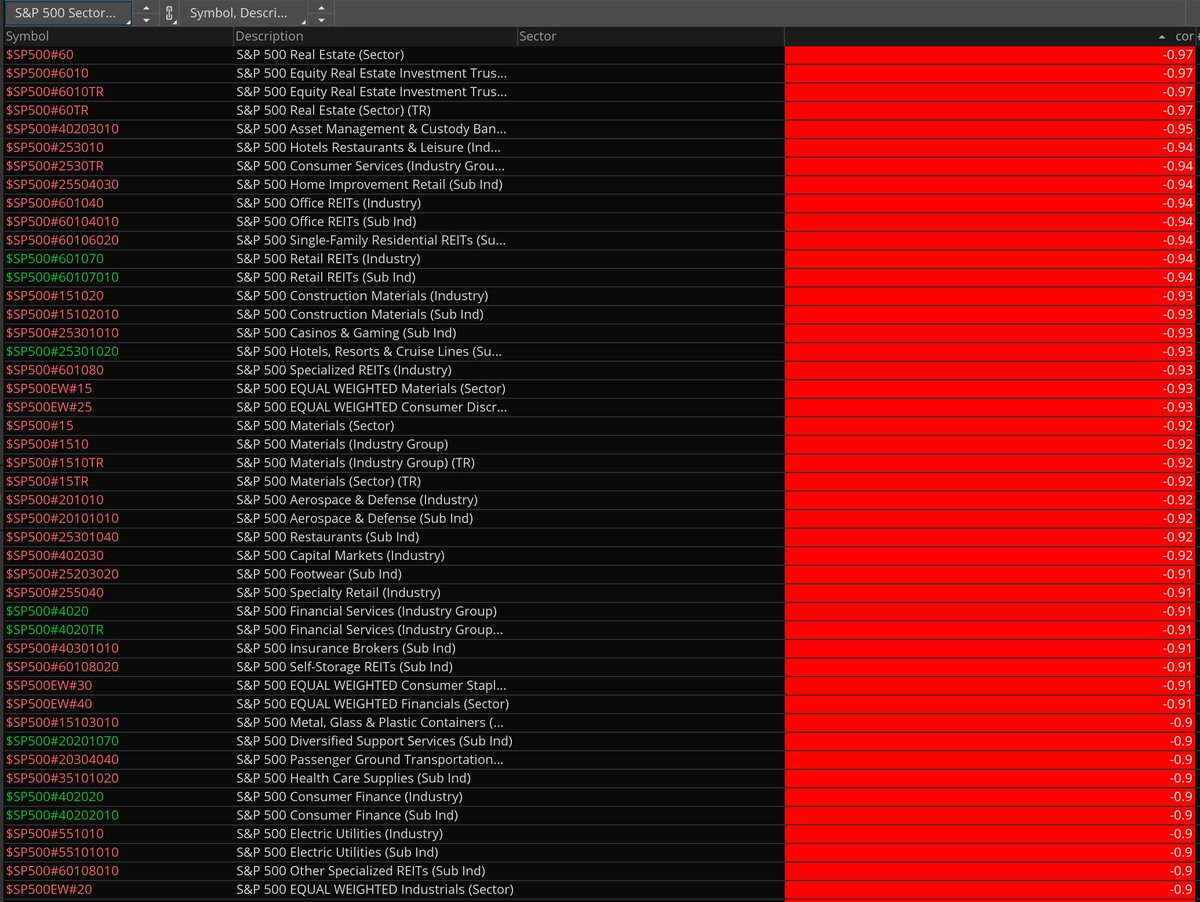
If it does, it would be worth keeping an eye on the sectors and industries that have been negatively correlated to rates.
The second image shows the industries with a strong 20 day negative correlation to the 10 year yield.
🚨 HOLY CR*P $MU IS REACHING THE POINT OF NO RETURN
Every single rally has nearly been identical.
It breaks the previous high → re-test the level as support → marks the bottom
The exact same $MU pattern being played right now.
So bears... tell me: what's the difference now?
Memory will without a doubt be the most important layer of AI.
$MU will arguably lead that sector.