Financial markets have evolved alongside every major industrial shift.
From commodities.
To energy.
To digital assets.
The AI economy introduces a new category:
Computational infrastructure.
At Rax Finance, we're exploring how markets can better understand, measure, and interact with the infrastructure powering the AI era.
The future of finance will not only value assets.
It will value future possibilities.
Every market starts with a question.
Will AI compute demand continue to grow?
Will GPU prices rise?
Will data center capacity keep expanding?
Prediction markets turn uncertainty into something measurable.
As AI infrastructure becomes an investable asset class, understanding probabilities may become just as important as understanding prices.
That's a future we're paying close attention to at Rax Finance.
If you had 10,000 USDC today, what would you do?
A. Keep it in your wallet
B. Deposit it into a vault
C. Lend it on DeFi
D. Something else
Tell us your reasoning 👇
🎬 RAX Finance Video Contest is live!
We’re inviting the community to create and share your vision of RAX. 🚀
📅 July 28 – August 3
Choose your topic:
🧊 RAX Finance Cube
🌎 Real-World Assets (RWA)
🏦 RAX Vault
Create an original 30–90s video:
• Post it on X and tag @RaxFinance
• Submit your entry here:
https://t.co/WZX6FQ79Vh
🎁 More details about rewards can be found in our Telegram community.
Show us your creativity 👀
Yield is a result.
Strategy comes first.
Sustainable returns don't happen by accident.
They come from disciplined execution, thoughtful risk management, and consistent capital deployment.
In your view, what defines a well-designed vault?
We're planning the next phase of the Rax community.
If you could add one thing to Rax Finance, what would it be?
No idea is too small.
We're reading every comment.
Most investors focus on returns.
Professional investors focus on capital allocation.
A vault is more than a place to deposit assets.
It is a disciplined framework for allocating capital according to predefined strategies and risk parameters.
That's how capital is put to work.
🎨 The Rax Cube Design Contest has come to an end!
A huge thank you to everyone who shared their creativity with us. The community delivered some amazing designs.
Here are the first 3 winning entries👇
Congratulations to the creators! 🧩
Which one is your favorite? Let us know below! 👀
Stablecoins are no longer just settlement assets.
They're becoming productive capital.
Idle capital carries an opportunity cost.
Every dollar should have a job. 👨🏻💻
For over 20 years, our CEO @MehowHacks has been finding security flaws before they become global problems.
From hacking electronic voting machines for the U.S. government to building one of crypto's most ambitious security companies, his mission has stayed the same: fix the infrastructure before it fails.
Read his latest profile by @Entrepreneur UK on why he believes crypto's biggest vulnerability isn't the blockchain, it's how people actually use it.
The pace of crypto development is also its biggest vulnerability.
Protocols ship before they're battle-tested.
New features open new attack surfaces faster than anyone can audit them.
Every innovation is also an unexamined door.
The industry rewards being first.
Attackers reward everyone who was first and unprepared.
A crypto address was meant to be a destination.
It became an identity.
Share it once and you've handed over a permanent, searchable record of everything you've done and will do.
No other financial system works this way.
Your account number isn't your public profile.
The single reusable address was a technical shortcut in 2009.
It became crypto's biggest privacy failure by default.
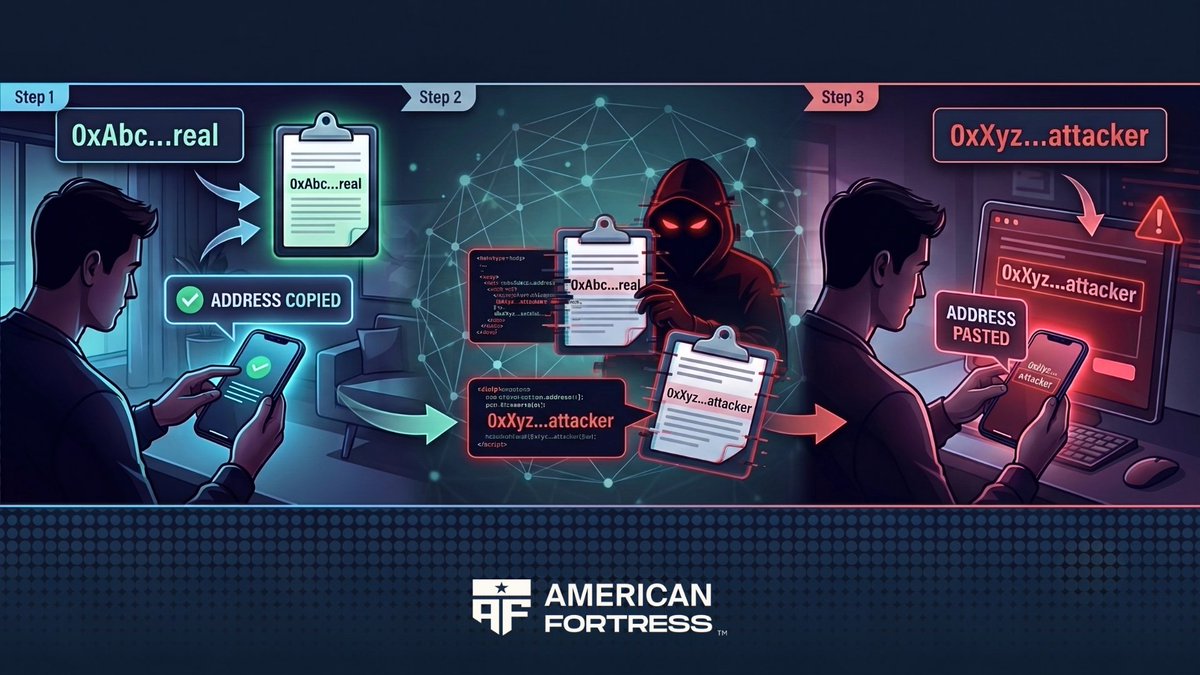
A new strain of malware is quietly rewriting crypto addresses on infected devices.
You copy a legitimate address. The malware swaps it for the attacker's before you paste. You confirm a transaction that looks right and isn't.
One recent campaign targeted 217 banking and crypto apps with this exact technique.
Before any transfer: verify the pasted address against a separate trusted source.
The clipboard is not a safe place to trust an address.
Analysts agree on the biggest weakness in the privacy coin sector: the off-ramps.
You can transact privately all you want.
The moment you convert to fiat, AML and KYC constraints expose everything at the exit.
Privacy that ends at the off-ramp was never complete privacy.
The real challenge isn't hiding transactions on-chain.
It's a privacy model that stays compliant all the way through the exit, so disclosure happens by choice, not by force at the worst possible moment.