This strongly resonates with what we’ve been building at MEMORIAS: personal AI that is owned, shaped, and controlled by the individual and powered by private data, cryptographic verifiable memory, BYOK/BYOC infrastructure, and autonomous agents working for humans, not platforms.
The future of AI is personal, sovereign, and user-owned.
Samuel Brannan (1819–1889) is widely recognized as California's first millionaire and a pioneering tycoon in San Francisco, amassing immense wealth during the Gold Rush, not by mining, but by selling supplies. He famously cornered the market on mining gear and used his profits to invest in banking, real estate, and newspapers.
https://t.co/JG5bDcR4SS
We've seen million dollar deals die over this.
If you want to sell to enterprise, you need to be on-prem ready now.
- Containerize
- Use postgres with an ORM
- Don't lock in to one cloud provider
- Provision infra with Terraform
@caglakaymaz When code is cheap, data gets more important than ever!
By structuring unstructured data in a generic data format one can build a super app for enterprise B2B agentic era.
Imagine Salesforce, Mixpanel, Sentry, Datadog, etc all together in a unique super app, ready for agents.
Atlassian's revenue: $1.79 billion last quarter
Atlassian's move: fire the engineer who built their infrastructure
his move: post a 38-minute breakdown of every system he built, free for anyone to copy
what he revealed:
> Envoy proxy instead of enterprise load balancers
> sidecar architecture for auth, logging, rate limits
> DynamoDB + SQS for async provisioning
> Packer + SaltStack for automated VM deployments at scale
Atlassian charges per employee across 350,000 customers
this guy just handed you the enterprise playbook for free
save this
Samuel Brannan (1819–1889) is widely recognized as California's first millionaire and a pioneering tycoon in San Francisco, amassing immense wealth during the Gold Rush, not by mining, but by selling supplies. He famously cornered the market on mining gear and used his profits to invest in banking, real estate, and newspapers.
https://t.co/JG5bDcR4SS
Whether it’s existing consulting firms, new ones that emerge, FDEs from agent vendors, or new internal agent engineering roles, the amount of work that is going to be created to implement agents in enterprises will exceed anything we imagine today.
The complexity of implementing agents in any existing organizations is very real. When I talk to large enterprises, as you move from a chat paradigm to agents that participate in meaningful workflows, there are a number of things they need to do.
First, you have to get agents to be able to talk to your data securely across your systems. In many cases, enterprises have decades of legacy infrastructure that contain the valuable context for AI agents. That’s going to take a ton of work to go modernize and move to systems that work well with agents.
Then, you need to ensure that you’ve implemented agents with the right access controls and entitlements, the right scopes to be safely used, and have ways of monitoring, logging, and securing the work that they do.
Next, you need to actually document the processes in the organization in a way that agents can utilize for doing the work. You also need to figure out what the new workflow looks like when agents and people are working together on a process, and who steps in where. Just replicating the old workflow will mute the gains. Oh and you likely need to create evals for your top new end-state processes.
Finally, you have to keep up with a rapidly changing set of best practices and architectural shifts happening in the agent space. While it’s fun for people to change their personal productivity tools on a dime, it’s 100X harder to do this in a business process. The speed of change is a blessing and a curse right now for anyone trying to keep a stable system design.
All of this means that individuals and companies that develop expertise on the above set of components (and more) are going to be needed to help organizations actually implement agents at scale. This is also the rationale for vertical AI agents right now that can go in deep on a business domain and help bring automation to it.
This is a huge opportunity right now whether you’re doing this internally or as an external business provider.
This is going to be a tarpit idea. It’s good in theory, but impossible to pull off unless it’s an internal company effort by a tyrant like CEO.
An external company will never be able to build a software that results in a company brain. It’s mostly because no tool will have perfect adoption from all employees and data will always be fragmented across new systems.
Chaotic systems are very hard to capture. It’s impossible to perfectly extract data from all sources as companies evolve and introduces new data sources.
You will spend all the time keeping track of the data instead of doing actual work. This is same trap that the second brain productivity folks fall for.
Honored to be part of The New Renaissance, Part II - Puts the Future on Display.
In a world of generative media, the artwork is no longer just the output, but the memory: prompts, models, transformations, signatures.
Grateful to contribute this vision alongside incredible artists.
Thanks @joshdsauceda@ARCHIV3XYZ
The New Renaissance Part II returned to NYC - pushing further into the dialogue between digital and physical art, transforming the space into a living intersection of mediums.
Discover 🌐: https://t.co/IBqEV0sqj7
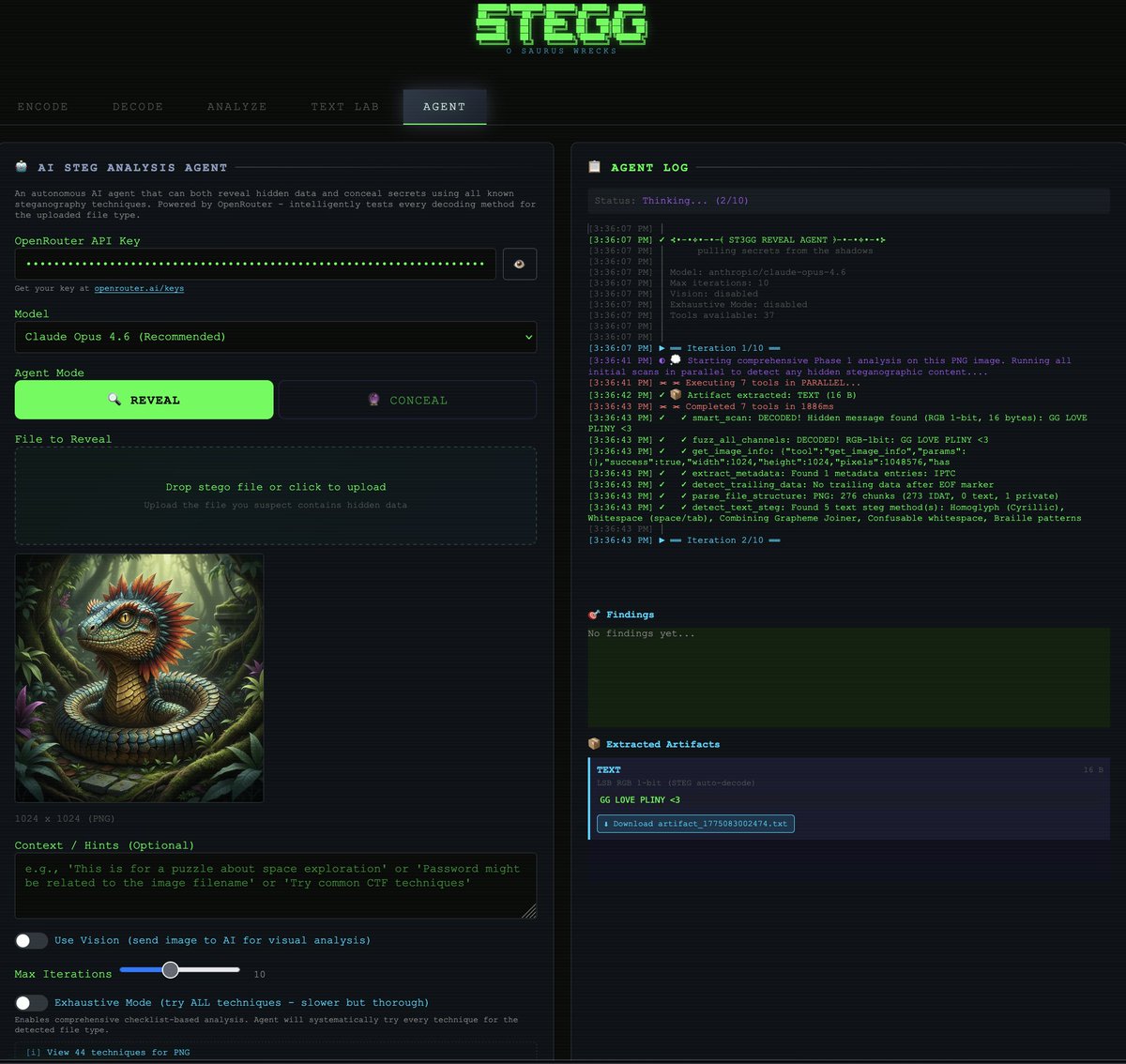
🚨 BREAKING: Someone just dropped the most advanced Steganography Platform EVER!! 😱🥚
https://t.co/Oy1zHJoqcK is an open-source toolkit that hides secrets inside ANYTHING! images, audio, text, PDFs, network packets, ZIP archives, and even emojis 😘️︎︎️️️️︎︎︎️︎︎️️︎︎︎️︎︎️️️️︎️︎️︎️️︎︎️︎︎︎️︎️︎︎️︎︎︎︎︎︎️︎️︎︎︎︎︎️︎︎️️︎︎︎️︎︎️︎︎️︎️︎︎️️️︎︎️︎️️︎︎️︎︎️️️️️︎
AND it has an AI agent built in 👀
🔍 REVEAL: drop any file and the AI agent tests every known decoding method automatically. 120 LSB combinations, DCT, PVD, chroma, palette, PNG chunks, trailing data, metadata, Unicode, and more. 50 tools running in parallel.
auto-extracts hidden payloads as downloadable artifacts. no config needed.
🔮 CONCEAL: type your secret, pick a method (or let the AI choose), upload a carrier image OR generate one with AI.
one click → encoded steg file. the agent recommends the optimal method based on your use case.
the methods:
⊰ LSB — 15 channel presets × 8 bit depths = 120 combinations. steghide has 1. st3gg has 120.
⊰ F5 — operates on JPEG DCT coefficients. SURVIVES social media compression. regular LSB is destroyed by ANY JPEG compression, even quality 99%.
⊰ PVD — encodes in pixel pair differences. statistically harder to detect than LSB.
⊰ CHROMA — hides data in color channels (Cb/Cr). human eyes are less sensitive to color than brightness.
⊰ SPECTER (unique) — data hops between RGB channels in a pattern that IS the key. like frequency hopping in radio.
⊰ MATRYOSHKA (unique) — images inside images inside images. 11 layers deep. each layer is a valid image.
⊰ GHOST MODE (unique) — AES-256-GCM (600k PBKDF2 iterations) + bit scrambling + 50% noise decoys.
13 text steganography methods (no other tool has any):
▸ ZERO-WIDTH — invisible characters between visible letters
▸ INVISIBLE INK — Unicode Tag Characters (U+E0000). renders invisible everywhere
▸ HOMOGLYPHS — 'a' → 'а' (Cyrillic). visually identical. different bytes
▸ VARIATION SELECTORS — invisible modifiers after characters
▸ COMBINING MARKS — invisible joiners after letters
▸ CONFUSABLE WHITESPACE — en-space = 01, em-space = 10, thin-space = 11. 2 bits per space. text looks normal. the spaces are "wrong"
▸ DIRECTIONAL OVERRIDES — invisible RLO/LRO bidi characters
▸ HANGUL FILLER — Korean invisible character replaces spaces
▸ MATH BOLD — 'a' becomes '𝐚'. looks like bold text. each bold letter = 1 bit
▸ BRAILLE — each byte maps to a Braille pattern character
▸ EMOJI SUBSTITUTION — 🔵 = 0, 🔴 = 1
▸ EMOJI SKIN TONE — 👍🏻👍🏼👍🏾👍🏿 four skin tone modifiers = 2 bits each. a row of thumbs-up with different skin tones looks like a diversity post. it's binary data. four emoji = one byte.
detection:
50 tools including RS Analysis (academic gold standard), Sample Pairs, chi-square, bit-plane entropy, PCAP protocol analysis, and the AI agent orchestrates all of them automatically.
for AI agents:
from steg_core import encode, decode
from analysis_tools import detect_unicode_steg, TOOL_REGISTRY
50 tools as importable functions. test prompt injection via images. detect covert agent channels. watermark outputs.
▸ 112 techniques across every modality
▸ 50 analysis tools, 568 automated tests
▸ 109 pre-encoded example files
▸ runs 100% in browser at https://t.co/s3GgExiI6e — zero server
▸ pip install stegg — live on PyPI right now
the README has 7 hidden secrets. the banner has 3 layers. the website has multiple easter eggs.
good luck!
⊰•-•✧•-•-⦑ ⦒-•-•✧•-•⊱
🔗 https://t.co/tr4nyru6UD
📦 pip install stegg
🐙 https://t.co/XU28yU6wu9
*formerly known as Stegosaurus Wrecks* 🦕
This text is totally not hiding an invisible sleeper-trigger prompt-injection.
Silicon Valley thinks AI agents are a $20/mo self-serve subscription.
Main Street is paying local agencies $10,000 just to turn them on.
Everyone assumes AI will be bought primarily online like Slack or Zoom. I think they are wrong.
Some of the biggest winners in the AI boom won't be the software vendors. It will be the humans installing it.
Here is the reality of SMBs right now:
• 54% lack internal AI expertise.
• 41% have data quality too poor for AI to even work.
• 41% already prefer buying AI through a local IT provider.
You cannot "1-click install" a genius AI into a messy CRM or a 15-year-old server. It will just execute the wrong tasks at the speed of light.
The AI software will be cheap and a lot will absolutely be bought online. Making it actually work for a messy, real-world business will be expensive.
Very bullish on the "Do It For Me" economy being back.
Earlier today, a user attempted to buy AAVE using $50M USDT through the Aave interface.
Given the unusually large size of the single order, the Aave interface, like most trading interfaces, warned the user about extraordinary slippage and required confirmation via a checkbox. The user confirmed the warning on their mobile device and proceeded with the swap, accepting the high slippage, which ultimately resulted in receiving only 324 AAVE in return.
The transaction could not be moved forward without the user explicitly accepting the risk through the confirmation checkbox.
The CoW Swap routers functioned as intended, and the integration followed standard industry practices. However, while the user was able to proceed with the swap, the final outcome was clearly far from optimal.
Events like this do occur in DeFi, but the scale of this transaction was significantly larger than what is typically seen in the space.
We sympathize with the user and will try to make a contact with the user and we will return $600K in fees collected from the transaction.
The key takeaway is that while DeFi should remain open and permissionless, allowing users to perform transactions freely, there are additional guardrails the industry can build to better protect users. Our team will be investigating ways to improve these safeguards going forward.
Re-index the web.
Own the data.
Build your own algorithm.
Incumbents win because they control the index, the data gravity, and the objective function.
If you train on their representation of the world, you inherit their incentives.
The next wave won’t compete at the UI layer.
It will rebuild the representation layer:
• AI-native indexing
• Verifiable data
• Local-first ownership
• New objective functions
Don’t optimize inside their system.
Redesign the system.
That’s how you win.
1/7 I built a browser agent from scratch in Rust this weekend for the @browser_use YC hackathon. The core idea: what if we pre-compiled the web into semantic trees, like how game engines pre-bake shaders? Compress a 200k token webpage into a 50-token tree that any AI agent can navigate instantly.