@quachelsey@Empty_America I switched my family to @JoinCrowdHealth this year. So far, it’s been great! We would have paid over $3k per month with a $10k deductible this year, otherwise. Absurd.
I have a limited number of free beta slots for Valotare.
Apply here if you're a:
-Owner who wants to know where they stand
-Buyer evaluating potential acquisitions
-Broker or SBA lender looking to provide value add to clients
https://t.co/VZOvrIEUHB
For those wanting a real product example utilizing managed loops, I launched @TryValotare in early beta this week.
Valotare is a 6-agent HITL platform that produces professional-grade small business valuation + due diligence reports.
Core architecture:
If you're building in this space:
-Start with a strong orchestrator like Paperclip
-Add HITL where it matters. Don't optimize for zero HITL just because you can
-80% or more of your time will be in skill design and refinement
Happy to share more details or answer questions
@normonics Congratulations! I have 4 and feel the same way. It’s nice when people compliment us on our kids but I always have imposter syndrome. It’s funny when what’s gained from knowledge and experience in a domain is revelation of ignorance.
Wanted: Experienced Webflow developer.
The project: Redesign and build a website for a fast-growing Series A-funded fintech.
If that's you (or someone you know), drop your portfolio/website link below 👇
Does this exchange remind anyone else of the exchange between Varys and Tyrion Lannister in GOT?
“Here, then. Power resides where men believe it resides. No more and no less.”
The full context 👇🏼
Oh, I think not,” Varys said, swirling the wine in his cup. “Power is a curious thing, my lord. Perchance you have considered the riddle I posed you that day in the inn?”
“It has crossed my mind a time or two,” Tyrion admitted. “The king, the priest, the rich man—who lives and who dies? Who will the swordsman obey? It’s a riddle without an answer, or rather, too many answers. All depends on the man with the sword.”
“And yet he is no one,” Varys said. “He has neither crown nor gold nor favor of the gods, only a piece of pointed steel.”
“That piece of steel is the power of life and death.”
“Just so… yet if it is the swordsmen who rule us in truth, why do we pretend our kings hold the power? Why should a strong man with a sword ever obey a child king like Joffrey, or a wine-sodden oaf like his father?”
“Because these child kings and drunken oafs can call other strong men, with other swords.”
“Then these other swordsmen have the true power. Or do they?” Varys smiled. “Some say knowledge is power. Some tell us that all power comes from the gods. Others say it derives from law. Yet that day on the steps of Baelor’s Sept, our godly High Septon and the lawful Queen Regent and your ever-so-knowledgeable servant were as powerless as any cobbler or cooper in the crowd. Who truly killed Eddard Stark, do you think? Joffrey, who gave the command? Ser Ilyn Payne, who swung the sword? Or… another?”
Tyrion cocked his head sideways. “Did you mean to answer your damned riddle, or only to make my head ache worse?”
Varys smiled. “Here, then. Power resides where men believe it resides. No more and no less.”
“So power is a mummer’s trick?”
“A shadow on the wall,” Varys murmured, “yet shadows can kill. And ofttimes a very small man can cast a very large shadow.”
Tyrion smiled. “Lord Varys, I am growing strangely fond of you. I may kill you yet, but I think I’d feel sad about it.”
“I will take that as high praise.
@elonmusk If you’re wondering why people are cheering at an exploding rocket, try building something. Then come back in a few months and cheer with the rest of us.
All day Claude has been telling me to quit working, go to sleep (even at noon) and pick it up tomorrow. Anyone else?
Anthropic must be pulling out all the stops to limit usage.
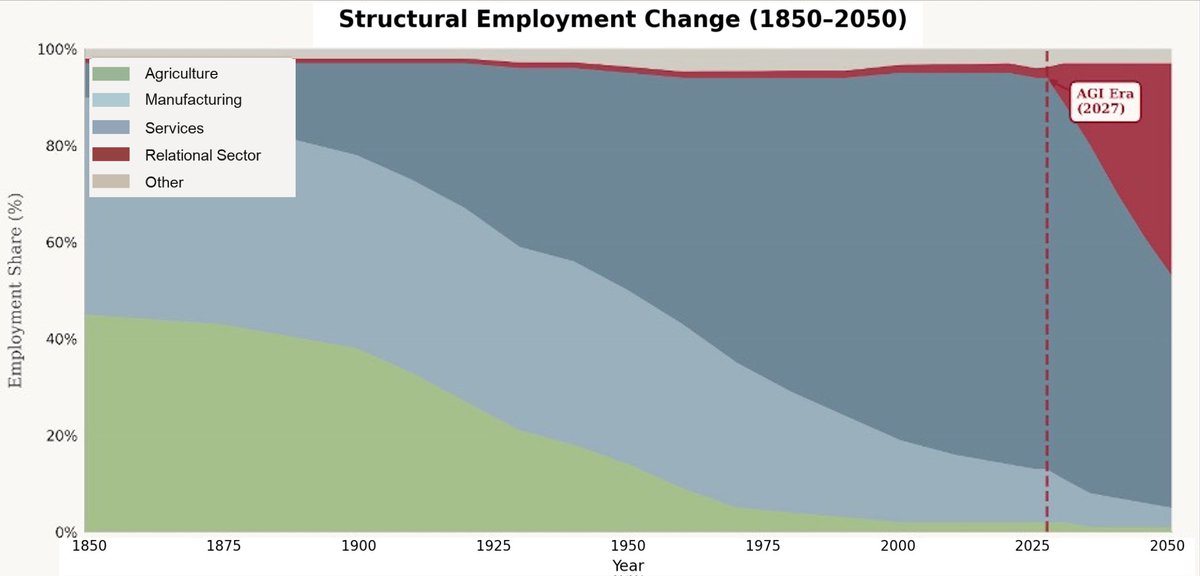
New essay on the economics of structural change and the post-commodity future of work.
1. Almost any question about the impact of advanced AI on the economy needs to start at the same place: what is still scarce? Answer that, and the analysis becomes pretty straightforward. This essay explores what becomes scarce if AI really can replicate most of what humans do in production, and what this mean for the future of jobs.
2. My conjecture, working through the economics: labor reallocates across sectors, and the sector it reallocates to has properties that keep labor a meaningful share of the economy. Ultimately this is about the structure of demand itself. For this, we have to go back to Girard, Augustine and Rousseau: once people's base needs are met, their preferences shift to comparative motives (e.g., status, exclusivity, social desirability). This motive is inherently non-satiated.
4. The key paper is Comin, Lashkari, and Mestieri (Econometrica 2021). As people get richer, they don't buy proportionally more of everything. They shift spending toward sectors with higher income elasticity. They estimate income effects account for 75%+ of observed structural change.
5. The ironic consequence: the sector that gets automated becomes a smaller share of the economy, not a larger one. Agriculture got massively more productive and its share of employment collapsed. Manufacturing too. The "stagnant" sectors absorb the spending and the jobs.
6. So the question is: which sectors have high income elasticity in a post-AGI world? I argue it's what I call the relational sector. Categories where the human isn't just an input into production, it is part of the value.
7. Why does the relational sector have high income elasticity? Because human desire has a mimetic, relational dimension. We don't just want things for their intrinsic properties. We want what others want, and we want it more when others can't have it. Girard, Rousseau, Augustine, and Hobbes all saw this.
8. In work with Kristóf Madarász, we showed this experimentally: WTP roughly doubles when a random subset of others is excluded from the good. And in new work with Graelin Mandel, AI involvement kills the premium. Human-made art gains 44% from exclusivity; AI-made art only 21%.
9. This all comes together for the core argument. The sector that absorbs spending as AI makes commodity production cheap is one where human provenance is part of the value, and demand for it grows faster than income. Exactly the profile that keeps labor meaningful.
10. To be clear about the claim: I'm NOT saying aggregate labor share must rise. It may fall. The claim is about sectoral composition, i.e., where expenditure and employment go once commodities get cheap, and the fact that the sector that will absorb reallocated labor maps to a substantial component of human preferences and desire.
11. If you're interested in the formal model, a linked companion technical note works out all the economics.
Read the essay here: https://t.co/NcjVgn2o8g