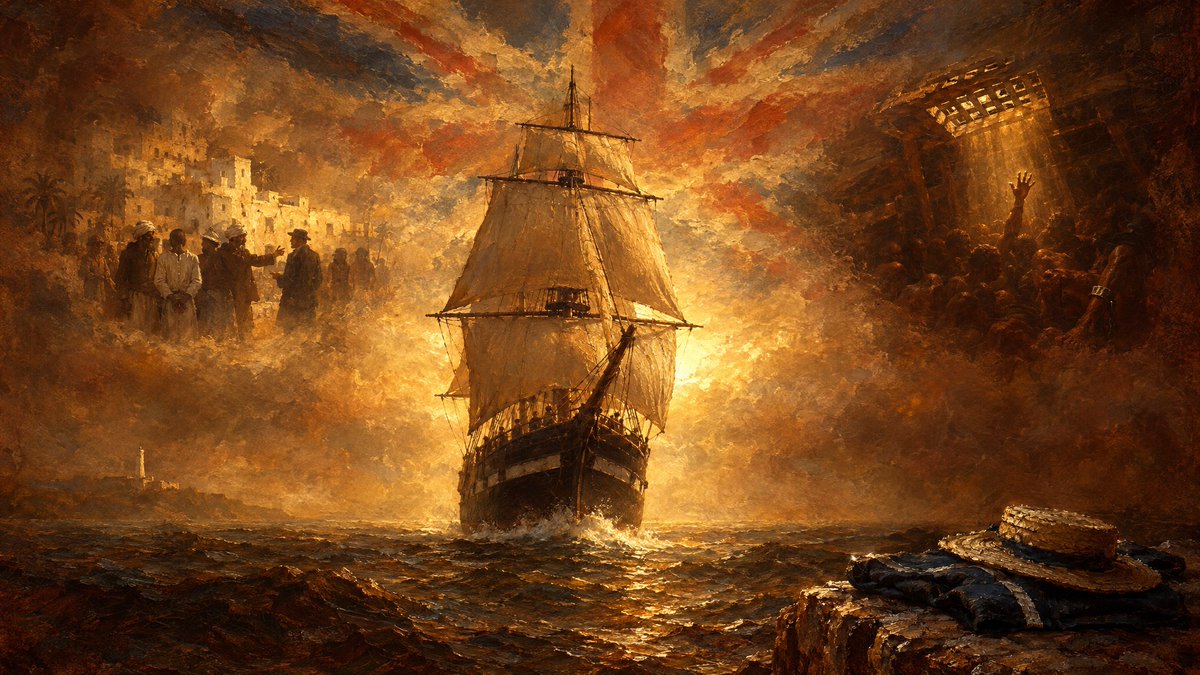
Yes, the monarchy was deeply implicated in the slave trade. But not the British monarchy.
The biggest African slavers were not pirates or bandits. They were kings. In the 1750s, King Tegbesu of Dahomey, in present-day Benin, was reported to be making £250,000 a year from selling slaves. That astronomical sum, equivalent to perhaps £45 million today, was vastly more than any British aristocrat
While Tegbesu was trafficking human beings, the future George III, who had recently become Prince of Wales, was becoming a convinced abolitionist. He wrote a monograph arguing that “slavery is equaly [sic] repugnant to the Civil Law as to the Law of Nature”. He went on, as King, to sign the abolition of the slave trade into law in 1807.
That act prompted incredulous rage among West African chiefs.
In the 1840s, King Ghezo of Dahomey, played by John Boyega in the 2022 film, The Woman King, fiercely resisted such pressure.
“The slave trade is the ruling principle of my people. It is the source and the glory of their wealth,” he complained.
Contrast his attitude with that of his British fellow-monarchs. Although Victoria, as Queen, was expected to refrain from expressing political opinions, her husband was under less constraint. Albert made his very first speech as Prince Consort to the Society for the Extinction of the Slave Trade and for the Civilization of Africa. His words are a reminder of how determined Britain was to ensure that ending the Atlantic slave trade did not simply push the commerce eastwards.
“I deeply regret that the benevolent and persevering exertions of England to abolish that atrocious traffic in human beings (at once the desolation of Africa and the blackest stain upon civilized Europe) have not as yet led to any satisfactory conclusion. But I sincerely trust that this great country will not relax in its efforts until it has finally, and for ever, put an end to a state of things so repugnant.”
The difference between the British Crown and contemporary African monarchies can be glimpsed in the story of Aina, a young Yoruba girl owned by King Ghezo of Dahomey.
In 1850, a naval captain called Frederick Forbes came to Dahomey to try to convince Ghezo to stop selling slaves. He was unsuccessful but, during his visit, he was offered Aina as a gift.
Forbes knew that such slaves were generally destined for human sacrifice, so he accepted the child, naming her Sara Forbes Bonetta. When Sara arrived in Britain, Queen Victoria became her godmother, paid for her education and arranged for her to marry a wealthy Yoruba businessman. Are the British really the baddies here?
Critics talk of telling our nation’s story “warts and all”; but they rarely get around to the “and all”. The “and all” surely includes the vast sums devoted to stamping out slavery, calculated by Chaim Kaufmann and Robert Pape as 1.8 per cent annually of GDP between 1808 and 1867, the most expensive moral foreign policy in human history. Even if there were a case for reparations in principle (which there is not) that sum alone – not counting the billions given in aid – would surely have covered any debt.
What we are seeing is not a debate about history, but an argument about contemporary politics. Critics want to convince us that Britain became rich through exploitation rather than, as was actually the case, through private property, free contracts and independent courts.
The easiest way to demonstrate the negative correlation between capitalism and slavery is to look at the places where human bondage is most prevalent today – in order, North Korea, Eritrea, Burundi, the Central African Republic and Mauritania. If William III owning shares in the Royal African Company bothers you more than the continuing abomination of slavery in those places, you need to ask yourself some hard questions about your motives.
On behalf of the British people, I would like to apologise for the slave trade. I am sorry we were the first great power in history to turn its guns on it. I am sorry it cost us around 2,000 sailors to free 150,000 people they would never meet. I am sorry the rest of the world took so long to follow.
Slavery did not begin with Britain. It is as old as civilisation. Babylon wrote it into law. Rome built an empire on it. The Vikings sold Englishmen through the slave market at Dublin. In 1625 Barbary corsairs took 60 men, women and children out of a Cornish church; by 1640 Parliament was told 3,000 to 5,000 English people were held in Algiers alone.
Every great power of the age took part in the Atlantic trade. Portugal and Spain for a century before an English ship did. Then the Dutch, the French — and the British, who in the eighteenth century carried more than anyone. That is the record. It is not disputed here.
Then a nation turned on the trade that had made it rich.
Wilberforce's bill was beaten year after year. On 25 March 1807 it passed. Then Britain did the part the critics never mention — it sent the Royal Navy to enforce it. The West Africa Squadron sailed in 1808, two ships for 3,000 miles of coast, and hunted slavers for nearly sixty years. Britain paid Spain and Portugal to open their ships to search. HMS Black Joke ran down the slaver El Almirante in 1829 and found 466 people in her hold.
Around 2,000 British sailors died doing it — most of fever, to free people they would never meet. 1,600 slave ships seized. 150,000 Africans set free.
In 1833 Parliament borrowed £20 million to end slavery across the Empire. The debt was not finally redeemed until 2015. The United States needed a civil war. Cuba held slaves until 1886. Brazil until 1888 — eighty-one years after Westminster voted.
Yes, we took part in the trade. Every power of the age did. None of them fought it like we did.
So yes. I will apologise. I am sorry it cost us so much. I am sorry the rest of the world took so long to follow.
That is not something you apologise for. That is something you teach.
#history #britishhistory #royalnavy #westafricasquadron
@RareRestore@NateHVT28@JohnMcHugh1878@ukhomeoffice No danger of you breeding is there? What with being a bot account shilling for Rupert Lowe and Russia...
Don't worry about me breeding. My multi-ethnic family are doing just fine thanks, being asked not to breed by an AI powered twitter entity is rather redundant.
@EthanLevins2 They aren't. That is years old insignia. If that is indeed a RM Commando, he is no longer in regular service.
What are you trying to imply with your ambiguous question?
@stephenp888@EthanLevins2 That insignia hasn't been used by the RM for years. Clearly this person is either a former RM Commando wearing uniform he kept after leaving regular service, or it is someone who has picked up kit that was already badged.
Either way, it is not proof of what you wrongly assert.
If you’re seeing a lot of posts saying that Russia isn’t America’s enemy, that Putin wants peace, and that Zelensky’s a dictator who’s causing the high gas/diesel prices in the US, congrats; Elon’s algorithm has you pegged as a monumentally stupid and gullible fucking moron.
@johnlew06084889@Imtiredbaus117@ValentinaForUSA And by following rules and norms, and working for her local community, she has been elected into Parliament.
Weird how that works out, eh? What have you done?