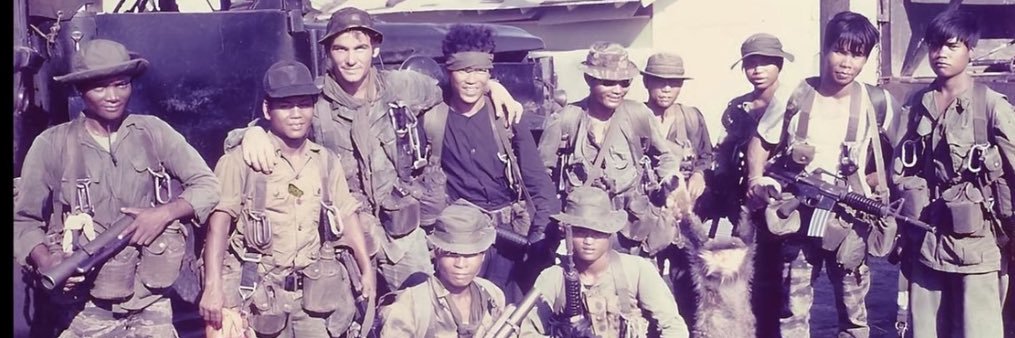
Jim Bolen was a highly decorated Special Forces Green Beret who served with the highly classified Military Assistance Command, Vietnam – Studies and Observations Group (MACV-SOG) during the Vietnam War. He led over 40 dangerous, top-secret missions into Laos and Cambodia, primarily targeting the Ho Chi Minh Trail and Sihanouk Trail.Bolen's expertise included infiltration, intelligence gathering, and prisoner snatch operations, often under heavy enemy fire
New Interview with Jim -https://t.co/Ji3l0XtLUr
Green Berets Jump Into Red-Held Area
SAIGON (UPI) — American Green Berets, in a rare combat jump, parachuted into Communist controlled central highland jungles to set up a border base near a Cambodian airfield the North Vietnamese are using to resupply their troops by air, it was learned today.
The air drop apparently took the Communists by surprise. The U.S. Special Forces and their tough Montagnard strikers met only a few scattered snipers.
UPI correspondent Robert Kaylor, a former paratrooper, jumped with them.
U.S. headquarters declined to comment, but the secretly planned operation was based on intelligence reports that confirmed for the first time the North Vietnamese were landing planes at the old French airbase known as Le Rolland to resupply Communist troops in the area.
The airbase is four miles from the border and about 110 miles north of Saigon. The Special Forces began building their camp across a strategic infiltration route two miles on the South Vietnamese side of the border.
The disclosure of the dramatic Green Beret mission came as three American infantry companies killed nearly 100 viet cong in a bitter eight hour battle Friday in the Mekong Delta 41 miles southwest of Saigon. It was the heaviest ground fighting in weeks.
The fight broke out 14 miles west of the main American Delta fortress at Dong Tam. A spokesman said mop up troops counted 74 bodies, but reports from field commanders estimated at least 100 guerrillas had been killed.
Nine Americans were killed in the fight, and 23 others wounded.
Over North Vietnamn U.S. warplanes streaked back near the Communist Chinese border for the fourth straight day, bombing highway and railroad targets. Military sources said rail traffic from China has been choked off, temporarily at least.
The Green Beret jump was made Thursday. First on the ground were the pathfinders. They jumped from a C-130 flying at 700 feet. Green nylon parachutes popped open, and within seconds they were on the sloping sides of a ridgeline.
Security troops moved out while the pathfinders marked out a drop zone. Occasional gunfire crackled in the back- the operation, said a North ground. But the several North Vietnamese platoon sized force that intelligence reports indicated they might find in the vicinity failed to materialize.
Less than 30 seconds later, six more C-130's roared overhead and dumped two companies of "Mike Force" troops, the Montagnard strikers, with their Green Beret advisors into a long, narrow drop zone.
Later, two more companies were whirled in by helicopter along with a 12-man special forces "A" team to help build the fighting camp as a permanent base.
(In the middle of the photo)Lt. Col. Ludwig Faistenhammer Jr. of Olean, N.Y., special forces commander who planned said a Vietnamese regiment was believed in the area. The area also was believed to be near the secret jungle headquarters of the Viet Cong's 10th military region which is defended by a tough guerrilla main force battalion.
VOL. 41, NO. 55 14 Pages-2 Sections Palm Springs, California, Saturday, October 7, 1967 PRICE 10 CENTS
He was in country for a short stint w ST1 on a psyop program as far as I know he was not on any hit patrols so to speak . Other than that he and his UDT training in the PI and checked bridges for sappers. Unless the guys did something wild they didn’t get much back then like the army .seals and Force always got end of tour awards which is ridiculous
Leo J. Meyer, one of only three hundred and three men who have been awarded three Combat Infantryman Badges.
Meyer earned his first Combat Infantryman Badge during Operation VICTOR V in the Southern Philippines Campaign. He earned his second Combat Infantryman Badge during the Chinese Communist Forces (CCF) Intervention Campaign (Nov 1950 to Jan 1951), "Task Force Dog", the forward element of the covering force for the X Corps’ withdrawal from the Chosin Reservoir.
At age 51 he was assigned to 5th Special Forces Group (Airborne), 1st Special Forces, in Nha Trang, Vietnam, where he earned his Jump Wings. Meyer earned his 3rd Combat Infantryman Badge while serving in the Rung Sat Special Zone with the 5th Mobile Strike Force, B55 (December 68 to February 69).
All goes accordingly we will have a ARVN BDQ ADVISOR on tomorrow.. If not I will have to do an old school phone interview and edit it and put it up 🇺🇸⚡️
Interview with 23rd ARVN Rangers ( [BDQ]) Advisor - Bill Miller https://t.co/ANI1oadTXC via @YouTube
Dom Marcellino is one of only a handful surviving triple amputees from the Vietnam War. While serving as a grunt with Echo Company 2/5, he volunteered to carry the radio.
In August of 1970, Dom’s platoon went on a patrol to protect a bridge along Highway 1 ; not far from An Hoa combat base. During the patrol, a bomb sniffing dog was dispatched along the path. Unfortunately the K-9 missed a buried explosive. Dom was the 11th man in the column when the booby trap exploded, severing his limbs.
For 45 mins he lay in the jungle waiting for a medevac. A Navy corpsman placed three tourniquets on his limbs while him preventing him from falling into shock.
Ultimately, Dom survived and spent two years in rehabilitation. Today at age 75, he walks on prosthetic legs and keeps himself busy helping other veterans.
On the master list of Special Forces personnel and advisors lost during the final operational years of the Vietnam War, Sgt. Paul H. Lawing Jr. and Sgt. Fred G. Mick fall right at the very end.Because regular U.S. Army Special Forces units (like the 5th Special Forces Group) officially drew down their heavy camp presence and cross-border operations by March 1971, the Green Berets who remained in 1972 served primarily in highly targeted advisory roles under MACV. Both men are grouped on the extreme tail end of the chronological casualty list, recorded on the first panel of the western wall of the Vietnam Veterans Memorial.
Historical Significance of Their Placement
**Sgt. Paul H. Lawing Jr. (June 1972): As the U.S. actively wound down direct ground combat, Sgt. Lawing was assigned to an advisory unit training the Forces Armées Nationales Khmères (FANK)—the Cambodian government forces fighting the Khmer Rouge and North Vietnamese Army. He was mortally wounded by small arms fire at a training outpost in Phuoc Tuy Province. On the chronological timeline of Special Forces losses, he represents the transition where Green Berets were almost exclusively embedded as specialized training advisors.
**Sgt. Fred G. Mick (October 1972): Sgt. Mick holds a somber and distinct place in military history. He is recognized by the 1st Special Forces Group as the very last Special Forces soldier killed in action during the Vietnam War. His death occurred in the Bien Hoa province from small arms fire during a hostile engagement, less than a month after his tour began. Because he fell so late in 1972, his position on Panel 01W sits near the absolute end of the recorded U.S. combat casualties of the war.
PHOTOS: Photo on left: Sgt Paul Lawing
Photo on right: Sgt Fred Mick