Jerry “Mad Dog” Shriver started his deployment in 1966, and for almost 3 and a half years he kept extending. He spent over 1,000 days in country.
Instead of debriefing and relaxing after a mission, Shriver would sneak out and tag along with another team for another patrol.
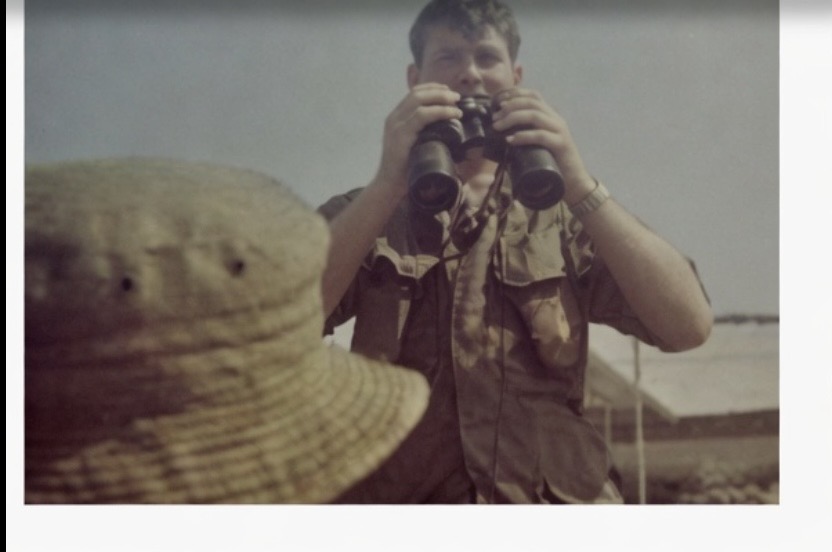
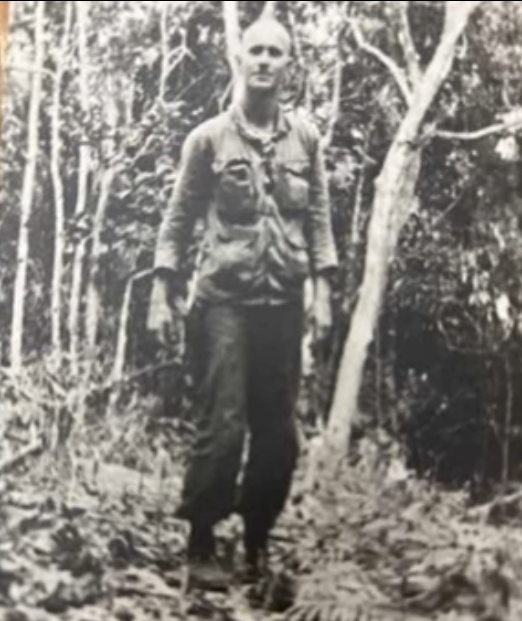
In March 1969 , a Michigan reconnaissance team led by Eldon Bargewell (pic 1) infiltrated the northwestern Asho Valley in South Vietnam. Their mission was to reconnoiter the North Vietnamese People's Army (NSB) command posts and communication stations, preparing for a subsequent attack by a Tomahawk force led by Jerry “Mad-Dog” Shriver (picture2) (a common SOG tactic, typically involving a small recon team scouting the target area before a larger, heavily armed Tomahawk force assaults it). At noon that day, the reconnaissance team was attacked by North Vietnamese mortar fire as soon as they landed from their helicopters. One soldier, wearing a green beret, was wounded. Bargewell ordered the helicopter to evacuate the wounded to base. After the helicopter left, the North Vietnamese shelling ceased, presumably assuming the team had retreated. The reconnaissance team had only traveled a few hundred meters when they discovered a cluster of North Vietnamese bunkers. While the bunkers were empty, they unexpectedly found numerous maps and documents detailing North Vietnamese supply points, shelters, and other locations. This intelligence would undoubtedly allow the U.S. military to inflict significant losses on the North Vietnamese. The reconnaissance team continued searching the vicinity. During their search, Bargewell found an AK-47 and a bullet pouch near a bunker . He had been wanting to take some souvenirs home, so he gave the AK-47 to one of his men, a local villager, and put the bullet pouch with the magazine on himself. He then led three men up the mountain to continue reconnaissance, while the others covered the rear. After climbing about 40 meters, they discovered 5-6 North Vietnamese soldiers playing cards around a table. Just as the reconnaissance team approached to capture them, a North Vietnamese soldier spotted them. The M79 marksman in the reconnaissance team opened fire, attempting to wound and capture one of them alive. However, the angle of fire was too high, and several North Vietnamese soldiers retreated into the bunker. Just as Bargewell rushed into the bunker, a North Vietnamese soldier fired at him. A bullet struck him in the chest, knocking him to the ground. After lying there for several minutes, he realized he wasn't dead, but in excruciating pain. It turned out that the magazine in his chest pouch had stopped the bullet. At this moment, the M79 gunner fired another shot into the bunker, covering Bargewell's retreat and allowing him to rejoin the rearguard. Embarrassed, Bargewell didn't tell the others about his recent experience. The deputy captain contacted forward air traffic controllers on the radio, requesting them to notify the Tomahawk troops to come and assist, but was told they wouldn't be able to arrive immediately. Bargewell then decided to return to the bunker himself. Inside, the reconnaissance team discovered a large amount of maps and intelligence. As their search deepened, they found various weapons, ammunition, equipment, and supplies. Each member of the reconnaissance team was fully loaded with these items and boarded a helicopter to return to base. Bargewell remained silent about being shot until he returned to his barracks. In a daze, he told his roommate that he had been shot in the chest by an AK-47 . He took off his sling, pulled out a magazine with a bullet hole, and gently shook it; bullets tumbled out. The following morning, Bargewell was informed that the intelligence brought back by the Michigan reconnaissance team was of extremely high value, and the U.S. military would send B-52 bombers to bomb the area. Later, Maddog 's Tomahawk force arrived in the area, drove out the North Vietnamese troops, and captured a large amount of supplies . It took 15 helicopters to bring all the spoils back to base.
THE RAVEN WHO FOUGHT AMERICA’S SECRET WAR
In 1970, Captain Brian E. Wages went to Laos and effectively disappeared from the conventional U.S. Air Force.
No uniform. Lao-marked aircraft. Civilian clothes. An M16 and sidearm close at hand. And a call sign that placed him among one of the most unusual groups of American combat aviators of the Vietnam War: Raven.
Wages first flew as Raven 48 from Long Tieng (LS-20A), the clandestine headquarters of Gen. Vang Pao’s Hmong army and the nerve center of the CIA-backed war in northern Laos. He later operated as Raven 31 from Lima Site 39.
The Ravens were active-duty USAF Forward Air Controllers operating inside a war Washington publicly kept at arm’s length. Flying low and slow over hostile territory, they located enemy positions, marked targets, and directed American fighters against North Vietnamese troops, artillery, and supply routes.
But this wasn’t an ordinary FAC assignment. The Ravens worked alongside CIA officers, Air America crews, Royal Lao forces, and Hmong fighters. Their aircraft often carried Lao markings, while the Americans flying them wore civilian clothes. A single Raven could direct devastating American airpower while remaining largely invisible to the public.
Wages also appears in accounts involving combat search-and-rescue operations, where a Raven’s knowledge of the terrain and enemy positions could mean the difference between bringing a downed airman home or losing another crew.
And Wages survived the Secret War. He remained in the Air Force, eventually rising to colonel. Two decades later, during Desert Shield and Desert Storm, he served as an Air Force liaison officer to U.S. Naval Forces Central Command.
The man standing beside that aircraft with an M16 wasn’t a mercenary or a civilian bush pilot. He was an American Air Force officer fighting in a war that wasn’t supposed to look like an American war.
Brian E. Wages. Raven 48. Raven 31. One of the Ravens of the Secret War.
#AircraftHistoryJunky #Raven #SecretWars #LongTieng #CIA #USAF #VietnamWar #CovertOperations #AviationHistory #VangPao #ForwardAirController #ColdWar #MilitaryAviation
.@SOFNewsUpdate@MAC_VSOG
Vladimir Sobichevsky Bio/obit.
Ran across this.
Great guy and very good at his job. Rare today when folks are blabbing for clicks.
THE RAVEN WHO TRADED A BIRD DOG FOR AN F-111
One pilot. Two aircraft. Two completely different worlds of Cold War aviation.
Somewhere in the shadows of America’s Secret War in Laos, USAF pilot Lloyd E. Van Zee flew one of the most politically sensitive missions of the Vietnam War.
He was a Raven Forward Air Controller, part of a small fraternity of American pilots operating under the classified Steve Canyon program.
His aircraft? An unmarked Cessna O-1 Bird Dog. His uniform? Civilian clothes. His mission? Find the enemy, coordinate airstrikes, and support friendly forces in a country where American combat operations were officially denied.
Flying low over Laos, Ravens worked alongside CIA supported forces, Royal Lao troops, and indigenous ground commanders. Armed with radios, marking rockets, and an intimate knowledge of the terrain, these pilots directed devastating American airpower from tiny observation aircraft.
Only about 200 men served as Ravens. Twenty-two were killed.
Van Zee was one of those who made it home.
But his aviation career took an extraordinary turn.
By 1974, Van Zee was flying the General Dynamics F-111E with the 55th Tactical Fighter Squadron at RAF Upper Heyford, England.
The same man who had flown a slow, vulnerable Bird Dog over a clandestine battlefield was now operating a supersonic, terrain following strike aircraft designed to penetrate heavily defended Warsaw Pact airspace.
From civilian clothes and smoke rockets over Laos to high-speed NATO strike operations over Europe.
Two very different cockpits. Two very different wars being prepared for.
And one largely forgotten American aviator whose career bridged them both.
AIRCRAFT HISTORY JUNKY
Like. Follow. Share.
#AircraftHistoryJunky #RavenFAC #SecretWar #Laos #SteveCanyon #O1BirdDog #F111Aardvark #USAirForce #CIAHistory #CovertAviation #ColdWarAviation #ForwardAirController #MilitaryAviation #AviationHistory #RAFUpperHeyford
THE CAPTURED T-28 THAT HUNTED A COVERT C-123
Before North Vietnam’s MiGs became famous, one of its first successful interceptions came from a captured American-built T-28 Trojan.
The aircraft, No. 963, had originally served with the Royal Lao Air Force before being flown into North Vietnam by a defecting pilot. Hanoi repaired it and turned it into an improvised night interceptor.
On 15–16 February 1964, radar picked up an aircraft approaching from Laos. Ground controllers vectored 963 toward the target until pilot Nguyễn Văn Ba spotted a twin engine transport in the dark.
It was a C-123 Provider.
Ba closed in and fired two bursts from the T-28’s 12.7 mm guns. The C-123 caught fire and crashed near the border.
The strange part: Vietnamese accounts say the Provider was carrying a commando or agent team into North Vietnam.
That places this little known shootdown inside the much larger clandestine air war already underway, CIA-backed infiltration missions, covert C-123 operations, and the transition toward what became MACV-SOG.
The exact C-123, crew, and operator are still unclear.
But the basic story is wild enough:
A captured American trainer, guided by North Vietnamese radar, shoots down another American-built aircraft apparently carrying a covert infiltration team.
No MiGs. No missiles. Just a stolen T-28 hunting in the dark.
AIRCRAFT HISTORY JUNKY
#AircraftHistoryJunky #T28Trojan #C123Provider #CovertAviation #VietnamWar #SecretWar #MACVSOG #CIA #AviationHistory